BTS Says It Will Boycott the Grammys, Turning a New Award Into a Bigger Debate About How Global Pop Is Classified
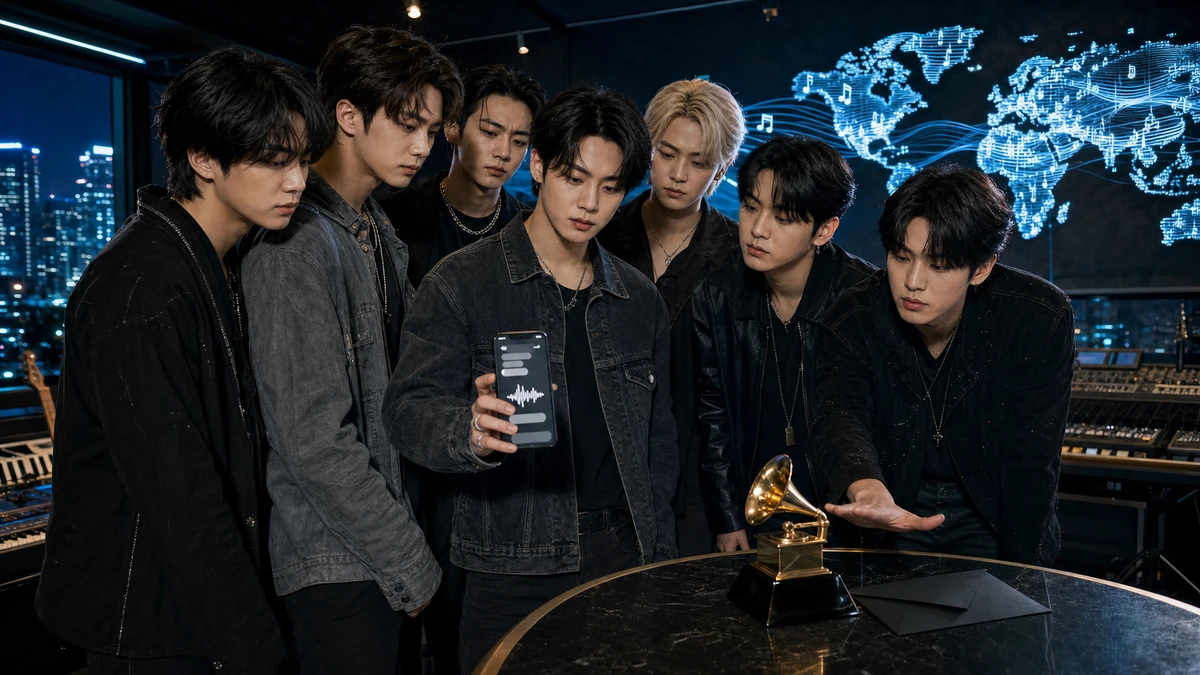
BTS shifts the conversation from trophies to categories
BTS, the South Korean group that helped turn K-pop from a fast-growing export into a central force in global pop culture, said it intends to boycott next year’s Grammy Awards, according to South Korean media reports and a message posted to the group’s social media accounts. The announcement did more than raise questions about whether the world’s biggest boy band will skip one of music’s most-watched nights. It also thrust a deeper argument into the spotlight: Should music still be sorted by region and language in an era when listeners move from Bad Bunny to Taylor Swift to BTS on the same playlist without a second thought?
The immediate trigger is the Recording Academy’s reported decision to introduce a new Grammy category, Best Asian Pop Music Performance, beginning with next year’s ceremony. On its face, the category can be read as a corrective, an attempt to create room for artists who have often struggled to break into the Grammys’ top fields despite commanding huge global audiences. But BTS, in a carefully worded statement, signaled discomfort with the idea that music from Asia needs its own lane rather than equal footing in the broader pop competition.
“We hope music can be heard and loved as music itself, rather than being divided by region or language,” the group said in its social media message, according to the Korean summary. The wording matters. BTS did not appear to launch a direct attack on the new category or on the Grammys as an institution. Instead, the group posed a question about the criteria behind recognition. It was less a denunciation than a challenge to the framework itself.
That distinction is important for American readers. Award shows often present categories as neutral containers, but categories also reflect power: who gets centered, who gets siloed, and who is treated as universal versus niche. In Hollywood, similar debates have played out for years around the “international film” label, a designation that can elevate non-English-language work while also marking it as separate from the mainstream. In music, the same tension is now playing out around Asia’s growing place in the global market.
For BTS, a group that has spent the better part of a decade proving that Korean-language music can top U.S. charts, sell out stadiums and shape youth culture far beyond Seoul, the symbolism is especially sharp. The act rose to international fame under the K-pop banner, yet its message now suggests that the label can become confining when institutions use it to sort artists away from the central contest. That is what makes this more than a celebrity boycott. It is a high-profile refusal to accept recognition on terms the group sees as limiting.
Why this matters beyond K-pop fandom
To Americans who do not closely follow Korean pop, the easiest way to understand the reaction is to imagine an artist with undeniable crossover success being told, in effect, that the most appropriate place to honor them is a category built around geography. That would not necessarily feel like inclusion. It could feel like a velvet-rope version of exclusion — a polished way of saying the main rooms still belong to someone else.
K-pop itself is often misunderstood in the United States as a genre in the narrow musical sense, like country or punk. In Korea, and increasingly among international fans, it is better understood as an industry system and cultural ecosystem: highly trained performers, synchronized choreography, elaborate visual concepts, devoted fan communities and multimedia storytelling that spans albums, social media, livestreams and touring. Musically, K-pop can contain R&B, hip-hop, EDM, rock, ballad traditions and glossy radio pop, often within the same album or even the same song.
That flexibility is part of the reason the phrase “Asian pop” can strike artists and fans as both broad and flattening. Asia is not a single music market. It includes distinct languages, histories, star systems and production cultures stretching from South Korea and Japan to India, the Philippines, Thailand and beyond. A category that claims to represent “Asian pop” may create visibility, but it also risks bundling together very different traditions under one umbrella that makes sense primarily from a Western vantage point.
This is not a new criticism. American institutions have long struggled with how to acknowledge non-Western cultural production without reducing it to a curated side section. The “world music” label, for example, became a catchall in the late 20th century for sounds that did not fit English-language commercial radio formats. It helped some artists find audiences. It also told listeners that a vast array of music from outside the Anglo-American mainstream could be shelved together as other.
That is the line BTS appears to be pushing against. The group’s statement asks whether a region-based category expands opportunity or quietly redraws the boundary between the center and the margins. Fans, critics and industry observers are now debating whether the new Grammy category is a long-overdue opening or a new kind of containment.
The Grammys’ long and uneasy relationship with global pop
The Recording Academy has often found itself lagging behind the way people actually consume music. Streaming has made language barriers more porous than ever. A teenager in Chicago can discover a Korean single on TikTok, watch the choreography on YouTube, buy concert tickets on a U.S. tour and join a fan community that translates interviews in real time. Global fandom no longer flows through traditional gatekeepers. In many cases, it runs around them.
Yet legacy institutions still tend to organize prestige around older assumptions. The Grammys remain influential, but they have repeatedly faced criticism for how they recognize genres outside the English-language pop-rock core. Rap, reggaeton, Latin pop and Afrobeats have all, in different ways, exposed tensions between commercial reality and institutional validation. When categories are added, artists sometimes welcome the recognition while also wondering why their work is not competing more consistently in general fields such as Record of the Year, Album of the Year or Song of the Year.
That history is part of why BTS’s move resonates beyond Korean music. The group has been here before. BTS received Grammy nominations in past years, and its appearances at the show were treated by many fans as breakthrough moments. But the group’s Grammy history has also become a case study in how global popularity does not always translate into top-tier institutional embrace. For a band with chart-topping records, massive streaming numbers and one of the most mobilized fan bases in the world, the absence of a competitive Grammy win has long been conspicuous.
That does not mean the Grammys have ignored music connected to K-pop entirely. Earlier this year, the original soundtrack song “GOLDEN” from the animated film “KPop Demon Hunters” won in the category for best song written for visual media, according to the Korean summary. But that was an award tied to a film soundtrack, not a direct competitive Grammy win for a K-pop recording act in a mainstream performance field. The distinction matters to fans who have spent years watching K-pop’s commercial influence outpace its awards recognition.
Now, just as a new category appears poised to create a historic first, BTS is effectively asking whether that first comes at too high a conceptual cost. If the path to a Grammy trophy requires accepting a specially designated regional slot, what exactly has been won?
A boycott from the favorite changes the stakes
BTS’s decision carries unusual weight because the group is widely seen as one of the strongest potential contenders for the new award. In other words, this is not a marginal act protesting from outside the room. It is a likely frontrunner signaling that the room may be arranged the wrong way.
That changes the conversation immediately. Instead of focusing on whether BTS might finally secure a Grammy through the new category, fans and commentators are now asking who, if anyone, benefits from the group’s absence and what kind of statement participation itself might make. In practical terms, the inaugural Best Asian Pop Music Performance race has become harder to predict. Without BTS in the mix, the field could open to artists from across Asia, though Korean stars may still dominate public expectations given K-pop’s visibility in the United States and Europe.
There is also the question of what other artists will do. HYBE, the company associated with BTS, has reportedly said that any submissions from its other artists would depend on each artist’s own decision. That cautious response reflects the complexity of the moment. A newer group or soloist might see the category as an overdue opportunity for recognition. Another artist might share BTS’s concerns but choose engagement over boycott. A third might try to avoid taking a public position altogether.
Those choices will be watched closely because they will help define what the category means in practice. If many major Asian artists embrace it, the award could develop legitimacy as a platform for a broad range of performers. If high-profile acts keep their distance, it may come to symbolize a compromise few top stars actually wanted. Either way, the first winner will not be the only story. The submission decisions, the public statements and even the silences around them will all shape the category’s identity.
That is part of what makes this moment so unusual. Usually, music awards are about winners, snubs and red-carpet spectacle. Here, the act of entering or refusing to enter the competition has become a message in itself. BTS has turned a conventional awards-season narrative into a debate over who gets categorized, by whom and for what purpose.
What BTS is really saying about identity and universality
BTS’s wording reflects a tension that many globally successful artists from outside the United States understand well. There is value in representing one’s language, nation and culture. BTS has never hidden its South Korean identity. The group has spoken Korean in major U.S. venues, woven Korean references into its work and helped familiarize international audiences with everything from Korean honorifics to Seoul street fashion. For many fans, that specificity is part of the appeal.
But representation is not the same as confinement. An artist can be proudly Korean and still reject a system that treats “Korean” or “Asian” as a qualifying adjective before “pop.” That appears to be the core of BTS’s message. The group is not arguing that regional identity should disappear. It is arguing that identity should not predetermine the level at which music is allowed to compete.
This is a familiar issue in American cultural life, even if the details differ. Black artists have long confronted assumptions that their work belongs in genre-defined categories while white artists are permitted to stand for “pop” or “general” music. Latin artists have wrestled with being celebrated in Latin categories while struggling to break fully into the general fields, even when their songs dominate the mainstream. The labels can honor community and history. They can also signal the edge of the map.
For BTS, whose career has consistently blurred the line between local identity and global reach, refusing the new category may be a way of insisting that those two things are not opposites. The group’s success has already challenged the old assumption that American listeners need English-language lyrics to form emotional attachment to a song. Fans have memorized Korean choruses, learned fan chants and followed album concepts across linguistic boundaries. In that sense, BTS is making an argument that many listeners have already accepted in practice: music can travel without being stripped of where it came from, and it does not need a special box to be understood.
The group’s stance also reflects how much K-pop’s position has changed. A decade ago, many artists from South Korea might have viewed a dedicated Grammy category as an unambiguous breakthrough. Today, with K-pop acts playing NFL stadiums, appearing on U.S. late-night television, collaborating with major American stars and posting numbers that rival domestic acts, the benchmark has shifted. The question is no longer whether there is a seat at the table. It is whether the seat is at the main table or at a newly constructed annex.
For fans, the debate is about more than one award show
K-pop fandom is often caricatured in the United States as intense but apolitical consumer energy. That misses how sophisticated many fan communities are about media systems, representation and institutional bias. BTS’s global fan base, known as ARMY, has spent years tracking chart rules, radio play patterns, awards voting structures and the ways American gatekeepers talk about Korean artists. The group’s announcement lands in a fan culture already primed to interrogate not just outcomes but frameworks.
That is why the reaction has focused less on whether BTS is “throwing away” an easy win and more on what kind of recognition should matter. To many fans, the point is not simply that BTS deserves a Grammy. It is that BTS should not have to accept a narrower category to get one. In this reading, the boycott is not anti-award so much as anti-compartmentalization.
At the same time, there is room for disagreement, even among supporters of Asian artists. Some will argue that any new category creates visibility and that visibility can lead to broader change. The first women’s categories, Black music categories and Latin music categories in major institutions did not solve inequity, but they sometimes created footholds. By that logic, Best Asian Pop Music Performance could be a meaningful step rather than a trap.
Others will counter that institutions often use new categories to absorb criticism without changing the hierarchy at the top. A special lane can become a substitute for genuine integration. If an Asian artist wins “Asian pop” but remains shut out of top pop categories, the structure may be doing exactly what BTS appears to fear: acknowledging demand while preserving separation.
Both arguments have merit, which is part of why this story has resonated so quickly. BTS did not hand fans an easy slogan. It posed a dilemma that does not have a simple answer. Is separate recognition a bridge or a border? In a media economy where global audiences are already ahead of many gatekeepers, the answer may determine how relevant those gatekeepers remain.
What comes next for the Grammys and for K-pop
The Recording Academy has not yet had to navigate many moments quite like this one: a globally dominant act framing a potential Grammy pathway not as a triumph but as a philosophical problem. The academy may decide to stand by the new category and emphasize inclusion. It may point to the diversity of Asia’s music scenes and argue that the award offers overdue acknowledgment to artists who have historically been overlooked. That argument will likely persuade some people.
But BTS has ensured that the category, if it moves forward, will debut under scrutiny. Every nomination will be read not only as a celebration of talent but also as evidence in a larger debate over how the West classifies cultural production from elsewhere. Every submission decision by a major Asian act will be interpreted as a stance, whether that is fair or not.
For K-pop, the episode underscores a broader transition from outsider ambition to insider leverage. The question used to be how Korean artists could gain access to Western institutions. Now one of the biggest Korean acts in history is pressuring those institutions to justify their terms. That is a different level of influence. It suggests that K-pop is no longer merely asking to be recognized. It is helping shape the language of recognition itself.
The first Best Asian Pop Music Performance trophy, if awarded, will still make history. But BTS’s announcement has already changed what that history will mean. Instead of a straightforward milestone, the award now arrives wrapped in a challenge: Can the Grammys evolve in a way that reflects how audiences actually hear music today, or will they continue to divide global pop into carefully managed compartments?
For American audiences, that question reaches beyond one Korean group or one awards show. It goes to the heart of how cultural prestige works in a country that increasingly consumes the world’s entertainment while still expecting the world to pass through familiar labels. BTS’s message, stripped to its essence, is not complicated. Let music be music. In 2025, that sounds less like a slogan than a test.
Comments
Post a Comment