BTS’ World Cup Halftime Show Sparks a Global Search Surge, Showing K-pop’s Reach Beyond Its Core Fans
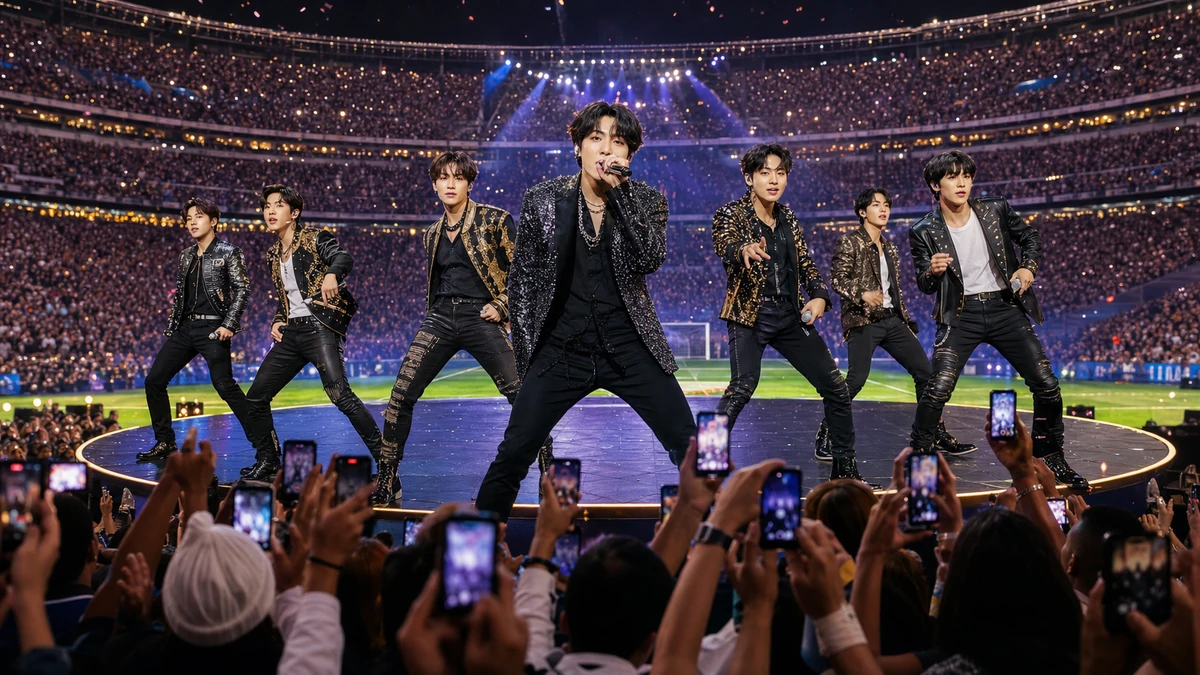
A halftime stage built for the biggest audience in sports
When BTS took the halftime stage during the 2026 FIFA World Cup final, the performance did more than deliver a flashy crossover between pop music and global sports. It also triggered a measurable wave of digital curiosity. According to Google Trends data released July 22 and cited by South Korea’s Yonhap News Agency, worldwide search interest in “BTS” on the day of the final rose to nearly four times its typical level from the previous week.
That kind of jump matters because the World Cup final is not a niche entertainment event or a fan convention where audiences already arrive primed for a music act. It is one of the rare live broadcasts that gathers viewers across continents, languages and age groups at the same time. In the United States, the closest comparison might be the Super Bowl halftime show, which often introduces artists to casual listeners or reminds millions of viewers why a familiar name still matters. But the World Cup final reaches even more of the globe, making it an unusually powerful platform for any performer, especially one like BTS whose fame already extends far beyond the music industry.
For American readers who may know BTS only broadly as a hugely successful Korean pop group, the search spike offers a useful clue about how global celebrity works in 2026. Fame is no longer measured only by album sales, TV ratings or concert attendance. It is also measured by what people do in the minutes after they see something. Do they pick up their phone? Do they search a name? Do they stream a song? Do they click into videos, interviews and back catalogs? In this case, the answer appears to be yes, and on a large scale.
The performance became a kind of digital ignition point. People who already knew BTS searched for them again. Viewers who had heard the name but had not kept up with the group apparently went looking for updates. And some portion of the audience, likely exposed to BTS for the first time through a soccer broadcast, entered that same online stream of curiosity. The result was not just a moment of applause inside a stadium. It was an immediate, global behavioral shift visible in search data.
What the numbers say — and what they do not
The data behind the story is straightforward, but it helps to understand what Google Trends actually measures. From July 12 to July 19, search interest for “BTS” hovered around 26 on Google Trends’ index. On July 20, the day of the World Cup final, that figure hit 100. In Google Trends terms, 100 does not mean a raw total of searches. It marks the peak level of interest during the chosen time period, with all other numbers scaled relative to that peak.
So the data does not tell us exactly how many people around the world typed “BTS” into Google. It does tell us that interest surged sharply and immediately, and that the jump was not subtle. Going from about 26 to 100 suggests a dramatic concentration of attention aligned closely with the halftime appearance. In other words, this was not a slow build over days or a vague increase driven by unrelated news. It was a spike.
That timing is one of the most important parts of the story. Media analysts often look for a clear connection between exposure and reaction. Here, the sequence is unusually clean: a globally televised performance, followed by a same-day jump in search activity. That does not prove the motives of every individual user, but it strongly suggests that the halftime show served as the catalyst.
There is also an important caution built into the data. A Google Trends peak does not automatically mean sustained interest over weeks or months. It captures intensity at a moment. A giant event can produce a burst of searches without guaranteeing long-term engagement. But even with that limitation, search data remains valuable because it measures an early stage of audience behavior. It shows when attention becomes active. And in the modern entertainment economy, active attention is often the bridge between a one-time viewing experience and a deeper relationship with an artist’s work.
That is why the reported rise in streaming matters, too. The Korean report says search activity was accompanied by a significant increase in music streaming after the show. Search is curiosity. Streaming is follow-through. One signals that viewers want to know more; the other suggests they acted on that interest. Together, the two paint a fuller picture of impact than viewership alone ever could.
Why a sports audience matters for BTS
BTS hardly needs an introduction in much of the world. The group has spent years at the center of K-pop’s rise from a regional phenomenon into a pillar of global popular culture. Its members have topped charts, sold out stadiums, spoken at the United Nations, partnered with major brands and built one of the most organized and influential fan communities in the world. In the United States, they have crossed into mainstream recognition in a way few non-English-language acts ever have.
But broad name recognition is not the same thing as continuous public engagement. That distinction is central to understanding why the World Cup moment matters. Many Americans know who BTS are in the same way they know the names of other pop powerhouses. Yet casual awareness can fade when an artist is between major releases, group activities or headline-grabbing appearances. A massive shared event can refresh that connection almost instantly.
This is especially true when the event reaches people outside the music bubble. A halftime show at the World Cup is not aimed only at pop fans, just as the Super Bowl halftime show is not limited to people who follow Billboard charts. It reaches sports viewers, families, older audiences, occasional listeners and people who might not actively seek out new music on their own. For a group like BTS, that kind of setting creates a different kind of visibility than a concert tour or a fan-centered online release.
It also highlights something important about K-pop’s evolution. For years, critics in the West treated Korean pop as either a trend driven by social media or a specialized fandom culture. That view has become harder to sustain as K-pop acts increasingly occupy global stages that have nothing to do with Korean entertainment alone. When BTS appears at the center of one of the world’s biggest sporting spectacles, the group is not operating on the margins of global culture. It is in the middle of it.
There is another layer here as well: the World Cup audience is multinational by design. BTS, as a name, travels easily. Unlike artists whose names are commonly translated or rendered differently across languages, “BTS” functions as a unified global keyword. That makes the group unusually searchable. Viewers in different countries can respond to the same performance with the same term, feeding a single stream of data. In a fragmented media environment, that kind of linguistic consistency has real power.
From fandom to mainstream recall
In South Korea, the term often used to describe a devoted fan base is “fandom,” but the concept can be broader and more organized than the way many Americans casually use the word. BTS fans, known as ARMY, are famous for coordinated digital engagement, including streaming, social media mobilization and support campaigns. Any discussion of BTS’ online numbers has to acknowledge that core base. The group’s fans are highly engaged and highly visible.
Still, the World Cup search spike appears significant precisely because it likely cannot be explained by fandom alone. The report’s core argument is that the halftime show reached well beyond BTS’ existing supporters and reintroduced the group to a broader public. That is a crucial distinction. Search growth at this scale, tied to a globally watched sports event, points to overlap between fan behavior and mass audience behavior.
For some viewers, the search may have been basic identification: Who is performing? For others, it may have been an update check: What has BTS been doing lately? Are they still active as a group? What songs are those? Are the members pursuing solo work? The point is not that all searches meant the same thing. The point is that the performance activated several layers of recognition at once.
That dynamic is common for legacy stars and major contemporary acts alike. A halftime performance often acts less as a first introduction than as a public reminder. Think about how a big TV appearance can send Americans back to Prince, Madonna, Beyonce or Usher, even if those artists were already household names. The exposure does not necessarily create fame from scratch. It refreshes it, updates it and places it in front of people who had drifted away or never paid close attention.
For BTS, that refresh cycle may be especially powerful because the group occupies a unique cultural position. It is both massively famous and still, for some audiences, treated as an act to be “discovered.” That tension reflects lingering Western assumptions about language, genre and geography. A World Cup halftime show cuts through those barriers by presenting the group in a context that demands no prior K-pop knowledge. Viewers do not need to know the history of Korean idol training systems, Korean music shows or fandom culture to react to a high-impact performance in the middle of a championship match.
The larger story of K-pop on the world stage
To understand why this matters beyond BTS, it helps to place the moment in the broader arc of the Korean Wave, often referred to by the Korean term “Hallyu.” The phrase describes the global spread of South Korean cultural exports, including music, television dramas, film, beauty products, fashion and food. In the United States, many consumers first encountered Hallyu through breakout moments: Psy’s “Gangnam Style,” the Oscar-winning success of “Parasite,” the global binge appeal of Korean dramas on streaming services and the explosive international rise of acts like BTS and Blackpink.
What makes this latest BTS data point notable is that it shows how thoroughly Korean pop has moved into spaces once dominated almost entirely by Western artists. This is no longer just a story about overseas fans finding Korean entertainment online. It is about Korean artists being programmed into the biggest live events in the world and generating immediate measurable engagement afterward.
That shift also says something about the changing structure of global culture. American entertainment companies once largely controlled which artists could access the world’s biggest stages and audiences. Today, the flow is more distributed. Platforms like YouTube, TikTok, Spotify and global search engines allow music to travel faster, but live events still matter because they concentrate attention. A World Cup halftime show can take years of diffuse global recognition and compress it into one peak moment of visibility.
For South Korea, those moments carry symbolic weight. Cultural exports are not just entertainment products; they are also a source of national influence and pride. BTS has long been viewed in South Korea as more than a successful band. The group has been discussed as a cultural ambassador, an economic engine and evidence that Korean-language pop can compete at the highest international level without fully reshaping itself for Western markets. That does not mean every performance must be read as geopolitics. But it does mean Korean media and audiences often view milestones like this one through a broader lens than American audiences might at first.
For American readers, perhaps the simplest takeaway is this: K-pop is no longer entering the mainstream. It is already there. What events like the World Cup final reveal is not whether Korean pop can go global, but how global attention behaves when one of its biggest acts steps into the center of a truly worldwide event.
Why search and streaming are now part of the story
There was a time when the impact of a live performance was judged mostly by critics’ reviews, next-day headlines or maybe record sales weeks later. That model now feels almost antique. Today, the audience response begins registering in real time. Search engines show what viewers want to know. Streaming platforms show what they want to hear. Social media shows what they want to share. Together, those signals create a near-instant map of cultural attention.
That is why the BTS numbers are so revealing. They capture the handoff from passive viewing to active engagement. Millions may watch a performance, but only some will immediately go looking for the artist. When they do, it suggests the performance cut through the surrounding noise of a massive event. That is not easy to do during the World Cup final, where the game itself is the main attraction and every other element competes with the emotional intensity of the match.
The reported rise in streaming after the halftime show suggests that viewers did more than satisfy a passing curiosity. They moved from identification to consumption. That is an increasingly important distinction in media economics. A memorable moment is valuable. A moment that sends people into a catalog, boosts streams and renews audience relationships is even more valuable.
For BTS, whose global career has already been defined by extraordinary digital fluency, this kind of response fits a familiar pattern. The group’s success has never depended solely on radio or traditional gatekeepers. It has been powered in part by fans’ willingness to search, share, translate, clip, stream and organize. But what makes this World Cup data stand out is the breadth of the stage. It suggests that even after years of global success, BTS can still use a single event to widen its funnel of attention.
That matters for the whole entertainment industry. The lesson is not just that BTS remains a major force. It is that live tentpole events still have the power to reshape digital traffic at scale. In a fractured media landscape where audiences are scattered across platforms and algorithms, there are still moments when the world watches together. And when the right artist appears in that window, the response can be immediate and enormous.
A reminder of what global stardom looks like now
In the end, the most striking part of the BTS World Cup story may be its simplicity. A group performed on one of the biggest stages in sports, and within hours the world went looking for more. Search interest jumped from around 26 to 100 on Google Trends. Streaming reportedly surged as well. Those numbers do not tell us everything, but they tell us enough to recognize the scale of the moment.
They show that BTS remains capable of commanding attention not only from loyal fans but also from the vast floating audience that surrounds every major cultural event. They show that K-pop’s biggest names can convert sports exposure into digital engagement across borders. And they show that in today’s entertainment ecosystem, the afterlife of a performance may be just as important as the performance itself.
For casual observers in the United States, the takeaway is less about one night’s spike than about the durability of BTS as a global brand. Plenty of artists can dominate one lane, whether that is touring, streaming or fan culture. Fewer can step into a universally recognized event like the World Cup final and emerge with renewed traction among general audiences. That is the mark of a top-tier act in any language.
It is also a reminder that global culture no longer flows in only one direction. American audiences are increasingly used to seeing Korean artists, shows and films shape mainstream conversation. But moments like this underscore just how normalized that exchange has become. BTS was not appearing as a novelty act from abroad. The group was appearing as a legitimate centerpiece performer at one of the largest shared spectacles on Earth.
Whether the search surge translates into a longer-lasting boost will become clearer only with time. Google Trends can capture a spike, not a full future. But even as a snapshot, the response is telling. It suggests that when BTS entered the World Cup spotlight, the world did what modern audiences do when they feel the pull of a cultural moment: It opened a browser, typed three letters and followed its curiosity from there.
Comments
Post a Comment