BTS wraps sold-out European stadium run with record crowds in Paris, underscoring K-pop’s global reach
A European tour measured in stadiums, not just buzz
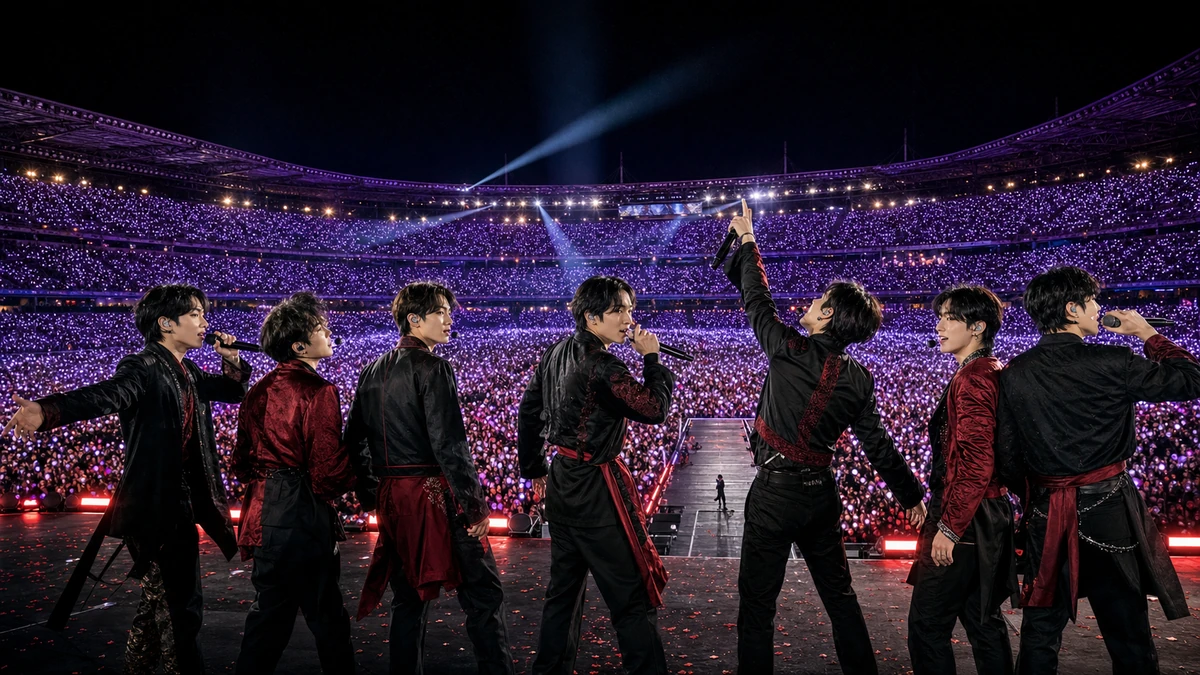
BTS closed out its "Arirang" European tour in Paris on July 18 after a run that, by any mainstream pop industry standard, would qualify as blockbuster territory. According to figures released by BigHit Music and reported by South Korea’s Yonhap News Agency, the group drew a total of 717,000 fans across 10 sold-out concerts in five European cities: Madrid, Brussels, London, Munich and Paris.
Those numbers matter in part because they are so large, but also because of how they were achieved. This was not a one-city residency or a single marquee event inflated by festival traffic. It was a multi-country stadium tour moving through major European markets with different languages, different concert cultures and different media ecosystems — and every date sold out. On average, that works out to more than 70,000 people per show, placing the run firmly in the territory occupied by the world’s biggest touring acts.
For American readers, the scale may be easiest to understand this way: Think of the kind of attendance figures associated with NFL stadiums, major Taylor Swift or Beyoncé tour stops, or a marquee international soccer match. That is the tier of live draw BTS is operating in here. And unlike the early years of K-pop’s international expansion, when overseas success was often discussed in terms of online views or social media trends, this tour offers a more concrete measure — actual tickets sold, actual bodies in seats, actual demand sustained from one city to the next.
The Paris finale supplied the most dramatic stat of the run. BTS performed two shows there, on July 17 and 18, and each drew 92,000 people. That figure, according to the company, marks the largest single-show audience in the group’s concert history. In other words, the tour did not simply end with a sold-out finale. It ended with BTS setting a new record for itself on one of Europe’s biggest stages.
That kind of finish is significant because it captures where BTS now sits in global pop: not as a niche export, not as a novelty from abroad, and not merely as a fan-driven internet phenomenon, but as a live act capable of filling enormous venues repeatedly across one of the world’s most competitive music markets.
Why the name "Arirang" carries extra meaning
The tour title itself added another layer of symbolism. "Arirang" is one of the best-known traditional Korean songs, often described as an unofficial anthem of Korea. There are many regional variations of it, but across versions, the song is deeply associated with Korean identity, memory, longing and resilience. UNESCO has recognized "Arirang" as part of the Intangible Cultural Heritage of Humanity, and for many Koreans, the word carries emotional resonance that goes far beyond entertainment branding.
That matters because BTS chose to place a distinctly Korean cultural marker at the center of a massive European stadium tour. The available materials summarized in Korean press coverage do not spell out the group’s internal reasoning for selecting the title, and it would be a mistake to overstate what is not publicly documented. But even without a formal explanation, the symbolism is difficult to miss. In market after market, audiences who may not speak Korean were asked to remember, pronounce and associate themselves with a Korean proper noun that has long stood as a shorthand for the nation’s cultural heritage.
For an American audience, one rough comparison might be a global superstar naming a major international tour after a folk symbol so rooted in national memory that it evokes history as much as entertainment. It would be a little like building a pop spectacle around a title that carried the cultural weight of "This Land" or another song tied to national self-understanding — except here the title remains fully Korean, untranslated and culturally specific. That is part of what makes the choice notable.
In practical terms, the title also reflects a broader shift in how Korean pop culture travels. Earlier waves of Asian pop aimed heavily at adaptation for Western ears, often softening local references in the hope of widening appeal. BTS has helped normalize the opposite model: keeping Korean language and identity visible while still competing at the highest commercial level. Fans do not have to understand every word for the branding to land. In fact, the foreignness of the title can become part of the draw, inviting curiosity rather than diluting it.
That does not mean every audience member in Madrid, Brussels, London, Munich or Paris arrived with a deep knowledge of Korean cultural history. Most likely did not. But the tour title ensured that one of Korea’s most recognizable cultural symbols traveled with the group from city to city, creating a bridge between a global pop event and a specifically Korean frame of reference.
Five cities, five markets, one sustained fan base
The route itself tells an important story. Madrid, Brussels, London, Munich and Paris are not interchangeable stops on a map. Each city sits inside a different national media environment and a different concert economy. Each speaks to a different slice of Europe’s music business. A sold-out date in one city can reflect local enthusiasm or a concentrated fan migration. A sold-out run across five major cities suggests something broader: a fan base that is geographically distributed, economically committed and strong enough to sustain stadium-scale demand over time.
That is part of why the 717,000 total audience number carries so much weight. It compresses a longer narrative into a single statistic. BTS did not just have a big night. It stitched together a continent-wide live event in which excitement in one stop fed momentum into the next, culminating in record-setting crowds in Paris. The result was less a collection of isolated concerts than one long, connected performance arc playing out across Europe.
For years, analysts of the Korean Wave — the global spread of South Korean popular culture, known in Korean as "Hallyu" — have pointed to online fandom as a key engine of growth. Social platforms, fan translations, streaming communities and digital organizing helped K-pop cross borders long before many gatekeepers in the West took it seriously. But live touring remains the harder test. Online engagement can be broad but shallow; buying a stadium ticket requires time, money, travel and real commitment. Sold-out concerts are one of the clearest ways to measure whether fandom can convert into offline power.
That conversion appears to be exactly what happened here. The Korean coverage emphasizes not only the total attendance but the fact that every show sold out. That distinction matters. A giant crowd can sometimes be driven by one extraordinary stop in one especially favorable market. A fully sold-out schedule from Spain to France suggests depth as well as scale. It indicates that BTS is not simply overperforming in a single European pocket; it is functioning as a pan-European live draw.
It also shows how K-pop fandom has matured. In its earlier global phases, the genre’s international success was often framed as youth-driven, online and somewhat niche, even when its digital footprints were massive. Stadium touring on this level argues for something more durable. These are not just fans clicking, reposting or participating in internet discourse. They are organizing travel, filling seats and helping produce the kind of repeatable, measurable turnout usually associated with the biggest brands in pop.
Paris becomes the emotional and statistical climax
If the tour as a whole demonstrated breadth, Paris supplied the peak. Two nights, 92,000 people each night, 184,000 total over the final city alone. By the numbers, the Paris stop was not just another sold-out destination. It became the defining image of the entire European run.
There is something fitting about that. Paris has long functioned as a symbolic capital in the global arts imagination, even if the modern music business is far more decentralized than that reputation suggests. A major pop act closing a European tour there can feel like a statement, and in BTS’ case the city delivered both scale and finality. The largest single-show audience of the group’s concert career happened not in a home market showcase or a one-off celebratory event, but at the tail end of a grueling multi-city run abroad.
Korean press reports also highlighted the members’ reaction. They said they had felt very happy from the beginning of the European tour through the Paris finale, and described the experience as moving enough to make them think about how often anyone gets the chance to perform in front of so many people. Those comments are worth noting because they push back, in a small but important way, against the temptation to reduce a tour like this to arithmetic.
Attendance figures are indispensable in understanding commercial impact, but they can flatten the human side of a live event. The members’ remarks reintroduce that dimension. A crowd of 92,000 is not only a record in a ledger; it is also a sensory reality for the people onstage and the fans in the venue. For those in Paris, the experience now carries an added layer of significance: they were present at the moment BTS set a new benchmark for its own live history.
The Paris turnout also demonstrates that demand was not exhausted by the mere prestige of a final stop. Two consecutive shows in the same city, both at the same extraordinary scale, indicate that the audience was not a one-night spike. It was sustained. In industry terms, that matters because it speaks to depth of demand rather than event novelty. BTS was not just selling the idea of a finale. It was meeting a level of appetite large enough to fill the venue twice.
European media response shows BTS is bigger than fan culture alone
Another notable element of the tour’s closing chapter is how local media responded. French daily Le Parisien described BTS as the group that helped bring K-pop to the top of the global music industry and called the Paris concert an "explosive and rich show." Even allowing for the enthusiastic language common to concert coverage, that framing is telling.
It suggests the event registered not merely as a fan community celebration, but as a broader pop-cultural happening with significance beyond the BTS faithful. That distinction is important in Western coverage of K-pop, where media outlets have not always known how to discuss the genre without either exoticizing it or reducing it to fandom intensity. When a mainstream local newspaper links BTS not simply to celebrity but to K-pop’s place in the global industry, it reflects a wider understanding that the group’s success is bound up with a larger structural change in music.
That structural change has been unfolding for years. The old assumption that global pop flows primarily from the United States and Britain outward has weakened considerably in the streaming era. Latin music, Afrobeats and K-pop have all helped rearrange the map, though each has done so differently. BTS has been central to K-pop’s version of that story. The group’s role is not just that of a hitmaker. It has functioned as a proof of concept — evidence that a Korean-language act can command the world’s attention without being remade in a Western mold.
Le Parisien’s description of the show as both explosive and rich also hints at something viewers of large-scale K-pop concerts often emphasize: spectacle matters, but so does density. K-pop’s best arena and stadium productions are designed not just around songs but around a total experience, often involving precise staging, visual storytelling, synchronized performance and intense audience participation. The Korean summary does not provide a detailed breakdown of the set list or production design, so it would be inappropriate to invent one here. But the local review language makes clear that French observers saw more than a large crowd. They saw a fully realized pop event.
That kind of validation does not determine whether a tour is successful; the sold-out numbers already do that. But it does broaden the significance of the achievement. The Paris concerts did not remain sealed inside the BTS fan ecosystem. They entered the mainstream conversation in France as a marker of how thoroughly K-pop has embedded itself into the contemporary global music order.
From stadium tour to World Cup halftime stage
BTS’ schedule makes the larger point even sharper. After finishing the European run, the group is set to headline the halftime show of the 2026 FIFA World Cup final at a stadium in the New York-New Jersey area on July 20, Korea time, according to the Korean summary. The billing reportedly includes Madonna as well, placing BTS in the kind of mixed global lineup typically reserved for artists with the broadest possible public recognition.
For American readers, the cultural meaning of a World Cup final halftime show may need a bit of translation. The FIFA World Cup does not mirror the Super Bowl in every respect, but the comparison is useful. It is one of the world’s most visible sports stages, a rare event that gathers a vast international audience larger and more globally dispersed than almost any other live broadcast. Headlining that kind of performance is not simply another concert booking. It is a statement about who qualifies as a worldwide entertainment center of gravity.
There is also an interesting contrast between the two settings. A BTS stadium tour is built around fans who buy tickets specifically to see BTS. A World Cup halftime show reaches a different public — not only dedicated music listeners but sports fans, casual viewers and people tuning in for a global event first and a pop performance second. Moving directly from a sold-out European run to that kind of platform illustrates the breadth of the group’s current reach. BTS is operating both at the center of a committed fandom economy and on the broadest stages of mass international spectacle.
That dual presence helps explain why numbers like 717,000 and 92,000 resonate beyond chart trivia. They are evidence of something larger than popularity in the abstract. They show that BTS can mobilize fans on its own and then pivot immediately into a role designed for the widest cross-section of the global public. Few acts can move comfortably between those two worlds. Fewer still can do it while carrying a strongly defined national and linguistic identity that remains visibly Korean.
What this says about BTS, K-pop and the current moment
The easiest way to read this tour is as another victory lap for one of the biggest groups in modern pop. That reading is correct, but incomplete. The "Arirang" European tour also says something about the current state of K-pop, the durability of fandom in an age of algorithmic entertainment and the changing terms of cultural influence.
First, it reinforces that K-pop’s global infrastructure is no longer hypothetical. For years, skeptics treated the genre’s international rise as digital hype that might not fully translate into long-term market power. A sold-out 10-show stadium run in five European cities is a rebuttal in concrete form. This is what institutionalized global demand looks like. It is logistically complex, commercially substantial and difficult to dismiss as a passing online craze.
Second, the tour highlights the way BTS continues to turn Korean specificity into a strength rather than a barrier. The title "Arirang" did not hide its origins. It foregrounded them. That decision matters in a global culture industry that has historically rewarded artists from outside the West when they make themselves more legible to Western tastes. BTS, by contrast, has repeatedly shown that familiarity can be built without erasing origin. Fans can learn new references. They can embrace titles, phrases and symbols that are not native to them. In that sense, BTS is not only exporting music; it is helping widen the terms of what global mainstream culture can comfortably contain.
Third, the all-sold-out nature of the tour underscores the continuing importance of community. Pop fandom in the 2020s often unfolds in fragmented digital spaces, where attention can be intense but fleeting. Stadium concerts are different. They demand organization, ritual and collective investment. They create memories that are physical, not merely algorithmic. That may be part of why the members’ own comments about happiness and awe landed so clearly in the Korean coverage. Behind every giant attendance figure is a crowd of people choosing to show up together in the same place.
Finally, the tour provides a snapshot of a broader cultural realignment. For a long time, American and European institutions acted as the primary validators of global pop significance. That is no longer the only path. BTS arrives in Europe not as a petitioning outsider but as a proven center of gravity in its own right. French media may praise the show, and that praise matters, but it follows — not creates — the fact of BTS’ stature. The sold-out crowds came first. Recognition followed.
That may be the clearest takeaway from the "Arirang" tour. Over 10 performances in five cities, with 717,000 tickets sold and a new single-show attendance record set in Paris, BTS demonstrated that K-pop’s contemporary reach is not merely symbolic. It is measurable, repeatable and immense. And by placing a deeply Korean cultural signifier at the center of that success, the group made another point just as clearly: global pop no longer requires cultural flattening to achieve global scale.
For European fans who packed the stadiums, the story is personal and immediate — a run of major concerts that delivered on spectacle and emotional connection. For the music business, it is a benchmark in live-demand economics. And for anyone still trying to understand the Korean Wave in practical terms, the numbers from this tour are hard to ignore. They show a Korean act moving through Europe at the level of the world’s biggest live performers, carrying its own language and cultural references with it, and leaving with a record-breaking finale in Paris.
That is no longer a surprise story. It is the story now.
Comments
Post a Comment