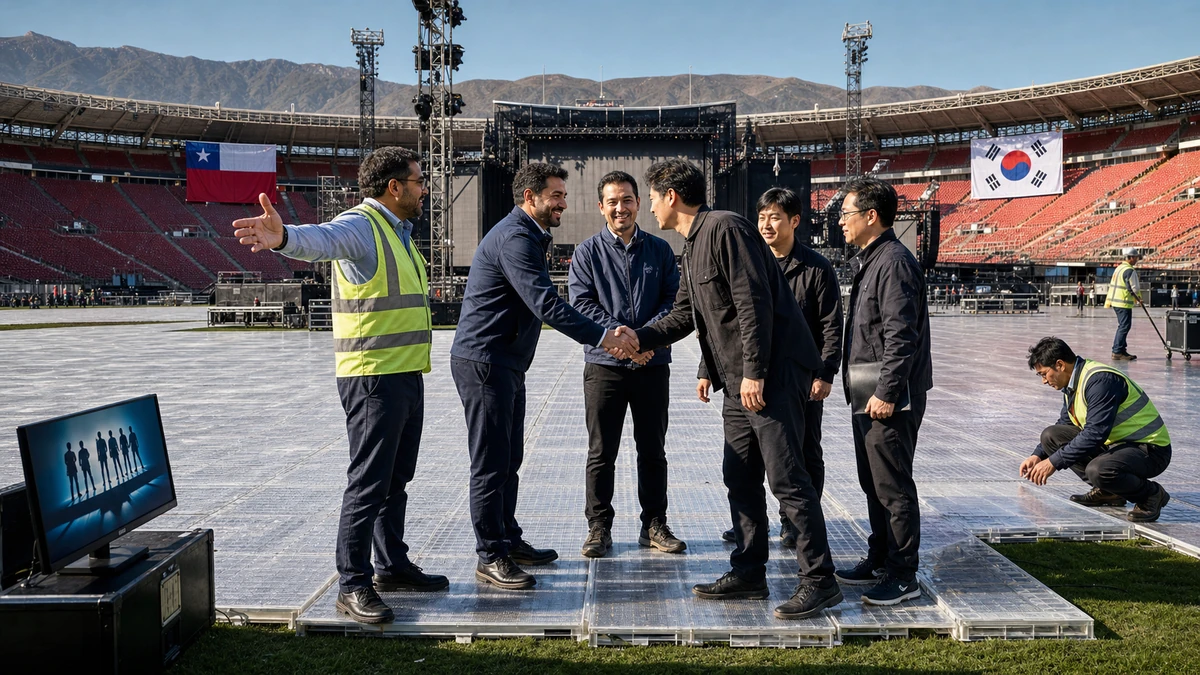
A stadium approval that became bigger than a concert booking
Chile’s government has given final approval for BTS to hold three concerts at Santiago’s National Stadium in October, clearing the way for performances on Oct. 14, 16 and 17 at one of the country’s most symbolically important public venues. On paper, that may sound like a straightforward tour stop confirmation. In reality, the decision says something much larger about where K-pop now stands in the global entertainment business, and about the practical negotiations required when a pop phenomenon meets the rules of a public sports facility.
According to the Korean news agency Yonhap, Chilean authorities signed off on the shows after discussions with local concert organizers over how to protect the stadium’s grass field and track. BTS had faced resistance earlier in the process because officials were concerned that the scale of the production, especially the installation of a 360-degree stage, could damage the venue’s athletic infrastructure. That concern was not brushed aside because of the group’s fame. Instead, organizers revised their plans, and Chilean authorities concluded that the updated technical measures were sufficient for final approval.
That distinction matters. In the United States, major stadium concerts often unfold behind the scenes through months of negotiations over turf protection, trucking routes, stage loads and post-event restoration. Whether it is Taylor Swift at an NFL stadium or U2 at a major arena, the public mostly sees the spectacle, not the engineering and municipal compliance that make it possible. Chile’s decision on BTS offers a similar glimpse behind the curtain. The story here is not only that one of the world’s biggest music acts is returning to Latin America. It is that a government and concert producers had to work through the same kinds of detailed logistical questions that increasingly define blockbuster touring in the modern live-music economy.
For American readers who know BTS as the seven-member South Korean group that helped turn K-pop into a truly mainstream force in the United States, from topping the Billboard charts to speaking at the United Nations, the Santiago approval is another sign that the group’s international footprint is no longer measured only by streaming numbers or social media fandom. It is now visible in the way cities and countries adapt major public spaces to host Korean pop culture on a scale once reserved almost exclusively for Western superstars and international sports events.
The Chilean government’s approval also gives BTS another distinction: the group is set to become the first Korean act to hold a solo concert at Santiago’s National Stadium. That “first” is meaningful not simply as a trivia point, but as a marker of how far Korean popular music has traveled geographically, commercially and institutionally. A national sports venue is not just another concert stop. It is a public symbol, a place where a country stages its biggest collective moments. For BTS to enter that space as a headlining Korean act reflects the changing map of global culture.
Why the venue matters in Chile
Santiago’s National Stadium is not just a large building with seats. Like many flagship public stadiums around the world, it carries national symbolism. It is a central sports facility, a piece of civic infrastructure and a stage for events that matter beyond entertainment. That helps explain why Chilean authorities treated the proposed BTS concerts as more than a routine commercial rental.
In many countries, public stadiums are under pressure to do multiple jobs at once. They host soccer matches, track and field events, civic ceremonies and major concerts that can bring in revenue, tourism and prestige. But each additional use creates friction. A massive live show, especially one involving heavy stage machinery, can threaten the very playing surface and track facilities that justify the venue’s public value in the first place. Governments and stadium managers are often forced to answer a familiar question: How do you open a national landmark to cultural events without undermining its primary purpose?
That appears to have been the core issue in Chile. Officials initially raised objections tied to the possible impact on the stadium’s grass and athletics infrastructure. This was not an abstract concern. Large-scale concert builds can involve cranes, steel decking, trucks, lighting rigs, sound towers and extensive labor crews moving through a venue over several days. Even before the first fan enters the gates, the production itself can place immense stress on the field and surrounding surfaces.
For an American comparison, think of the debate that sometimes erupts when baseball parks host football games, or when a stadium packed with natural grass must accommodate several nights of concerts in quick succession. Fans see a venue as a flexible entertainment platform; operators see a fragile and expensive surface with maintenance schedules, repair costs and contractual obligations. Chilean officials appear to have viewed the BTS proposal through that same operational lens.
What makes this case notable is not that the government was cautious, but that the final approval came after technical revisions rather than political pressure or symbolic appeals. The message was not simply, “This is BTS, so make an exception.” It was closer to, “If you want to use this public facility at this scale, show us how you will do it responsibly.” That reflects a broader reality in global touring: stardom may open doors, but it does not eliminate the need for compliance, especially when the venue belongs to the public.
How a 360-degree stage became the central issue
One of the most important details in the approval process was the use of a 360-degree stage. For readers less familiar with stadium concert design, a 360 stage is built so fans can watch from multiple sides, often encircling the performance area instead of facing a single end-stage setup. It can create a more immersive atmosphere and maximize sight lines, but it also complicates installation, rigging and equipment movement.
That complexity seems to have been at the heart of Chile’s concern. According to the Korean summary, the key technical change involved ensuring that heavy machinery would not move across the grass during the installation of the 360-degree stage. Instead, cranes needed for stage construction and production were to operate from the running track rather than the field itself. The adjustment allowed organizers to preserve a central element of the show’s design while reducing direct pressure on the turf.
This may sound like a niche production detail, but it is precisely the sort of detail that often determines whether a stadium event lives or dies. Large concerts are, in effect, temporary construction projects layered on top of entertainment events. Every route used by a crane, every support platform placed over a field and every hour of access can shape the risk profile for the venue. If that sounds more like civil engineering than pop music, that is because at this level the two are inseparable.
The BTS case underscores an important truth about modern arena and stadium productions: the glamour of the performance often depends on highly technical compromises. Organizers did not appear to abandon the ambitious stage concept. They adapted the logistics around it. In that sense, Chile’s approval shows that cultural spectacle and public-facility protection are not always mutually exclusive. The path forward can be found through design revisions, load management and operational planning.
It is also a reminder that K-pop’s international success now rests partly on the industry’s ability to deliver these kinds of solutions abroad. For years, discussion of Korean pop music outside Asia often focused on choreography, fandom culture, fashion or digital savvy. All of those elements matter, but they tell only part of the story. To sustain global touring at the highest level, K-pop companies and their local partners must also master the unglamorous side of the business: venue negotiations, municipal regulation, safety compliance and infrastructure protection. Chile’s decision illustrates that those capabilities are becoming part of K-pop’s global identity as well.
BTS, Latin America and a fan base that long predates this approval
The significance of the Chile concerts is also tied to the longstanding enthusiasm for K-pop in Latin America, a region that has often embraced Korean acts with an intensity that rivals fandoms in the United States and Asia. BTS did not create that interest from scratch, but the group has become one of its most visible beneficiaries and accelerators. Across Latin America, fans have organized streaming campaigns, flash mobs, charity drives and fan events that mirror the disciplined, highly networked fandom culture associated with the group worldwide.
To many Americans, K-pop’s rise may still be framed through familiar milestones such as Billboard No. 1 singles, sold-out U.S. stadium dates, Grammy appearances or late-night TV performances. But outside the United States, the story has unfolded through a different set of markers: regional fan communities, social media translation networks, cultural festivals and the gradual movement of Korean music from niche import to mainstream pop force. Chile has been part of that story for years, as have countries including Mexico, Brazil, Peru and Argentina.
That context helps explain why three dates at Santiago’s National Stadium matter. The schedule itself suggests that demand is expected to be substantial. A one-night symbolic appearance would have been notable enough. Three performances at a national venue point to something more durable: not just curiosity, but an audience large enough to justify repeated use of a major stadium and the complicated logistics that come with it.
At the same time, it is important not to overstate what is known. The source material does not provide ticket sales figures, projected attendance totals or economic impact estimates. So the most responsible conclusion is not that these will automatically be the biggest shows in Chilean history or the most lucrative K-pop events in the region. The confirmed significance lies elsewhere. BTS has received final approval, the group will play a landmark public venue on multiple nights and a Korean act will headline the stadium for the first time.
Still, even without broader commercial data, the symbolism is hard to miss. For many fans in Latin America, international tours by Asian acts have historically been less frequent than stops in North America, Europe or Japan. When major acts do arrive, those appearances can carry outsized meaning because they signal recognition of fan communities that have long felt underserved by the global tour circuit. In that sense, the Santiago dates are not just concerts. They are a statement about where the industry believes demand is real and worth building for.
What this says about K-pop’s next stage of globalization
The most revealing part of Chile’s approval process may be what it says about the maturation of K-pop as a global export. For years, analysts described the “Korean Wave,” often using the Korean term “Hallyu,” as the spread of South Korean popular culture through music, television, film, beauty products and digital media. In the American imagination, Hallyu is often represented by a handful of breakthrough moments: “Gangnam Style,” the Oscar success of “Parasite,” the global popularity of Netflix’s “Squid Game,” and BTS selling out stadiums from Los Angeles to London.
But the next chapter of that story is less about surprise breakthroughs and more about institutional integration. Korean cultural products are no longer merely arriving in foreign markets as novelties. They are being incorporated into the operational systems of those markets. That means dealing with government agencies, local promoters, labor rules, venue standards and public expectations. The Chile decision is a case study in that transition.
In other words, K-pop’s globalization is no longer measured only in cultural attention. It is measured in whether a Korean act can navigate the same complex infrastructure demands faced by the biggest touring brands in the world. BTS’s Santiago concerts suggest the answer is yes, but only through the same type of negotiation and technical adaptation any major international production would require.
This matters because it pushes back against a simplistic narrative that K-pop succeeds abroad merely because of devoted online fandom or polished visuals. Those factors may drive interest, but they do not secure stadium access. They do not move cranes, protect fields or satisfy public authorities. The Chile case highlights a less visible source of K-pop’s staying power: professionalization. Korean entertainment companies and their international partners increasingly operate at a level where they can translate fan demand into large-scale events that meet local regulatory and logistical standards.
That may become even more important as Korean acts seek growth in regions where public venues are tightly regulated, sports calendars are crowded and infrastructure concerns are politically sensitive. In those environments, international expansion depends not just on having a fan base, but on proving operational credibility. Chile’s final approval amounts to a public acknowledgment that such credibility was demonstrated here.
Why governments are paying closer attention to pop culture infrastructure
There is another layer to this story that extends beyond BTS and beyond K-pop. Around the world, governments are increasingly being asked to balance cultural opportunity against infrastructure stewardship. A major concert can bring tourism, hotel bookings, transportation activity and international attention. It can also leave behind repair bills, scheduling conflicts and public criticism if something goes wrong. For officials, the challenge is not simply whether to say yes or no, but how to say yes under conditions that preserve the public asset.
Chile’s handling of the BTS request suggests a model that many cities and national authorities may find instructive. Officials did not permanently reject the concerts at the first sign of risk. Nor did they wave them through because of star power or potential excitement. Instead, the process appears to have revolved around identifying specific vulnerabilities and requiring specific remedies. That is often how major public decisions are made in sectors far removed from entertainment, from transportation to construction to sports management.
For American readers, this is a familiar pattern even if the artists change. Cities routinely negotiate with sports franchises over stadium upgrades, with festival operators over park restoration and with promoters over public safety plans. What is unusual here is not the bureaucratic logic but the cultural actor at the center of it: a Korean pop group whose influence is strong enough to trigger high-level consideration over how a national stadium should be used.
That alone says something about the new geography of global entertainment power. Not long ago, the idea that a Korean act would become central to a debate over the use of one of Latin America’s most prominent public venues might have seemed far-fetched to many Western observers. Today, it feels like a natural extension of shifts that have been building for more than a decade. Asian pop culture, once framed in American media mainly as a niche import, now shapes mainstream consumer behavior, touring strategy and cultural policy conversations across continents.
What comes next before October
With final approval now in place, the biggest immediate question is how the agreed-upon safeguards will be executed in practice. The source summary makes clear that the administrative hurdle has been cleared, but it also suggests that the protective conditions tied to the stadium’s grass and track remain central to the project. That means the real test will come during setup, operation and breakdown, when plans on paper meet the physical demands of a live production.
For now, the available facts support a measured conclusion. Chile did not simply reverse itself without explanation. It approved the BTS concerts after local organizers incorporated technical changes intended to protect the venue’s sports infrastructure, including keeping heavy machinery off the grass and using the track area for crane operations. The group is scheduled to perform three times in mid-October, becoming the first Korean act to headline a solo concert at Santiago’s National Stadium.
Everything beyond that should be approached carefully. There is no confirmed information in the source material about secondary operational changes, future venue policies or broader economic effects. But even within those limits, the episode carries weight. It demonstrates that the international expansion of Korean pop culture is now happening not only through fan enthusiasm and digital visibility, but through negotiations over real urban space, real public infrastructure and real administrative standards.
That may be the clearest takeaway for an American audience. BTS’s Santiago approval is not just a fan story and not just a culture story. It is also a governance story, a business story and an infrastructure story. It shows what happens when a global entertainment force arrives at the gates of a national public venue and the answer depends not on hype, but on engineering, regulation and compromise.
If the concerts proceed as planned in October, they will almost certainly be remembered by fans as a celebration. But the broader significance will remain even before the lights go up. Chile’s decision shows that K-pop’s place in the world is no longer defined solely by whether people are listening. It is defined by whether institutions are prepared to make room for it, and under what terms. In Santiago, that room has now been made, carefully and conditionally, on one of the country’s biggest stages.
Comments
Post a Comment