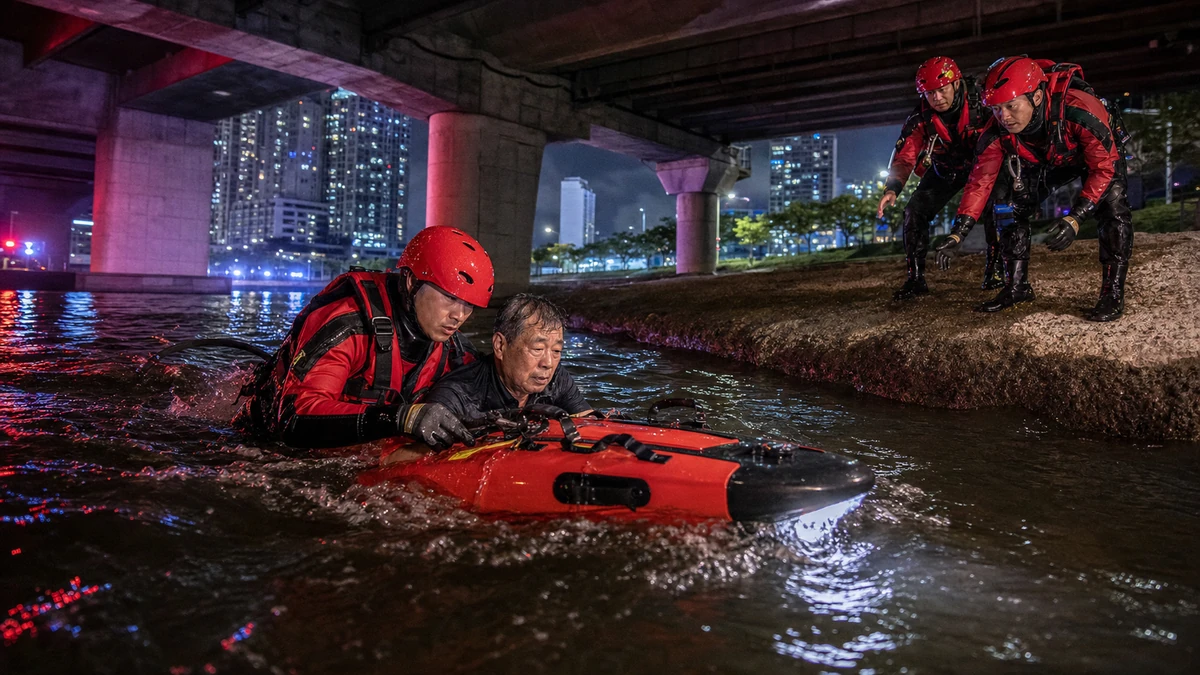
A nighttime rescue in one of South Korea’s busiest coastal cities
On a hot summer night in Busan, South Korea’s second-largest city, firefighters used a remote-controlled water rescue board to help save a man in his 60s who was found floating beneath a bridge in an urban waterway, local authorities said. The rescue, carried out July 25 and announced the following day by the Busan Fire and Disaster Headquarters, offers a striking example of how new public-safety technology is beginning to show up not in futuristic demonstrations, but in the ordinary, urgent work of saving a life.
According to officials, the emergency call came in at 8:06 p.m. reporting that a person was floating in the water under Gwajeong Bridge in the Jaesong neighborhood of Haeundae district. Within 13 minutes of the report, rescue crews had located the man, reached him using the specialized device and brought him ashore before transferring him to a hospital.
Authorities did not release details about the man’s condition or how he ended up in the water. But even with those questions unanswered, the case has drawn attention in South Korea because of where and how it happened: not at one of the country’s crowded summer beaches, but along a city waterway at night, and not through a fully automated machine, but through a hybrid rescue method combining human judgment with powered, remotely steered equipment.
For American readers, the closest comparison may be the expanding use of drones, rescue robots and remote flotation devices by fire departments and lifeguard agencies in the United States. But the Busan case also underscores a basic truth familiar to first responders everywhere: technology can shorten the distance between danger and help, yet it still depends on trained people making decisions in real time.
That combination — speed, visibility in low light, and the ability to get a rescuer across the water quickly — appears to be what mattered most here.
What exactly was used in the rescue
The device at the center of the rescue has been described by Busan officials as a remote-controlled surfboard-style water rescue tool. That wording matters. It was not a leisure surfboard in the California or Hawaii sense, and it was not an autonomous robot that carried out the mission by itself. Instead, it was a powered board designed to move over the water while being directed remotely, allowing a responder to use it as a fast approach platform.
In footage and descriptions released after the incident, the rescuer did not stand back on shore and send the machine alone toward the victim. Rather, the firefighter held onto or rode with the device to close the distance rapidly, assess the man’s condition up close and guide him back toward land. In other words, the board functioned less like a replacement for a person and more like an engine-assisted extension of the rescuer’s reach.
That distinction is important in understanding what happened. In public conversations about emergency technology, there is often a tendency to frame innovation as a story of humans being replaced by machines. The Busan rescue suggests something more practical and more likely: equipment that helps emergency crews get where they need to go faster, especially in conditions that are hazardous, dark or time-sensitive.
Water rescues are among the most dangerous operations first responders perform. Currents, poor visibility, uncertain victim condition and the risk of turning one victim into two all complicate the job. A device that can move a rescuer more quickly across the surface while conserving energy and reducing exposure could make a measurable difference, especially during the first few minutes after a person is spotted in the water.
That appears to be the role the board played in Busan. It did not eliminate the need for searching the shoreline, identifying the victim, choosing the right intervention and physically accompanying the man back to safety. It simply made the movement phase — often one of the most critical parts of a rescue — faster and potentially safer.
Why the location matters in South Korea
At first glance, a water rescue in Busan may not sound unusual. The city is famous for its oceanfront setting, seafood markets and beaches, especially Haeundae, which is one of South Korea’s best-known vacation destinations. Every summer, huge crowds descend on the city’s waterfront, much the way Americans flock to places like Myrtle Beach, the Jersey Shore or Southern California beach towns.
But this rescue did not happen on a tourist beach lined with umbrellas and lifeguard stands. It happened under a bridge in a built-up part of the city, a reminder that water-related emergencies are not confined to postcard locations. In Busan, as in many coastal and riverfront cities, urban life exists in close proximity to canals, rivers, bridges, harbors and tidal inlets. Those spaces can be beautiful and heavily used, but they can also become dangerous quickly, especially after dark.
That context is significant in South Korea, where summer safety campaigns often focus heavily on beaches, vacation travel and seasonal recreation. News coverage during the hottest months routinely tracks crowds at resort areas, heat risks and water accidents along the coast. The Busan case broadens that picture. It suggests that emergency planners must think beyond designated swimming areas and prepare for incidents in everyday urban environments where people may walk, fish, drink, commute or simply pass near the water.
For American audiences, a comparable scenario might be an emergency near the Chicago River, San Antonio’s River Walk, the canals around Fort Lauderdale or a bridge crossing in Baltimore or Seattle. These are not necessarily places people associate with swimming, yet they are all settings where a person can fall in, become distressed or go unnoticed until help is urgently needed.
In Busan’s case, the report that “a person is floating in the water” triggered a response chain that moved quickly from dispatch to on-site search to direct intervention. That sequence is part of the story’s importance. The rescue was not just about a new gadget. It was about a city emergency system adapting specialized equipment to a non-tourist, urban nighttime setting.
The 13-minute window and what it says about emergency response
The headline number released by Busan officials was 13 minutes: the time between receiving the emergency call and rescuing the man and taking him for medical treatment. On its face, that is a remarkably short period, especially considering the steps involved. Those steps likely included call intake, dispatch, travel to the scene, a waterside search, visual confirmation of the victim, deployment of the board, contact with the man and the return to land.
That does not mean every future rescue will unfold that quickly, nor does it prove that the equipment alone accounts for the response time. In fact, one of the more useful takeaways from this case is the opposite: speed in emergencies usually comes from connection between steps, not from a single tool. Someone noticed the man and called for help. Dispatch relayed usable information. Responders searched effectively. Once they found the victim, they had a device ready that fit the situation. The transition from one phase to the next appears to have happened without delay.
For American readers used to hearing about “golden minutes” in trauma care or the importance of rapid intervention in drowning cases, that point will sound familiar. In water emergencies, the timeline is unforgiving. Darkness, panic, fatigue and hypothermia can all worsen a person’s condition quickly. Even when a victim is still visible, getting to them can be the hardest part.
That is why the Busan rescue has resonated in South Korea beyond the immediate facts of the incident. It offers a concrete example of how preparedness looks in practice: not merely owning advanced equipment, but integrating it into a response system where firefighters know when to use it and how to incorporate it into conventional rescue tactics.
Officials have emphasized that the firefighters first searched the waterfront and then, after locating the man, deployed the remote-controlled board. That sequence matters because it shows the device was used as part of a decision-making process, not simply because it was available. In emergency services, the best equipment is rarely the equipment used automatically. It is the equipment used appropriately.
Human judgment stayed at the center of the rescue
In an era when headlines often lean toward words like “AI,” “autonomous” and “robotic,” the most revealing aspect of this rescue may be how human it remained. The responder still had to approach the victim personally. The responder still had to assess the surroundings, determine how best to bring the man back and remain involved from first contact through transport to shore.
That division of labor — machine for mobility, human for judgment — may become increasingly common in public safety. It is already visible in police drone programs, wildfire mapping, search-and-rescue operations and even some medical logistics. The selling point is not usually that machines can replace professionals. It is that they can help professionals reach a scene faster, see more clearly or work with less risk.
Water rescue is especially suited to that model. Conditions can shift from minute to minute. A victim may drift. Reflection from city lights can distort visibility. The rescuer may need to react to current, debris, bridge structures or the victim’s physical state. Those are not circumstances in which agencies are likely to want fully hands-off automation. They are circumstances in which a powered tool that buys time and distance can be valuable while still keeping trained personnel in control.
In the Busan case, authorities specifically highlighted that the remote-controlled board’s practical value was assisting the rescuer’s movement over water. That is a narrower, and arguably more credible, claim than saying the device itself “performed” the rescue. The rescue was performed by firefighters. The technology made their job easier at a critical moment.
That may also explain why the incident has been presented by local officials as evidence of real-world usefulness rather than technological spectacle. There is no need to overstate what happened. One man was in the water at night. Responders found him. A remote-controlled rescue board helped a firefighter get to him quickly. He was brought ashore and taken to a hospital. That is enough to make the event notable.
Busan’s broader push toward practical safety technology
After the rescue, Busan fire authorities said the incident helped validate the field effectiveness of advanced water-rescue equipment and that they plan to pursue introduction of improved versions of the surfboard-style device. Officials did not provide details on what upgrades are under consideration, how many devices might be added or where they would be stationed.
Still, the language points to a familiar pattern in emergency management: a successful real-world deployment becomes the basis for future procurement and refinement. Training exercises and vendor demonstrations can only go so far. For many agencies, the true test of equipment comes when it is used under pressure in a live incident, with limited visibility, incomplete information and no time for ideal conditions.
South Korea has, in recent years, invested heavily in public-safety systems, disaster management and municipal technology, part of a broader national emphasis on infrastructure, connectivity and rapid service delivery. In major cities such as Seoul and Busan, that can mean everything from sophisticated transit information systems to smart-city pilot programs. But public trust is often shaped less by grand strategy than by small, tangible moments: whether help arrives, whether systems work and whether institutions seem prepared.
That makes the Busan rescue compelling beyond the novelty of the device. It is a case study in practical modernization. Rather than showcasing technology in isolation, it shows how equipment may be woven into the day-to-day routines of firefighters and rescue crews. For a country often associated abroad with consumer tech giants, high-speed internet and cutting-edge electronics, this is a quieter but meaningful version of innovation — municipal technology serving a public, local purpose.
American cities are engaged in similar conversations. Fire departments and marine units across the U.S. have experimented with rescue drones, inflatable remote-controlled flotation systems and thermal imaging to improve search response. The policy debate is usually the same on both sides of the Pacific: what tools genuinely improve outcomes, how much they cost and whether crews can deploy them reliably under real conditions. Busan’s experience will likely feed into that conversation in South Korea.
A reminder that summer water danger extends beyond the beach
Every summer, public-safety messaging tends to focus on the most obvious risks: ocean currents, crowded beaches, alcohol use on boats and children around pools. Those dangers are real. But incidents like the one in Busan are reminders that water risk is broader and often less visible. Urban rivers, bridge underpasses, canals and harbor edges can become deadly in moments, particularly at night.
Busan is a city where the boundary between dense urban development and water is constant. That relationship is central to its identity, economy and appeal. It is also what makes stories like this feel instructive. The rescue did not unfold in a remote wilderness setting or at a heavily staffed resort beach. It happened in a routine urban landscape — the sort of place residents may pass without much thought.
For English-speaking readers, that is perhaps the easiest way to understand why the story matters. This was not just a tale of flashy technology in a faraway city. It was a recognizable urban emergency: a person in distress near water after dark, first responders racing the clock and a new tool making the difference between a slower approach and a faster one.
There is also a caution against overreading it. One successful rescue does not mean the same outcome is guaranteed in every case. Officials have not released enough technical detail to judge the full capabilities of the device, and without more information about the man’s condition, it is impossible to know how close the situation came to becoming fatal. But it is reasonable to say the incident demonstrated the operational value of a tool designed to shrink response time on the water.
If there is a broader lesson, it may be this: the future of emergency response is likely to look less like science fiction and more like this — a firefighter, a specialized machine, a dark stretch of water and a decision made quickly enough to matter. In Busan, on a summer night under a bridge, that combination appears to have saved a life.
Comments
Post a Comment