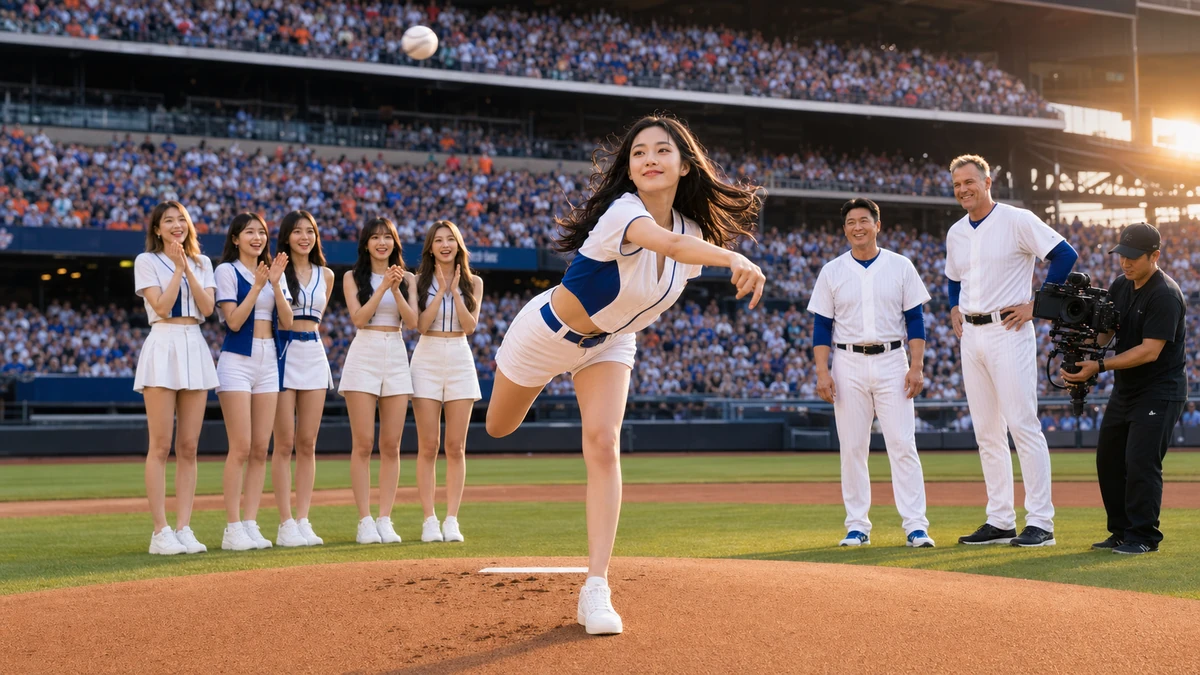
A K-pop arena act steps into one of America’s most recognizable sports rituals
IVE, one of South Korea’s most commercially successful girl groups, is set to make an appearance at an unlikely but symbolically powerful stop on its North American swing: a Major League Baseball game in New York. The group has been officially invited to attend the July 26 matchup between the New York Mets and the Los Angeles Dodgers at Citi Field, and member Jang Won-young will throw the ceremonial first pitch before the game.
For American readers who do not closely follow K-pop, that may sound like a simple celebrity crossover. In practice, it is something more strategic and culturally telling. The ceremonial first pitch is one of the most familiar traditions in American sports, a brief but high-visibility moment that places a public figure at the symbolic starting line of a game. Politicians, actors, musicians and hometown heroes have all taken part. For a Korean pop star whose career has largely been built on music broadcasts, sold-out concerts and digital fandom, stepping onto the mound at a Mets-Dodgers game signals a deliberate move into a broader American mainstream setting.
The appearance also comes at a moment when K-pop’s relationship with U.S. audiences is changing. The genre no longer exists only as a niche import or internet obsession. It now appears regularly on festival lineups, award shows, late-night television and retail shelves. But sports venues remain a distinct frontier. Baseball fans are not necessarily there to see a Korean pop act, and that is precisely what makes the opportunity valuable. At Citi Field, IVE will be introduced not just to its established fan base, but also to a cross-section of local spectators who came to watch the Mets and Dodgers.
That contrast matters. A concert audience arrives pre-committed, often having purchased tickets months in advance and learned fan chants or choreography. A baseball crowd is different. It is multigenerational, more casual in its entertainment habits and gathered around the rhythm of the game, not the identity of a performer. If a K-pop group can make a memorable impression there, even in a short pregame appearance, it suggests a different kind of cultural reach: not just popularity among fans, but recognizability in the wider public square.
In that sense, IVE’s visit to Citi Field reflects a larger story unfolding across global entertainment. Korean pop is not simply traveling overseas anymore; it is increasingly being woven into the routines and institutions of local culture, including one of the most American settings imaginable: an evening at the ballpark.
Why Jang Won-young’s first pitch matters beyond the photo opportunity
Among the details announced around the visit, the most attention-grabbing is Jang’s role as first-pitch guest. In South Korea, as in the United States, ceremonial first pitches are a staple of baseball presentation. They often feature actors, singers, TV personalities and athletes from other sports. In Korea, however, the practice has become particularly intertwined with entertainment culture, with stars frequently appearing at games in team jackets or customized outfits and clips of their appearances circulating widely online.
For American audiences, the closest equivalent may be the way celebrity courtside moments at NBA games become social media content in their own right, even when they last only a few seconds. The first pitch serves a similar purpose in baseball: a tightly choreographed ritual that is both part of the game-day experience and an easily shareable media event. The pitch itself may take less than a minute, but the image can travel far beyond the stadium.
Jang, who is often known internationally by the romanized spelling Wonyoung, is one of the most visible young stars in Korean entertainment. She has built a public image around poise, confidence and polished stage presence, making her one of the most recognizable faces of fourth-generation K-pop, a label fans use to describe the cohort of idol groups that rose to prominence in the late 2010s and early 2020s. For someone with that profile, appearing at a Mets-Dodgers game is not merely an extracurricular stop between concerts. It is a test of how well a star associated with highly stylized performance can connect in a more spontaneous, mass-market environment.
According to the event announcement, Jang said she was honored to take the mound for a major game watched by baseball fans around the world and wanted to deliver positive energy to both the crowd and the players. That phrasing may sound polished, but it points to a central feature of idol culture in Korea. K-pop performers are typically expected to present not just songs and choreography, but also a consistent emotional tone: approachable, upbeat, hardworking and audience-focused. In other words, “good energy” is not filler language. It is part of the professional identity.
At a baseball stadium, that identity is compressed into a single moment. There is no set list, no costume change, no elaborate stage production to support the interaction. A celebrity walks out, greets the crowd, throws the pitch and exits. The entire impression depends on body language, composure and whether the audience senses ease or awkwardness. That is why first pitches, while lighthearted on the surface, can become surprisingly memorable. Americans have seen everything from expertly thrown strikes to wildly off-target tosses that live forever on highlight reels. The ritual is small, but it is revealing.
For Jang and for IVE, the challenge is not to turn a baseball game into a K-pop event. It is to fit naturally into a preexisting American sports ritual while still making the group’s identity visible. If that balance is struck, the result can be more effective than a conventional promotional appearance because it feels organic rather than imposed.
What IVE represents in today’s K-pop landscape
To understand why this appearance has generated interest, it helps to know where IVE sits in the Korean pop ecosystem. The six-member group debuted in late 2021 under Starship Entertainment and quickly became one of the defining acts of its generation, scoring a series of hits that helped it stand out even in a crowded field. In K-pop, commercial success is measured through a mix of streaming, album sales, music show wins, endorsements, touring power and online influence. By those standards, IVE has emerged as one of the strongest names of the past few years.
The group’s appeal has often been tied to a polished, self-assured image rather than a deliberately underdog narrative. That distinction matters in K-pop, where concepts are carefully crafted and public identity is part of the product. IVE’s music and branding frequently emphasize elegance, ambition and confidence, qualities that translate effectively in fashion campaigns and international promotions. For U.S. audiences less familiar with the internal logic of the idol industry, it may help to think of K-pop groups as operating somewhere between a pop act, a lifestyle brand and a serialized entertainment franchise. Their appeal extends beyond songs to visuals, personality, behind-the-scenes content and the sense of a world fans can follow closely.
That multi-platform structure is one reason the Citi Field appearance makes sense. K-pop groups are no longer judged solely by chart performance. Global visibility now depends on how well they can appear across formats: concerts, social media, variety content, brand partnerships and public events outside music. A baseball game offers something no concert can. It presents the group in a space where the audience is not self-selecting around fandom.
That is especially important in the United States, where K-pop still occupies an unusual dual position. On one hand, it is powerful enough to fill arenas and dominate online discourse. On the other, it can still seem specialized to people who do not actively follow global pop culture. An event like the Mets-Dodgers game helps bridge that gap. It puts IVE in front of people who may recognize none of the members by name but understand celebrity ritual, sports pageantry and the broader appeal of a live event.
For American news consumers, there is also a useful comparison here with the way Latin music crossed into mainstream U.S. cultural institutions over time. It did not happen only through radio hits. It also happened through award-show appearances, sports tie-ins, brand deals and moments when artists became visible in everyday American settings. K-pop has been moving through a similar process, though with its own industrial logic and fan culture. IVE’s stop at Citi Field is one more sign that the genre’s U.S. strategy is broadening beyond music-only platforms.
Why Citi Field is a different stage from a concert arena
The location matters almost as much as the guest. Citi Field is not a neutral venue in this story. It is a major league ballpark in New York, one of the most media-saturated cities in the world, and the host site for a game between two franchises with distinct national profiles. The Dodgers carry the weight of a glamorous, big-market brand with a deep history and a broad fan base. The Mets, while often defined in relation to their crosstown rivals, have their own loyal following and a strong local identity. A Mets-Dodgers game, especially in New York, offers both star power and reach.
That kind of setting gives IVE access to an audience that differs sharply from the crowd at a tour stop. Concertgoers come to see the artist and are primed for emotional investment. Baseball fans come for innings, scorecards, concessions, stadium traditions and the particular social atmosphere that surrounds an MLB game in midsummer. For many, the celebrity first pitch is a fun prelude, not the main attraction.
That can be an advantage. Because expectations are lower, the pressure to perform in the usual sense is gone. What matters instead is familiarity, curiosity and tone. A short appearance can invite baseball fans to look up the artist afterward, while giving existing K-pop fans a fresh context in which to see someone they already follow. In media terms, the event works in two directions at once: it deepens loyalty among fans and expands awareness among nonfans.
There is also something distinctly American about the baseball setting itself. In the United States, baseball has long functioned as more than a sport. It is an archive of civic ritual and regional identity, from Little League nostalgia to seventh-inning stretch singalongs to the pace of a summer evening game. Even as football dominates ratings and basketball shapes youth culture, baseball still holds a symbolic place in the national imagination. When an international pop act appears in that environment, it signals a desire not just to visit America, but to participate in one of its oldest public traditions.
For Korean entertainment companies, these appearances can be especially meaningful because they allow artists to enter a shared cultural script that Americans instantly recognize. No lengthy introduction is needed. A singer on a mound before first pitch is a legible image, whether the viewer follows K-pop or not. In a media environment defined by short attention spans and visual circulation, that kind of instant recognizability is valuable.
It also offers a reminder that globalization does not always work through grand spectacles. Sometimes it happens through small symbolic insertions into local life. A Korean group shows up at a New York baseball game, a clip spreads online, fans discuss it, sports viewers become curious, and a cultural boundary shifts just a little. That may not sound dramatic, but it is how soft power often functions in practice.
The North American tour and the logic of expanding beyond the venue
IVE’s visit to Citi Field is not happening in isolation. It falls in the middle of the group’s North American tour, which runs from July 21 to Aug. 9 and includes stops in cities such as Toronto and Oakland. That timing is important because it turns the baseball appearance into part of a larger campaign rather than a one-off detour.
In the streaming era, international touring is about much more than the concert itself. Artists are expected to generate a steady flow of moments in each city they visit: local press hits, social media updates, backstage clips, brand tie-ins and culturally recognizable side events. Fans do not experience a tour only through the songs performed onstage. They experience it as a rolling narrative, city by city, post by post, with each stop adding texture to the broader story.
By appearing at an MLB game during the tour, IVE effectively broadens that narrative. Instead of limiting its North American presence to ticketed venues and fan-centered spaces, the group is inserting itself into a major slice of U.S. public culture. That is savvy from a media standpoint. Concert footage will mostly circulate among people already interested in the act. A first pitch at a high-profile baseball game has a better chance of crossing into general interest coverage, sports social feeds and local news ecosystems.
It also suggests that the group’s U.S. activities are being designed with layered audiences in mind. There are the dedicated fans who will attend the concerts and track every update. There are casual K-pop listeners who may know the name but are not fully invested. And there is the much larger public that may encounter IVE for the first time in a baseball context, through a clip, headline or social media post. Reaching all three audiences requires different kinds of appearances. A tour stop alone reaches one layer. A stadium ritual reaches another.
That kind of planning reflects how sophisticated K-pop’s global playbook has become. Entertainment agencies in South Korea are no longer simply exporting finished acts and hoping they resonate. They are building ecosystems of visibility across media formats, trying to ensure that a group appears not only where fans expect them, but also where new audiences already are. In the United States, sports remains one of the few cultural spaces capable of gathering broad, diverse and live audiences at scale. That makes a ballpark appearance more than a novelty. It is a useful point of entry.
The added baseball connection: content with Byung-hyun Kim and Dustin Nippert
The group’s MLB-related schedule will also include separate content filming with former pitchers Kim Byung-hyun and Dustin Nippert, according to the announced plans. The exact format has not been detailed, but the pairing itself is notable because it introduces another bridge between Korean and American baseball culture.
Kim is well known to U.S. baseball fans of a certain era for his major league career, including his years with the Arizona Diamondbacks and Boston Red Sox. In South Korea, he has remained a recognizable figure well after retirement, with a public profile that extends beyond sports. Nippert, meanwhile, is an American former pitcher who became a familiar name to many Korean baseball fans after a long and successful run in the Korea Baseball Organization. Together, the two men represent different but complementary pathways between the U.S. and Korean baseball worlds.
That matters because crossover content works best when it contains interpreters, people whose presence helps different audiences feel less like outsiders. For fans of IVE who do not know baseball well, former players can offer an accessible entry point into the setting and the rules of the ritual. For baseball viewers who do not follow K-pop, the involvement of recognizable sports figures adds legitimacy and familiarity. It tells the audience that this is not just a celebrity drop-in, but a curated exchange between adjacent entertainment spheres.
There is a broader trend at work here, too. K-pop agencies increasingly treat every public event as source material for digital content. A ballpark visit is no longer merely something to attend; it becomes footage to be edited, packaged and distributed later across platforms. That extends the life of the event far beyond game day. Fans who cannot be at Citi Field in person will still be able to experience the visit through interviews, clips, behind-the-scenes segments or social posts.
In an age when fandom is sustained by constant online engagement, that afterlife is essential. The live event creates the core image. The digital content builds narrative around it. Together, they turn a brief appearance into a shareable cultural product. For IVE, that means the first pitch may be only the most visible tip of a larger piece of North American storytelling.
A sign of where Korean pop and American public culture are meeting
Ultimately, the significance of IVE’s appearance at Citi Field lies less in the mechanics of the first pitch than in what it says about the current stage of Korean pop’s global expansion. There was a time when K-pop’s U.S. ambitions were measured mainly by whether a song charted on Billboard or an act landed a TV booking. Those milestones still matter, but they are no longer the whole picture. Real cultural integration also looks like showing up in places where pop promotion and everyday public ritual overlap.
A Mets-Dodgers game is exactly that kind of place. It is highly visible but not overly formal, local but globally legible, rooted in a specifically American tradition while open to celebrity reinvention. For IVE, it offers a way to present itself not just as an imported act on tour, but as a participant in an American summer ritual that millions recognize on sight.
For American audiences, the moment may also offer a useful lens into how Korean entertainment operates. K-pop artists are not simply singers who release songs and hold concerts. They are public figures working inside an intensely organized ecosystem that values branding, atmosphere and audience connection across many platforms. A first pitch can therefore carry significance out of proportion to its length. It condenses image, aspiration, cultural exchange and promotional strategy into one camera-ready gesture.
Whether Jang throws a perfect strike or bounces the ball is almost beside the point, though the internet will almost certainly care. What matters more is the symbolism of the appearance itself: a Korean girl group in the middle of a North American tour stepping into one of America’s most established sports ceremonies, meeting baseball fans where they already are, and doing so in a way that feels less like interruption than invitation.
That invitation runs both ways. For K-pop fans, it is a chance to see their favorite act move through a new kind of public space. For baseball fans, it is a brief encounter with one of the most influential export industries in contemporary South Korea. In a media environment where culture often feels fragmented into hyper-specific niches, events like this stand out because they create shared viewing moments across communities that do not always overlap.
On July 26, Citi Field will still primarily belong to the Mets, the Dodgers and the game itself. But before the first inning begins, the ballpark will also briefly become a stage for a different story, one about the continued convergence of Korean pop culture and American public life. For IVE, that is the opportunity. For everyone watching, it is a snapshot of how global entertainment now moves: not only through charts and streams, but through rituals, places and moments that translate instantly on both sides of the Pacific.
Comments
Post a Comment