
A milestone that means more than one swing
In American baseball, fans instinctively understand what certain benchmark numbers mean. A 3,000th hit signals a career of relentless consistency. Five hundred home runs marks uncommon power sustained over many years. And when a player keeps clearing a familiar threshold season after season, that kind of durability can say as much about greatness as any single headline-grabbing blast.
That is what made Choi Jeong’s latest home run resonate so strongly in South Korea on Thursday night.
The 39-year-old star of the SSG Landers became the first player in Korea Baseball Organization history to hit at least 20 home runs in 11 consecutive seasons, according to Yonhap News Agency, the South Korean wire service. The record came in a home game against the KIA Tigers at Incheon SSG Landers Field, when Choi launched his 20th home run of the 2026 season — a go-ahead, two-run shot that flipped the game and added another chapter to one of the most durable power careers Korean baseball has ever seen.
For readers less familiar with South Korean baseball, the KBO is the country’s top professional league, the rough equivalent of Major League Baseball in the United States in terms of domestic standing and cultural visibility. It has its own rich history, its own iconic franchises and stars, and a fan culture that is often louder, more choreographed and more communal than what many Americans are used to at a ballpark.
Within that world, Choi is not simply a productive veteran. He is one of the defining sluggers of his era, the kind of player whose name has become shorthand for reliable power. And this particular record — 11 straight seasons with 20 or more home runs — helps explain why.
Anybody can have one monster year. Plenty of hitters can catch lightning in a bottle, ride a hot swing, take advantage of a favorable ballpark or a weakened pitching environment, and put up a big home run total once. What is much harder is to meet the same standard every year, across changes in age, health, team context and league conditions. Choi has now done that from 2016 through 2026, without interruption.
That is the achievement hidden inside one swing: not just his 20th home run of the season, but the culmination of 11 years of never falling below a demanding power benchmark.
The at-bat that delivered history
The record arrived in a moment that would have felt dramatic even if history had not been at stake.
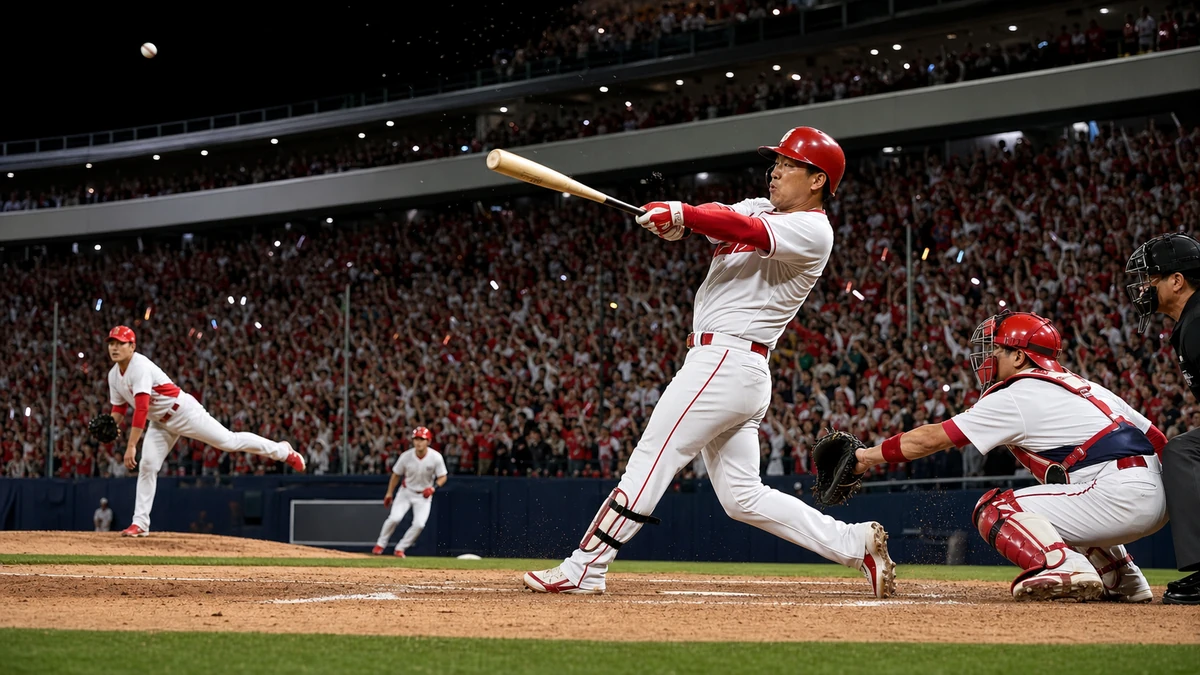
SSG trailed KIA 1-0 in the bottom of the fifth inning when Choi came to the plate with one out and a runner on first. Facing KIA starter Adam Oller, Choi worked the count full. On the sixth pitch of the at-bat, Oller threw a 135-kilometer-per-hour slider on the inner half — about 84 mph. Choi did not miss it.
He turned on the pitch and drove it over the left-field wall for a 130-meter homer, roughly 427 feet, giving SSG a 2-1 lead and igniting the home crowd. It was the kind of moment baseball fans anywhere can picture immediately: a veteran slugger behind in the game, a full count, nowhere to hide for pitcher or hitter, and then one clean swing that changes both the scoreboard and the historical record book.
That combination matters. This was not a quiet milestone reached in a lopsided game or a statistical footnote tucked inside a routine win. Choi’s home run had a direct competitive impact. It erased a deficit. It put his club ahead. And it arrived in a pressure spot, which only amplified the moment inside the stadium.
There is also something revealing about the pitch itself. An inside slider in a full-count situation is not an automatic mistake pitch, but it is a dangerous one against an experienced hitter who can recognize spin and react quickly. Choi’s ability to get the barrel to that ball and pull it out to left showed the kind of bat speed and anticipation that do not linger automatically into a player’s late 30s. Those skills have to be maintained, adjusted and sharpened year after year.
Just as important, the at-bat suggested that the weight of the record did not make him passive. Entering the game, Choi was sitting on 19 home runs, one away from another KBO first. It would have been easy to imagine a player pressing, expanding the strike zone or, conversely, becoming too cautious in a big moment. Instead, Choi looked like a hitter focused less on the milestone than on the game situation. He got a pitch he believed he could drive, and he did.
That is often how the best milestones happen in baseball — not in a ceremonial vacuum, but inside the ordinary competitive chaos of a real game.
Why 11 straight seasons of 20 home runs is such a big deal
To casual fans, 20 home runs may not sound like the flashiest number in modern baseball. In the major league context, the sport has been conditioned by 40-homer seasons, 50-homer chases and the occasional spikes that distort expectations. But the meaning of a streak like this is not really in the number 20 by itself. It is in the word “consecutive.”
Consecutive records are ruthless. They do not care why a season falls short. A nagging injury, a shortened schedule, a slump, a dip in bat speed, a strategic change in how teams pitch a hitter — any of those can break the chain. Once the standard is missed even once, the streak is over.
That is what makes Choi’s 11-season run so unusual. He has not merely accumulated home runs over a long career, though he has done plenty of that as well. He has met a meaningful power threshold every single year from 2016 on. That means he has weathered aging, scouting adjustments, changing pitching plans and the normal wear of professional baseball without losing the defining trait of his offensive profile.
Home run hitting is not just about brute strength. It is a blend of pitch recognition, timing, strike-zone discipline, bat path and the ability to identify when to attack. A player can still be strong and yet lose the fraction of a second needed to punish a pitch. He can still know the strike zone and yet fail to get the ball in the air with authority. Sustained power, in other words, is a skill that has to keep evolving.
Choi’s streak suggests that he has done exactly that. The version of Choi who hit 20 or more home runs in 2016 was not the same player, physically or contextually, as the one who did it in 2026. The league changed. His body changed. Opponents certainly changed the way they approached him. Yet the outcome stayed remarkably stable.
In the United States, baseball fans often revere players who age well enough to remain dangerous into their late 30s. Think of the admiration reserved for veteran sluggers who keep producing even after they have moved beyond their physical prime. Choi’s record fits into that same conversation. It is a measure not only of talent, but of maintenance — the often invisible work of staying strong, staying available and staying adaptable.
At 39, he is not surviving on reputation. He is still extending that reputation with current performance.
A career defined by persistence, not just peaks
South Korean sports coverage often uses the term “ganpan taja” to describe a team’s marquee hitter — the lineup centerpiece, the player fans associate most readily with a club’s offensive identity. Choi has occupied that space for SSG, the Incheon-based franchise that traces its lineage through earlier ownership eras and remains one of the more recognizable organizations in Korean baseball.
His latest milestone reinforces a point that long careers can sometimes blur: Choi’s value is not built only on cumulative totals or nostalgia. It rests on repeated proof.
Yonhap noted that this is the second time this season he has established a new KBO first in a long-term home run category. In May, he became the first player in Korean professional baseball to record 10 or more home runs in 21 consecutive seasons. That mark highlighted the astonishing breadth of his career, a reminder that he has been a source of power for more than two decades.
The new record — 11 straight seasons with at least 20 homers — says something slightly different. If the 21-year, 10-homer streak captures longevity in the widest sense, the 11-year, 20-homer streak captures a more demanding standard of sustained impact. It says that Choi has not just stayed relevant; he has remained a high-output power threat deep into the back half of his career.
That distinction matters because veteran stars in any sport can become symbols before they stop being producers. Fans continue to cheer them, celebrate them and buy jerseys bearing their names, sometimes even as their on-field contributions shrink. Choi is in a different category. The historical aura is real, but it is supported by present-day evidence. His milestone home run was not a ceremonial swing from a fading icon. It was a game-changing shot from a player still influencing outcomes.
There is also a broader lesson in how careers are remembered. Sports history often favors peaks — MVP seasons, title runs, record-breaking campaigns. But persistence can be just as meaningful, especially in baseball, where the season is long, repetitive and unforgiving. A player who repeatedly reaches the same standard across more than a decade demonstrates a kind of excellence that is less dramatic than a single explosion and, in some ways, more impressive.
That is the story of Choi’s streak. It is less about one towering year than about refusing, season after season, to fade below the line.
How Korean baseball frames moments like this
For American readers encountering the KBO mainly through occasional highlights, there is useful context in how South Korea experiences baseball and honors records. The KBO became especially familiar to some U.S. audiences during the early months of the COVID-19 pandemic, when ESPN aired games from Korea at a moment when most American sports were paused. Viewers were introduced to coordinated cheering songs, bat-flip confidence, vibrant crowd sections and a league that often wears emotion more openly than MLB does.
That atmosphere shapes how milestones land. In Korea, baseball stars are not just statistical performers; they are central characters in a highly participatory fan culture. Each team has organized chants for individual players. Crowds sing, clap and move in rhythm. A big home run, especially by a franchise star, can feel as much like a collective performance as an individual accomplishment.
So when Choi hit a go-ahead two-run homer at home to set a league record, the significance operated on multiple levels at once. It was a personal milestone, a meaningful game swing and a shared fan moment. Those layers are part of what gives Korean baseball some of its distinctive energy.
There is also the matter of what kind of record this is. It is not a novelty stat or a niche split. It is a clean, accessible standard that communicates across cultures. Anyone who follows baseball can grasp the difficulty of hitting 20 home runs for 11 straight seasons. You do not need deep familiarity with KBO history to understand why that number carries weight.
And because the record is a first in league history, it becomes a marker of where Choi stands in the national game. South Korea has produced many powerful hitters and many long careers. To do something no one else in the league has done over this length of time places Choi in a rare historical tier.
That does not necessarily mean his career should be read through an American template or forced into direct MLB comparisons. The leagues are different, the schedules and environments are different, and baseball cultures do not need to be identical for achievement to be recognized. But the emotional logic is universal: fans appreciate stars who remain stars longer than seems reasonable.
What this says about aging, greatness and the second half of the season
Choi’s record also arrives at a time of year when baseball seasons, in Korea as in the United States, begin to harden into something more legible. In the second half, standings races intensify, workloads accumulate and season-long numbers start to carry a more final feel. Every home run still counts the same, but late-summer milestones tend to feel heavier because they confirm patterns that were only emerging earlier in the year.
On the same day Choi made history, the Samsung Lions beat the Lotte Giants 4-1 to hold onto first place and widen their edge over the second-place LG Twins to one game. That is a reminder that the KBO, like MLB, is built on parallel stories: pennant races, playoff jockeying, breakout seasons, veteran reinventions and record pursuits all unfolding at once.
Choi’s home run belongs to that larger seasonal tapestry. It did not happen in isolation from the competitive urgency of the league. It happened within it.
And there is a reason veteran milestones often resonate so strongly with fans, regardless of country. Aging in sports is one of the easiest stories to understand and one of the hardest to master. Everyone knows the basic script: bodies slow down, recovery gets harder, roles shrink, and younger players arrive to take over. A 39-year-old still serving as a lineup anchor challenges that script, or at least delays its ending.
That is why Choi’s age keeps surfacing in coverage of this achievement. It is not that being older automatically makes any number meaningful. Rather, his age sharpens the point that sustained production is fragile. To still reach 20 home runs at 39, while also pushing a consecutive streak to 11 seasons, suggests that this is not merely a player coasting on old power. It is a player still finding new ways to preserve his core skill.
For teammates, that has value beyond the box score. Younger hitters can see what a long professional standard looks like. Clubs can rely on the emotional steadiness of a veteran who has seen every kind of season. Fans get the pleasure, increasingly rare in modern sports, of watching a familiar star remain central rather than ceremonial.
In that sense, Choi’s home run was a record, but it was also a statement about relevance. He is still here. He is still dangerous. And he is still moving the historical bar.
Why American fans should pay attention
It can be tempting for U.S. audiences to view international baseball stories as curiosities unless they involve an MLB posting candidate or a former major leaguer. But moments like Choi’s are worth attention on their own terms, because they expand the baseball map and remind fans that the sport’s most compelling themes are not confined to one league.
Consistency, adaptation, pressure, aging, fandom, the meaning of a home run in a tight game — none of that needs translation in the literal sense. What does need explanation is the setting, the league and the cultural rhythms around the game. Once those are understood, the appeal is immediate.
Choi Jeong’s record is one of those achievements that becomes more impressive the longer you sit with it. Eleven consecutive seasons of 20 home runs is not loud in the way a single-season home run race is loud. It is quieter, steadier and maybe more demanding. It tells you that for more than a decade, one hitter kept arriving at the same destination no matter how many reasons there were to fall short.
That is the sort of accomplishment baseball people everywhere respect. It is not built on hype. It is built on repetition against resistance.
On Thursday in Incheon, that long story condensed into one full-count swing: a slider inside, a drive to left, a ball over the fence, a game turned around and a record that had never before existed in Korean baseball.
For the KBO, it was history. For anyone who loves the sport, it was something simpler and maybe better: proof that greatness often looks like doing the hard thing again, and then again, and then one more time than anyone else ever has.




0 Comments