PSY’s ‘Gangnam Style’ Hits 6 Billion YouTube Views, Cementing the Song That Helped Open America to K-pop
A viral punchline that became a global landmark
Nearly 14 years after it first ricocheted across office break rooms, college campuses and late-night television in the United States, PSY’s “Gangnam Style” has reached another milestone that few songs in any language can claim. The music video for the South Korean artist’s 2012 megahit has surpassed 6 billion views on YouTube, according to confirmation reported by South Korea’s Yonhap News Agency, making it the first K-pop music video ever to cross that threshold.
The video officially cleared the mark on July 20, 2026, though the actual crossing point came on the afternoon of July 17 in Korea, the report said. That means the clip added up those views over 14 years after its release on July 15, 2012 — an extraordinary lifespan in an internet culture better known for moving on by the end of the week.
That number matters for more than bragging rights. In the digital age, old hits can continue gathering clicks long after radio stations stop playing them, but “Gangnam Style” is not just another legacy song from the early YouTube era. Its continued growth says something larger about how Korean pop music, or K-pop, became a durable part of global entertainment. It also underscores how a track once dismissed by some as a novelty became a foundational chapter in the story of how non-English pop broke through to mainstream American audiences.
For many Americans, “Gangnam Style” was the first Korean song they could identify by name, mimic by dance or recognize within seconds from its opening beats. Long before streaming algorithms routinely served listeners songs in Korean, Spanish or Japanese without explanation, PSY’s video arrived as a cross-cultural event. It was goofy, loud, instantly memeable and impossible to ignore. Now, with 6 billion views, it has become something else too: a historical monument of the internet age.
The word “first” has always followed “Gangnam Style.” In December 2012, it became the first video in YouTube history to reach 1 billion views, a feat so unprecedented at the time that YouTube engineers reportedly had to adjust the platform’s view counter. Now it has added another first — the first K-pop music video to hit 6 billion — extending a legacy that still shadows the genre’s biggest modern stars.
Why this number still means something in 2026
Big round numbers on YouTube can sometimes feel abstract. In an era when major artists debut videos with carefully coordinated fan streaming campaigns, view counts alone do not tell the whole story. But the significance of “Gangnam Style” lies in how those views were accumulated: not in one burst, but over more than a decade of rediscovery.
The video had already passed 5 billion views on Dec. 30, 2023. From there, it took another two years and seven months to add 1 billion more. That is striking because once a video has already been watched billions of times, every additional billion suggests ongoing exposure beyond a nostalgic replay from people who remember 2012. It points to younger audiences finding the video for the first time, casual users stumbling onto it through YouTube recommendations, teachers using it as a pop-culture reference point, and longtime fans returning to a familiar internet artifact that still works.
In other words, “Gangnam Style” has had the rare digital afterlife of a song that is both a time capsule and a living piece of culture. It belongs to a specific moment — the early 2010s, when viral videos could still feel like a shared global joke — but it also keeps functioning in the present. That is difficult to achieve, especially in pop music, where even major hits are often tied tightly to the trends, technology and attention spans of their moment.
The 6 billion figure also offers a measurable reminder that K-pop’s global rise did not begin with the current generation of meticulously engineered fandoms and stadium tours. Those developments came later. “Gangnam Style” helped establish the pathway. It showed that a Korean-language song could capture mass attention outside Korea not by slowly crossing borders, but by erupting everywhere at once through a single piece of digital media.
For Americans who now see K-pop as a standard category at awards shows, on streaming charts and in arena schedules, it can be easy to forget how unfamiliar the genre once seemed in the mainstream. In 2012, many U.S. listeners had little context for Korean entertainment beyond niche fan communities. “Gangnam Style” did not just become popular; it changed the frame through which a huge number of people first encountered Korean pop culture.
The joke, the dance and the genius of instant recognition
Part of the reason “Gangnam Style” has lasted is that it works even when viewers do not understand the lyrics. That may sound obvious in hindsight, but it was crucial to the song’s crossover power. The music video lowers the barrier to entry almost immediately. PSY appears with oversized confidence, exaggerated seriousness and a comic swagger that signals to viewers that they do not need to decode every word to get the point.
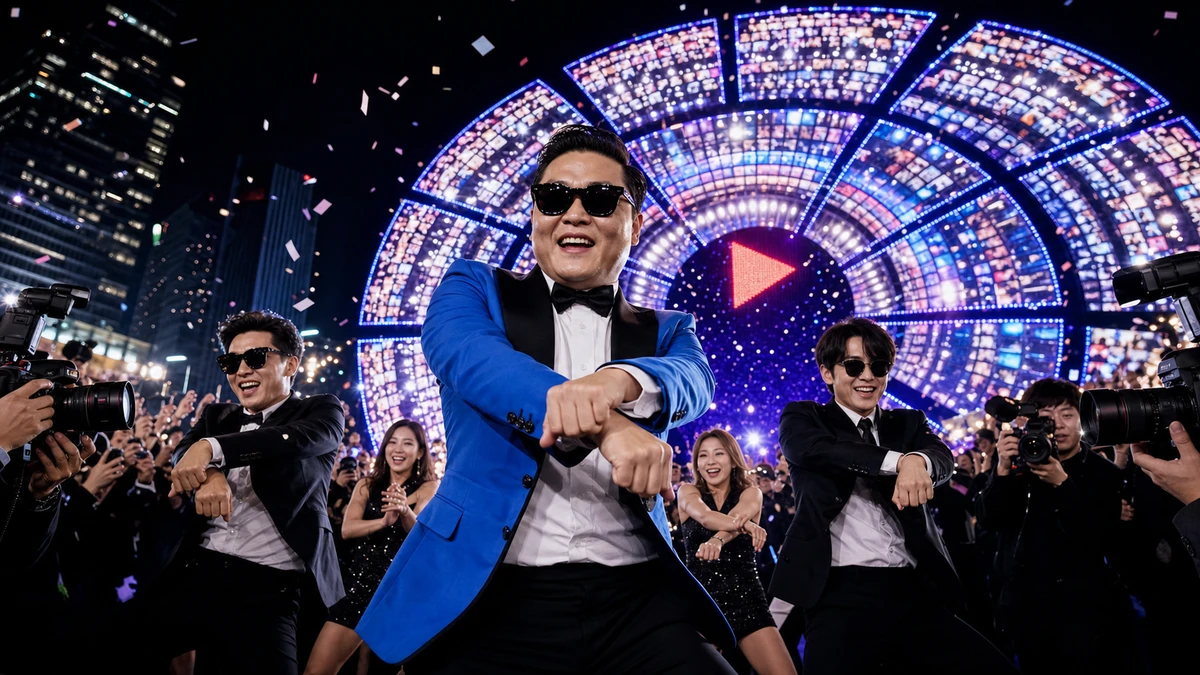
At the center of that appeal is the famous “horse-riding” dance, known widely in Korea and abroad as the “horse dance.” It is one of the most recognizable bits of choreography in modern pop culture — simple enough for children, grandparents, athletes and politicians to imitate, but specific enough that nearly anyone can identify it in silhouette. That matters because memorable dance moves often become a form of social participation. You do not just watch the video; you try it, reenact it, joke about it and share it.
That dynamic helped turn “Gangnam Style” from a song into a communal performance. In the United States, it became the kind of phenomenon that showed up at weddings, pep rallies, baseball dugouts, morning news shows and holiday parties. It fit the same broad cultural space once occupied by dances like the “Macarena” or “YMCA” — participatory pop artifacts that work because the choreography is part of the hook. But unlike those earlier examples, “Gangnam Style” was born and spread in the social media era, where a dance challenge could move across continents in hours instead of months.
The video’s humor was just as important. PSY, whose real name is Park Jae-sang, built the clip around self-aware comedy rather than the glamorous mystique that dominates much of global pop. The settings are flashy and absurd. The expressions are broad. The joke lands visually even before the cultural satire behind the song is fully understood.
That satire is tied to Seoul’s Gangnam district, one of South Korea’s wealthiest and most status-conscious neighborhoods. Americans often recognize the name “Gangnam” because of the song, but not always the social meaning behind it. In Korea, Gangnam evokes money, image, aspiration and a particular brand of polished urban affluence — think of a blend of Beverly Hills, Manhattan luxury branding and Silicon Valley-era status signaling. “Gangnam Style” playfully skewered that world, turning social commentary into a pop spectacle. Yet even viewers who missed that layer could still latch onto the clip’s energy, exaggeration and comic absurdity.
That double function — local satire at home, universal humor abroad — is one reason the video has remained accessible to new audiences long after the original news cycle faded. It is rooted in Korean society but not trapped by it.
The moment America realized K-pop could not be ignored
When “Gangnam Style” exploded in 2012, it did more than generate memes. It broke into the American music industry’s formal markers of success. The song spent seven consecutive weeks at No. 2 on the Billboard Hot 100, held back from the top spot but still achieving something that seemed improbable at the time for a Korean-language track by a Korean artist. That chart run helped prove that online virality could translate into mainstream market power.
For the U.S. music business, this was a wake-up call. Up to that point, there had been international crossover hits, of course, but they typically came through more familiar channels: English-language recordings, heavy label infrastructure in the United States, or gradual inroads into radio. “Gangnam Style” took another route. Its music video itself became the delivery system. The song did not wait for American gatekeepers to introduce it. Viewers found it, shared it and made it unavoidable.
That is a central reason the song still occupies such an important place in K-pop history. Before BTS sold out stadiums and topped the Billboard 200, before Blackpink became Coachella headliners and luxury brand ambassadors, “Gangnam Style” demonstrated that Korean pop culture could command attention at scale in the West. It did not fully resemble the polished idol-group model that later came to define K-pop for many U.S. consumers, but it widened the entry point.
It also changed expectations inside Korea. The country’s entertainment industry had already spent years expanding across Asia through what is often called the “Korean Wave,” or “Hallyu” — the global spread of South Korean culture through television dramas, film, beauty, fashion and music. But “Gangnam Style” gave that wave a different delivery mechanism. Instead of relying primarily on regional TV distribution or diaspora audiences, it used a global video platform to reach viewers directly, all at once, with the same original content.
That mattered because it suggested that translation was not always the main obstacle. Sometimes performance, image and format could do the work of crossing borders. “Gangnam Style” was not a carefully localized version of Korean culture for foreign consumption. It was unapologetically Korean in language and sensibility, yet still globally legible. For American audiences, that was a subtle but important shift. It invited them to come toward the content rather than asking the content to fully come toward them.
YouTube changed the rules, and PSY arrived at the right moment
PSY himself has reflected in recent years on how YouTube transformed the way Korean culture traveled. His argument, in essence, is hard to dispute now: the platform changed the map for Hallyu, and “Gangnam Style” was among the first major examples of Korean entertainment using that map perfectly.
Timing was everything. In 2012, YouTube had already become a major venue for music discovery, but it still felt more open and less saturated than it does today. A truly unusual video could leap from one corner of the internet to the center of global conversation. “Gangnam Style” took advantage of that moment with almost ideal precision. It offered a clean, instantly shareable package: a catchy beat, a bizarre visual world, a dance anyone could parody and a charismatic performer willing to look ridiculous in public.
Just as important, viewers in different countries were all watching the same original clip. There was no need for separate versions tailored to local markets. A teenager in Seoul, a college student in Ohio and a family in Brazil could all watch the exact same video and participate in the same phenomenon. That may sound ordinary now, but it represented a major shift in how music circulated globally.
YouTube also gave the song a second and third life. Unlike radio spins or one-time television appearances, a YouTube view count keeps accumulating as new generations encounter a video. It captures not just the initial blast of attention but the long tail of rediscovery. That is what makes the journey from 5 billion to 6 billion views especially revealing. It shows how digital culture preserves certain works not simply as archives, but as still-active objects of attention.
In practical terms, “Gangnam Style” remains easy to teach, reference and revisit. Teachers discussing globalization can use it. Parents can show it to children who were not born when it came out. New K-pop fans can treat it as origin-story viewing. And because the video is comedic rather than solemn, it does not require much context to be enjoyable on first contact.
That repeatability is a key part of why the song has outlived the typical viral cycle. Plenty of videos go viral. Very few remain culturally functional more than a decade later.
More than nostalgia: Why ‘Gangnam Style’ keeps finding new audiences
One tempting explanation for the 6 billion milestone is simple nostalgia. Surely, the argument goes, people who lived through 2012 occasionally replay the song because it reminds them of a specific internet era. That is certainly part of the picture. But nostalgia alone does not account for another billion views after the clip had already crossed 5 billion.
What seems more likely is that “Gangnam Style” operates on multiple timelines at once. For those who remember its original ascent, the video is a memory trigger — a reminder of when viral culture still felt oddly communal, before feeds became more fragmented and personalized. For younger viewers, it serves as a historical gateway into K-pop’s global story. They may discover it after hearing about BTS, NewJeans, Blackpink, Seventeen or Stray Kids, then work backward to the song that many in the United States still see as the first major rupture in the language barrier around Korean pop.
There is also the matter of sheer design. The clip is visually legible in seconds. You do not need subtitles to understand its exaggerated mood. You do not need familiarity with Korean society to recognize that it is making fun of performance, vanity and bravado. And unlike some internet-era hits whose references feel trapped in their moment, “Gangnam Style” remains broad enough to survive changes in platform culture.
That continuing discoverability reflects something larger about K-pop today. The genre is often discussed in terms of speed — fast-rising groups, fast-moving fandoms, rapid-fire comebacks and instantly shifting online discourse. But the 6 billion-view mark suggests another truth: K-pop now has a deeper time horizon. New songs can explode overnight while older signature works continue drawing meaningful attention years later. The ecosystem has grown large enough to support both churn and canon.
In that sense, “Gangnam Style” occupies a role similar to certain landmark American pop videos that outlast their release era and become permanent references. Think of Michael Jackson’s “Thriller” not just as a song, but as a visual event that changed expectations for what a music video could do. “Gangnam Style” is not identical in scale or artistic ambition, but it belongs to that category of defining audiovisual pop works whose influence exceeds the track itself.
PSY’s singular place in K-pop history
It would be a mistake to attribute all of this solely to platform mechanics. YouTube created the conditions, but PSY supplied the spark. Not every video uploaded in 2012 became a cross-generational global artifact. What made “Gangnam Style” difficult to replace was its singularity.
PSY did not fit the conventional mold of a pop idol marketed through sleek perfection. His persona leaned into excess, comedy and anti-cool confidence. That made him legible to audiences who might have felt intimidated or excluded by a more polished pop presentation. He was in on the joke, but he was also the engine of it.
The music video and the song are so tightly fused that it is difficult to separate one from the other. Try to remember the track without picturing the horse dance, the elevator scene or PSY’s facial expressions. Try to recall the video without hearing the chorus in your head. That synthesis is part of why the work remains memorable. The clip is not just promotional packaging for the music; it is the full identity of the song.
That distinction matters in K-pop, where visual performance has long been essential rather than secondary. Choreography, styling and concept are not add-ons. They are core components of how songs are built, marketed and experienced. “Gangnam Style” made that logic visible to audiences outside Asia on an enormous scale. It taught millions of people, many without realizing it, that in K-pop the visual and the musical are often inseparable.
PSY’s agency, P NATION, has described the 6 billion-view milestone as a symbolic record in K-pop history and evidence of content that continues to be loved across borders and generations. That framing is not mere hype. The timeline supports it. Fourteen years after release, and long after the first billion-view shock wore off, the clip continues to gain viewers at a scale most artists would envy even for new material.
That durability also helps explain why PSY remains such a fascinating figure in Korea’s pop history. He is both central and unusual: a star who opened a global door for K-pop without necessarily resembling the export model that later dominated the market. His success was disruptive, comic and in some ways unrepeatable. But that does not make it less important. If anything, it makes the achievement stand out more sharply.
What 6 billion views says about K-pop now
The newest milestone arrives at a time when K-pop is no longer an exotic curiosity in the United States. Korean acts routinely chart on Billboard, tour major U.S. cities, collaborate with Western artists and appear on American TV. Streaming audiences are more comfortable with multilingual playlists than they were in 2012, and younger listeners are often less concerned than previous generations about whether a song is in English.
That broader change makes the “Gangnam Style” story easier to appreciate in full. The song did not build today’s K-pop industry by itself, and it certainly did not predict every direction the genre would take. But it proved something essential at a formative moment: a Korean cultural product could reach the center of global popular culture without losing the traits that made it specifically Korean.
Its 6 billion views also send a message to an entertainment industry obsessed with novelty. Longevity matters. Distinctiveness matters. So does the ability to create a piece of culture that people can understand, imitate and pass along even when they do not share a language. “Gangnam Style” succeeded not because it erased difference, but because it transformed difference into invitation.
For American audiences, that may be the song’s most lasting lesson. The globalization of pop has not meant flattening culture into sameness. At its best, it means people are willing to meet music where it is — to dance first, ask questions later, and discover that humor, rhythm and performance can travel farther than translation alone.
Fourteen years on, the horse dance is no longer just a meme from the early smartphone era. It is part of the architecture of 21st-century pop culture. And with 6 billion views, “Gangnam Style” has once again reminded the world that what once looked like a fleeting joke was, in fact, the beginning of something much bigger.
Comments
Post a Comment