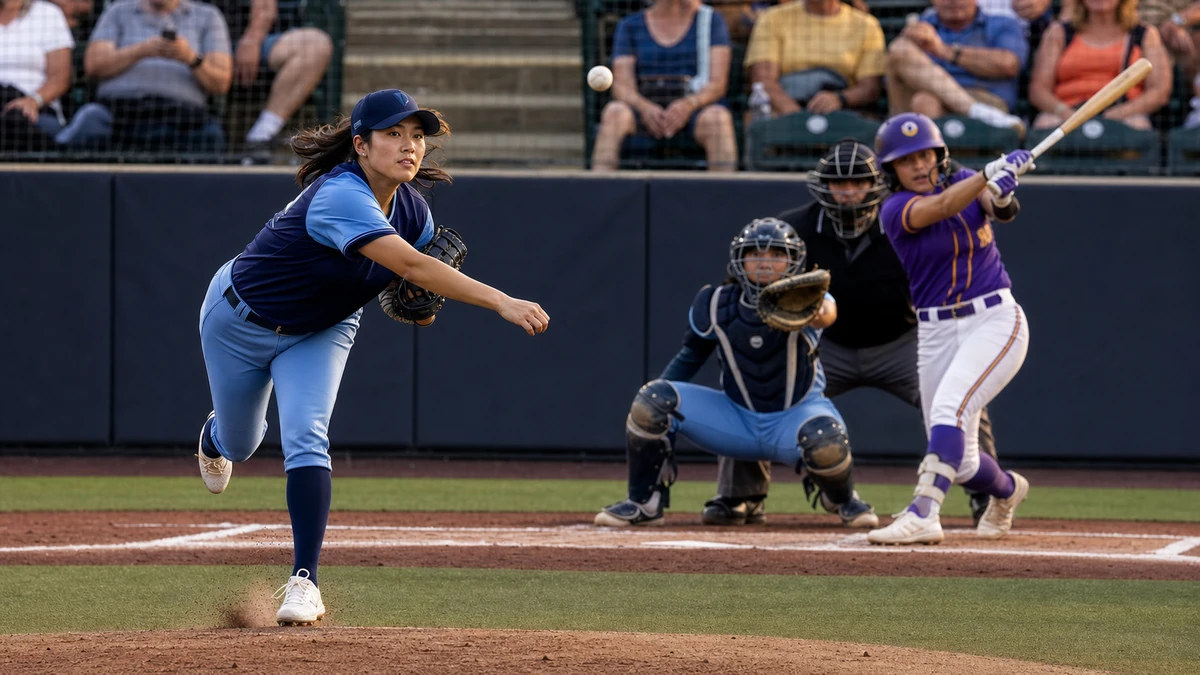
A long-dormant league returns, and a Korean ace steps into the first spotlight
When Kim Ra-kyung took the mound in Illinois for the opening game of the 2026 American Women’s Professional Baseball League, she was not simply making another overseas appearance. She was walking into a piece of sports history.
The right-hander from South Korea started for the New York Heights against the Los Angeles Queens at Robin Roberts Stadium, helping usher in the first U.S. women’s professional baseball league season in 72 years. In a sport that often treats its firsts with near-sacred importance — first pitch, first hit, first home run, first strikeout — Kim claimed one of the most memorable: the league’s first strikeout of the modern era.
That one out, recorded early in a four-inning outing, will now live in the official history of a league trying to reconnect with a chapter many American sports fans know only vaguely, if at all. Kim finished with four strikeouts, allowed two hits and four walks, and was charged with four runs over four innings. It was not a flawless debut. But in baseball, and especially on an opening day built as much on symbolism as on standings, the moment mattered beyond the box score.
For American readers, the closest comparison may be the emotional pull that comes when an old franchise returns to a city, or when a once-defunct league gets a second life and immediately produces a headline nobody could have scripted better. Here, that headline belonged to a Korean pitcher representing a women’s baseball movement that has developed largely outside the mainstream spotlight.
Kim’s team ultimately lost 10-8 after surrendering a late lead in the seventh and final inning. Her potential opening-day win disappeared with it. But the image that remains is not the blown lead. It is Kim, on the mound, becoming part of the first scene in a revived American league that is trying to prove women’s baseball is not a historical curiosity, but a living, competitive sport with global reach.
Why 72 years matters in American sports history
The phrase “72 years later” carries real weight in the United States, where baseball mythology is built on continuity, nostalgia and record books. The women’s professional game in America is most widely remembered through the All-American Girls Professional Baseball League, the circuit immortalized by the 1992 movie “A League of Their Own.” For many Americans, that film is the primary cultural reference point for women playing professional baseball in the U.S.
That memory, however, has often stayed frozen in black-and-white photographs, wartime anecdotes and Hollywood storytelling. Softball, rather than baseball, became the more familiar pathway for female athletes in the U.S. over the second half of the 20th century. Girls grew up with Little League softball, college softball and, more recently, the Women’s College World Series on national television. Baseball remained far less accessible to girls and women at the organized professional level.
That is what makes the new league’s launch significant. It is not just another sports startup. It is an attempt to reopen a lane that had effectively been closed for generations. Every opening-day milestone therefore carries extra meaning, because the league is not only starting a season; it is trying to restart a tradition.
In that setting, Kim’s first strikeout becomes more than a stat. It becomes a marker of who is helping define this new era. The answer, at least on day one, was not an American-born veteran or a player attached to a familiar U.S. baseball pipeline. It was a Korean pitcher whose presence underscored how international women’s baseball has become, even if the sport still fights for visibility country by country.
That international angle matters for American audiences. In men’s baseball, fans are accustomed to global rosters. Major League Baseball clubhouses include players from Japan, South Korea, the Dominican Republic, Venezuela, Cuba and beyond. Women’s baseball has not had the same media exposure, but its growth is also international. Kim’s role in the opener was a reminder that the sport’s future may be built not just in American suburbs and school programs, but through cross-border talent and shared investment.
Who is Kim Ra-kyung, and why her start resonated in South Korea
In South Korea, Kim is known as one of the leading figures in women’s baseball, a sport that exists in a much smaller ecosystem than the country’s hugely popular men’s professional game. To understand why her outing drew attention, it helps to understand the place baseball holds in South Korean life. The sport is woven deeply into the country’s culture, from packed Korea Baseball Organization stadiums and rhythmic cheering sections to the outsized celebrity of star players.
But women’s baseball in South Korea has not enjoyed the same institutional support, commercial muscle or public recognition. As in the United States, girls and women have often had fewer formal pathways in baseball itself, even in a country where the men’s game can dominate summer conversation. Players who rise to the top of that system are often doing so with fewer resources, less coverage and less certainty about professional opportunity.
That helps explain why Kim’s opening-day assignment carried meaning beyond her own career. She was not simply a foreign player getting a chance abroad. She was, in many ways, representing a corner of Korean baseball that rarely gets this kind of international stage. Korean coverage described her as an ace of the women’s game, language that signals both status and responsibility. In baseball parlance, an ace is the staff leader, the pitcher expected to set the tone and handle the pressure games.
She did just that in one important sense: She took the ball for a historic opener and lasted the four innings required in this seven-inning format to qualify for a win. Under league rules, that meant if New York had held its lead, Kim could have been credited as the winning pitcher in the first game of the revived league. That possibility survived deep into the contest. When she left the game, the Heights were still in position to turn her outing into a win, and they remained ahead 8-6 through six innings.
For Korean readers, the story is partly about national sporting pride — a familiar narrative in a country highly attuned to its athletes’ success overseas. American readers will recognize the dynamic. It is the same instinct that turns an expatriate athlete into a symbol of the homeland’s growing reach. But there is a twist here: Kim was not joining a fully established powerhouse from abroad and simply adding a Korean footnote. She was helping write the first page of a new American chapter.
What happened on the field: strong strikeout stuff, uneven command, and a lead that vanished late
On the field, Kim’s performance told a more complicated story than the headline milestone alone suggests. She allowed only two hits in four innings, a sign that Los Angeles was not consistently squaring her up. She also struck out four batters, showing an ability to generate outs without relying on the defense behind her. In any league, that is one of the clearest indicators of a pitcher with swing-and-miss potential.
At the same time, the four walks point to an issue that baseball people on either side of the Pacific would recognize immediately: command. Strikeouts can erase trouble, but free passes often create it. Kim’s line — four innings, two hits, four walks, four strikeouts, four runs — is the kind that invites two very different readings. The optimistic version says her stuff was good enough to limit hard contact and miss bats. The cautionary version says her control put extra traffic on the bases and made each mistake more expensive.
Both interpretations can be true at once, especially in an opening game loaded with nerves, ceremony and the pressure of representing both team and league. Opening day often produces strange baseball. Pitchers can overthrow. Defenders can rush routine plays. Managers can make shorter leashes and sharper decisions. In a new league, where everything from game rhythm to travel routine is still being learned in real time, that volatility can be even greater.
Kim nevertheless did the essential job of a starter: she got her team into the middle innings with a chance to win. In a seven-inning game, four innings is not a token appearance. It is substantial work, enough to establish pace, absorb early pressure and line up a bullpen to finish the game. By that standard, her outing was meaningful and, for stretches, effective.
The game’s final turn illustrated one of baseball’s cruelest truths. A starting pitcher can do enough to qualify for a win, leave with the lead, and still watch the result dissolve after she is done. That is what happened here. New York led by two entering the final inning, only to allow four runs and lose 10-8. For Kim, the official win disappeared. For the league, the drama may have been an accidental gift: the opener delivered history, tension and a late reversal all at once.
Why this matters beyond one game
It would be easy, especially in a crowded sports landscape, to file this away as an opening-day novelty. A pitcher from South Korea got the first strikeout in a revived women’s baseball league. Interesting, then on to the next item. But that would miss the larger significance.
Women’s baseball has long lived in the shadow of both men’s baseball and women’s softball. In the United States, the infrastructure for girls who want to play baseball rather than softball has often been thin. In many places, talented players have had to move between the two sports, explain their choice repeatedly, or build opportunities through national teams and independent programs rather than the kind of developmental ladder male players can take for granted.
That is why moments like this carry outsized importance. They do not solve structural problems. They do, however, create visibility, legitimacy and narrative momentum. A revived professional league gives players something tangible to aim for. A historic opening day gives media outlets a reason to pay attention. And an international player like Kim becoming one of the event’s defining figures sends a message that the league’s ambitions are broader than nostalgia alone.
For American sports fans, there is also a familiar lesson in how leagues grow. Women’s sports in the U.S. have repeatedly shown that visibility is not just a byproduct of success; it is part of how success gets built. The WNBA, the National Women’s Soccer League and women’s college basketball all reached new audiences through a combination of talent, storytelling and persistence. None became culturally relevant overnight. Each benefited from moments that helped casual viewers understand why they should care.
Kim’s first strikeout is one of those moments for women’s baseball. It offers an easy headline, but also a deeper narrative: a Korean athlete, in a revived American league, claiming a permanent place in the history books on opening day. That is the kind of story that can travel, particularly in an era when sports fandom is increasingly global and audiences are more comfortable following athletes across borders.
The Korean Wave, women’s sports, and the globalizing of niche audiences
There is another reason this story lands differently in 2026 than it might have a decade or two ago: the audience for Korean stories in America is larger, more curious and more culturally fluent than before. The Korean Wave — often referred to by the Korean term “Hallyu” — has changed how many Americans encounter South Korea. What began for many as an interest in K-pop, Korean dramas, Korean film or Korean food has widened into a broader familiarity with Korean culture and public life.
That does not mean the average American reader knows the contours of Korean women’s baseball. Most do not. But it does mean there is a more established appetite for stories in which Korean figures are not treated as distant novelties, but as participants in global culture on equal footing. A Korean pitcher making history in an American league fits naturally into that broader pattern.
Still, there is an important distinction to make. This is not a K-pop celebrity crossover or an entertainment-driven Hallyu story. It is a sports story shaped by many of the same forces that have elevated women’s athletics elsewhere: the search for opportunity, the push for institutional backing and the importance of transnational visibility. Kim’s appearance says as much about the growth of women’s baseball networks as it does about her own resume.
In that sense, the story also reflects a shift in how American audiences consume global sports. Once upon a time, foreign athletes became legible here primarily after entering a major U.S. men’s league. Now, audiences encounter them across a much wider field — from Olympic competition to women’s soccer, from mixed martial arts to international baseball and basketball. The question is no longer whether fans can follow an athlete from another country. It is whether media organizations and leagues can tell those stories well enough to sustain attention.
Kim’s outing offers a strong starting point because it combines a clean narrative with real stakes. There was history in the record book, tension in the game and a broader conversation about who gets to be visible in baseball. For editors and broadcasters looking to explain why women’s baseball deserves space, this is exactly the kind of story that resonates.
What comes next for Kim and for the league
The temptation after a debut like this is to freeze the player inside the symbolism. Kim made history, therefore the history is the story. But if the league is to matter, and if Kim is to matter within it beyond one headline, the focus will have to shift from symbolism to performance. Can she continue missing bats? Can she trim the walks? Can she turn a promising but uneven opener into consistent production over multiple starts?
Those baseball questions are the ones that ultimately give a league credibility. Fans can be drawn by novelty, but they stay for competition, rivalries and recognizable excellence. Kim’s first outing offered both strengths and warning signs. Limiting opponents to two hits suggests her arsenal can play. Recording four strikeouts suggests she has the kind of stuff that can stand out. The four walks suggest there is room, and need, for adjustment.
For the league, the challenge is broader. Opening day is the easiest day to command attention; the harder task is keeping it. That requires stable operations, quality play, effective promotion and enough local buy-in for teams to become part of their communities rather than one-time curiosities. It also requires telling the stories of players like Kim in a way that makes their careers intelligible to new fans.
There is reason to think those stories can connect. Americans understand comeback narratives. They understand underdog leagues, pioneers and athletes carrying the hopes of communities larger than themselves. They understand the appeal of baseball as a stage for firsts that echo for decades. Kim Ra-kyung now occupies one of those firsts.
Her team lost, and the record will show that plainly. It will also show something else: when women’s professional baseball in the United States began again after 72 years, the first strikeout belonged to a Korean pitcher. In sports, victories can vanish in the final inning. Firsts tend to last much longer.
Comments
Post a Comment