A Korean Study Suggests One More Family Meal a Week May Be Linked to Better Teen Mental Health. The Finding Resonates Far Beyond South Korea.
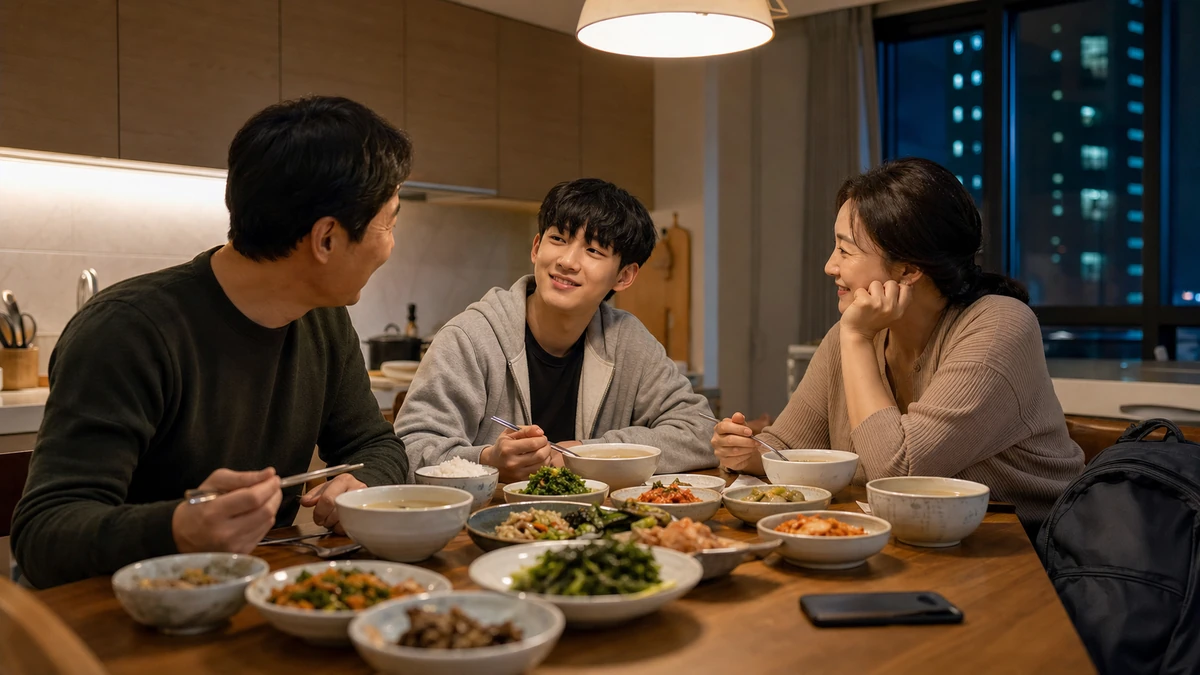
Image to help understand the article
A small ritual with big implications
In South Korea, where teenagers often spend long days moving between school, private tutoring academies and late-night studying, one ordinary family routine is getting fresh attention: sitting down to eat with parents. A new analysis released by the Korea Disease Control and Prevention Agency, drawing on youth panel data collected from 2019 through 2023, found that adolescents who shared meals with their parents more often in early adolescence later reported lower levels of severe stress, depressive feelings and anxiety in later adolescence.
The headline number is straightforward and striking. For each additional shared meal with parents per week, severe stress was lower by 12%, depressive feelings by 9% and high anxiety by 8%, according to the statistical association found in the study. Researchers also found that about one in eight Korean teenagers ate with their parents fewer than four times a week.
Those figures do not mean family dinner is a form of therapy, or that adding a meal automatically reduces mental distress by a fixed amount for every child. The study does not claim that. What it does suggest is that a recurring, measurable feature of daily life, how often parents and teenagers sit at the same table, may be meaningfully connected to emotional well-being over time.
That matters because much of the public conversation around adolescent mental health, in South Korea and in the United States, tends to focus on crisis response: counseling, medication, school intervention, emergency care, screen time panic or social media blame. Those issues are real. But this Korean research points attention to something less dramatic and more mundane: the structure of everyday life. It asks whether regular contact, even in the form of a simple meal, can act as a protective factor during a period of life that is often emotionally volatile.
For American readers, the idea is familiar even if the setting is not. In the United States, family dinner has long been treated as a kind of civic virtue, celebrated in parenting books, public health campaigns and nostalgic television images from Norman Rockwell to network sitcoms. Yet for many families, it has also become harder to sustain amid shift work, long commutes, after-school activities, divorce, gig-economy schedules and the general fragmentation of modern life. That is what makes the Korean findings feel less foreign than they may initially sound. The cultural details differ, but the underlying question is deeply shared: How much does ordinary family time matter for adolescents who are under pressure?
Why this Korean study stands out
Part of the importance of the Korean research lies in its design. Rather than taking a snapshot of teens at a single moment, the study used panel data, meaning it followed the same group over time. That approach allows researchers to look at whether experiences in early adolescence are linked to outcomes later on, which is more informative than simply comparing one group of teens to another on a single day.
That distinction may sound technical, but it is crucial. A one-time survey can tell us that teens who eat with their parents more often also seem less stressed. A longitudinal study, even without proving cause and effect, is better suited to asking whether those family routines might have a lasting relationship to how young people fare emotionally as they grow older.
The Korean study also focused on the frequency of meals with parents, not on what was served. It was not a study about kimchi, rice, protein intake, ultra-processed food or any particular national cuisine. That makes the findings easier to relate to across borders. The point is not that Korean food is protective. The point is that repeated shared time may matter more than the menu.
In a country like South Korea, where meals have traditionally played a central role in family life, that may seem unsurprising. Korean culture places a strong emphasis on shared eating as a social act, not just a nutritional one. The Korean language itself reflects this. Asking someone whether they have eaten can function less as a literal question about food than as a check-in, a way of expressing care. Meals often serve as one of the most regular opportunities for intergenerational contact in a society that still places high value on family bonds, even as work and education pressures strain them.
At the same time, South Korea is also an intensely modern, fast-moving society where those traditions are under stress. Teenagers commonly spend evenings at hagwons, or private cram schools, after regular school hours. Parents often work long days. Birth rates are low, households are changing and social isolation has become a concern. In that context, the family meal is not merely a quaint custom. It is a measurable point of contact in lives that may otherwise run on parallel tracks.
The study’s findings therefore land at an intersection of tradition and modernity. They suggest that one old habit may still carry relevance in a high-pressure, digitally saturated society. That does not make it a cure. But it does make it worth watching.
What the numbers do and do not mean
The most responsible way to read the study is with both curiosity and restraint. The numbers are compelling, but they are not a license for overstatement. Correlation is not causation, and the Korean summary makes that clear. The research shows a statistical association between more frequent meals with parents and lower reported distress. It does not prove that one causes the other.
There are many possible reasons the relationship exists. Families who eat together more often may also have more stable schedules, less economic strain, stronger communication, lower household conflict or more predictable caregiving. Teenagers who are already struggling with anxiety or depression may also be less likely to join family meals. In other words, the meal could be part of a broader picture rather than the sole driver of better outcomes.
Still, that does not make the finding trivial. In public health, easily observed daily patterns often matter precisely because they can serve as signals. A teen who regularly shares meals with parents may be embedded in a routine where adults can notice changes in mood, sleep, appetite or behavior. A meal creates natural openings for conversation without the pressure of a formal mental health check-in. It allows parents to observe whether a child is withdrawn, irritable, exhausted or suddenly quiet. For teenagers, it may offer a dependable moment of contact in a week otherwise shaped by school performance and peer dynamics.
The Korean study also suggests a useful practical frame: one additional meal per week, not a fantasy of perfect family life. That matters because discussions of family dinner can quickly become moralizing. Many parents, in the United States as in Korea, do not have the luxury of a fixed evening schedule. Nurses, restaurant workers, warehouse employees, delivery drivers and single parents may be juggling schedules that make nightly sit-down dinners unrealistic. A finding framed around incremental change is more realistic and less judgmental.
That may be one reason the Korean study is resonating. It does not require expensive interventions or idealized domestic scenes. It points instead to a repeated behavior that families can potentially adapt to their own circumstances, breakfast instead of dinner, a weekend lunch instead of a weekday meal, a quick bowl of noodles or takeout rather than a home-cooked spread. The protective value, if there is one, may lie in the recurrence and the connection, not in the performance of family perfection.
What this means in the United States
For Americans, the Korean findings arrive at a moment when adolescent mental health remains a major concern and when policymakers, educators and parents are searching for responses that go beyond emergency intervention. The U.S. has its own body of research linking family meals to a range of outcomes, including healthier eating patterns, lower substance use and better emotional functioning. But the Korean study adds something useful to that conversation: an international data point from another advanced, high-pressure society where teenagers face intense academic and social expectations.
That cross-national perspective matters because the United States and South Korea are often discussed together in very different contexts, semiconductors, defense ties, electric vehicle supply chains, trade, K-pop and streaming entertainment. Yet they also share quieter social challenges: declining birth rates in some communities, concern over youth loneliness, intense parental anxiety about achievement and a growing debate over how much mental health can realistically be outsourced to schools and clinicians.
American audiences may also recognize a familiar tension in the Korean story. In the U.S., family dinner has been idealized for decades, but many households live far from that ideal. Economic inequality shapes family time as much as values do. A white-collar parent working from home may be able to make dinner regularly; a parent working two hourly jobs may not. If policymakers or commentators turn findings like these into lectures about personal responsibility, they miss the structural reality. Time is not distributed equally.
That is where the Korean study may be most useful to an American audience: not as a sentimental endorsement of old-fashioned dinner tables, but as evidence that ordinary shared time deserves a place in public conversations about youth mental health. Employers, schools and local governments often talk about supporting families in abstract terms. A study like this suggests that predictable time together may itself be part of the support system.
There is also a business and cultural dimension. American media companies, streaming services and consumer brands have spent years capitalizing on the Korean Wave, or Hallyu, through K-pop, Korean dramas, beauty products and food culture. But stories like this remind American audiences that South Korea is not only an exporter of pop culture. It is also a society wrestling with many of the same pressures Americans face, and sometimes generating research or policy insights worth paying attention to. That broadens the U.S. understanding of Korea beyond fandom and geopolitics.
For Korean American families, the story may land in yet another register. Shared meals have long been one of the most durable forms of family continuity in immigrant households, even when language, schedules and generations pull in different directions. The Korean data will not map neatly onto every American household, but it may validate something many families already suspect: that routine contact, especially around food, can be one of the few spaces where emotional life becomes visible.
Beyond Korea: a global trend hiding in plain sight
The broader significance of the Korean study is that it fits into a growing international awareness that mental health is shaped not only by clinical care but also by the architecture of daily life. Public health experts increasingly talk about social determinants of health, meaning the social and environmental conditions that affect well-being. Housing, income, transportation and education are part of that framework. So are relationships, routine and belonging.
Teenagers, in particular, live at the intersection of these forces. Adolescence is often when emotional disorders first emerge, but it is also when family routines start to fray. Young people seek independence. Academic pressure rises. Peer life becomes more central. Devices and online spaces compete for attention. Family meals, in that sense, are not important because they are magical. They may be important because they are one of the last recurring rituals many families still share.
That may help explain why the Korean study focused attention on frequency rather than on perfection. In a world of personalized screens and individualized schedules, repetition itself may carry meaning. A weekly or near-weekly moment of co-presence can create continuity. It can say, without saying it directly, that the family still has a common rhythm.
This is where the Korean findings become analytically interesting, not just emotionally appealing. They suggest that small units of social infrastructure, the habits built into private life, may deserve more attention from researchers and policymakers. Mental health is often framed either as a deeply personal issue or as a matter for professional systems. Shared meals sit somewhere in between. They are intimate, but they are also shaped by work hours, school design, commuting patterns and economic policy.
In both Korea and the United States, that raises an uncomfortable question: If family time is good for young people, why are so many societies organized in ways that make it harder to sustain? Long work hours, high educational competition and economic insecurity are not family-level problems alone. They are policy choices and market realities. A study like this does not answer those questions, but it sharpens them.
What parents, schools and policymakers should watch next
The next step is not to turn family meals into a simplistic metric of good parenting. That would be a mistake, and a particularly unfair one for families with the least flexibility. Instead, the more useful question is what else needs to be studied and what modest lessons can be applied now.
Researchers will likely want to know more about the mechanism behind the association. Is it conversation quality, emotional warmth, household stability, lower conflict, parental monitoring or some combination of those factors? Does breakfast count the same as dinner? Do meals with one parent offer similar benefits? Does the effect vary by age, gender or socioeconomic status? And perhaps most importantly, how do teenagers themselves describe these meals? A silent, tense dinner is not the same as a supportive one.
Schools and youth-serving institutions may also take note. Not because they should police family life, but because they often search for warning signs of distress after problems have escalated. If routine shared time at home matters, educators and counselors may need to think more broadly about what protective factors look like outside formal services. The point is not to ask students whether they had dinner with their parents and draw conclusions from a single answer. It is to understand that mental health may be tied to patterns of contact that are easy to overlook because they seem ordinary.
For policymakers, the implications are subtler but still real. Family-support measures, flexible work policies, predictable scheduling, after-school timing and community meal programs all shape whether households can realistically create shared time. In both South Korea and the United States, conversations about fertility, family strain and youth well-being often circle around large, expensive interventions. Sometimes the issue is simpler, though not easier: whether adults and children can regularly be in the same place at the same time without being rushed or exhausted.
For parents, the most practical takeaway may be the least glamorous one. If shared meals matter, then consistency may be more valuable than spectacle. The goal is not a picture-perfect dinner table or a nutritionally flawless menu. It is a repeatable opportunity to notice, to listen and to be noticed in return.
A modest finding worth taking seriously
The Korean study does not promise that one extra meal a week will solve the youth mental health crisis. It does not erase the need for therapy, school support, medication when appropriate or better public systems. And it does not justify judging families whose schedules, finances or relationships make shared meals difficult.
What it does offer is something more modest and, for that reason, more credible. It identifies a simple pattern in everyday life that appears to move in the same direction across several measures of distress. That pattern is not a cure, but it may be a clue.
In a media culture that often looks for breakthrough treatments, technological fixes or alarming villains, that can feel almost disappointingly ordinary. But ordinary may be the point. Much of adolescent life is built from repeated moments: rides to school, texts with friends, homework at the kitchen table, quiet resentment, routine laughter, fatigue, boredom and brief openings for connection. A shared meal is one of those moments. The Korean data suggest it may deserve more attention than it usually gets.
For American readers, the lesson is not that Korea has discovered a secret. It is that another country, facing its own version of modern pressure, has produced evidence reinforcing a deeply familiar idea: that time together counts. In the era of the Korean Wave, the most exportable insight from South Korea may not be a song, a skincare routine or a TV format. It may be a reminder that a regular place at the table can still matter, especially for teenagers whose inner lives are often harder to read than adults would like to believe.
Comments
Post a Comment