A season that looked stuck suddenly has a new storyline
For much of the summer, Daejeon Hana Citizen looked like the kind of team sports fans everywhere know well: talented on paper, ambitious in the preseason and maddeningly unable to turn that promise into results. Then, in the span of two matches, the mood changed.
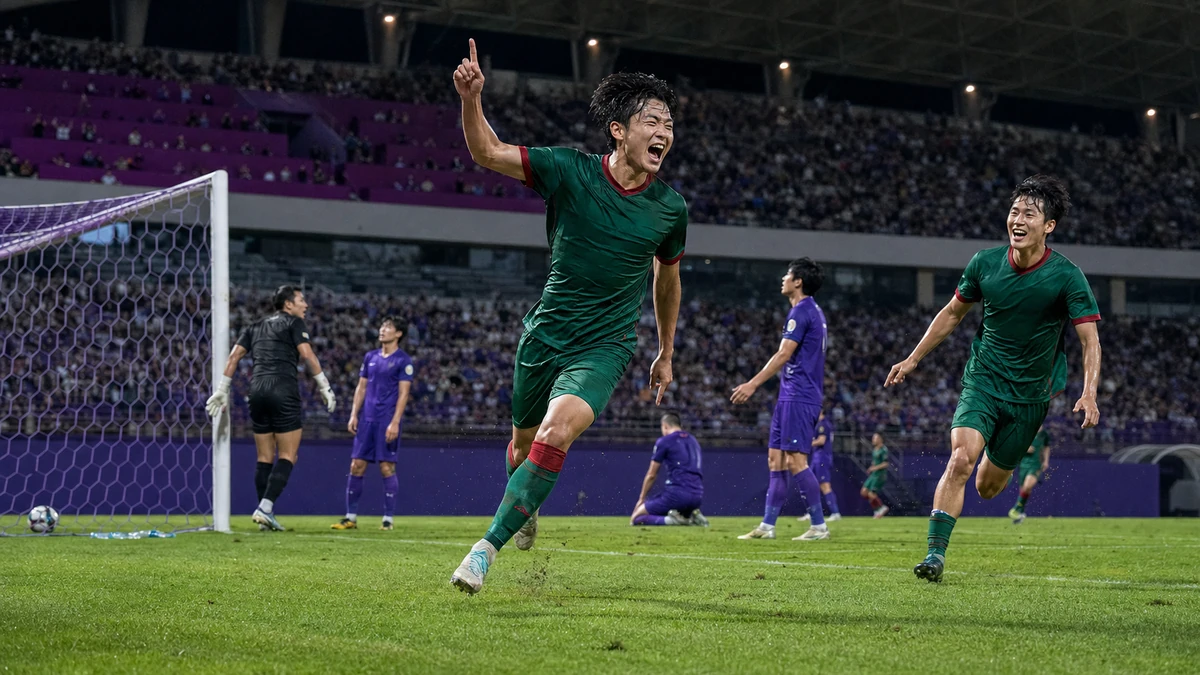
Daejeon beat FC Anyang 2-1 on the road Saturday in a K League 1 match, collecting back-to-back wins for the first time in roughly three months and offering its clearest sign yet that its season may not be drifting after all. The central figure was veteran striker Joo Min-kyu, who scored once and set up another goal, directly contributing to both of Daejeon’s scores in a performance that felt larger than a routine line on a stat sheet.
For American readers less familiar with South Korea’s top soccer competition, K League 1 is the country’s first division, the equivalent of Major League Soccer’s top tier in the United States, though with a much longer domestic history and a more traditional promotion-and-relegation structure underneath it. Clubs are closely tied to regional identity, and form swings can quickly take on an emotional intensity familiar to fans of European or Latin American soccer.
That helps explain why this result resonated beyond the simple fact of three points. Daejeon did not merely win again. It followed up a 2-0 victory over Gwangju FC — a game that snapped a 10-match winless run and delivered the club’s first home win of the season — with another victory away from home. In other words, the team did not just experience a one-night release. It showed the early signs of a real reset.
Before this recent turn, Daejeon had spent weeks buried in a frustrating cycle: enough talent to inspire belief, enough missed opportunities to create doubt. Saturday’s win in Anyang suggested that cycle may be breaking. And because it came with Joo’s long-awaited return to center stage, it gave the club something every struggling team craves at midseason: a believable reason to think better days are ahead.
Why Joo Min-kyu mattered so much in this one
Joo’s stat line — one goal, one assist — tells the basic story. It does not fully capture why his performance felt so important.
In soccer, and especially in leagues where margins are often thin, a center forward does more than finish chances. He becomes a pressure valve, a tone-setter and often the player who either confirms or calms a team’s collective nerves. Daejeon needed all of that from Joo against Anyang, and for one of the first times in weeks, it got it.
His goal ended a scoring drought of about a month. Just as important, his assist showed he was not operating as a striker isolated up front, waiting for service and hoping a game would tilt his way. He was involved in shaping the attack itself, connecting moves and helping turn possession into a final product. For a club that had spent too much of its season searching for decisive moments, that kind of all-around attacking influence was exactly what had been missing.
There is an American sports cliché that stars have to “show up when the team needs them most.” It may sound overused, but it applies here. Daejeon entered the match needing proof that its previous victory was not a fluke. Joo responded in the clearest way a striker can: by putting his signature on the game.
After the match, Joo said he was happy the team could repay fans with a victory and added that overcoming the recent crisis had made Daejeon stronger. In the Korean sports context, those comments carry a little more weight than they might in a standard postgame quote in the United States. Korean athletes often speak in terms of responsibility to supporters and collective resilience, emphasizing gratitude, group harmony and endurance rather than personal triumph alone.
That does not mean the emotions are less competitive. If anything, it means the stress of a prolonged slump can cut deeper. Joo acknowledged that players had felt burdened by the poor results, but he also said the locker room remained positive and that teammates never doubted one another. That detail may be one of the most revealing parts of Daejeon’s recent turnaround. Losing streaks do not only affect league tables; they test trust. When players begin second-guessing teammates or drifting from the manager’s ideas, a difficult stretch can become a season-defining collapse. Daejeon, at least by its own account and by recent evidence, avoided that spiral.
Joo also said the team believed it could get results if it could just push past one difficult moment, and that belief had grown stronger with consecutive victories. That sentiment matters because confidence in soccer is rarely abstract. A striker scoring again is not just a personal milestone. It changes how defenders react, how midfielders choose passes, how early a team presses and how long it believes a match can still be won.
For Daejeon, Joo’s return to form was not just a bright individual performance. It functioned as a kind of emotional permission slip for the rest of the squad to trust its own game again.
From preseason expectations to a 10-match drought
To understand why two straight wins have generated so much attention, it helps to understand where Daejeon was supposed to be by this point in the season.
Daejeon entered the year with the profile of a club many observers believed could challenge near the top. Instead, it struggled to stack points. As of the end of Round 22, the club stood at 6 wins, 8 draws and 8 losses for 26 points, good for ninth place. Its goal difference, plus-3, came from 27 goals scored and 24 allowed.
Those numbers are revealing. Ninth place is not where a would-be contender wants to be, but the goal difference suggests a team that was not getting blown off the field. This was not a total structural collapse. It was, in many respects, a season of under-conversion — decent enough performances without the finishing touch or game control needed to turn close matches into wins.
That is a familiar story across sports. In baseball terms, it is the team with a respectable run differential but a disappointing record in one-run games. In NFL terms, it is a roster that moves the ball but cannot close drives in the red zone. In soccer, the effect can feel even more psychological because a single goal changes everything: shape, urgency, crowd energy and decision-making.
Daejeon’s lowest point came in a 10-match winless streak that dragged on long enough to reshape how the season was being discussed. The longer a drought lasts, the harder each subsequent match becomes. Players start chasing the game emotionally. Chances feel heavier. Mistakes multiply because the fear of making them becomes its own problem.
Then came the 2-0 home win over Gwangju. On paper, it was simply the end of a bad run. In reality, it did more than that. It delivered Daejeon’s first home victory of the campaign after 21 matches, lifting a specific burden that had likely become impossible to ignore. Home struggles can weigh on a club in a different way because they unfold in front of the fans most invested in the team’s identity. Every missed opportunity is witnessed by the people who have waited the longest for relief.
That win over Gwangju did not guarantee anything. Teams often produce a one-game surge after a long drought, only to fall immediately back into old habits. What made the Anyang result different was the follow-up. Daejeon won away from home in its very next outing, turning release into momentum.
It was also the club’s second two-game winning streak of the season, and the first since back-to-back victories in early May. In a league season, that gap matters. It means Daejeon had gone about three months without proving it could sustain positive form over even a short stretch. Now, at last, it has done so again.
What this says about confidence, momentum and the manager’s message
After the match, Daejeon manager Hwang Sun-hong pointed to two concepts that can sound vague until a team actually starts winning: confidence and momentum.
“In the end, soccer is about confidence and momentum,” Hwang said, adding that his players should not feel intimidated and expressing hope they could carry the same belief into the next game.
American sports fans may hear that and think of a basketball coach insisting that the ball moves differently once shooters see a few early baskets fall, or a baseball manager saying the dugout energy changes when a club starts stringing together quality at-bats. In soccer, the equivalent can be even more dramatic because the sport offers fewer scoring moments. Confidence influences whether a fullback overlaps, whether a midfielder attempts a line-breaking pass and whether a striker attacks the near post with conviction rather than hesitation.
Hwang’s comments also stood out because they matched Joo’s assessment of the team’s internal state. The coach emphasized belief. The star forward emphasized that players had not turned on one another and had maintained faith in their level of play. When a manager’s public message aligns with what key players say privately and publicly, it is often a sign that a team’s recovery is built on more than a lucky bounce or a hot finishing night.
That does not mean Daejeon’s tactical questions have all been solved. It would be premature to claim that two wins have fixed every structural issue that contributed to the earlier slump. But soccer seasons are rarely rescued all at once. More often, they turn because a team regains the mental stability to let its underlying quality show. Daejeon increasingly looks like a club trying to make that transition.
There is also a cultural dimension worth explaining for readers outside Korea. Hwang is not just any manager; he is one of the more recognizable figures in South Korean soccer, both for his playing career and his work in coaching. In Korea, that kind of pedigree can shape how a team’s struggles are discussed. Pressure does not fall only on players or front offices. It also gathers around the coach’s authority, reputation and ability to hold the group together through adversity.
So when Hwang talks about confidence after a road win, it is not empty locker-room rhetoric. It is a statement of team management as much as tactics — a signal that he believes the emotional tenor of the season is shifting, and that the players now have a platform from which to build rather than merely survive.
Why the K League context matters for international readers
For people who do not regularly follow Korean soccer, this kind of midtable rebound story might seem modest compared with the global attention commanded by the English Premier League or UEFA Champions League. But one of the strengths of the K League is precisely that these kinds of local swings still matter deeply. The league may not dominate American sports conversation, but it offers something increasingly valuable in world soccer: strong regional identity, genuine competitive tension and clubs whose fortunes are felt directly by their communities.
Daejeon, based in one of South Korea’s major cities, carries the expectations that come with a large and engaged fan base. The club’s ups and downs are not abstract. They are experienced in stadiums, on commuter trains, in neighborhood bars and across social media communities that track every tactical choice and every missed chance. That is true in many soccer cultures, of course, but South Korea’s fan culture often blends intense loyalty with a collective sensibility that may feel somewhat different from American pro sports atmospheres.
Supporters in Korea frequently talk about enduring difficult stretches together with the team, and players often speak directly to that emotional bond. Joo’s comment about being glad to repay fans with a win fits squarely within that tradition. In the United States, athletes certainly thank fans, too, but in Korean sports discourse the reciprocal relationship can be more explicitly stated, particularly after a painful slump.
There is also the matter of league parity and pressure. K League 1 is competitive enough that prolonged inconsistency can drag a supposed contender into the lower half of the table in a hurry. At the same time, a short run of form can dramatically alter the mood around a club. Daejeon’s current position still leaves plenty of work ahead, but the difference between a team in ninth place that looks broken and a team in ninth that has rediscovered its attacking spearhead is substantial.
For international readers, that makes Daejeon’s story an accessible entry point into Korean soccer. It contains all the familiar elements: preseason expectations, a star striker’s drought, a long winless run, a coach preaching belief and a fan base desperate for evidence that the season can still be salvaged. But it also reflects distinctly Korean patterns of communication around hardship, unity and the obligation to answer supporters with results.
The next test could reveal whether this is a blip or a real climb
If Daejeon’s win over Anyang offered encouragement, the next stretch will determine whether the club is truly on the rise or simply enjoying a brief release from pressure. That is how turning points in soccer work. They are rarely obvious in the moment. A result that later looks historic can initially feel ordinary; a supposed breakthrough can vanish if not reinforced quickly.
Daejeon’s upcoming challenge is a significant one. Its next opponent, FC Seoul, sits atop the K League 1 standings with 44 points. That kind of matchup provides a clean measurement of how far Daejeon has come. It is one thing to beat Gwangju and Anyang and restore calm. It is another to carry that belief into a meeting with the league leader and perform like a team that expects to compete rather than merely endure.
Hwang made clear that he wants his players to take the field with confidence against Seoul. That may sound simple, but it gets at the heart of the matter. During a winless streak, strong opponents can seem larger than they are. After consecutive wins, the same opponent can look like an opportunity rather than a threat.
This is where momentum becomes testable. If Joo continues to look sharp, if Daejeon’s attack remains connected and if the team can avoid the tentative play that often accompanies fragile form, then the club may begin to resemble the contender many expected before the season began. If not, it may still have gained something valuable from the last two matches: proof that it can at least climb back into the fight.
Either way, Saturday’s 2-1 victory mattered because it restored narrative control to a team that had lost it. For weeks, Daejeon was defined by what it could not do: win, finish, protect belief. Now it is being discussed for what it has started to do again.
In standings terms, the gap between Daejeon and first-place Seoul remains large. An 18-point deficit is not erased by a pair of wins or by one striker’s return to form. But sports stories are not always about the top of the table alone. Often, they are about the moment a team reclaims the right to imagine a better ending.
Daejeon has not completed its comeback. It may not even be fair yet to call this a comeback at all. But after three months without consecutive wins, after a 10-match stretch without a victory and after weeks of frustration that threatened to define the season, the club finally has something tangible: momentum, yes, but also credibility.
And in a sport where confidence can vanish as quickly as it appears, that may be the most valuable result of all.
Comments
Post a Comment