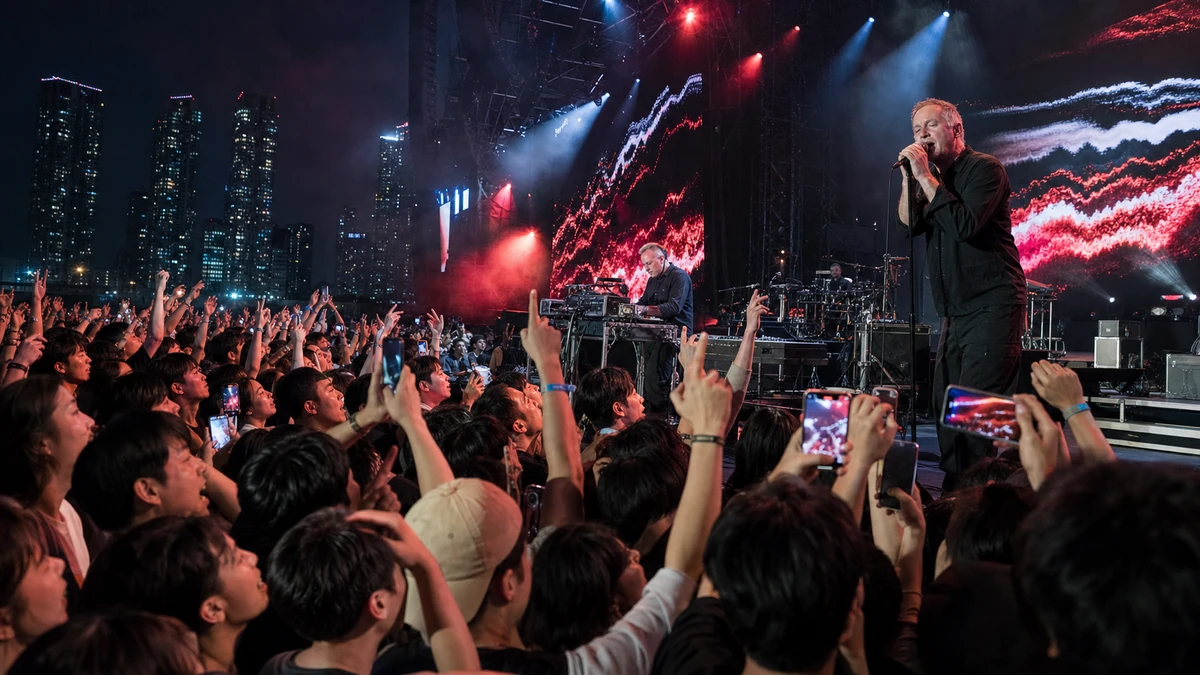
A British headliner delivers an unexpected Korean chorus
At many big summer music festivals, the script is familiar: international headliners arrive with a setlist built around their own classics, the crowd sings along to the hits, and the night ends in a blur of lights and nostalgia. That is not quite what happened Saturday night at the Incheon Pentaport Rock Festival, one of South Korea’s best-known outdoor music events. Instead, British group Massive Attack gave fans something far less predictable and, for many in attendance, more memorable. In the middle of a major headlining performance, the band sang parts of “Sidae Yugam,” a landmark Korean song by Seo Taiji and Boys, in Korean.
For an American audience, the equivalent would be a globally known overseas act taking the stage at Coachella or Lollapalooza and suddenly breaking into a culturally loaded American song — not just borrowing the melody, but carefully delivering the original English lyrics because of what they mean in their home context. The surprise in Incheon was not simply that a foreign artist performed a local song. It was that Massive Attack reached for a track with deep historical and political resonance in South Korea, then chose to preserve the Korean language rather than flatten it into a generic tribute.
According to South Korean reporting, the performance took place at Songdo Moonlight Festival Park in Incheon, west of Seoul, where Massive Attack appeared as a headliner on the festival’s second night. Fans filling the outdoor venue reportedly locked in as familiar Korean lines rang out across the grounds: “Why, we’ve waited for this,” followed by a darker refrain suggesting that the world seemed on the verge of collective madness. The words belonged to a song first released more than 30 years ago, but in that setting — in the voice of a British act known for politically charged music of its own — they landed with fresh force.
That choice transformed the performance from a novelty into something closer to a cultural exchange. It was not karaoke. It was not a wink to the crowd. It was a deliberate insertion of Korean social memory into a global festival set.
Why “Sidae Yugam” still matters in South Korea
To understand why the moment mattered, it helps to know what “Sidae Yugam” means in South Korean pop culture. Seo Taiji and Boys, the early-1990s act behind the song, occupies a place in Korean music history that is hard to overstate. If Americans need a frame of reference, think of a figure who helped break open the mainstream the way Nirvana shifted rock, Public Enemy sharpened political edge in hip-hop, and MTV-era pop remade youth culture — then imagine all of that compressed into one act’s effect on a fast-changing society. Seo Taiji and Boys is widely credited with helping reshape modern Korean popular music, laying groundwork for what would eventually become the global Korean Wave.
“Sidae Yugam,” often rendered in English as “Regret of the Times,” is especially remembered for its direct criticism of social absurdity and hypocrisy. In the 1990s, South Korea was still navigating the aftershocks of authoritarian rule, rapid modernization and a fiercely competitive social order. The song gave voice to frustration felt by many younger Koreans who saw institutions as rigid, moralizing and out of touch. Its lyrics were sharp, confrontational and emotionally raw.
The track also carries another layer of significance because of South Korea’s long and complicated relationship with censorship. The original became tied to debates over artistic freedom and who gets to decide what criticism is acceptable in popular culture. That history is part of why the song remains bigger than a nostalgic old hit. For many Koreans, it represents an era when pop music did not merely entertain; it challenged authority, irritated gatekeepers and articulated generational anger in a language young listeners instantly recognized.
That may help explain why the response at Pentaport was reportedly so intense. For older audience members who knew the song from its original moment, hearing it return in a large outdoor festival setting likely felt like a reopening of memory. For younger listeners, including those who may know Seo Taiji more as a foundational name than as a lived cultural experience, the performance offered a reminder that Korean pop history did not begin with today’s idol groups, TikTok choreography or Billboard chart runs. It includes songs that pushed against the culture from the inside.
More than a cover: A gesture of respect in the original language
Plenty of foreign artists perform local songs while touring abroad. Often, those gestures are charming but lightweight: a verse for crowd reaction, a phonetic singalong, a social-media-friendly moment designed to travel online. What made Massive Attack’s performance stand out, based on the Korean accounts, was that the group did not use the Korean chorus as a decorative flourish. They reportedly delivered the Korean lines carefully and in sequence, treating the language as integral to the song rather than incidental to it.
That distinction matters. In an age of globalization, local culture is often celebrated only after being made frictionless for international consumption. Lyrics get translated, cultural specifics get softened, and songs become export products divorced from the circumstances that gave them meaning. Massive Attack’s approach suggested something else: that a song’s power can survive, and perhaps even deepen, when its original language remains intact.
For American readers, there is a useful parallel in how audiences respond when artists preserve Spanish, Arabic or Indigenous languages in performances rather than converting everything into English. The act of leaving language untouched can signal that the culture itself is not being filtered for outside convenience. In Korea, where language is central to identity and where global attention on entertainment can sometimes reduce Korean culture to polished commercial imagery, hearing a major British act use Korean onstage carried symbolic weight.
It also fit Massive Attack’s own artistic identity. The group, formed in Bristol and long associated with moody, politically aware music, has never been just a playlist staple from the trip-hop era. Massive Attack’s catalog often circles war, surveillance, anxiety, inequality and dislocation. In that sense, “Sidae Yugam” was not an arbitrary local selection. It sits within a lineage of music that distrusts easy narratives and confronts broken systems. The bridge between the British group and the Korean song was not only sonic. It was ideological.
That may be why the performance appears to have resonated beyond simple appreciation for effort. Fans were not grading pronunciation like a language exam. They were responding to the visible attempt to honor the song’s meaning and emotional charge. In live music, sincerity is often easier to detect than technical perfection. By most accounts, that sincerity was the point.
Pentaport and the changing role of Korean festivals
The setting also matters. The Incheon Pentaport Rock Festival is not just another stop on a tour schedule. For years, it has been one of South Korea’s most recognizable large-scale rock festivals, a space where domestic acts and international names meet outside the more tightly managed world of K-pop television stages and arena spectacles. If K-pop often represents the highly organized, export-ready face of Korean popular music, Pentaport has long stood for something a little rougher, broader and more band-oriented — closer in spirit to the festival culture Americans would associate with major rock and alternative gatherings.
That made Massive Attack’s choice particularly potent. A headliner occupies a different symbolic space than an early afternoon act. Headliners help define what a festival night will be remembered for. When a top-billed international act chooses to perform a local song in the host country’s language, it changes the relationship between performer and audience. Rather than treating local fans as consumers of a prepackaged global product, it acknowledges them as participants in a shared cultural moment.
In practical terms, it narrowed the distance between stage and crowd. Thousands of people may come expecting to hear the songs they already know from the visiting act. But when that act instead turns outward and reflects the host country’s own musical memory back at the audience, the festival becomes less of an import event and more of a dialogue. In Korea, where international validation can sometimes be discussed in one direction — Korean artists breaking into Western markets, Korean culture being recognized abroad — this was a case of a Western act stepping into Korean history on Korean terms.
The location underscored the point. Songdo, a modern planned district in Incheon known internationally for its glass towers, ambitious urban design and proximity to South Korea’s main international airport, often symbolizes the country’s global-facing identity. To stage a performance there in which a British band resurrects a 1990s Korean protest song is to compress several eras of Korean self-understanding into one scene: democratization-era frustration, late-20th-century pop rebellion, and 21st-century global cultural confidence.
It also demonstrates how South Korean festivals increasingly serve as sites where music history — domestic and international — is actively negotiated, not just displayed. The result is different from a museum-like tribute. It is living memory, amplified through a foreign voice.
A song crossing generations, not just borders
One of the most striking elements of the Pentaport moment is how it connected generations as much as nations. In the Korean coverage, the song was described as one that once criticized the contradictions of Korean society in blunt terms. More than 30 years later, those same lines were heard again in a crowd that almost certainly included listeners born well after the song first made its impact.
That intergenerational handoff is significant in South Korea, where the pace of social and technological change has been extraordinarily fast. The Korea that produced Seo Taiji and Boys in the early 1990s is not the Korea of today’s streaming economy, global luxury branding and K-pop stadium dominance. Younger fans are often fluent in the newest trends but may experience older Korean music through recommendation algorithms, television nostalgia programs or family memory rather than direct experience. A performance like this can collapse that gap in real time.
For older fans, the song carries the texture of a specific historical mood: impatience with authority, anger at social conformity, and a sense that youth culture could say what official language would not. For younger listeners, especially those raised in an era when Korean culture is widely celebrated abroad, the song may register differently — as evidence that Korean pop has long contained dissent, complexity and critical intelligence, not only polished entertainment.
That matters because international coverage of South Korean music still tends to flatten the story. Too often, the narrative begins and ends with the “K-pop phenomenon,” as though Korea’s musical significance emerged suddenly in the 21st century through idol training systems and fan armies. But Korea’s contemporary soft power rests on deeper cultural foundations, including rock, hip-hop, ballads, indie music and politically meaningful pop from previous decades. “Sidae Yugam” belongs to that lineage.
By performing it in Korean, Massive Attack helped spotlight that continuity. The moment suggested that Korean music’s global life does not have to depend only on the newest charting songs or the most exportable styles. Older works can reenter public conversation when an artist from elsewhere recognizes their relevance. In that sense, Pentaport was not merely revisiting the past. It was reactivating it.
What the performance says about cultural exchange now
The larger significance of the night may lie in what it says about the changing relationship between global artists and Korean audiences. For years, the dominant model in international pop was relatively one-way: American and British acts traveled outward, and local fans adapted to them. Language barriers were accepted as part of the package. The prestige flowed largely from center to periphery.
That model has been weakening for some time, and South Korea is one reason why. As Korean film, television and music have become central to global pop culture, the country is no longer just an eager host for international acts. It is a cultural power in its own right, with its own canon, expectations and historical touchstones. Visiting artists increasingly perform in that context, not above it.
Massive Attack’s Pentaport set is a vivid example of that shift. The crowd came to see an acclaimed British group, but the group returned the favor by engaging directly with Korean cultural memory. The exchange was mutual. Instead of erasing the difference between artist and audience, the performance made that difference part of the meaning. A Korean song, sung by British musicians, in front of a Korean festival audience, became a meeting point rather than a contradiction.
There is also something notable in the choice not to overexplain. According to the Korean summary, the performance relied on the original Korean lyrics rather than adding new commentary or translating the song’s message into a different framework. That restraint may be part of why the moment worked. It trusted the song to carry its own history. It trusted the audience to understand what it meant — or, for those hearing it for the first time, to feel the energy before fully knowing the backstory.
In a media era saturated with instant context, that kind of trust is increasingly rare. But live music often operates best on exactly those terms: emotion first, explanation later. What fans remember from nights like this is not a footnote or a lecture. It is the sensation of recognition when something familiar arrives from an unexpected place.
For South Korean fans, that sensation was likely amplified by the knowledge that this was not a domestically staged nostalgia act, but a foreign headliner choosing to speak — literally — in the language of a Korean classic. For international observers, it is a reminder that globalization in music does not always mean homogenization. Sometimes it means the opposite: artists and audiences meeting more fully in one another’s particular histories.
An unforgettable festival image in the era of the Korean Wave
As the Korean Wave continues to evolve, moments like this may prove more revealing than headline-grabbing chart statistics. They show how influence actually circulates: not only through sales, streams and social media fandom, but through acts of listening, selection and respect. Korea’s cultural reach is often measured by how successfully Korean artists cross borders. The Pentaport performance points to another measure: how deeply non-Korean artists are willing to enter Korea’s own cultural vocabulary.
That does not mean every overseas musician needs to perform a Korean song to connect with Korean audiences. But it does suggest that the most meaningful cross-border performances are often the ones that acknowledge place rather than treating every city as interchangeable. In an industry built around repeatable tour stops, the Pentaport set appears to have created something site-specific and difficult to replicate elsewhere. A British group performing a Korean protest anthem in Korean at one of South Korea’s major festivals is not the sort of moment that can be copy-pasted into another market.
That uniqueness is part of why it is likely to endure in festival memory. Long after production details fade, people tend to remember the scenes that shift the emotional weather of an event: a surprise guest, an unplanned rainstorm, a song that suddenly belongs to everyone in the field. At Pentaport, that song was “Sidae Yugam.”
For Americans following Korean culture from afar, the story offers a useful corrective to simplistic views of the Korean Wave as a one-directional export machine. Korean culture is not only traveling outward; it is also being answered, interpreted and reflected back in ways that can deepen its significance at home. On one August night in Incheon, a song born from South Korea’s 1990s anxieties returned in the voice of British musicians before a modern festival crowd. It crossed not just a national boundary, but a generational one.
And in doing so, it showed how a local song can become newly alive without losing what made it local in the first place. That may be the most powerful kind of global performance there is.
Comments
Post a Comment