BTS’ Grammy boycott forces a bigger question: Can American music institutions still treat ‘Asian pop’ as a catchall?
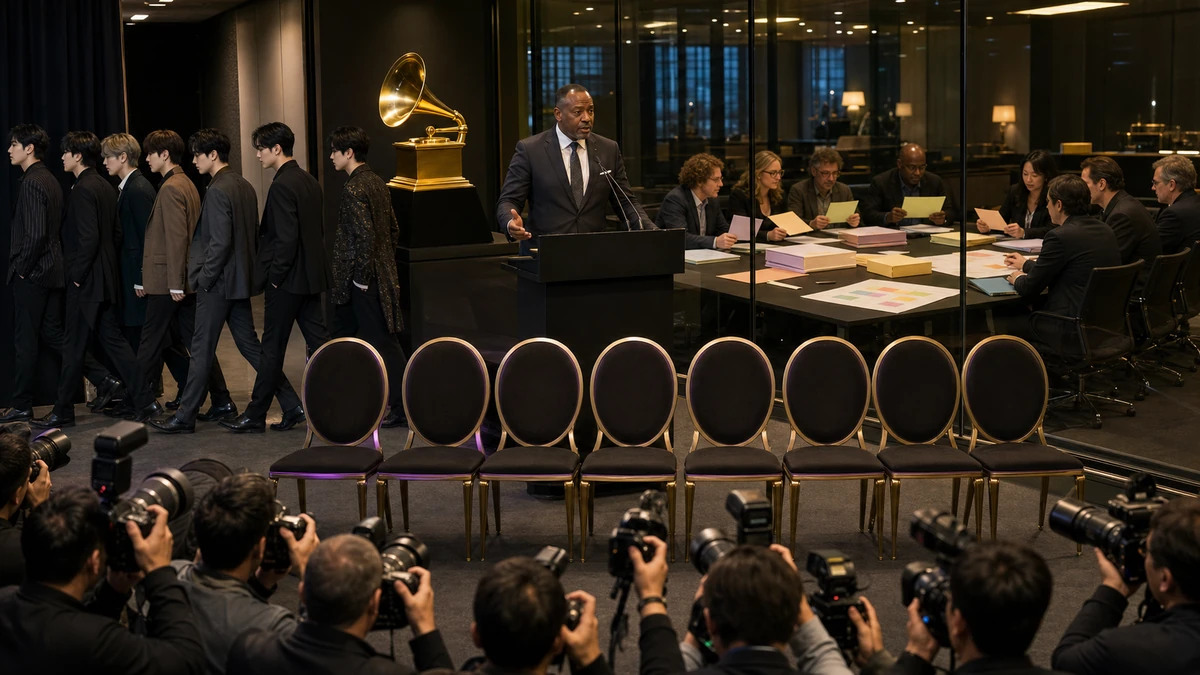
Image to help understand the article
A protest from the world’s biggest K-pop group is testing how the Grammys define global music
About two weeks after BTS said it would boycott the Grammy Awards over concerns surrounding the academy’s “Best Asian Pop Music Performance” category, the organization that runs the awards signaled it may revisit how that category works. Recording Academy CEO Harvey Mason Jr., according to Billboard, said it had become clear that some artists feel the category does not adequately represent the music they worked hard to create. He did not announce an immediate renaming, suspension or elimination of the prize. But for a body as tradition-bound as the Grammys, even acknowledging that the structure may be flawed is significant.
For American readers, the dispute may sound technical at first glance, like an inside-baseball argument over awards bureaucracy. It is not. At its core, the controversy is about who gets to name music, how institutions sort it, and whether categories intended to increase visibility can also flatten real artistic differences. When one of the most recognizable pop acts in the world says a label meant to honor Asian artists feels inadequate, the issue quickly becomes larger than one award and larger than K-pop itself.
BTS matters here not only because of its stature in South Korea, where the group has become a national cultural force, but because of its deep penetration into the U.S. market. The group is not a niche import in America. It has topped the Billboard Hot 100, sold out stadiums, collaborated with major Western artists and built a fandom that reaches far beyond Korean-language pop specialists. The Korean report cites a recent Luminate survey showing BTS’ U.S. awareness at 42% and favorability at 46%, well above the average artist measured. That helps explain why this protest did not stay confined to fan forums or Korean entertainment media. It landed squarely in the middle of an American industry debate over representation, genre and institutional lag.
The story also reflects something that has changed over the last decade: K-pop is no longer just seeking acceptance from American gatekeepers. It is now powerful enough to challenge the terms of that acceptance. That shift may prove more important than the fate of any single Grammy category.
Why the phrase ‘Asian pop’ has become so contentious
On paper, a category like “Asian pop” can look inclusive. The intent is easy to imagine: create a space to recognize artists from a part of the world that has often been overlooked by Western awards systems. But categories do not operate only on good intentions. They shape how audiences understand art, how industries market it and how prestige is distributed.
The problem critics see is that “Asian pop” is so broad that it risks telling American audiences that music from Seoul, Tokyo, Manila, Bangkok, Jakarta and beyond belongs in one oversized basket, regardless of language, sound, industry structure or cultural context. Asia is not a genre. It is a vast region containing radically different pop traditions. Even within South Korea alone, the term K-pop can encompass idol groups, hip-hop-influenced acts, R&B singers, rock bands, dance music producers and singer-songwriters whose work may share little beyond a national market and an export pipeline.
That matters because genre labels are not neutral. They carry assumptions about sound, audience and legitimacy. Americans have seen similar tensions before in their own music industry. The “Latin” category, for example, has long been criticized for grouping together artists with sharply different traditions, from reggaeton to regional Mexican to Latin pop. The industry’s old use of “world music” was another notorious catchall, often serving as shorthand for “everything important that was made outside the English-speaking mainstream.” In each case, the label solved one institutional problem while creating another: it made room for recognition, but on terms set by the center.
That is why the Korean reporting frames the issue not as a simple battle over whether “Asian pop” is a good or bad phrase, but as a question of whether the category truly reflects the identity and diversity of the music inside it. Mason’s statement is notable because it appears to accept that intent alone is not enough. If artists themselves feel misrepresented or sidelined, then the framework needs another look.
This is also a matter of dignity. Awards are not merely trophies; they are official language. They tell the public what counts, how music should be described and where certain artists sit in the hierarchy. If creators believe that language reduces their work rather than clarifies it, the problem is institutional, not semantic.
K-pop has moved from seeking validation to exercising leverage
The most striking part of this episode may be the speed of the response. Roughly two weeks after the boycott became public, the Recording Academy’s top executive was already publicly signaling openness to reform. That does not guarantee change. Institutions often respond to controversy with careful wording, listening sessions and limited procedural tweaks. Still, the sequence itself is revealing. It suggests K-pop, and BTS specifically, now carries enough cultural and commercial weight to pressure one of America’s most prestigious music organizations into rethinking how it classifies artists.
That is a different stage of globalization from the one K-pop occupied in the 2010s. Back then, much of the conversation in the United States revolved around whether Korean acts could “break into” the American market. The milestones were invitations, chart placements, TV appearances and nominations. Those markers still matter, but they belong to an earlier phase, one in which entry into the system was the main goal.
Now the more interesting question is what happens after entry. Once a Korean act becomes deeply embedded in the American music economy, sells tickets at U.S. stadium scale and commands a national fan base, it no longer has to accept institutional terms passively. It can ask whether the categories themselves are out of date.
That evolution mirrors broader shifts across entertainment. In Hollywood, Asian American performers and filmmakers have pushed back against tokenized inclusion and demanded greater control over narrative and authorship. In television, streamers have learned that subtitled content can attract mass U.S. audiences. In publishing and fashion, the conversation has similarly moved beyond whether non-Western creators can be admitted into elite spaces to whether those spaces are willing to change their standards and assumptions.
Seen in that light, BTS’ boycott is not just a celebrity protest. It is evidence that Korean pop culture now has institutional bargaining power in the United States. That is a meaningful development in U.S.-Korea cultural relations. South Korea is no longer simply exporting content to America; it is helping shape the terms under which that content is evaluated.
What this means in the United States
For the American market, the controversy arrives at a moment when the business of pop music is becoming unmistakably multilingual and transnational, while many of its prestige structures remain largely built around old assumptions. U.S. listeners increasingly consume music through playlists, short-form video and fandom communities that are less concerned with national borders than previous generations were. But awards bodies, radio formats and even some label marketing strategies still rely on legacy boxes: pop, urban, Latin, global, international. Those boxes often reveal more about how the American industry organizes difference than about how music actually travels.
That creates a practical issue for U.S. companies as well as a symbolic one. Major labels, streaming platforms, promoters and brand partners have spent years investing in Korean acts and in Asian music more broadly. American concert promoters know there is real money in K-pop touring. U.S. retailers know the collectible-album economy around idol groups can move product. Streaming services know that fan-driven consumption patterns can deliver repeat engagement at extraordinary scale. If awards institutions lag behind audience behavior, they risk looking increasingly detached from the market they claim to celebrate.
There is also a broader diplomatic backdrop. South Korea is one of the United States’ closest allies in Asia, and cultural exchange has become an important layer of that relationship. Korean film, television, beauty products and music all now play roles in how Americans imagine the country. That does not mean every pop dispute becomes geopolitics, but it does mean American institutions should recognize that how they frame Korean culture has consequences. A category that appears to lump together diverse Asian artists in a way creators find reductive can read, fairly or unfairly, as a sign that the U.S. establishment still sees Asia as a marketing region before it sees it as a set of distinct artistic traditions.
American audiences, meanwhile, are more sophisticated than gatekeepers sometimes assume. The success of acts like BTS, BLACKPINK and others has helped normalize the idea that listeners do not need music translated into English to care about it. That should, in theory, make institutions more willing to use sharper definitions, not blurrier ones. If U.S. fans can learn fan chants, follow Korean release schedules and parse the difference between idol pop and Korean indie, there is little excuse for major awards systems to settle for a one-size-fits-all label.
For U.S. media companies, the lesson is similar. Coverage of Korean entertainment that still treats all Asian popular music as a single trend line risks sounding increasingly dated. The market has matured. The audience has matured. The language around it may need to mature, too.
The debate is bigger than BTS: It touches the future of Korean music beyond idol groups
One of the more revealing details in the Korean report is the reference to singer John Park, who said at a Korean cultural event in New York that K-pop groups and idols opened the road to the global market, but that Korean music’s long-term health depends on independent artists and singer-songwriters reaching international audiences too. That point matters because it highlights a tension inside the global K-pop boom: the category’s very success can become restrictive if outsiders use it to describe nearly every Korean act, regardless of style.
To Americans who mainly encounter Korean music through glossy, highly choreographed idol groups, this may require some explanation. In South Korea, as in the United States, the music scene is much broader than the most exportable stars. There are indie bands, ballad singers, rappers, alternative R&B artists and veteran singer-songwriters operating with different aesthetics and business models. Some are adjacent to the idol system; some are not. If international awards create labels that mostly reflect the commercial architecture of the most visible acts, they may unintentionally leave less marketable but artistically significant musicians without a clear place.
That is one reason the Recording Academy’s apparent willingness to revisit not just the category’s wording but also the process of creating new categories could matter. Mason reportedly noted that the Grammys now have more than 100 categories. The issue, then, is not simply whether there are enough boxes but whether those boxes are designed with enough precision and enough consultation from the artists they affect.
In the best-case scenario, this dispute could push American institutions toward a more nuanced way of recognizing Asian music: one that avoids both invisibility and overgeneralization. In the worst-case scenario, it could produce cosmetic adjustments that preserve the same logic under a slightly different name. That is what observers should watch next. Will the academy merely refine the label, or will it rethink the assumptions behind the label?
The answer matters because K-pop’s global rise has already altered the economics of the U.S. music business. The next stage may be whether it can alter the vocabulary and values of the institutions that sit atop that business.
What to watch next at the Grammys and across the industry
For now, there are clear limits to what can be concluded. The Recording Academy has not released a formal redesign, a timeline or specific criteria changes. No one can say with confidence whether the category will be renamed, split, redefined or eventually discarded. But the public acknowledgment itself suggests several likely pressure points in the months ahead.
First, expect more scrutiny of process. Who is consulted when new categories are created? Are working musicians from the affected scenes involved in a meaningful way, or are decisions driven mainly by administrators and broad market assumptions? Process often sounds dull, but it is where representation is either built or diluted.
Second, watch how other artists respond. If BTS opened the door, others may be more willing to say whether they feel seen by current classifications. That could include Korean artists beyond the idol sphere, as well as musicians from elsewhere in Asia who may have their own reservations about the “Asian pop” umbrella.
Third, expect American companies to pay attention even if they do not say much publicly. Labels and partners generally prefer stability around major awards brands, but they also follow artists and audiences. If the perception grows that a category is out of step with how music fans understand the field, the commercial ecosystem around those artists will quietly factor that into its strategy.
Finally, this episode is a reminder that globalization does not end when American institutions decide to open a door. It continues when the people coming through that door insist on being described accurately and treated with respect. That is the deeper significance of this moment. A Korean act that spent years proving it belonged in the American mainstream is now asking whether the mainstream’s own categories are sophisticated enough for the world it claims to honor.
That question extends well beyond the Grammys. It speaks to a wider adjustment underway in the United States, where cultural gatekeepers are being forced to catch up with audiences who already live in a far more interconnected entertainment landscape. BTS’ boycott may have started as a pointed response to one category. But the reaction it triggered suggests something larger: the old habit of packaging Asian music for Western convenience is running into a market, and a fan culture, that expects better.
If the Recording Academy follows through with substantive review, the immediate result may be a technical reform. The larger result could be an overdue recognition that in 2024, global pop cannot be sorted with 20th-century shortcuts. And if an American institution as influential as the Grammys begins to accept that, the effects could ripple far beyond one awards show and far beyond one superstar Korean group.
Comments
Post a Comment