BTS’ latest French gold certification shows K-pop’s staying power — and offers clues for the U.S. market
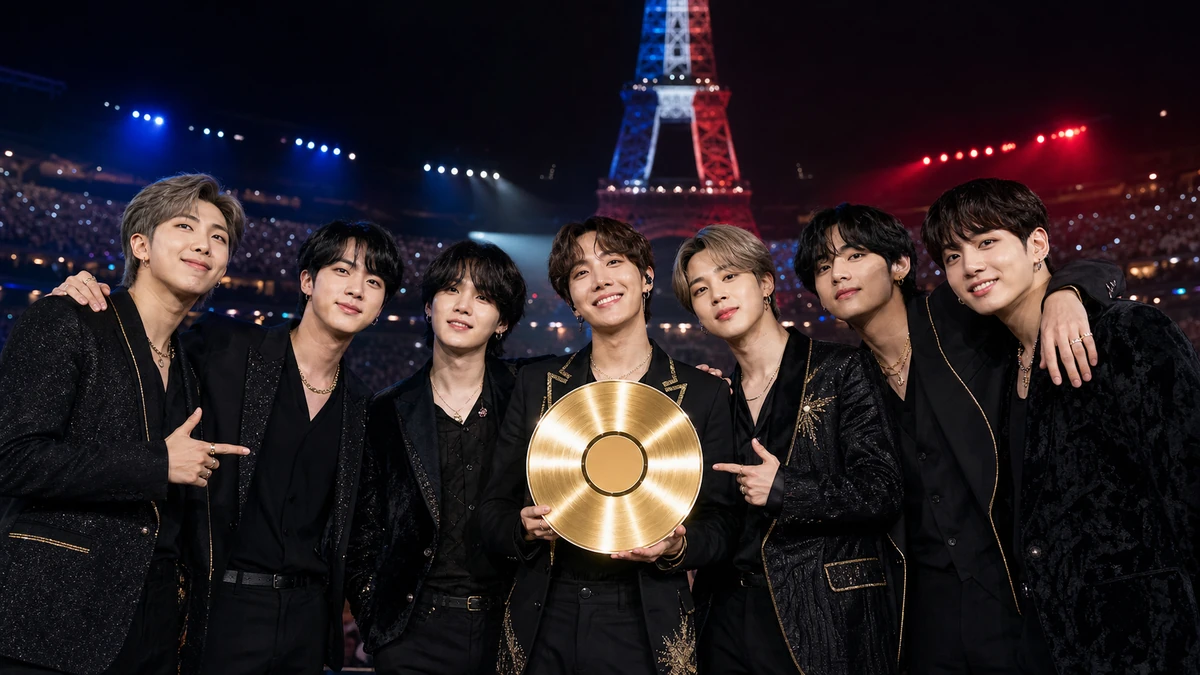
Image to help understand the article
A French milestone that says more than a chart spike
BTS has added another marker to its international track record, this time in France, where the group’s song “Swim,” the title track from its fifth full-length album “Arirang,” has received a gold single certification from SNEP, the French music industry association. On paper, that may sound like one more overseas accolade for one of the world’s biggest pop acts. But the French certification matters for a reason that goes beyond bragging rights or a flashy debut week.
Under the standard cited in Korean reports, a song earns SNEP’s gold certification when its combined total — including streaming, downloads and physical sales converted into a single metric — reaches the equivalent of 15 million streams. That makes this a different kind of signal from the social-media-fueled excitement that often surrounds a new release. It points to a song being played repeatedly, purchased in more than one format and absorbed into the listening habits of a real market over time.
That distinction is especially important in the current music economy, where a No. 1 headline can be generated quickly but can fade just as fast. A certification from a local industry body is less about one weekend of concentrated fandom and more about sustained behavior. It shows that listeners in France did not just notice “Swim.” They kept returning to it.
With the new certification, BTS now has 10 gold-certified singles in France, according to BigHit Music. Korean coverage noted earlier French gold certifications for songs including “Dynamite” and “Butter,” which were global crossover hits from a different phase of the group’s career. When songs from different eras continue clearing the same benchmark in the same country, the pattern suggests something sturdier than a one-song breakthrough. It suggests an audience base that remains active across releases, concepts and promotional cycles.
That is the bigger story here. In an industry still trying to distinguish between momentary buzz and durable market presence, BTS’ latest French certification looks like evidence of the latter. It says the group’s catalog is not being consumed as a novelty from abroad, but as music that listeners continue to choose in everyday life.
Why certifications matter more than viral moments
To American readers, it may help to think of this in terms familiar from the U.S. market. In the United States, a chart debut can be driven by a coordinated release strategy, fan mobilization, playlist visibility or sheer online anticipation. Those things matter, and they are part of modern pop. But certifications from organizations such as the Recording Industry Association of America, or RIAA, have long carried a slightly different weight because they point to cumulative consumption. They measure whether a song or album kept moving after the first wave of attention.
France’s SNEP certifications serve a similar symbolic function in that country. They compress multiple forms of consumer behavior — streams, downloads and physical purchases — into one threshold. That is meaningful for K-pop in particular, because K-pop has often been discussed through a narrow lens in Western coverage: trending hashtags, fan voting, YouTube view counts or online “fandom power.” Those are real forces, but they can also flatten a more complicated story.
What the French gold for “Swim” reflects is less spectacle than accumulation. Someone streamed the song more than once. Someone else downloaded it. Someone bought a physical version connected to the release. When enough of those actions happen repeatedly and over time, the result becomes an official local certification. That is the kind of evidence that helps answer a question critics and industry executives alike have asked for years: Is K-pop merely visible internationally, or is it truly integrated into overseas music markets?
In France, at least for BTS, the answer increasingly appears to be yes. And that matters because France is not simply another stop on a world tour map. It is one of Europe’s most influential music markets, with a strong domestic music culture and a history of treating language, national industry and cultural policy seriously. For an international act to build repeat consumption there is notable. For a Korean act to do it across multiple singles is more notable still.
The Korean reporting makes a useful point here: the significance lies not just in the number 15 million, but in how that number is assembled. It is built from ordinary acts of listening and collecting. In other words, “Swim” seems to have moved from being discovered to being lived with. For any artist trying to prove long-term relevance abroad, that is a meaningful threshold.
BTS and the evolution from breakthrough act to catalog artist
There was a time when every overseas BTS milestone was framed as a first: the first major U.S. television appearances, the first stadium shows, the first chart records, the first award-show breakthroughs. Those moments were historically important, especially for a Korean-language act entering Western pop spaces that had not always made room for Asian artists on equal footing. But the group’s latest French certification suggests BTS has entered a different phase of global significance.
This is no longer just a story about breaking in. It is about remaining in. That may sound like a small distinction, but in pop music it is enormous. Plenty of artists score one undeniable crossover hit. Far fewer establish the kind of deep catalog consumption that keeps older songs circulating while new releases also gain traction. That is often the line between a fad and an institution.
The fact that “Dynamite,” “Butter” and now “Swim” all appear in France’s gold-certified mix matters because those songs do not all occupy the same lane. Some were overtly designed for broad international reach; others sit in a different artistic or career moment. Yet listeners in the same market are continuing to reward them. That broadens the picture of what BTS represents abroad. The group is not only a hit-making machine tied to a single era of global attention; it is increasingly a catalog act whose brand and music travel together.
That is a familiar pattern in American pop history. Think about how artists from Taylor Swift to Drake to Beyoncé or even earlier acts such as Michael Jackson and Madonna have benefited not just from blockbuster singles, but from a body of work that listeners revisit across years. The songs talk to each other. New releases push old tracks back into circulation. Recognition compounds. BTS appears to be doing some version of that internationally, including in markets where language and geography once would have been assumed to be barriers.
That is also why the French result may be more telling than a one-day chart headline. A chart can capture peak attention. A certification often captures accumulated trust. In this case, it indicates that a meaningful number of French consumers are treating BTS less like a foreign curiosity and more like a regular part of their music diet.
For the broader K-pop industry, that is an encouraging sign. One of the longstanding questions facing Korean entertainment companies has been whether global expansion can outlast novelty. Can international listeners stay engaged after the first explosion of interest? Can multiple songs, not just one monster single, become embedded in local markets? BTS’ latest milestone does not answer those questions for every act, but it does offer one of the clearest examples yet of what a mature overseas footprint looks like.
What this means for the United States
For the U.S. music business, BTS’ French certification is worth watching not because it happened in Paris rather than Los Angeles, but because it reinforces a larger trend American companies can no longer dismiss: K-pop is functioning more and more like a durable global entertainment system, not a niche import sustained only by online superfans. If a Korean group can continue generating multi-format consumption in France across several singles and career phases, U.S. labels, promoters, streamers and retailers have another reason to think about K-pop as a long-cycle business.
American audiences have already played a central role in BTS’ rise, from sold-out stadium dates to Billboard chart success to a visible fan culture that helped normalize K-pop in mainstream U.S. spaces. But the French milestone adds a useful comparative point. It shows that this is not just a U.S.-specific phenomenon driven by the size of the American market or the publicity machinery surrounding U.S. entertainment. It is part of a broader pattern in which K-pop can create repeat listening habits in major Western markets with different media systems and consumer habits.
That has implications for U.S. companies. Streaming platforms operating in America increasingly rely on international repertoire to keep users engaged. Concert promoters have discovered that Korean acts can sell premium tickets, merchandise and fan experiences at levels once reserved for established Western stars. Retailers, especially in major metro areas, have learned that physical K-pop albums remain one of the few bright spots in an era when many younger consumers otherwise do most of their listening digitally. A certification that includes not just streams but also downloads and physical sales speaks directly to that hybrid consumption model.
For American fans, the development also underlines something they have been arguing for years: that engagement with Korean pop is not shallow or temporary. U.S. fan communities have often been caricatured as hyper-online and excessively organized, as though their enthusiasm were somehow less “authentic” than the fandoms built around domestic stars. But the repeated accumulation of official certifications in multiple foreign markets suggests something more ordinary and more powerful. People are listening because they want to keep listening.
There is also a diplomatic and cultural dimension. South Korea and the United States are longtime allies whose relationship is usually discussed in terms of security, trade and technology. But culture has become a major part of that connection. Korean music, television, film and beauty brands now shape how many Americans, especially younger ones, encounter South Korea. Every sustained commercial success story in music deepens that familiarity. It creates more touchpoints between U.S. consumers and Korean companies, artists and cultural norms.
None of this means every K-pop release will become a U.S. mainstream smash, and the source material here does not provide evidence for that claim. But it does support a narrower and more defensible conclusion: international certifications like this one help validate K-pop as a category American industry players must treat seriously over the long term. The lesson for the U.S. market is not that every Korean act will follow BTS’ exact path. It is that the old assumption — that overseas enthusiasm for K-pop is mostly noise — has become increasingly hard to sustain.
Beyond the song: IVE’s exhibition points to a second growth engine
The Korean story that carried news of BTS’ French certification also highlighted another development in the K-pop business: IVE members Ahn Yujin and Jang Wonyoung are opening a fan exhibition in Seoul titled “AN-YOUNG in Seoul,” a wordplay that combines elements of their names while also echoing a greeting. That may seem unrelated to a gold single in France, but together the two stories sketch a revealing picture of where K-pop is headed.
One direction is measurable through numbers: streams, downloads, physical purchases, official certifications. The other is experiential: spaces where fans can spend time with an artist’s image, mood and narrative outside the standard concert stage or music-show broadcast. The IVE exhibition will feature previously unreleased photos, media art and programs for fans, according to the company. Even without a detailed program list, the concept itself says a lot.
For readers less familiar with Korean idol culture, K-pop agencies have long treated fandom as something that extends well beyond the song. Fans do not just consume music; they collect photo cards, attend pop-up stores, visit birthday cafe events, watch behind-the-scenes content and participate in highly designed offline experiences. In American terms, this can resemble a blend of museum exhibit, branded pop-up and fan convention, but with the visual discipline and emotional intimacy of idol marketing.
That matters because it broadens the definition of what success looks like. BTS’ French milestone demonstrates sustained listening. IVE’s exhibition shows how companies are also building “dwell time” — opportunities for fans to linger, interact and convert affection into memory, community and spending. Those are different forms of engagement, but they support each other. A fan who repeatedly listens is more likely to seek out an in-person experience. A fan who has an immersive offline experience may feel more attached to the music afterward.
In the United States, entertainment companies have been moving in a similar direction. Think of pop-up experiences tied to movie franchises, museum-style exhibits built around musicians, or immersive events that turn fandom into a place-based activity. K-pop’s version of that strategy can feel especially deliberate because the industry has spent years developing artists not just as performers, but as worlds fans can enter.
Seen together, the BTS and IVE updates suggest that K-pop’s global durability may depend on two reinforcing habits: listening over time and showing up in person. One is counted by certification agencies. The other is harder to quantify but increasingly visible in how agencies design fan relationships. Both indicate that K-pop is maturing from a fast-moving content pipeline into a more embedded cultural ecosystem.
What to watch next in K-pop’s global expansion
If there is a takeaway from these developments, it is that the next phase of K-pop’s international story may be less about spectacular firsts and more about evidence of endurance. Analysts, media outlets and investors have spent years focusing on rankings, virality and headline-making records. Those measures will remain part of the story. But official local certifications and fan-centered offline experiences may tell us more about whether Korean pop has truly rooted itself in markets outside South Korea.
In BTS’ case, France offers one useful test. The country’s latest gold certification for “Swim” suggests the group continues to generate repeat value there, not just residual name recognition. That matters because sustained overseas success is what allows a global act to withstand changing trends, military service gaps, shifting promotional schedules and the inevitable churn of the pop marketplace. A fandom that repeatedly listens across eras is a more durable asset than one that appears only on release week.
For the wider K-pop field, the challenge will be whether more acts can replicate that pattern without depending solely on short-term hype. The source material does not give enough information to claim that they will. But it does point to a framework worth watching: local certifications as one marker of longevity, and experiential fan projects as another marker of depth. If both continue to grow, K-pop’s international footprint will look less like a periodic export boom and more like a stable part of global pop consumption.
That has consequences for the United States as well. American media organizations may need to get better at covering K-pop as an ongoing industry story rather than only as a novelty or a fan phenomenon. U.S. businesses that still treat Korean music as a side category may find themselves behind competitors that understand how globalized and diversified the audience has become. And American listeners, many of whom discovered Korean entertainment through streaming-era algorithms or pandemic-era binge watching, are likely to see more opportunities to participate in the culture both online and in person.
In that sense, the French gold for “Swim” is not just a French story. It is a snapshot of how K-pop now travels: across borders, across formats and across different kinds of fan behavior. It is also a reminder that in pop music, longevity is built less by one explosive moment than by repetition — by being chosen again and again. That is what official certifications capture. And that is why this latest BTS milestone deserves to be read not simply as another trophy, but as evidence of how Korean pop has settled into the daily habits of audiences far from Seoul.
Comments
Post a Comment