ENHYPEN’s First No. 1 on the Billboard 200 Shows K-pop’s U.S. Staying Power Has Moved Beyond the Breakthrough Era
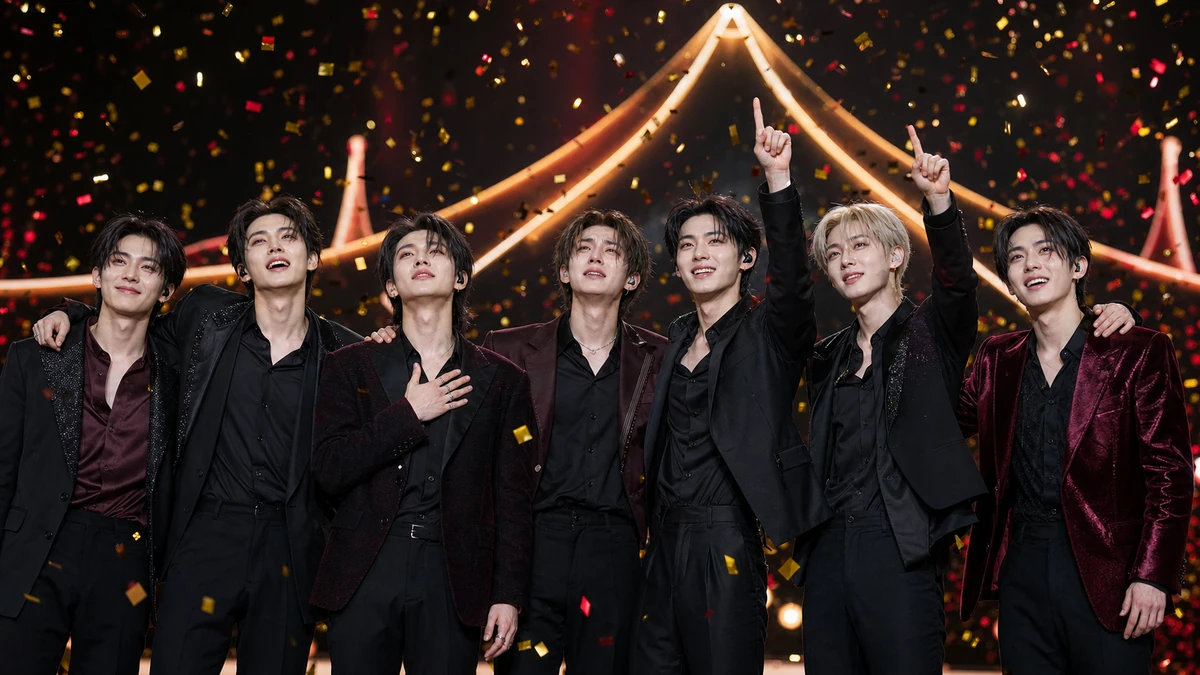
Image to help understand the article
A long climb ends at the top
ENHYPEN has reached a milestone that says as much about the current shape of the American music business as it does about the group itself. Nearly six years after its debut, the South Korean boy band has landed its first No. 1 album on the Billboard 200 with its eighth mini album, THE SIN : BLISS, according to Billboard’s chart preview. In practical terms, that means the group did more than notch another respectable U.S. chart showing. It beat major competition and claimed the top spot on the country’s most watched album ranking, a chart that still carries symbolic weight even in an era dominated by playlists, TikTok clips and streaming-first listening habits.
For American readers who may know K-pop primarily through BTS, Blackpink or occasional viral moments online, ENHYPEN’s rise is a reminder that the Korean pop industry’s U.S. expansion is no longer a one-group story. The band now becomes the sixth K-pop boy group to top the Billboard 200, joining BTS, SuperM, Stray Kids, ATEEZ and Tomorrow X Together. Put that alongside chart-topping runs by girl groups including Blackpink, NewJeans and TWICE, as well as other Korean-linked projects that have found traction in the United States, and a clear pattern comes into focus: K-pop is no longer simply breaking into America. It is building a durable place within the American music marketplace.
That distinction matters. For years, coverage of Korean pop in the United States often treated each chart feat as a novelty, a surprise crossover event or proof that something once considered niche had finally gone mainstream. ENHYPEN’s first No. 1 suggests a different frame is now more useful. This is not just about a new act sneaking through the door. It is about an ecosystem that keeps producing albums capable of competing at the highest level in the United States, often through a combination of devoted fandom, sophisticated release strategies and a form of pop storytelling that encourages listeners to invest in albums as complete experiences rather than as one-off singles.
That helps explain why this week’s chart result feels bigger than a single trophy. ENHYPEN did not arrive at No. 1 out of nowhere. The band has been building toward this moment, one release at a time, in a way that mirrors how K-pop has gradually moved from curiosity to commercial force in the U.S. market.
Why this No. 1 is more significant than a typical chart win
The most important fact in this story may be the least flashy one: ENHYPEN has now placed 10 albums on the Billboard 200 since first entering the chart in 2021 with BORDER : CARNIVAL. Before this week, the group had already climbed as high as No. 2 with ROMANCE : UNTOLD and THE SIN : VANISH. In other words, the group had been knocking on the door for some time. This No. 1 is less a sudden breakout than the completion of a slow, disciplined ascent.
That kind of trajectory is often a better indicator of long-term market power than one spectacular debut. In the American music industry, artists can score a brief chart spike off a viral moment, a headline-making collaboration or intense opening-week fan mobilization, only to fade when the hype passes. ENHYPEN’s history on the Billboard 200 suggests something more stable. The group has now sent seven straight albums into the chart’s top 10, beginning with MANIFESTO : DAY 1. Sustained repetition at that level indicates that the act’s U.S. fan base is not merely loud online; it is organized, recurring and willing to keep showing up release after release.
That is one reason Billboard 200 milestones remain important. The chart blends traditional album sales, streaming-equivalent albums and track-equivalent albums into a single number. It is imperfect, as all charts are, but it offers a broad snapshot of how audiences consume music. When an act keeps returning to the upper tier, it suggests a deeper market footprint than a single successful song on Spotify or Apple Music might. For K-pop groups in particular, repeat album performance can reveal whether fandom has matured into a reliable commercial base in the United States.
ENHYPEN’s chart arc also says something about timing. American audiences have spent the past several years becoming more comfortable with non-English pop at the top of the market. That shift did not happen by accident. Streaming normalized multilingual listening. Social media collapsed traditional gatekeeping around radio and music television. Younger listeners, especially Gen Z, became more comfortable building fan identities across borders. In that environment, K-pop acts no longer need to be understood by U.S. listeners as exotic exceptions. They can instead compete as fully formed global pop brands.
The business behind the chart: Physical albums still matter
One of the clearest details in ENHYPEN’s Billboard 200 victory is also one of the most revealing. THE SIN : BLISS earned 98,000 album units in the United States during the chart tracking week. Of those, 92,000 came from album sales, while 6,000 came from streaming-equivalent albums. Track-equivalent units were negligible. In plain English, ENHYPEN got to No. 1 primarily because fans bought the album rather than simply streamed it.
That is a defining feature of K-pop’s U.S. business model, and it often confuses Americans used to thinking of streaming as the only metric that matters. In K-pop, albums are often designed as collectible objects as much as containers for songs. Multiple versions, elaborate packaging, lyric books, photo cards and concept-driven visuals can turn a release into something closer to merchandise, memorabilia and fan participation rolled into one. To some American consumers, that may look unusual. But the closest U.S. comparison might be the vinyl revival, deluxe box sets or Taylor Swift’s ability to turn physical editions and fan engagement into major chart outcomes. The difference is that K-pop industrialized that logic earlier and more systematically.
That does not make the result less real. It makes it instructive. In a fragmented market where many artists struggle to convince listeners to pay for music at all, K-pop groups have shown they can still motivate fans to purchase albums at scale. ENHYPEN topping both the Billboard 200 and the Top Album Sales chart underscores that point. This is not just passive consumption. It is active fandom converted into measurable commerce.
The Korean market offers an even larger illustration of that purchasing power. According to the summary of the Korean report, THE SIN : BLISS surpassed 2.02 million copies in cumulative sales in South Korea, becoming a double million-seller. Those Korean and U.S. totals are measured differently and should not be directly compared. But taken together, they tell a consistent story: ENHYPEN’s fan base is not concentrated in one territory. It is distributed across markets and capable of moving in tandem.
For American music companies, that should not be dismissed as a fandom quirk. It is a signal about where value still exists in an age when recorded music economics increasingly revolve around scale. K-pop has become one of the strongest proofs that listeners will still buy music in a meaningful way when albums are marketed as experiences, communities and identity markers rather than as disposable content.
What ENHYPEN tells us about K-pop’s next phase in America
It is tempting to interpret every K-pop success in the United States through the lens of crossover, as if the central question is whether Korean acts can become understandable to mainstream American audiences. But ENHYPEN’s achievement points to a more mature and more useful framework. The real story is not simply crossover anymore. It is category formation.
K-pop is increasingly behaving in the United States like a durable segment of the music market, with enough depth that multiple acts can thrive at the same time. That matters because industries change when success stops being singular. One blockbuster can be an outlier. Several acts charting repeatedly begins to look like infrastructure.
This week offers a useful snapshot. As ENHYPEN reached No. 1, other K-pop acts also remained in the Billboard 200 top 10, including Stray Kids and KATSEYE, according to the Korean summary. That kind of clustering suggests listeners are not choosing just one Korean act as a symbolic representative of the genre. They are making distinctions within K-pop itself, following different groups, sounds and brand identities. That is a hallmark of market maturity. In the United States, country music, Latin music and hip-hop did not become stable commercial categories because one artist occasionally won big. They became institutionalized because multiple artists could win at once, with fans understanding the differences among them.
ENHYPEN’s own artistic packaging also plays into that strength. THE SIN : BLISS is described as the second installment in the group’s THE SIN series, built around a narrative involving lovers who break taboos and face the consequences of escape. The album includes 10 tracks, including the lead single Bloody Paradise and the B-side Two Fools. For audiences less familiar with K-pop, this kind of release strategy is worth noting. Korean idol groups often present albums as chapters in a larger fictional or thematic universe. That can sound a bit like the Marvelization of pop music, but the more precise analogy may be serialized storytelling in prestige TV: each new installment matters partly on its own and partly as part of a wider arc. Fans are not only consuming songs; they are following a world.
That narrative design encourages album loyalty, not just song-level sampling. In an American context, where playlists have trained listeners to move fluidly from track to track and artist to artist, K-pop’s series-based approach offers a different proposition. It gives fans a reason to care about the complete package and to return for the next chapter. ENHYPEN’s first No. 1 can be read as evidence that this model continues to work in the United States.
What this means for the United States
For the U.S. market, ENHYPEN’s Billboard 200 win is not merely a fan headline. It is a business and cultural indicator. American labels, promoters, retailers and streaming platforms have spent the past decade trying to understand how Korean pop operates and how best to work with it. Results like this suggest the answer is no longer to treat K-pop as a specialty import aimed only at a niche audience. It has become part of the mainstream competitive field, especially in the album market.
For U.S. companies, that means several things. Concert promoters can look at groups like ENHYPEN and see not just social-media buzz but a repeatable consumer base willing to spend on tickets, merchandise and premium fan experiences. Retailers can see that physical product still matters when the right fan culture exists around it. Media companies can see that coverage of K-pop is no longer only about celebrity fascination or trend reporting; it increasingly overlaps with broader questions about global youth culture, platform economics and the future of fandom itself.
For American artists and executives, there is also a competitive lesson here. The U.S. music business has often optimized for low-friction consumption: more singles, more playlist visibility, more always-on streaming. K-pop, by contrast, has remained unusually good at creating event releases that fans want to own, discuss and organize around. That does not mean American pop should simply copy Korean idol systems. Cultural and labor contexts differ, and K-pop’s training model has long sparked debate. But it does suggest that U.S. pop has something to learn from the way Korean companies build anticipation, narrative continuity and collector value around albums.
There is also a diplomatic and soft-power dimension. South Korea’s cultural exports, from film and television to beauty products and music, have become a significant part of the country’s global profile. In U.S.-South Korea relations, culture increasingly sits alongside security and trade as an area of meaningful connection. When a group like ENHYPEN tops the Billboard 200, the immediate result is commercial. But the broader effect is cultural familiarity: more American fans learning Korean names, following Korean media cycles and becoming attentive to a U.S. ally through entertainment rather than geopolitics.
That matters in subtle ways. For years, many Americans encountered South Korea in news coverage mainly through the lens of North Korea, military tension or semiconductor supply chains. The Korean Wave, or Hallyu, has widened that picture. K-pop’s continued chart success reinforces the idea that South Korea is not just strategically important to the United States; it is culturally influential in ways that shape taste, consumer behavior and everyday conversation among younger Americans.
Beyond one week: What to watch next
The challenge for ENHYPEN now is the same one faced by every act after a career-best opening week: turning a breakthrough into a baseline. A first No. 1 changes the terms of future expectations. The accomplishment confirms that the group’s U.S. audience can deliver top-tier chart results, but it also raises the bar for what comes next. Every future release will now be measured not only against past growth but against the precedent of having already reached the summit.
That makes the next phase especially interesting. Will ENHYPEN’s streaming numbers grow enough to complement its formidable album sales? Can the group convert chart momentum into even greater visibility in the broader American mainstream, whether through touring scale, media appearances or deeper recognition beyond core K-pop fandom? And perhaps most important for industry watchers: will this result prove to be another data point in K-pop’s continuing institutionalization in the United States, or will it mark the beginning of an even more expansive phase in which Korean acts become routine presences at the top of major American charts?
There are reasons to think the larger trend is durable. ENHYPEN’s path to No. 1 was incremental, built across 10 chart entries and seven straight top 10 albums. That is a stronger foundation than one-off virality. The group’s U.S. result also lines up with robust sales in South Korea, reinforcing the idea of a fan network that operates globally rather than locally. And the fact that multiple K-pop acts continue to appear near the top of U.S. charts suggests that audience appetite has broadened, not narrowed.
Still, the American market remains volatile. Chart rules evolve. Streaming behavior shifts. Fandom intensity can be hard to sustain indefinitely. U.S. radio, long less central than before, still tends to lag behind in its embrace of many non-English or internationally developed acts. For ENHYPEN and for K-pop more broadly, the next frontier may not simply be more No. 1 debuts. It may be a deeper kind of normalization: longer chart runs, more casual listeners, broader generational reach and stronger integration into the everyday habits of American music consumers who do not already identify as K-pop fans.
For now, though, ENHYPEN’s first Billboard 200 No. 1 deserves to be read in full context. It is a career milestone for a group that has spent years climbing toward it. It is evidence that K-pop’s U.S. album business remains unusually potent. And it is another sign that the Korean Wave has moved well past the stage of novelty in America. The headline may be about one group and one chart, but the larger story is about permanence. K-pop is no longer asking whether it belongs in the American mainstream. By now, it is helping define what that mainstream looks like.
Comments
Post a Comment