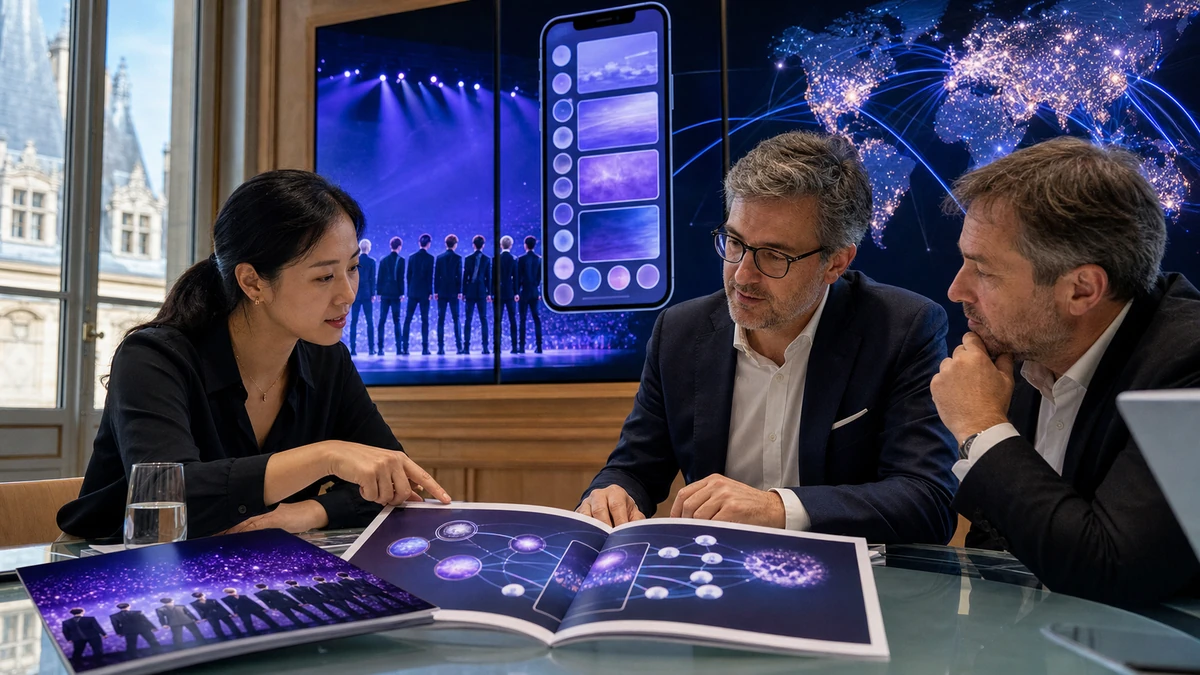
Image to help understand the article
From global pop phenomenon to MBA curriculum
BTS has spent the better part of the past decade doing what very few music acts from any country ever manage: breaking out of a niche, crossing language barriers and becoming a truly global cultural force. Now the group’s rise — and, crucially, the corporate strategy behind it — is being studied in one of the world’s top business school settings.
INSEAD, the France-based graduate business school known for its international MBA program, has published a case study examining the growth of HYBE, the South Korean entertainment company best known as the home of BTS. According to South Korean media reports, the case study is titled “HYBE: Building Growth Beyond BTS.” That title matters. It suggests the focus is not simply on how seven performers became international stars, but on how a company once considered a relatively small player in South Korea’s fiercely competitive entertainment business turned one breakout act into a broader global business model.
For American readers, the significance is easy to grasp if you imagine a top MBA program treating the rise of Disney, Apple or the NBA not only as a story of hit products, but as a case about how fandom, technology and commerce can be woven into a durable system. BTS is the headline draw, but the underlying subject is bigger: how cultural content becomes infrastructure, and how fan loyalty can evolve into a long-term business ecosystem.
The case study was prepared by researchers affiliated with INSEAD’s Blue Ocean Strategy Institute, and it reportedly frames HYBE as a company that created a formula for sustained growth. The research follows a progression familiar to anyone who has watched K-pop expand internationally: BTS’s debut, the creation of the fan platform Weverse, and the expansion of a wider entertainment ecosystem. In other words, it does not stop at chart success. It looks at the mechanics underneath — music, digital communication, fan participation and commerce — and asks how those elements reinforced one another.
That shift in emphasis is one reason this news is drawing attention well beyond the classroom. K-pop has often been covered in the United States through the lens of spectacle: synchronized choreography, devoted fans, sold-out arenas, Billboard rankings and social media buzz. Those things are real and important, but the INSEAD study points to another story, one that executives, investors and media analysts have been increasingly trying to understand. Why did BTS and HYBE work at this scale? And what, if anything, can other industries learn from it?
For fans, the message is also striking. Activities that are often dismissed as ordinary “stan culture” — streaming songs, sharing posts, joining online communities, buying merchandise, attending concerts and translating content for other fans — are being treated as part of a serious business and management discussion. That does not mean fandom has become a spreadsheet. It means institutions that train future executives are recognizing that in the digital economy, relationships can be just as important as products.
Why “blue ocean strategy” matters here
A central concept in the INSEAD analysis is “blue ocean strategy,” a term that may sound academic but is fairly straightforward. Instead of fighting rivals for a bigger share of an already crowded market — the so-called “red ocean,” stained by competition — companies try to create new demand where little existed before. In the American business conversation, it is the difference between winning a brutal price war and inventing a category people did not know they needed.
Applied to HYBE and BTS, the argument is that the company did not merely outcompete other K-pop agencies for the same pool of existing fans. It expanded the market by pulling in listeners who had little or no connection to Korean pop music in the first place. That is an important distinction. If BTS had simply become the favorite group among people already deep in K-pop fandom, that would still be impressive, but it would be a more conventional success story. The INSEAD framing suggests something larger happened: BTS helped create new consumers, new habits and new cultural pathways.
American audiences have seen versions of this before. Think of how “Hamilton” brought many people into musical theater who were not regular Broadway fans, or how the Marvel Cinematic Universe turned comic-book storytelling into a mainstream global ritual. The best comparison is not exact, but the pattern is familiar: a cultural product with a strong internal identity finds ways to welcome outsiders without losing what made it distinctive. That is often the hard part. Niche culture can go mainstream, but in doing so it sometimes becomes generic. BTS largely avoided that trap.
The researchers reportedly argue that HYBE’s strategy extended beyond direct competition within South Korea’s domestic idol market. Rather than focusing only on how to win over current K-pop consumers, HYBE and BTS connected with people across national, linguistic and cultural lines through music, storytelling and direct digital communication. That approach made the fan base broader than a typical genre audience. It also made K-pop less of a foreign curiosity and more of an emotional point of entry for listeners around the world.
That matters in the U.S., where foreign-language pop has historically broken through only occasionally and often in short bursts. American music consumers have embraced Latin music more fully in recent years, but for decades the industry assumption was that English-language dominance was nearly impossible to challenge at scale. BTS did not erase that reality, but the group complicated it. Their success suggested that personality, message, narrative consistency and fan access could sometimes matter more than the language barrier that executives once treated as decisive.
In business terms, blue ocean strategy here appears to mean that HYBE found growth by expanding the emotional and commercial universe around its artists. The company was not just selling songs. It was creating a recurring relationship — one in which fans discovered music, followed an unfolding story, joined a community and then encountered products and experiences that felt like extensions of that relationship rather than unrelated sales pitches.
The BTS factor: story, authorship and emotional credibility
Any serious explanation of HYBE’s rise has to begin with BTS themselves. Business systems matter, but systems need a catalyst, and in this case the catalyst was a group whose appeal went far beyond polished performance. The INSEAD study reportedly highlights the importance of BTS members’ participation in songwriting and the narrative structure of their music. That may sound like a small artistic detail, but it is central to why the group resonated so powerfully.
In K-pop, “self-produced” or “self-written” work often carries a special weight with fans because it signals authenticity and creative ownership in an industry that outsiders sometimes stereotype as highly manufactured. That stereotype is not entirely fair — pop music everywhere is collaborative and heavily managed — but it persists. BTS challenged it by becoming known not just as performers, but as artists who helped shape their own message. Their songs often addressed youth anxiety, ambition, alienation, mental health, social pressure and self-acceptance, themes that traveled well even when the lyrics were in Korean.
For American readers, one way to understand this is to think about the difference between a catchy single and an artist universe. A hit song can produce a moment. A coherent body of work can produce loyalty. BTS’s music, videos, album concepts and public messaging often felt interconnected, encouraging fans to follow not just the next release but the broader arc. That serial quality — the sense that there was always another chapter — helped turn casual listeners into long-term participants.
The group’s underdog narrative also mattered. BTS debuted in 2013 under what was then Big Hit Entertainment, a much smaller company than the South Korean industry’s dominant agencies. In the American imagination, that story often gets simplified into a classic “garage-band beats the establishment” arc. The reality is more complex, but the emotional logic is recognizable. Audiences tend to respond when a cultural act appears to be building something against the odds, especially when the members seem to speak openly about struggle and aspiration.
That emotional credibility gave HYBE something many entertainment companies spend years trying to manufacture and rarely achieve: trust. Fans did not just consume BTS content; they invested meaning in it. In an age when media attention is fragmented and loyalty is fragile, that is an extraordinary asset. The company could not have built a larger ecosystem without it.
The INSEAD case study’s emphasis on story suggests that this was not incidental. The music was not merely the bait that lured fans toward more profitable products. It was the foundation. That is a crucial point, especially as critics often worry that pop fandom is being reduced to monetization. The research appears to argue the opposite sequence: compelling art and credible storytelling created an emotional bond, and only then could platform strategy and commerce scale around it.
Weverse and the business of belonging
If BTS was the emotional engine, Weverse was one of the key pieces of infrastructure that helped HYBE turn attention into an ecosystem. Weverse, HYBE’s fan platform, is reportedly treated in the INSEAD case study as another major pillar of the company’s growth. The platform offers a place where artists and fans can interact, consume content, buy merchandise and participate in community life within a branded digital environment.
To an American audience, Weverse can be understood as part social network, part fan club, part retail channel and part content hub. It folds together activities that U.S. entertainment consumers often experience separately across Instagram, TikTok, Discord, Ticketmaster, Shopify and subscription apps. HYBE’s insight was that bringing those functions into a connected space could deepen loyalty and reduce friction. A fan who watches a post, comments on a livestream, joins a discussion and then buys merchandise is not moving randomly across the internet. They are progressing through a designed experience.
The INSEAD analysis reportedly describes a cycle linking content, community and commerce. Someone encounters an artist’s music or video content, joins the fan community, forms an ongoing relationship through digital interaction and then channels that engagement into purchases or other participation. Those purchases are not just transactions; they help fund more content, events and platform activity, which in turn sustains the community. In the best case, the cycle becomes self-reinforcing.
This is where the role of fans gets redefined. In older industry thinking, fans were mainly the end consumers in the chain — the people who bought the album or the concert ticket after the company did its real work. In the digital fandom economy, fans do much more. They circulate meaning, create visibility, build social proof, mentor newcomers, organize campaigns and keep interest alive between major releases. In K-pop especially, fandom often includes subtitling, clip-sharing, streaming coordination, charity drives and communal rituals that blur the line between audience and volunteer promoter.
That level of participation can be difficult for outsiders to understand. To some Americans, it may look hyper-intense or overly commercial. But one reason K-pop fandom has become such a consequential force is that it gives participants a sense of belonging and purpose, not just consumption. Weverse helped formalize that dynamic. Instead of relying entirely on third-party social media platforms, HYBE built a place where the relationship itself could be hosted, measured and expanded.
From a business school perspective, that is a fascinating move. Media companies have long worried about depending too heavily on platforms they do not control. News publishers have wrestled with Facebook and Google. Film and television companies have built streaming platforms to reclaim the customer relationship. HYBE appears to have made a similar calculation in entertainment fandom: if the connection between artist and fan is the company’s most valuable resource, then the company should own more of the environment where that connection lives.
What this says about K-pop’s global evolution
The fact that an elite MBA program is studying HYBE says something broader about how K-pop is now viewed internationally. For years, much Western coverage treated K-pop as a trend to be decoded, often with a mix of fascination and condescension. Articles tended to focus on training systems, beauty standards, intense fan culture and highly choreographed performance. Those topics are still relevant, but they are no longer sufficient to explain the industry’s place in the global cultural economy.
K-pop is increasingly being recognized not only as entertainment but as a sophisticated export model. South Korea has spent decades cultivating cultural industries as part of its broader soft-power reach, though not always through a single top-down plan as outsiders sometimes assume. Music, television, film, beauty and digital platforms have grown together in ways that reinforce the country’s global visibility. The popularity of Korean dramas on Netflix, the Oscar success of “Parasite,” the international prestige of “Squid Game,” and the worldwide spread of Korean skincare and fashion all form part of that larger story.
Within that ecosystem, BTS occupies a particularly important place because the group helped normalize Korean-language pop in mainstream markets where it had once been marginal. Their success did not happen in isolation, and they were not the first Korean act with international appeal. But they reached a level of recognition that forced major institutions to pay attention. When BTS appeared at the White House, addressed the United Nations, topped U.S. charts and sold out stadiums in Los Angeles and Las Vegas, the group ceased to be understandable solely as a fan phenomenon. They became part of mainstream cultural and political conversation.
The INSEAD case study suggests that international business education is catching up to what fans and industry observers have already seen: K-pop’s power lies not just in individual songs or viral moments, but in the architecture around them. That includes narrative design, artist development, digital intimacy, community management and the ability to translate enthusiasm into repeatable business value without entirely flattening the emotional core that made the enthusiasm possible.
It also raises a new question for the global entertainment industry. If HYBE’s model depends on fan trust, artist storytelling and platform connectivity, can it be replicated outside K-pop? That is not a simple yes-or-no question. K-pop’s training systems, release cycles and fandom traditions are culturally specific. The term “fandom” itself may not capture the full Korean context, where organized fan communities often function with a high degree of coordination and collective identity. Still, the broader lessons — reduce distance between artist and audience, treat community as an asset rather than an afterthought, and build systems that connect culture with commerce — are widely applicable.
Beyond BTS: The challenge of building a lasting company
The case study’s title, “Building Growth Beyond BTS,” points to perhaps the most important business issue of all: whether HYBE can prove that its success is durable beyond the act that made it famous. That is the challenge facing nearly every entertainment company built around a once-in-a-generation star. A blockbuster can transform a business. It can also distort it, making everything else look smaller and less certain.
HYBE has spent years trying to address that risk. The company rebranded from Big Hit Entertainment to HYBE, expanded its roster, leaned into a multi-label structure, developed Weverse, and pursued international growth strategies that went beyond one group. In the United States, that kind of expansion is familiar from companies that try to move from hit-driven operations to platform-based businesses. The goal is not just to find another BTS, which may be impossible, but to create conditions where multiple artists, labels and revenue streams can coexist inside a system that is larger than any single act.
The INSEAD framing appears to validate that effort, at least as a matter of strategy. It treats HYBE not as a company that happened to benefit from a singular success, but as one that used that success to build capabilities for the future. That distinction is critical for investors, competitors and business students alike. One-hit wonders do not usually become case studies. Companies that convert momentum into structure do.
There is, of course, a note of caution here. Entertainment remains notoriously unpredictable. No case study can guarantee that what worked once will work again. Fandom can be loyal, but it can also be volatile. Digital platforms can deepen community, but they can also invite burnout, over-commercialization and privacy concerns. And any company operating at the intersection of celebrity, technology and global commerce will eventually face questions about labor, governance, data use and cultural responsibility.
Still, the academic interest itself is revealing. It signals that BTS and HYBE are no longer being treated as an anomaly to be marveled at from the sidelines. They are being studied as a model that helped redefine how culture travels, how audiences organize and how entertainment businesses grow in the internet age. For American readers, that is the real headline. The story is not simply that a Korean pop group became textbook material in France. It is that the global business world is beginning to take seriously an idea fans understood long ago: in modern entertainment, community is not a side effect of success. It can be the engine that drives it.
And that may be the most enduring lesson of all. In a media environment flooded with content, what people crave is not just another product. It is connection, identity and a reason to keep coming back. BTS and HYBE, whatever one thinks of the music or the machinery around it, built a system that delivered exactly that. Now business schools want to know how.
Comments
Post a Comment