In Frankfurt, South Korea’s president turns a diaspora stop into a lesson in history, memory and soft power
A stopover that was about more than logistics
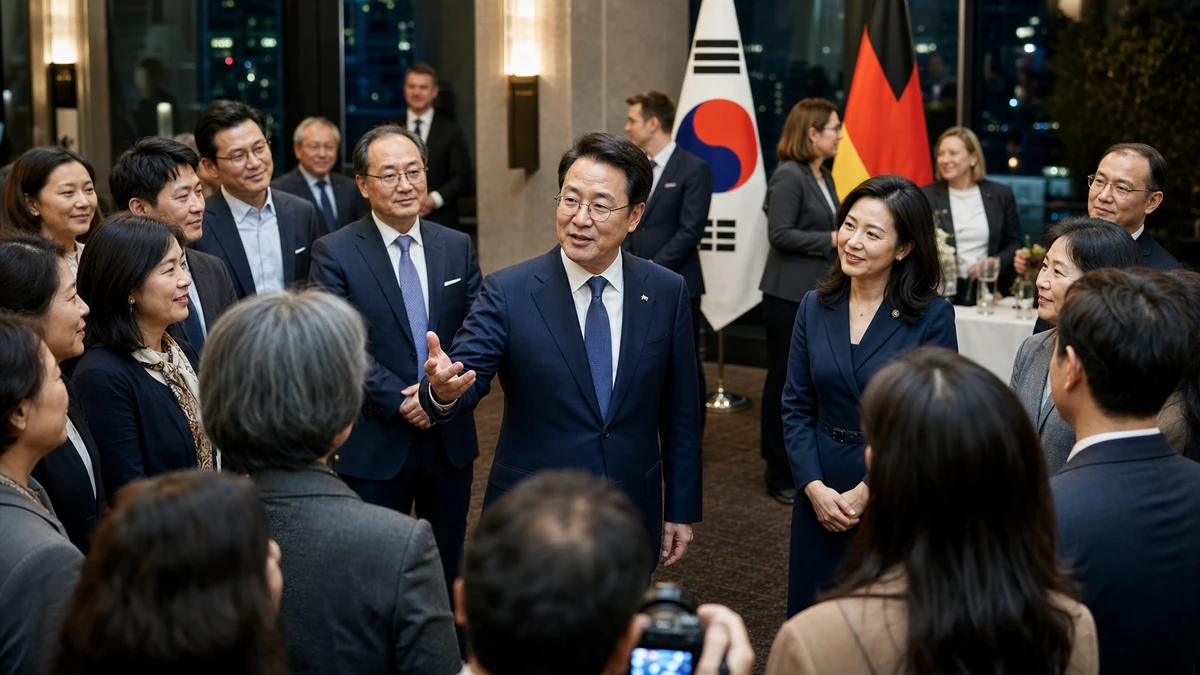
South Korean President Lee Jae Myung made what might have looked, at first glance, like a routine diplomatic stop on his way home from an overseas trip. Returning from a swing through the United States and South America, Lee stopped in Frankfurt on Wednesday and met with members of Germany’s Korean community at a hotel gathering alongside first lady Kim Hye-kyung. There were no headline-grabbing treaty signings, no major defense announcement and no fresh trade package rolled out for cameras. But in the language of modern diplomacy, the meeting still mattered.
What Lee offered in Frankfurt was something closer to narrative diplomacy: an effort to explain South Korea’s place in the world through a story Germans would immediately recognize and, by extension, one that international audiences can understand without specialized knowledge of Korean politics. He told the audience that South Korea and Germany are deeply alike, pointing to two of the most defining experiences in each country’s modern history: war and national division. Both countries, he said, endured devastation and separation and then rebuilt themselves into advanced industrial democracies.
That framing was not accidental. For American readers, the comparison lands somewhere between a state visit speech and an Ellis Island-style remembrance event. It linked the arc of national recovery to the lived experience of migrants, workers and families who helped build a country’s reputation abroad. In doing so, Lee used a small diaspora meeting in Germany to make a larger point about how South Korea sees itself: not only as an economic success story, but as a nation whose credibility was built through hardship, discipline and international trust.
The setting helped. Frankfurt is one of Europe’s biggest transportation and financial hubs, a city of arrivals, departures and cross-border commerce. For South Koreans, it also carries historical resonance because it is associated with one of the most important chapters in Korean migration to postwar Europe. Lee used that symbolism to connect the country’s national rise to the people who represented Korea overseas long before K-pop, Oscar wins and Netflix made Korean culture familiar in the United States.
In an era when summit diplomacy is often measured in deliverables and signed communiques, the Frankfurt event underscored another reality: countries also compete to shape how their histories are understood. Lee’s message to the Korean community in Germany was also a message to a broader global audience about resilience, reconstruction and the people-to-people ties that underpin statecraft.
Why Germany is such a powerful mirror for South Korea
Lee’s most notable line was also his simplest. South Korea and Germany, he said, have much in common. To Americans, that may sound like a broad rhetorical flourish, but in both countries the comparison carries real historical weight. Germany was divided after World War II into East and West, separated by ideology, military alliances and eventually the Berlin Wall. Korea was divided after Japanese colonial rule and then the Korean War, which ended in an armistice rather than a peace treaty, leaving the peninsula technically still at war and split between the South and the North.
That shared experience of division has long made Germany a reference point in South Korean political thought. German reunification is often studied in Seoul not because the two countries are identical — they are not — but because Germany offers one of the most vivid modern examples of a nation overcoming a Cold War rupture. For South Koreans, Germany’s story has represented both hope and caution: hope that division can end, and caution that reunification, if it comes, is socially and economically complicated.
Lee took the comparison one step further by pairing two familiar phrases: the “Miracle on the Rhine,” shorthand for West Germany’s postwar economic recovery, and the “Miracle on the Han,” the term often used to describe South Korea’s rapid industrialization in the decades after the Korean War. For Americans unfamiliar with the phrase, the “Han” refers to the Han River, which runs through Seoul, much as the Hudson evokes New York or the Potomac evokes Washington. The phrase captures the speed and scale of South Korea’s transformation from one of the world’s poorest countries in the 1950s into a major exporter of semiconductors, cars, ships and cultural products.
By placing the two “miracles” side by side, Lee did something subtle but important. He did not present South Korea as a junior partner still learning from Europe, nor did he reduce Germany to a convenient historical analogy. Instead, he cast the relationship as one between two societies that rebuilt themselves in different ways after catastrophe. That matters in diplomacy. The most effective symbolic messaging is rarely about declaring friendship in abstract terms; it is about finding a shared frame that feels earned.
For a president speaking in Germany, especially before ethnic Koreans whose lives bridge both societies, the language of parallel recovery is a way of honoring the host country while asserting South Korea’s own historical dignity. It says, in effect, that the relationship is not just transactional. It is grounded in memory, reconstruction and a mutual understanding of what it means to emerge from national trauma.
The Korean community in Germany, and why its history still matters
The emotional center of Lee’s remarks was not really state-to-state comparison. It was the Korean diaspora in Germany, especially the first generation that arrived decades ago under far more difficult circumstances than today’s globally mobile professionals and students. Lee noted that this year marks 60 years since Korean nurses first arrived at Frankfurt airport in 1966, an anniversary that gave the gathering a commemorative tone.
That reference points to a chapter of Korean history that many Americans may not know well. In the 1960s and 1970s, South Korea, then still a poor developing country, sent workers abroad as part of its broader development strategy. Among the most remembered groups were miners and nurses dispatched to West Germany. The arrangement served multiple purposes. Germany, in the midst of economic expansion, needed labor. South Korea needed foreign currency, employment opportunities and international footholds. What emerged was not simply a labor exchange, but a deeply formative migration story.
Korean nurses in Germany became especially significant in the public imagination because they embodied sacrifice, professionalism and upward mobility. They worked in hospitals, adapted to a foreign language and culture, and often sent money home at a time when remittances mattered greatly to South Korea’s fragile economy. In Korean public memory, they are often grouped with miners as symbols of the generation that helped lay the groundwork for the nation’s later prosperity.
Lee’s praise for those first-generation migrants followed that script, but it also reframed it. He said their diligence and sense of responsibility helped introduce German society to Korean reliability and, over time, built trust in South Korea itself. That is more than ceremonial gratitude. It reflects an important truth about how countries are perceived. National branding is not built only through embassy campaigns, glossy tourism ads or presidential speeches. It is also built through ordinary people showing up to work, keeping promises, earning respect and becoming known, over decades, as dependable members of a local community.
For an American comparison, think of how certain immigrant communities came to shape perceptions of their countries of origin through churches, small businesses, medical professions or civic activism. Over time, those communities become informal ambassadors, whether or not they ever hold official titles. That is the role Lee highlighted in Frankfurt. He was effectively telling the audience that they were not peripheral to South Korea’s rise. They were part of the architecture of its international legitimacy.
That message matters politically because diaspora communities often want to be recognized as participants in national history, not merely recipients of government outreach. By thanking Korean Germans not only for preserving identity abroad but for actively strengthening Korea’s reputation, Lee elevated their status from constituency to partner.
What this kind of diplomacy says about South Korea’s global ambitions
It is easy to dismiss gatherings with overseas nationals as ceremonial add-ons to presidential travel. Leaders from many countries hold them. They thank expatriates, pose for photos and then move on to the more visibly consequential parts of the trip. But the Frankfurt stop suggests that, for South Korea, these events increasingly serve a broader strategic function.
South Korea today occupies a different place in the world than it did when the first nurses landed in Germany. It is a Group of 20 economy, a leading technology power, a critical U.S. ally in Asia and a global cultural force whose movies, television, music and beauty products are recognized far beyond Korean-speaking audiences. Yet Seoul still faces a persistent challenge familiar to middle powers: how to narrate its significance in ways that are not overshadowed by the U.S.-China rivalry, the threat from North Korea or the latest market data on chips and exports.
One answer is to lean into what scholars and diplomats often call public diplomacy or soft power — the ability to persuade and attract rather than coerce. But soft power is not just about pop culture. It is also about moral storytelling, historical framing and social trust. Lee’s remarks in Frankfurt fit that model. He tied South Korea’s modern identity to themes that resonate beyond Korea itself: recovery after war, persistence through division, the contribution of migrants and the long-term building of trust across borders.
That kind of message works particularly well in Germany, where historical memory carries exceptional weight in public life. To frame bilateral ties through shared experience rather than immediate bargaining is to speak in a register Germans are likely to understand. And to make that argument in front of the Korean diaspora is to remind both sides that international relationships do not begin and end with leaders meeting around conference tables.
For South Korea, this is also a way of broadening the meaning of diplomacy. Traditional diplomacy is often measured in official meetings, policy statements, military coordination or investment deals. Those remain central, especially for a country confronting regional security threats and navigating global trade pressures. But there is another layer, one that involves shaping international perception and reinforcing social bonds that make formal cooperation more durable. In Frankfurt, Lee appeared to be working in that second layer.
Notably, he did so without overpromising. No new bilateral agreement with Germany was announced. No major cooperative framework was unveiled at the gathering. That may actually strengthen the significance of the moment. Because it was not attached to a policy rollout, the event can be read more clearly for what it was: an attempt to reinforce an emotional and historical foundation for the relationship.
The politics of memory, from the Rhine to the Han
Lee’s comparison between Germany and South Korea also reveals something about how contemporary Korean leaders want the country’s modern history to be understood abroad. For many years, foreign coverage of South Korea has tended to swing among a familiar set of frames: tensions with North Korea, trade and technology, democratic protests, and more recently the global spread of Korean entertainment. All of those are important. None, however, fully captures how South Koreans often explain their own modern experience.
Inside South Korea, the memory of war, authoritarian rule, rapid development and democratic struggle remains central to the national story. The country’s rise is rarely described simply as market success. It is also told as a narrative of survival, discipline, sacrifice and institutional maturation. By invoking the “Miracle on the Han,” Lee was drawing from that domestic story, but he translated it into terms more legible to international listeners by pairing it with Germany’s better-known “Miracle on the Rhine.”
This is a classic technique of cross-cultural political communication. Rather than asking a foreign audience to absorb an unfamiliar historical vocabulary on its own terms, a leader anchors it to a parallel the audience already understands. In the United States, politicians do this all the time, comparing one moment to another in order to make a complex issue more intuitive. Lee’s version of that strategy was to explain South Korea through Germany.
It is worth noting what he did not emphasize. He did not dwell on ideological confrontation in narrow terms, nor did he turn the gathering into a detailed argument about current domestic politics. Instead, he focused on war, division, growth and trust — broad themes that travel well internationally. That choice suggests a deliberate effort to present South Korea not through partisan language but through a story of collective national resilience.
There is also a public-relations logic here. In global affairs, countries are constantly competing not just for investment and influence, but for intelligibility. Nations that can explain themselves in ways others readily grasp often have an advantage. Germany’s postwar redemption and reconstruction are globally intelligible. By aligning South Korea with that pattern, Lee positioned his country within a narrative of democratic recovery and economic achievement that Western audiences already know how to read.
That does not erase the important differences between the two countries. Germany reunified; Korea remains divided. Germany’s postwar trajectory unfolded within Europe and NATO; South Korea’s security environment is shaped by Northeast Asia and the unresolved Korean War. But diplomacy often works by building bridges from similarity without denying difference. Lee’s Frankfurt remarks did exactly that.
Why this resonates beyond the Korean diaspora
For Korean Germans in the room, the gathering likely carried immediate personal meaning. It recognized parents, grandparents and community elders whose labor and adaptation often unfolded far from headlines. But the event also has wider resonance at a moment when migration, identity and belonging are major political questions across many democracies.
One of the clearest subtexts of Lee’s remarks was that emigrants are not a loss to the nation. They can also be part of how a nation becomes visible, respected and trusted abroad. That idea may sound self-evident in a globalized age, but governments do not always behave as though it is true. Overseas communities are sometimes treated mainly as remittance sources, voting blocs or targets for consular services. In Frankfurt, Lee instead cast the Korean diaspora as co-authors of South Korea’s international standing.
That is an especially significant message in the Korean case because the country’s global image has changed so dramatically within a few generations. The first wave of Korean workers in Europe arrived from a country still associated with poverty and war. Today, younger Koreans encounter a world where their nationality may be associated with Samsung smartphones, Hyundai cars, “Parasite,” “Squid Game,” BTS or Korean skin care. The distance between those two eras is enormous. Lee’s remarks implicitly connected them, arguing that the contemporary prestige of South Korea rests partly on the quiet reputational work done by those who went abroad earlier and proved themselves in difficult settings.
For American audiences, there is something familiar in that argument. It echoes the way U.S. politicians sometimes honor immigrant groups or military families not only for personal sacrifice but for what they contributed to the nation’s character and image. Whether the message will translate into specific policy support for overseas Koreans is another question. But as political symbolism, it is potent.
It also points to a broader truth about diplomacy in the 21st century. A country’s international stature is not created only in ministries, embassies and summit halls. It is also created in hospitals, factories, schools, restaurants, churches and neighborhoods where migrants live ordinary lives under extraordinary pressure to represent themselves well. Lee’s Frankfurt stop placed that reality at center stage.
What to watch next
The immediate significance of the Frankfurt meeting lies in its symbolism, not in any institutional breakthrough. There was no announced roadmap for new Korea-Germany initiatives tied to the event, and no obvious indication that the stopover will produce rapid policy changes. That makes the next phase less about documents than about reception: how German society, the Korean diaspora and South Korean domestic audiences interpret the message.
If the speech resonates, it may reinforce a style of diplomacy that values historical empathy and diaspora engagement as complements to more formal statecraft. That could shape future presidential travel, especially in countries where older Korean migrant communities played a meaningful role in building Korea’s reputation. It could also encourage a broader rethinking in Seoul of how overseas Koreans are incorporated into the national story — not as a sentimental afterthought, but as strategic partners in public diplomacy.
For Germany, the episode is a reminder that its relationship with South Korea extends beyond trade figures and shared commitments among U.S. allies. It includes a decades-long human connection forged through labor migration, medical care, family formation and social integration. In a Europe wrestling with demographic change and historical memory, that is not trivial. It is a living archive of how two countries once helped meet each other’s needs and, in the process, built a durable reservoir of goodwill.
For the broader world, including the United States, the Frankfurt remarks offer a useful glimpse into how South Korea wants to be seen. Not merely as a frontline state facing North Korea. Not merely as a cultural trendsetter. Not merely as a manufacturing powerhouse. But as a country whose modern identity was shaped by the same big forces that shaped much of the 20th century: war, division, migration, recovery and the long work of earning trust.
That is a story with particular force in 2024, when democracies are increasingly preoccupied with fragmentation at home and competition abroad. Lee’s message in Frankfurt suggested that South Korea’s answer to those pressures is not only policy competence or economic performance, but a claim about character — national character built through historical hardship, and international character reinforced by citizens who carried that reputation overseas.
Whether that claim gains traction will depend on what follows. Symbolic diplomacy works best when words are backed by sustained attention, cultural fluency and meaningful ties with the communities being honored. But even standing alone, the Frankfurt stop made one thing clear: South Korea’s leaders increasingly understand that the country’s global influence is not measured only by what it signs, sells or streams. It is also measured by how convincingly it can tell the story of who helped build it, and why that story matters far beyond Korea itself.
Comments
Post a Comment