Image to help understand the article
A summer comeback built on nostalgia — but not just nostalgia
K-pop is built on reinvention, but the speed of those reinventions can still be striking. A group can move from one visual era to the next in a matter of months, treating each release not just as a new single but as a new world. That is the backdrop for the latest comeback from KiiiKiii, the South Korean girl group that has returned with a new mini album, WhyKiiiKiii, and a title track called Pop Off Pop Off. Released Aug. 10, the project positions the group squarely in summer-pop territory while drawing heavily on the sounds and styles of the 2010s — an era now far enough away to be mined as pop-cultural memory.
For American readers who may not follow K-pop closely, a “comeback” in Korea does not mean an artist has been absent for years. It is the industry term for a new release cycle: a fresh single or album, a new concept, new stage outfits, new music videos and a concentrated run of performances on television music shows and online platforms. In K-pop, the comeback is often the main event, a tightly choreographed relaunch of a group’s identity. KiiiKiii’s latest release fits that model exactly. The group is not just putting out a summer song; it is using summer as a frame for another carefully designed chapter in its evolving image.
According to comments released through Starship Entertainment, the group said it was happy to share “KiiiKiii’s own summer song” and promised to repay fans through upcoming performances. That may sound like routine promotional language, but it points to something central in K-pop strategy. A seasonal track is rarely just a seasonal track. Summer songs, in particular, carry a specific set of expectations: bright melodies, easy hooks, playful styling and visuals that suggest escape, release and fun. In the United States, that role might be played by the yearly “song of the summer,” a category that can stretch from beach-party anthems to car-radio earworms. In K-pop, however, the idea is even more deliberately packaged. The aesthetic matters as much as the sound.
What makes KiiiKiii’s release notable is that it does not chase generic summer imagery alone. Instead, it filters summer through a 2010s lens. If the group’s earlier work touched on innocence, nature and later Y2K styling, this release moves into the next era of nostalgia — from the late-1990s and early-2000s references that have dominated recent youth fashion into a period that American audiences may associate with skinny jeans, neon accents, glossy synths, Tumblr-era visual culture and the rise of festival-pop exuberance. KiiiKiii is not simply reviving that period wholesale. Rather, the group appears to be using it as a grammar: a recognizable set of sounds and images that can be reassembled into something that still feels current.
Why the album title matters
The album’s title, WhyKiiiKiii, is doing more work than it may seem at first glance. It borrows from Waikiki, the famous Honolulu beach district that for many global audiences instantly evokes palm trees, surf, resort wear and postcard summer. But the title also doubles as a pun: “Why KiiiKiii?” In other words, why this group, and why now?
That kind of wordplay is common in K-pop branding, where album and song titles often need to function across languages and markets at once. A name has to be catchy, meme-ready, visually distinctive and easy to attach to a concept. In this case, the title offers both a familiar vacation image and a subtle statement of identity. For an American audience, Waikiki is one of those place names that comes preloaded with fantasy. It suggests not just Hawaii but an idea of leisure — a dream version of summer vacation shaped by movies, travel ads and decades of pop culture. KiiiKiii takes that instantly recognizable image and folds its own name into it, turning a resort reference into a branding exercise.
There is also a more interesting question beneath the pun. The title implies that the group is asking listeners to consider what, exactly, makes KiiiKiii distinct in a crowded K-pop field. That question matters because K-pop’s girl-group landscape is intensely competitive. New teams debut constantly, and many operate in adjacent territories: youthfulness, fashion fluency, online-savvy humor, catchy choruses and tightly engineered concepts. Standing out requires more than a good hook. It requires a coherent sense of self — or at least the ability to make each reinvention look like part of a larger story.
By framing the album around “Why KiiiKiii,” the group is not answering that question with heavy lore or a complicated narrative universe. Instead, the answer appears to be experiential. KiiiKiii’s identity comes through in the attitude it carries from one concept to another: a bright, teasing energy; a sense of fun; and a willingness to reinterpret different eras without becoming trapped in any single one. In that sense, the title works both as a summer postcard and as a mission statement. The group is saying: Here is our version of the season, and here is our version of nostalgia.
From Y2K to the 2010s: how K-pop’s nostalgia machine keeps moving
One of the more revealing details in the Korean coverage is that the members said they looked up a lot of 2010s music and fashion while preparing for this release. That may sound simple, but it reflects a broader pattern in K-pop and global youth culture. Nostalgia now moves faster than it once did. The 1990s had their revival, then the 2000s. More recently, Y2K — shorthand for the turn-of-the-millennium style universe of low-rise silhouettes, shiny fabrics, chunky accessories and early-internet futurism — became one of the dominant looks in both fashion and pop marketing. Now the 2010s are emerging as the next archival source.
For Americans, that decade can be difficult to pin down because it contains multiple overlapping aesthetics. Early 2010s pop was shaped by electronic dance music, glossy maximalism and the last gasp of the monoculture before streaming fully fragmented listening habits. Think of the era when Top 40 radio was stuffed with booming synths, fist-pump choruses and songs built for festivals, clubs and giant singalongs. Fashion from the same period carried its own recognizable markers: color-blocking, statement accessories, varsity-inspired casualwear and a social-media-driven attention to the curated everyday look. It was also the age when smartphones stopped being novel and became the basic infrastructure of youth identity. Much of what people wore and listened to was already being filtered through Instagram, YouTube and online fandom.
K-pop has a special talent for turning those broad memories into compact visual and sonic signals. Instead of reproducing the past exactly, it tends to borrow the most legible elements — a synthesizer texture, a silhouette, a palette, a type of choreography, a video editing rhythm — and redeploy them for the present moment. That seems to be what KiiiKiii is doing here. Earlier in its career, the group introduced itself with an image of youthful freedom and natural innocence. A later release leaned into Y2K cues. Now it has moved on to the next phase of retrospective styling, suggesting that its core identity may be less about one fixed image than about its ability to inhabit different cultural timestamps.
That approach is especially smart in today’s K-pop economy, where fans do not simply listen to songs; they consume eras. Every album is also a fashion drop, a social-media mood board and a set of performance clips designed to circulate globally. KiiiKiii’s 2010s turn lets the group tap into a period that is familiar enough to feel comforting but recent enough to feel shareable. For younger listeners, it may read as novelty. For older Gen Z and millennials, it may trigger recognition — not unlike hearing a synth line that recalls the golden age of iTunes charts, summer mall playlists and the peak of bright, hyper-digital pop.
The sound of ‘Pop Off Pop Off’ and the logic of the summer hook
The title track, Pop Off Pop Off, is described as an electronic synth-pop song built around an addictive chorus. That description alone places it in a long line of summer singles designed less for introspection than for immediate payoff. Summer pop, whether in Seoul or Los Angeles, thrives on recognizability. The listener should know where the song lives emotionally within seconds. Is it breezy? Flirty? Euphoric? Built for a dance challenge? Made to soundtrack a car ride, a beach scene or a vacation montage? KiiiKiii’s song appears to land on the playful, high-energy end of that spectrum.
One member, Sui, highlighted the song’s memorable melody and fun lyrics, saying the message encourages listeners to beat the summer heat in KiiiKiii’s own playful way. That framing matters. Rather than presenting summer as a grand emotional metaphor — for romance, escape or heartbreak — the song reportedly treats it as something to laugh through together. The heat is not tragic; it is an excuse to move, joke and lean into the season’s overstimulated joy.
In that respect, the repetitive title is doing exactly what many successful pop hooks do: turning a phrase into a rhythmic device. American pop has always relied on repetition, from disco chants to club slogans to radio-ready choruses engineered for instant recall. K-pop, with its emphasis on performance and replayability, often doubles down on that strategy. A repeated phrase is not just easy to sing along with; it is easy to clip, caption, dance to and remember after a single listen. In a crowded digital environment, that kind of stickiness is not incidental. It is survival.
Synth-pop also makes sense as the vehicle for this concept. The genre carries a particular emotional duality. It can be sleek and cool, but it can also be exuberant, sugary and nostalgic, especially when paired with bright visual storytelling. For a group drawing on 2010s influences, synth textures provide an efficient bridge between past and present. They evoke an earlier phase of chart pop while still sounding current enough to fit streaming-era playlists. The result, at least on paper, is a song aimed directly at the sweet spot of summer listening: light enough for immediate enjoyment, structured enough to become an earworm, and playful enough to support performance-driven promotion.
That last point is crucial because K-pop songs are rarely judged on audio alone. They are built to be completed on stage. Choreography, facial expressions, wardrobe, camera blocking and fan interaction all shape how a track lands. A chorus like Pop Off Pop Off is almost certainly designed with those repeated performance moments in mind — the parts of a song that audiences can anticipate, imitate and carry from one clip to the next. For KiiiKiii, the single’s success may depend as much on how the hook looks in motion as on how it sounds in headphones.
What KiiiKiii’s concept says about K-pop’s global vocabulary
One reason this comeback may resonate beyond Korea is the way it mixes cultural references that already travel well. There is the Hawaii image embedded in the title; the English-language pun; the 2010s fashion and music cues familiar to international audiences; and the polished, performance-centered framework of a Korean girl-group release. None of these elements are unusual on their own. Together, though, they illustrate one of K-pop’s greatest strengths: its ability to function as a global collage.
K-pop has never been a purely domestic genre in the narrow sense. Even when songs are mostly in Korean, their production influences, styling references and promotional ambitions are often transnational. Hip-hop, R&B, EDM, European dance pop, Japanese idol traditions, luxury fashion branding and American social-media habits all circulate through the form. For American audiences, that can make K-pop feel simultaneously familiar and foreign. A melody may evoke a radio format they know; a visual may recall a decade they lived through; a performance style may still feel distinctively Korean in its precision and discipline.
KiiiKiii’s new release seems to lean into that hybrid quality. Waikiki is an American reference point, but also a globalized one — a place name many people know whether or not they have visited Hawaii. The 2010s are not a Korean memory alone; they are a shared transnational archive of internet-era aesthetics. And synth-pop is one of the most internationally legible pop forms available. By combining those elements, the group lowers the barrier for new listeners while still operating within the conventions of K-pop fandom.
That may help explain why concept changes matter so much in Korean pop. In the United States, artists often spend years refining one signature identity before making a dramatic pivot. In K-pop, it is more common for identity to be revealed through the pivots themselves. The question is not whether an artist remains visually identical from release to release, but whether a consistent personality survives the changes. With KiiiKiii, the thread appears to be a bright, youthful, slightly mischievous energy that can be translated into different cultural settings. Nature-girl freshness, Y2K attitude and now 2010s summer synth-pop all become chapters in the same broader character arc.
The bigger test will come on stage
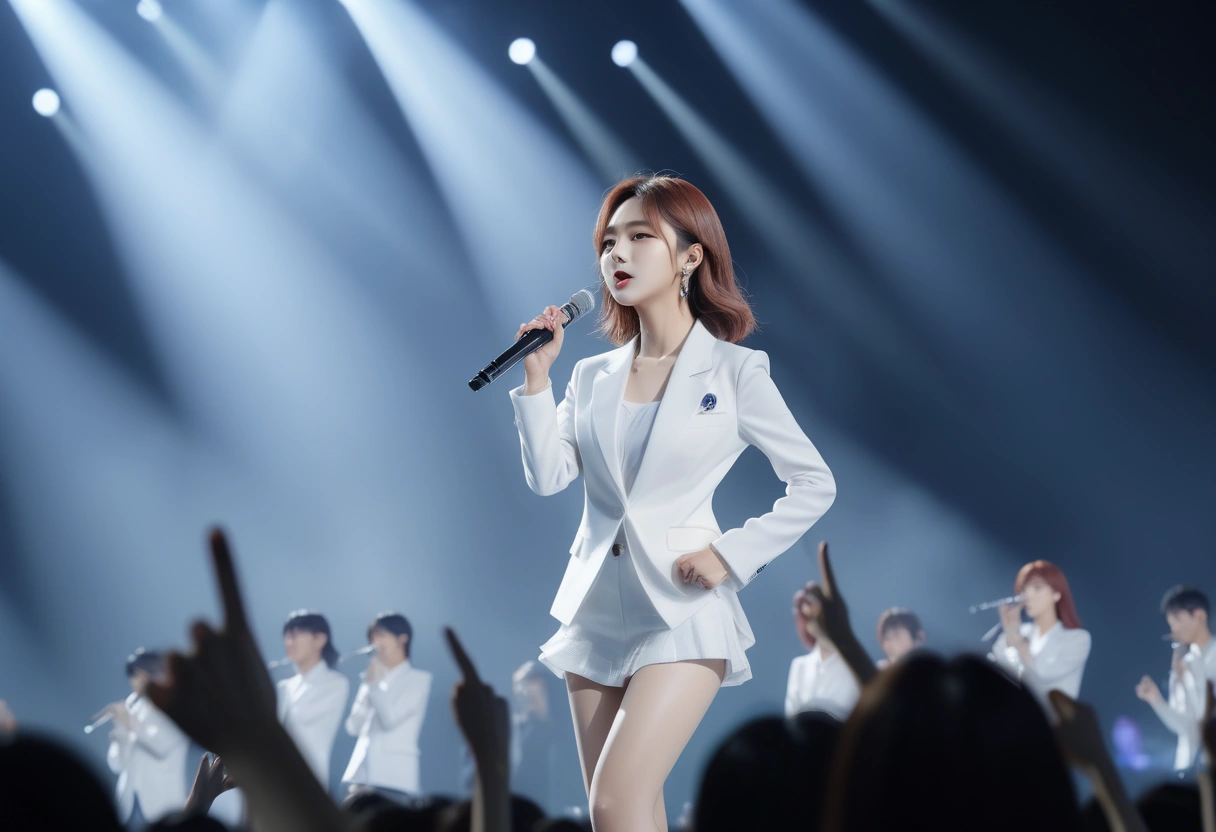
If there is a central takeaway from the Korean coverage, it is that this album is meant to be finished in performance. The group itself has emphasized the stages still to come, and that emphasis is not accidental. In K-pop, songs often achieve their full meaning through repetition across music shows, fan cams, dance challenges and live appearances. A well-built chorus can become more powerful after the fifth performance, not less, because audiences start to anticipate the gestures and expressions attached to it.
That is especially true for a concept like this one, which depends on translating an era into movement and styling. The 2010s influence will not live only in the production. It will show up in hair, makeup, wardrobe choices, camera-friendly poses and the overall performance mood. The question is whether KiiiKiii can make those references feel alive rather than merely referential. Nostalgia is easy to announce. It is harder to embody without turning it into costume.
Still, the group has given itself a useful advantage by not treating nostalgia as a museum piece. The concept, as described, is less “remember this?” than “here is a fun way to use that memory right now.” That distinction matters. The strongest pop revivals do not demand historical literacy from the audience; they reward it, but they do not require it. A listener does not need a detailed recollection of early-2010s fashion blogs or synth-heavy chart hits to enjoy a bright summer hook. But if they do have those reference points, the song and album may carry an extra layer of recognition.
For KiiiKiii, that is probably the right formula at this stage. The group is still defining itself, and this release suggests it plans to do so not by narrowing its image too quickly but by proving it can absorb multiple aesthetics while maintaining a recognizable tone. In an industry where novelty is constant and competition is unforgiving, that flexibility can be a major asset.
Whether WhyKiiiKiii becomes a breakout moment or simply another well-executed seasonal release, it reflects something larger about where K-pop is now. The genre remains exceptionally adept at taking fragments of global pop memory — a beach destination, a decade’s worth of style cues, a sticky synth hook — and rebuilding them into something polished, portable and performance-ready. KiiiKiii’s new album does not just ask why this group. It asks what kind of summer feeling still connects across borders, platforms and generations. Its answer is straightforward: bright melodies, playful confidence, a little nostalgia and the promise that the full picture will come into focus under the stage lights.
Comments
Post a Comment