KATSEYE’s Billboard No. 1 Signals a New Phase of K-pop’s Global Strategy — and a Bigger Stakes Game in the U.S.
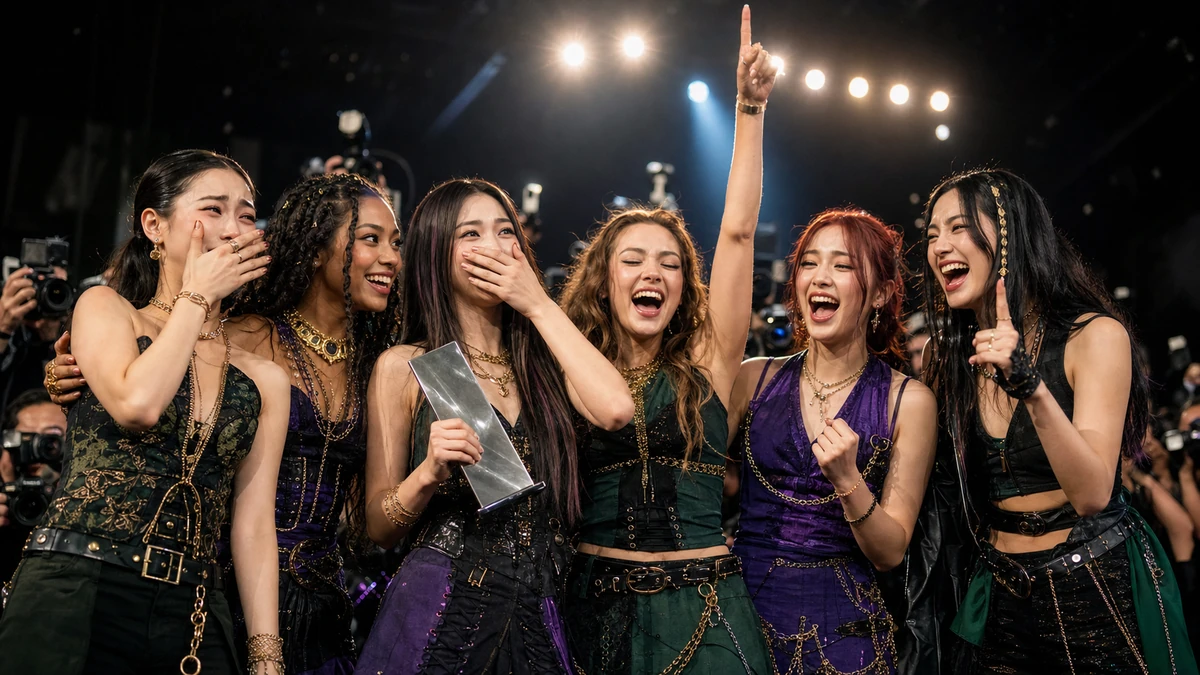
Image to help understand the article
A Billboard breakthrough that means more than a chart win
KATSEYE’s first No. 1 album on the Billboard 200 is, on its face, an easy story to summarize: a rising girl group scored the biggest album in the United States for the week. But the details around that achievement make it far more significant than a routine pop-chart victory. The group’s third EP, WILD, debuted atop Billboard’s main album chart with 170,000 equivalent album units, according to Billboard’s early chart report, beating releases by Phoebe Bridgers and Stray Kids. It also landed at No. 1 on the Top Album Sales chart, driven by 145,000 in traditional album sales, while adding 24,500 streaming equivalent units and a small contribution from track downloads.
For American readers, that mix matters. In the streaming era, a No. 1 album can arrive on the strength of passive listening alone, a viral hit, or a sharp but short-lived burst of digital attention. KATSEYE’s numbers suggest something broader and more durable: a fan base willing to buy albums in meaningful quantities, paired with enough streaming traction to show the music is not living only inside a tightly organized fandom bubble. In music-business terms, that combination is powerful. It suggests an act with both conversion and reach — the ability to turn enthusiasm into purchases, and the ability to attract repeat listening across the platforms that now shape mainstream pop.
The chart result also follows another strong international showing: WILD reached No. 2 on the U.K.’s Official Albums Chart Top 100. That places KATSEYE in a rare position for a relatively new act. Within a short time, the group has shown it can compete in the two most closely watched album markets in the English-speaking pop world. That is not simply a sign of fandom intensity. It is evidence that the group has become legible — commercially and culturally — to audiences beyond the core K-pop fan community.
And that is where the story becomes bigger than KATSEYE alone. This is not just another example of a successful Korean act exporting music overseas. It is increasingly being read, including by Korean analysts, as proof of a broader shift: from “Made in Korea” to “Made by Korea.” In other words, the center of gravity may be moving from finished Korean idol groups entering the U.S. market to Korean-style pop production methods being used to create globally oriented acts from the ground up.
That distinction may sound subtle, but it carries major implications for the future of the music business, especially in the United States. If K-pop is no longer defined only by the nationality of its members or the language of its songs, but by a production system — intensive training, synchronized performance, visual storytelling, concept-driven releases and tightly integrated fan engagement — then what counts as “K-pop” is changing in real time. KATSEYE’s No. 1 debut is one of the clearest signs yet that American audiences are not just consuming Korean pop as an import. They are increasingly embracing a model that can be localized and rebuilt for the global mainstream.
Why KATSEYE is different from the K-pop groups Americans already know
American pop fans are already familiar with the biggest names of K-pop’s global rise. BTS became a stadium act and a cultural force. BLACKPINK established itself as both a chart presence and a luxury-fashion juggernaut. TWICE, NewJeans and Stray Kids helped turn K-pop from a niche category into a recurring part of the American commercial landscape. But KATSEYE occupies a different lane in that story.
The group is described in Korea as a U.S.-Korea joint project, and that framing is crucial. Rather than a conventional Korean idol group made up solely of Korean members and trained for export, KATSEYE represents a hybrid model: Korean idol-development know-how fused with the instincts and commercial language of the American pop market. That includes not just sound, but presentation — how songs are structured, how performances are staged, how visual identity is built, and how individual personalities are woven into a broader group narrative.
For readers less familiar with K-pop as an industry, this is an important point. In the United States, a pop act is often understood first through the artist’s voice, songwriting, celebrity persona or social media presence. In K-pop, by contrast, the “system” itself is often central. Entertainment companies typically build groups through long training periods and highly coordinated development across vocals, dance, styling, variety content, visuals and fan communication. Songs are only one part of the product. The total package — the choreography, the concept, the video language, the group chemistry, the release strategy — is often what gives K-pop its distinctive force.
KATSEYE appears to be benefiting from exactly that system, while presenting it in a way that feels more immediately accessible to Western pop listeners. The Korean reporting on WILD describes a formula in which mainstream pop’s broad listenability meets the precision performance and high-concept visual grammar that K-pop has refined over the past decade. The title track, “Hootie Frutti,” is framed as a percussion-forward pop song with heavy drum accents, witty lyrics and a bold music video. The album as a whole centers on self-acceptance, instinct and freedom — themes familiar to American pop audiences, but delivered through a performance architecture associated with K-pop.
That combination helps explain why KATSEYE’s success may feel different from prior crossover moments. This is not just K-pop “breaking into” America again. It is a case of Korea’s entertainment-development model being adapted to America’s pop ecosystem in a way that does not require listeners to choose between categories. Fans can hear it as pop. Industry watchers can see the K-pop framework underneath it. Both can be right.
What the numbers say about fandom, format and staying power
Billboard 200 math can be arcane to casual readers, but the composition of KATSEYE’s chart total tells an unusually useful story. Of the 170,000 equivalent album units credited to WILD, 145,000 came from traditional album sales. Another 24,500 came from streaming equivalent albums, with 500 from track equivalent albums, a category tied to digital track downloads. In plain English: people did not just sample this record. They bought it.
That matters because album buying in 2024 and 2025 is less a default consumer habit than a statement of commitment. For most artists, especially younger ones, streaming dominates. Physical and digital album purchases tend to come from superfans, collectors or consumers motivated by merchandise bundles, special editions or loyalty to an act. K-pop has been particularly effective at building this kind of demand, often through collectible packaging, multiple versions and fan-oriented release strategies. Critics sometimes dismiss those mechanics as artificial. But the commercial reality is more complex. If fans are paying, collecting and returning, that is still market power — and an increasingly valuable kind in a music economy often overly dependent on low-margin streams.
At the same time, KATSEYE’s streaming total suggests WILD was not sustained only by the kind of physical-sales engine that can produce a splashy debut and then disappear. Twenty-four thousand five hundred streaming equivalent units is not incidental. It signals active listening beyond the transaction itself. For an act operating at the intersection of K-pop and Western pop, that matters because it hints at wider usability: songs people will replay, not just albums people will purchase to support the act.
The broader significance is that KATSEYE seems to be activating multiple pathways to chart success at once. In today’s industry, artists often specialize in one route. Some dominate streaming but lack buyers. Some have niche but intense purchasers without mainstream listening scale. Some go viral on short-form video but struggle to translate that into full-project performance. WILD appears to have avoided dependence on any single lane. That does not guarantee long-term durability, but it is one of the healthiest signals a young group can send to labels, promoters, advertisers and international partners.
It also helps explain why the accomplishment stands out even in the increasingly crowded field of K-pop-related chart stories. American audiences have grown used to splashy first-week sales from Korean acts. The important question now is no longer whether K-pop fandom can organize. It can. The question is whether the model can keep evolving as the audience broadens. KATSEYE’s numbers suggest that evolution is underway: fandom remains the engine, but accessible pop construction may be widening the vehicle’s appeal.
The American angle: why this matters in the United States
For the U.S. music business, KATSEYE’s No. 1 debut is not just a feel-good international success story. It is a live case study in how the American market may increasingly absorb Korean entertainment methods, not merely Korean acts. That is a meaningful distinction for labels, management firms, streaming platforms, concert promoters and brand partners trying to figure out what the next decade of pop looks like.
For years, American companies treated K-pop as both a phenomenon and an exception — a high-engagement import with unusually disciplined fandoms, elaborate visuals and strong merch economics, but one that still sat partly outside the mainstream U.S. artist-development system. KATSEYE complicates that view. If a group shaped through Korean-style development can top the Billboard 200 while functioning within an English-speaking pop market, then the Korean model is no longer just something American companies license, distribute or imitate from afar. It becomes a direct competitor, collaborator and template.
That has implications for how U.S. labels develop acts. American pop has long prized authenticity, or at least the appearance of it: the singer-songwriter narrative, the self-made star, the confessional voice, the viral personality who “breaks naturally.” K-pop has often been more comfortable foregrounding construction — training, polish, team-based creativity and concept discipline. If American audiences are increasingly willing to embrace acts built through that more openly engineered system, then the old binary between “manufactured” pop and “authentic” pop may matter less than executives once assumed. U.S. pop has, of course, always been manufactured to some degree, from Motown to boy bands to Disney pipelines. KATSEYE may simply be making the machinery more visible again.
There is also a U.S.-Korea relationship angle worth watching. Cultural exchange between the two countries has deepened over the past decade, from streaming television and film to beauty products, food and music. K-pop’s success in America has already helped expand South Korea’s soft power — a term used to describe cultural influence that shapes public perception and economic opportunity. But KATSEYE suggests a next step, one less about Korean culture as a foreign export and more about Korean production expertise becoming embedded in globally consumed entertainment. For U.S. companies, that makes Korean partners not just content suppliers, but strategic architects.
American fans are likely to feel that shift first. Many already move fluidly between genres, languages and national industries. Younger listeners in particular are less invested in rigid category lines than previous generations of radio and retail consumers were. To them, the difference between “K-pop,” “global pop” and “American pop” may be less important than whether a song works, a performance feels exciting and an act has a compelling identity. KATSEYE’s rise fits that environment well.
There are parallels here to earlier moments in U.S. pop history. American music has repeatedly absorbed outside systems and influences — British rock, Latin pop, Caribbean rhythms, Scandinavian songwriting, Afrobeats collaborations. What is different in this case is that the import is not just a sound. It is a production philosophy. If that philosophy proves durable in the United States, the impact could extend far beyond one group’s chart peak.
From “Made in Korea” to “Made by Korea”
One of the most revealing ideas in the Korean coverage of KATSEYE’s success is the shift from “Made in Korea” to “Made by Korea.” The phrase captures a structural evolution in how Korean pop influence operates globally. For years, the standard model was straightforward: Korean companies created Korean groups in Korea, then exported them abroad through touring, social media, local distribution deals and English-language promotion. That model remains highly successful. But it depends, at least in part, on crossing a cultural and linguistic border after the product is complete.
The newer model is more flexible. Instead of exporting only finished acts, Korean companies and producers can export the system itself — the methods of training, storytelling, performance design, release sequencing and fandom cultivation. Under that framework, a group does not need to look like a traditional Korean idol act in order to express K-pop’s industrial DNA. The “K” in K-pop becomes less about passport or language and more about a set of creative and commercial practices.
This matters because it expands the ceiling for global growth. There are only so many markets where a fully Korean-language or Korea-centered act will be able to scale at the highest mainstream level, even with the genre’s enormous international fan base. But a localized group built with K-pop methodology can meet audiences where they are, in the language and cultural frame most natural to them, while still benefiting from the proven strengths of the Korean system.
KATSEYE’s success offers a persuasive early argument for that approach. The group’s achievement on both the U.K. and U.S. album charts suggests this is not a one-market experiment. It also suggests that global listeners may be increasingly responsive to a package that blends familiar pop sounds with the kind of discipline and visual coherence many associate with Korean acts. In effect, Korea’s entertainment industry may be doing what Hollywood, Nashville and other major cultural centers have long done: turning a domestic model into an exportable global framework.
That does not mean national identity disappears. On the contrary, Korean cultural influence remains central to why this system carries prestige in the first place. But it does mean the rules of membership are changing. A decade ago, many people asked whether K-pop could succeed in America without losing what made it distinct. Today, a different question is emerging: can the methods that made K-pop successful reshape pop music globally, even when the resulting acts do not fit older definitions of the genre? KATSEYE’s No. 1 suggests the answer may be yes.
The lineage of girl-group success — and the shift KATSEYE represents
There is also a gender and industry-history dimension to this moment. KATSEYE joins a short but notable list of female groups to reach No. 1 on the Billboard 200 in the post-2020 K-pop era, following BLACKPINK’s BORN PINK, NewJeans’ Get Up and TWICE’s With YOU-th. That is significant on its own. Girl groups have long played an outsize role in shaping K-pop’s visual language, choreography trends and youth-market appeal, even as the global touring and album-sales conversation has sometimes focused more heavily on boy groups.
But KATSEYE’s case extends the lineage rather than simply repeating it. BLACKPINK, NewJeans and TWICE each symbolize, in different ways, the international reach of groups formed within Korea’s existing idol framework. Their success helped normalize the idea that Korean girl groups could compete directly in the U.S. market at the highest levels. KATSEYE points to a further stage, in which the underlying system can generate top-tier results through a globally configured act rather than a conventionally Korean one.
That evolution could matter especially for how companies think about female-group strategy. Girl groups in the United States have historically had a more fragile commercial life cycle than solo female stars, despite major exceptions from The Supremes to Destiny’s Child to Fifth Harmony. The reasons are familiar: label priorities shift, member identities can be hard to balance, and the American market often struggles to sustain group acts over the long term. K-pop, by contrast, has developed a more reliable institutional model for maintaining group identity, nurturing fan communities and building narratives around comeback cycles. If that model translates well to English-language, globally marketed girl groups, it could reopen a lane that the U.S. industry has often underused.
In that sense, KATSEYE’s success is not just about one album or one week at No. 1. It is about the possibility that the girl-group format — long beloved, periodically revived, but rarely stabilized in modern U.S. pop — may find new life through Korean-style systems. For American executives and artists alike, that is a trend worth studying closely.
What to watch next
The most interesting question now is whether KATSEYE’s breakthrough becomes a blueprint. One chart-topping debut does not prove a model at scale. The music industry is full of one-off phenomena that looked like structural change until the next release cycle arrived. Still, several indicators will determine whether this moment marks a real turning point.
First is repeatability. Can KATSEYE sustain attention beyond the first week and turn WILD into a longer commercial arc? Follow-up streaming, radio exposure, social-video traction, ticket demand and brand partnerships will all matter. So will whether the group can maintain a coherent identity as expectations rise. In pop, the second big test often comes after the breakthrough, when novelty fades and the audience decides whether to stay.
Second is industry imitation. If American and international labels begin investing more seriously in groups built through Korean-influenced training and rollout systems, KATSEYE will look less like an anomaly and more like an early mover. That does not mean every company will suddenly start launching idol-style acts. But it could mean more hybrid development strategies, more cross-border partnerships and more attention to the aspects of K-pop that have been hardest for Western companies to replicate: discipline, consistency and community-building.
Third is audience definition. One of the most important developments in global pop over the past decade is that audiences no longer behave as neatly as industry categories once assumed. Fans jump between languages, platforms and markets with ease. If KATSEYE continues to draw both traditional K-pop fans and broader pop listeners, it will reinforce the idea that genre borders are weakening faster than institutional labels can keep up.
For now, the clearest takeaway is that KATSEYE’s No. 1 album is not simply another Korean Wave headline. It is evidence that the Korean Wave itself is evolving. The old story was about Korea exporting culture successfully to the West. The emerging story may be about Korea exporting a system — one capable of reshaping how pop is made, marketed and understood in the United States and beyond.
That is why WILD matters. The album’s success shows that a group born from a U.S.-Korea hybrid model can win in America’s most visible album race while also signaling something larger about the future of music. For fans, it is a milestone. For the industry, it is a warning shot — and perhaps an invitation. The next era of pop may not belong to one country’s sound. It may belong to the countries, companies and artists that learn how to build across borders most effectively. Right now, KATSEYE looks like one of the strongest examples of that future arriving.
Comments
Post a Comment