Lee Kang-in Opens His Atletico Madrid Era in Seoul, Turning a Preseason Loss Into a Homecoming Moment
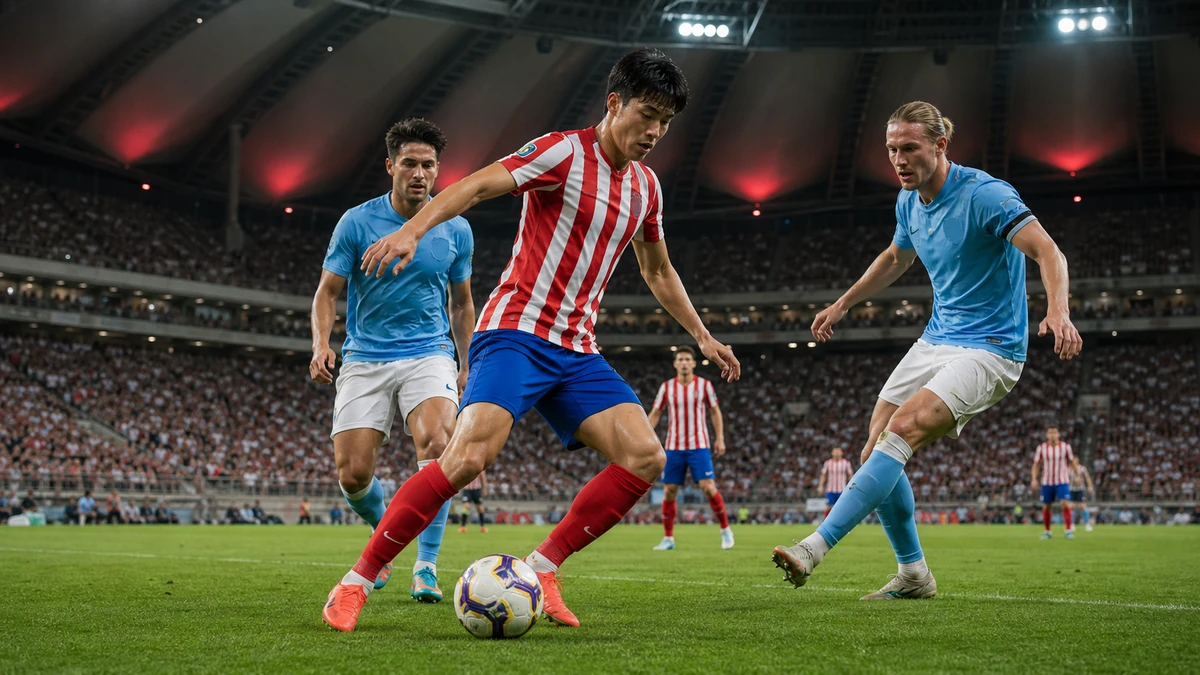
Image to help understand the article
A debut measured in more than goals
SEOUL — On paper, it was only a preseason friendly, the kind of August exhibition that usually matters less for the score line than for fitness, chemistry and marketing. Manchester City beat Atletico Madrid 3-1 at Seoul World Cup Stadium on Saturday, overturning an early Atletico lead and reminding everyone why Pep Guardiola’s club remains one of the standard-bearers of European soccer. But inside the stadium, and across South Korea’s soccer-obsessed media landscape, the result was almost beside the point.
The real story was Lee Kang-in, the South Korean midfielder whose first appearance in Atletico Madrid’s red-and-white stripes served as both a club debut and a national event. Lee entered in the 64th minute, heard a roar that far exceeded the stakes of a summer exhibition, and began what many Korean fans hope will be the next major chapter in one of the country’s most closely watched soccer careers.
For American readers, the atmosphere would have felt less like a routine exhibition and more like a superstar homecoming game — something closer to an NBA All-Star-level crowd greeting a local favorite back in his hometown, or a baseball crowd turning out not just for the matchup but for the symbolic first appearance of a franchise-changing player. The stands at Seoul World Cup Stadium held 50,078 spectators, and they were not there simply to watch two famous European clubs run through preseason minutes. They came to see one of Korea’s biggest soccer names step onto a new stage.
That stage, importantly, was home turf. Seoul World Cup Stadium is one of the symbolic centers of Korean soccer, closely tied to the national team and to some of the sport’s most meaningful moments in the country. For Lee to make his Atletico debut there, rather than quietly in Spain during a closed-door summer tuneup, gave the occasion an emotional weight that statistics cannot fully capture.
In South Korea, where European club soccer commands massive attention and top Korean players abroad are followed with extraordinary intensity, Lee’s move to Atletico is not being treated as a routine transfer. It is being read as a measure of how Korean talent continues to travel deeper into the highest levels of the global game. Saturday’s match offered fans an early glimpse, even if only a partial one, of what that next step might look like.
Why Lee Kang-in matters in South Korea
Lee is not just another export from Asia to Europe. He is one of the most recognizable faces of the current South Korean national team and one of the country’s most technically gifted midfielders, a player long associated with creativity, close control and the ability to change a game with a pass, a dribble or a set piece. Korean fans have watched his development for years, first as a youth prodigy in Spain, then as a player who gradually established himself in one of Europe’s toughest environments.
His profile in Korea reflects something American audiences may recognize from the way international stars can come to embody more than their sport. Think of how fans in smaller basketball markets rally around a homegrown NBA standout, or how an American tennis player can become shorthand for the country’s presence on a global circuit. Lee’s career has come to symbolize not just individual success, but Korea’s continuing relevance in world soccer beyond the legacy of Son Heung-min.
That broader context matters. South Korea has produced globally respected players for decades, but there remains intense interest in which young stars can become more than promising names — which ones can anchor elite European clubs, shoulder tactical responsibility and thrive under pressure. Lee’s move from Paris Saint-Germain to Atletico Madrid raises precisely those questions.
He arrives with pedigree. After three seasons at PSG, one of Europe’s most scrutinized clubs, Lee joined Atletico on a long-term deal running through June 2031. The reported transfer fee — 35 million euros, with another 5 million euros potentially attached in add-ons — signals meaningful investment. So does the No. 7 shirt, a number that carries symbolic weight at many clubs and is rarely handed out casually.
In the Korean press and among fans, those details are being interpreted as a sign that Atletico does not view Lee as a short-term experiment or a depth piece who can be rotated in and out without consequence. Rather, the club appears to see him as part of a longer-term plan, someone whose skill set can be molded into a larger role over time. That expectation helps explain why a preseason cameo in Seoul drew so much attention.
A summer exhibition that felt like a statement
By the time kickoff approached, fans in both Manchester City blue and Atletico’s striped red jerseys had already filled the area around the stadium. Hours before the match, crowds gathered outside in scenes familiar to anyone who has attended a major international sporting event: photo lines, team scarves, chants, phone cameras held high and pop-up commerce surrounding a marquee occasion. But there was one visual detail that stood out repeatedly — shirts bearing Lee’s English name and his new No. 7.
When Lee, listed among the substitutes, appeared and waved before the match, the reaction was immediate. The roar was not simply for a popular player. It was for a moment of recognition: one of Korea’s own was beginning again, and he was doing it in front of the people who have followed him most closely.
That is part of what makes preseason tours in Asia so different from the way they are sometimes perceived in Europe or the United States. From the outside, these matches can look like branding exercises — elite clubs extending their reach into lucrative markets. And they are that, in part. But for fans in places like South Korea, Japan or Singapore, these tours can also provide rare in-person access to players and storylines that are otherwise experienced at a distance, often in the middle of the night on television or streaming platforms.
For Korean supporters, seeing Lee debut in person for Atletico transformed the game into something larger than a commercial roadshow. It became a bridge between Korea’s domestic fan culture and Europe’s club elite, a reminder that even when the center of the sport feels geographically distant, Korean players can still stand at its center.
The symbolism of the opponent mattered, too. Manchester City is not just another European club; it is one of the most dominant teams of the modern era, known across global sports audiences in much the same way a dynasty in American sports becomes unavoidable. Facing City in a debut, even in preseason, gave Lee’s first steps with Atletico added visibility and drama.
What happened on the field
Atletico struck first through 16-year-old defender Jorge Dominguez, whose goal gave the Spanish side an early lead and briefly suggested the possibility of an upbeat opening result. But the second half shifted decisively. Manchester City found another gear, and Omar Marmoush scored twice before Rayan Ait-Nouri added a third, sealing a 3-1 comeback win.
Lee entered in the 64th minute. In limited time, he showed flashes of the qualities that have defined him: comfort on the ball, a willingness to take defenders on and involvement in set-piece situations, including a free kick that drew crowd anticipation. Still, this was not the kind of debut that produces instant highlight reels or invites sweeping conclusions.
That restraint is important. Preseason matches are often misleading if treated as final judgments. Players are at different fitness levels, managers experiment with lineups and tactical roles, and the rhythm can swing between intensity and disjointedness. For a recent arrival still acclimating to new teammates and new instructions, a short outing rarely reveals very much about what a player will ultimately become in that team.
Atletico coach Diego Simeone emphasized as much afterward, saying Lee has not yet had extensive training time with the team and needs time to recover match rhythm. In other words, the issue is not whether Lee dazzled in a 26-minute cameo. It is whether he begins absorbing the tempo, movement patterns and tactical demands of Simeone’s system.
That is a different, slower process, and one that does not lend itself to viral overreaction. American fans familiar with a rookie quarterback learning a new playbook, or a star NBA acquisition adjusting to a coach’s defensive scheme, will recognize the dynamic. Talent may be obvious, but fit takes repetition.
Simeone also described Lee as a versatile player whose role could change based on team needs. That remark may prove more revealing than anything that happened during the match itself. It suggests Atletico sees Lee not as a one-position specialist but as a flexible attacking piece, someone who can be deployed differently depending on the opponent, game state and available personnel.
Why the loss may matter less than the adaptation
In a results-driven sport, it can sound counterintuitive to say a 3-1 loss is secondary. But that is often the truth of preseason, especially for clubs integrating new players and evaluating younger ones. Atletico did not hold its lead, and City’s quality eventually told. Yet the match still gave Atletico useful information: a teenager scored, newcomers got minutes, and Simeone had another chance to assess how his team responds under pressure against elite competition.
For Lee, the evening’s importance lay even more clearly in adaptation than output. He is moving not just between clubs, but between environments, expectations and footballing identities. PSG, for all of its pressure and star power, is different from Atletico. Simeone’s teams are typically defined by collective discipline, tactical precision and emotional intensity. Players are expected to understand roles deeply, defend with commitment and respond to the team’s structure rather than simply showcase their individual flair.
That does not mean Lee’s creativity will be suppressed. It means it will need to be integrated. The challenge for him is not merely to produce special moments, but to connect his strengths — his technique, his passing, his ability to operate between lines — with what Atletico needs in different phases of a match.
This is where some of the Korean reaction has been notably sober, despite the excitement. The long contract, the transfer fee and the No. 7 jersey all point to confidence in Lee’s long-term value. But there is also a recognition that one friendly appearance cannot define his place in the squad. The more realistic benchmark is patience.
That may be especially important given how quickly narratives harden around high-profile Asian players in Europe. A strong debut can produce inflated expectations; a quiet one can provoke doubts that say more about the impatience of the commentary cycle than about the player. Saturday’s game offered a healthier frame. Lee appeared, contributed in small ways and began the process of finding his footing.
The meaning of the crowd in Seoul
If the on-field takeaway was measured, the emotional response in the stadium was not. Every time Lee touched the ball, the crowd stirred. When he stood over a free kick, anticipation rose palpably. The fans were reacting not just to the possibility of an immediate goal or assist, but to the feeling that they were witnessing the opening scene of something significant.
In Korean sports culture, the bond between national pride and individual athletes competing abroad can be especially intense. This is not unique to Korea, of course. American fans do it, too, especially in the Olympics or when homegrown stars break into global leagues. But in South Korea, where the number of internationally prominent athletes in certain sports can be relatively small, those figures often carry an outsized representational role.
Lee’s debut was therefore never only about Atletico Madrid. It was also about Korean soccer’s continuing self-image — where it stands now, what it exports and how it is seen abroad. The 50,000-plus crowd responded with the kind of emotional investment reserved for events that feel both personal and national.
Even the location carried added resonance. Seoul World Cup Stadium is commonly referred to in Korean soccer circles as Sangam, shorthand familiar to local fans in the way Americans might refer to Lambeau, the Garden or Wrigley as more than just venues. To debut there in front of a packed house gave Lee a ceremonial entry into his new club life, one framed by the country that first claimed him as a star.
There is also a deeper K-wave angle here. South Korea’s cultural export power is often discussed through K-pop, film, television and beauty products. But sports increasingly belong in that conversation. The global circulation of Korean athletes, and the passionate transnational audience that follows them, is another form of soft power. Lee’s move, like Son’s long Premier League career before him, operates within that same ecosystem of visibility and influence.
Lee’s reaction showed why fans connect with him
What stood out after the match was not triumph. It was Lee’s seriousness. Even on a night that might have tempted a more celebratory tone — a debut with a new European powerhouse, played in front of home fans — Lee reportedly did not simply bask in the occasion. Before fielding questions, he began with words of self-reflection.
That posture resonates in South Korea, where athletes are often expected to balance confidence with humility and to show an awareness that their performances reflect on more than themselves. For American audiences, it may help to think of the way some star players emphasize accountability after a high-profile loss, even when their personal milestone might invite self-congratulation. The instinct is to frame the night not as a party, but as responsibility.
Lee also urged attention to the positive aspects of Korean soccer more broadly, an important detail that widened the lens beyond his own debut. That gesture reinforced the idea that he understands his platform in collective terms. On a night centered on his transfer and his future, he pointed back to the sport at home.
That is one reason Lee has become such a compelling figure in Korean football. He is skilled enough to attract international attention, but grounded enough to maintain credibility with local supporters who want their stars abroad to remain connected to the domestic story. In a media environment that can quickly elevate athletes into brand figures, authenticity still matters, and Lee’s demeanor continues to be part of his appeal.
What comes next for Atletico and for Lee
The immediate question is not whether Lee can become a headline after one preseason outing. It is how Atletico intends to use him once the season’s real demands begin. Simeone’s description of Lee as versatile suggests multiple possibilities. He could be deployed centrally or in wider areas, asked to create, combine or carry the ball depending on the context. The challenge will be less about whether he can play and more about where he can most consistently help Atletico win.
That process will likely take time. He is joining a club with a strong identity, an established manager and a tactical environment that requires trust. Players often need weeks or months, not days, to fully settle into that world. His training load, his chemistry with teammates and the team’s broader needs will shape how quickly he moves from intriguing addition to indispensable contributor.
Still, the signs of belief are already there. Clubs do not hand out long contracts, significant fees and visible shirt numbers without a plan. Atletico appears to view Lee as someone worth building with, not merely around. That matters in a sport where short-term opportunism often defines transfer windows.
For global audiences, including American fans who increasingly follow European soccer through both club allegiance and player-centered narratives, Lee’s next chapter offers a compelling storyline. He is a technically gifted midfielder entering one of Europe’s most demanding tactical systems, carrying the expectations of a soccer-mad country and doing so after arriving from one of the continent’s most glamorous clubs. That is enough to draw attention even before the first meaningful league match.
And for South Korean supporters, the image likely to last is not the final score. It is Lee in Atletico’s striped jersey, stepping onto the field in Seoul as 50,000-plus fans roared their approval. The game ended in defeat, but the larger message was clear: a new era has begun, and a Korean star is once again asking to be measured on one of the sport’s biggest stages.
That is why this night will linger longer than most preseason friendlies do. It was not simply a tuneup between European powers. It was a public handoff from one chapter of Lee Kang-in’s career to another, staged in the city and before the fans who best understand what that journey means.
Comments
Post a Comment