South Korea’s Biggest Comedy Festival Shows How the Korean Wave Is Expanding Beyond K-pop and K-dramas
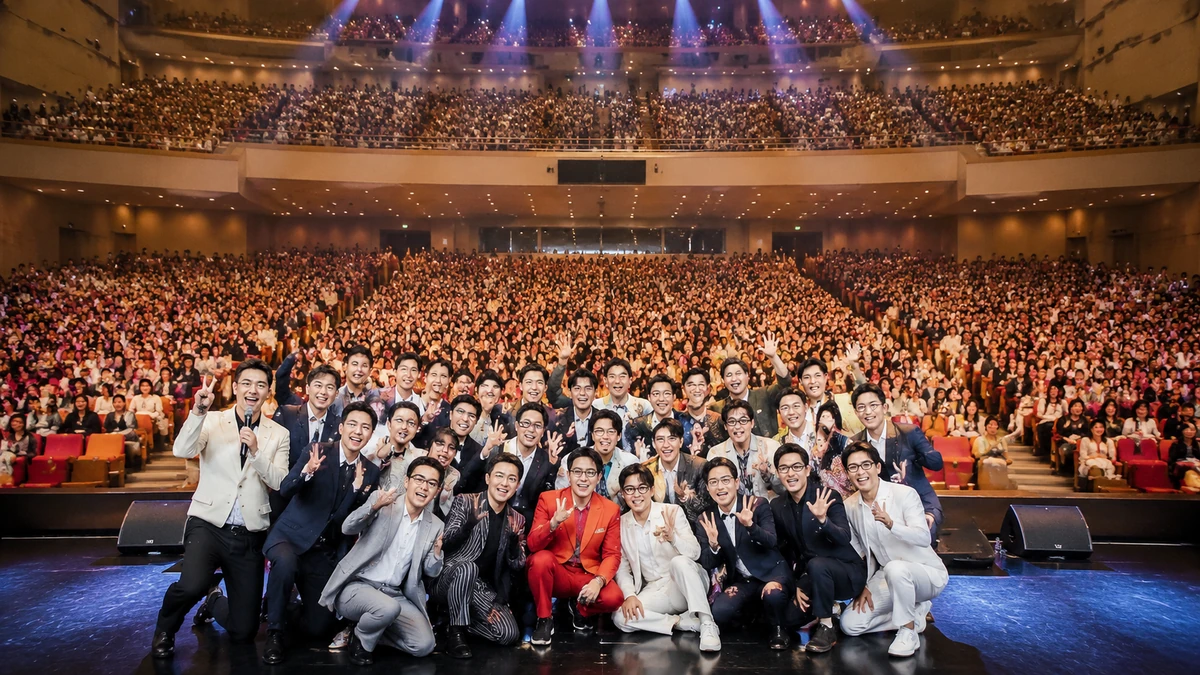
Image to help understand the article
Busan turns comedy into a global stage
For many Americans, South Korea’s global cultural rise is easiest to recognize through a few familiar exports: BTS, Blackpink, Oscar-winning films such as "Parasite," Netflix hits like "Squid Game," and beauty brands that have become fixtures in U.S. retail. But in the southern port city of Busan, another part of Korean popular culture is making a case for international attention: comedy.
The 14th Busan International Comedy Festival opened Aug. 21 at BEXCO Auditorium in the city’s Haeundae district, launching a 10-day run with more than 1,800 audience members filling the venue and performers from 10 countries joining leading South Korean comedians onstage. Organizers describe it as Asia’s largest comedy festival, and the opening made clear that the event aims to be more than a series of shows. It is positioning itself as a showcase for Korean comedy as a cultural ecosystem, one capable of drawing fans, introducing international performers to Korean audiences and widening the idea of what the Korean Wave can include.
That matters because comedy has long been one of the hardest entertainment genres to export. Songs travel. Fashion travels. Prestige TV travels, especially in the streaming era. But jokes are often deeply local, bound up in language, rhythm, class cues, politics and shared memories. A country that can make comedy legible across borders is doing something difficult and significant.
What unfolded in Busan suggests South Korea is trying to solve that challenge not by pretending comedy is universal in the abstract, but by turning the live festival itself into the universal experience. The event’s opening was presented not simply as a formal ceremony, but as a fan-centered spectacle, built around crowd energy, recognizable TV personalities, multigenerational performers and emotionally resonant moments that did not always depend on perfect translation.
In that sense, the Busan festival resembles the logic that helped K-pop become global. It is not just about the content onstage. It is about participation, access, community and a sense that fans are helping complete the performance. In Busan, laughter became the shared language, but so did the mechanics of fandom.
Why the blue carpet matters
One of the most revealing details from the opening was not a joke at all. Before the main event, the festival staged a "blue carpet," a comic spin on the red carpet traditions associated with film awards and celebrity galas. Hosted by comedian Yang Sang-guk, it featured a parade of well-known Korean comedians including Lee Hong-ryeol, Park Jun-hyung, Kim Soo-yong, Park Sung-ho and Park Sung-kwang.
To an American audience, the easiest comparison may be Comic-Con, a late-night TV audience warm-up and a movie-premiere photo line rolled into one. The point is not simply to show stars to the public. It is to collapse the distance between performer and fan before the performance even begins. For a genre like comedy, which thrives on immediacy and rapport, that matters enormously.
South Korean comedy has often been consumed through television, especially sketch and variety programming that builds loyalty around recurring personas. The blue carpet turned that television familiarity into a live ritual. Audiences were not merely waiting for a show to start; they were participating in an event where seeing the comedians in person was part of the entertainment. That may sound ordinary in an era of celebrity branding, but in the context of comedy it reflects a larger shift. The festival is selling not just jokes, but comic culture.
That distinction is important. In the United States, stand-up has built entire business models around touring, podcasts, fan meet-and-greets and viral clips that deepen the bond between comedian and audience. South Korea’s comedy scene has its own traditions and formats, but Busan’s opening signaled a similar understanding: fandom is no longer something that happens after the performance. It is part of the product.
The blue carpet also worked as a cultural translator. International guests did not need fluent Korean to understand the spectacle of fan excitement, the hierarchy of celebrity, or the sense of occasion. They could read the room. That may be one reason festivals like this matter more than isolated TV exports. A live event can communicate tone and status even where words fall short.
A family-friendly turn in Korean comedy fandom
Another notable moment at the opening involved cast members tied to the KBS program "Malja Show," who reportedly drew some of the loudest cheers of the night. Comedians Kim Young-hee and Jung Beom-gyun appeared on the blue carpet, joined by Kim’s daughter, Yoon Hae-seo-yang, while Kim was in grandmother makeup associated with the show’s character work.
That scene may sound highly specific to Korean broadcasting culture, but its broader significance is easy to understand. It illustrated how character-based comedy, family participation and fan intimacy can merge into a live event that is welcoming rather than exclusionary. The child’s appearance brightened the atmosphere and reinforced the idea that comedy is not only an adult-night-out genre, but something that can function as shared family entertainment.
For Americans, there are echoes here of how certain forms of comedy become household culture rather than niche fare. Think of the eras when "Saturday Night Live" catchphrases entered daily conversation, or when family-friendly comics and sketch performers became cross-generational names. In Busan, the dynamic appears less about irony and more about warmth: recurring characters, visual humor, costumes and audience recognition combine to create an instant connection.
That helps explain why Korean comedy may be more exportable than skeptics assume. Wordplay and topical references do not always cross borders, but physicality, costume, facial expression and crowd reaction often do. The festival opening underscored this point. Unlike dialogue-heavy scripted content that depends on subtitles, parts of live comedy can travel through image and atmosphere. Even viewers unfamiliar with the language can understand the emotional contract between stage and audience.
This is a key feature of the broader Korean Wave. Its global success has never depended solely on linguistic comprehension. K-pop broke through internationally not because fans understood every lyric, but because performance, style, choreography and fan participation created a compelling package. Korean comedy may be attempting a parallel route: start with the universally legible elements, then let curiosity do the rest.
The packed opening night, with more than 1,800 people sharing the same reactions in real time, also highlighted another trend that media executives in many countries are wrestling with: audiences increasingly value communal experiences in an age of solitary streaming. Laughter is especially contagious. A crowd does not just consume comedy; it amplifies it. In that sense, Busan is selling something digital entertainment cannot easily replicate.
Comedy, memory and emotional range
The opening ceremony also included a more reflective moment, when comedian Shin Bong-sun took the microphone to promote a one-time Aug. 22 performance titled "Jeon Yu-seong Without Jeon Yu-seong Show." Even without full background detail, the title itself carries emotional weight, suggesting a performance shaped by the presence and absence of a figure important enough to be felt even when not onstage.
That moment matters because it pushes back against a common misconception, both in Korea and abroad, that comedy is by definition lightweight. The Busan festival appears to be making a different argument: comedy can hold grief, remembrance and tenderness without stopping being comedy. In fact, the ability to absorb difficult feeling may be one of comedy’s strengths.
American audiences are familiar with this dynamic. Some of the most durable U.S. comedy traditions, from post-9/11 late-night monologues to stand-up about illness, family loss or political anxiety, rely on the idea that laughter does not erase pain but helps a public process it. The Busan opening seems to gesture toward a similar understanding. By placing exuberant fan service alongside a show framed through absence and memory, the festival presented comedy as emotionally broad rather than tonally narrow.
That is a mature cultural move. It suggests confidence in the audience and in the art form itself. Festivals that want global recognition cannot rely only on novelty. They need texture. Busan’s opening, as described in local coverage, offered that texture by holding joy and poignancy in the same frame.
There is also a strategic dimension here. International audiences often first approach foreign entertainment through genre labels: thriller, romance, horror, music, reality TV. But genres travel better when they reveal complexity rather than stereotype. Korean cinema earned global acclaim in part because it repeatedly demonstrated that a film could be funny, tragic, political and suspenseful all at once. If Korean comedy festivals can communicate similar tonal richness, they may broaden international assumptions about what Korean humor looks like.
What this means for the United States
For Americans, the most important takeaway from the Busan International Comedy Festival is not simply that South Korea hosted a big entertainment event. It is that Korean cultural influence may be entering a new phase, one with implications for U.S. media companies, live event businesses and audiences that already engage deeply with Korean content.
The U.S. market has become one of the most important overseas arenas for Korean popular culture. American concert venues host major K-pop tours. U.S. streamers license and produce Korean series. Korean films and actors now move through the same awards-season and fandom circuits as their Hollywood counterparts. What has lagged behind, by comparison, is comedy. There are reasons for that: humor is notoriously difficult to localize, and U.S. audiences often encounter Korean comedians only indirectly, through variety show clips, dubbed social media segments or crossover appearances.
But Busan’s festival suggests several paths forward that American companies will likely notice. One is the event model. Rather than trying to export individual jokes stripped of context, Korean comedy can travel through curated live experiences, festival packages, touring showcases and fan events where the appeal is broader than punch lines alone. Another is the hybrid model, where television-born characters and digital fandom feed into ticketed in-person performances. That is already a familiar business pattern in the United States, from podcast tours to Netflix comedy festivals. Korean entertainment firms and U.S. partners may see room to adapt it for Korean-language comedy or mixed-format events aimed at diaspora communities and curious mainstream audiences alike.
There is also a talent-development question. If Korean performers increasingly share stages with comics from multiple countries, they gain exposure not only to foreign audiences but to different comedic structures, pacing and performance styles. That exchange could create more performers capable of working across markets, whether through bilingual sets, festival collaborations, writing rooms or unscripted streaming formats. American entertainment has long benefited from importing comic voices shaped by multiple cultural traditions. Korea may become a more active participant in that exchange.
For U.S. audiences, especially younger fans already comfortable moving between subtitles, social platforms and live fandom, the barrier to entry is lower than it once was. A decade ago, Korean comedy might have seemed too embedded in local language and TV references to travel. Today, a generation raised on meme culture, reaction videos, fan cams and cross-border online communities is more accustomed to decoding performance through context clues, visuals and collective response. That does not eliminate the translation problem. It does, however, make the audience more adventurous.
There is a geopolitical dimension, too, even if festivals are not diplomatic summits. U.S.-South Korea ties are often discussed through security cooperation, semiconductor supply chains and trade. Culture offers a softer but still consequential layer to that relationship. The broader and more diversified Korea’s cultural exports become, the more stable and embedded its presence is in American public life. A Korean Wave that includes comedy, not just music and drama, is a Korean Wave with deeper roots.
None of this means Korean comedy is about to become the next K-pop in the United States. Comedy rarely scales the same way music does. But the Busan festival shows that the pipeline is widening, and American media and live entertainment companies would be unwise to ignore that shift.
From one-off event to broader trend
The most interesting way to read the Busan opening is not as a one-night celebration, but as evidence of a larger trend in Korean entertainment. For years, South Korea’s cultural industries have become more sophisticated at building systems rather than hits: trainee pipelines, global fan communities, streaming distribution, festival branding and transnational partnerships. Busan’s comedy festival appears to be applying that system-building mindset to a genre that historically has been treated as more domestic.
The festival’s structure itself tells the story. It brings together veteran comedians and current television figures, performers from 10 countries, family audiences, fan-service rituals and programming that moves between exuberance and emotional reflection. That is not accidental. It is the architecture of a platform. And platforms matter because they can outlast individual stars.
That may be the clearest sign of institutional maturity. According to the reporting from the opening, the festival did not center on one breakout celebrity or one dominant TV franchise. Instead, it presented a broad range of faces and formats, effectively arguing that Korean comedy should be understood as a cultural field, not a single act. For an industry looking to grow internationally, that is the smarter long-term bet. Global audiences may arrive for stars, but they stay for ecosystems.
This is also happening at a moment when live entertainment worldwide is recalibrating. Since the pandemic years, event organizers have had to persuade people that leaving home is worth the effort and cost. Music has managed this through spectacle and fandom. Sports have it built in. Comedy has had mixed results, depending on the market. A festival like Busan’s suggests one answer: make attendance feel participatory, layered and culturally meaningful, not just transactional.
For South Korea, Busan has particular symbolic value in that effort. The city is already internationally associated with major cultural events, especially the Busan International Film Festival. Positioning Busan as a city where global audiences can also encounter Korean comedy extends that identity. It turns the city into a broader performance hub, not just a film destination. That urban branding matters in a competitive regional entertainment landscape where cities increasingly market themselves through festivals and cultural tourism.
What to watch next
The real test for the Busan International Comedy Festival will be what comes after the applause. If the event wants to become a meaningful gateway for Korean comedy beyond Korea, several questions will matter. Can it generate international media attention that goes beyond novelty? Can it create recurring partnerships with overseas festivals, producers or platforms? Can performers translate festival visibility into sustained cross-border careers? And can organizers package Korean comedy in ways that preserve its local character without making foreign audiences feel locked out?
There are reasons for cautious optimism. The ingredients that helped South Korea succeed in other cultural sectors are visible here as well: a strong live audience culture, a fan base ready to participate, performers who move fluidly between broadcast and event spaces, and an industry increasingly aware that global visibility depends on experience design as much as on content creation.
Still, comedy remains hard territory. Unlike pop songs, jokes cannot always be replayed endlessly out of context. Unlike binge-worthy dramas, live comedy often depends on the chemistry of a room. That means festivals may become especially important as laboratories, places where Korean and foreign performers, producers and audiences test what actually travels.
The opening in Busan offered an early answer. Some things do travel: celebrity ritual, crowd energy, visual humor, emotional sincerity and the pleasure of laughing with strangers. Those elements were enough to turn the launch of a 10-day festival into something closer to a fan event with international ambition.
For Americans watching the Korean Wave continue to evolve, that is the larger story. South Korea is no longer only exporting polished music idols and high-concept television. It is increasingly exporting formats of participation, ways of building audience attachment and public rituals that make culture feel communal. The Busan International Comedy Festival, at least in its opening moments, suggests comedy may be the next arena where that strategy is tested.
If it works, the significance will extend beyond Busan, and beyond comedy. It will mean South Korea has found yet another way to make local culture resonate globally, including in the United States, where audiences are more open than ever to discovering that what makes people laugh somewhere else may also reveal how they live, remember and gather together.
Comments
Post a Comment