What South Korea Searched for on Aug. 24 Offers a Window Into a Country Balancing Scandal, Celebrity Giving, Baseball and AI Anxiety
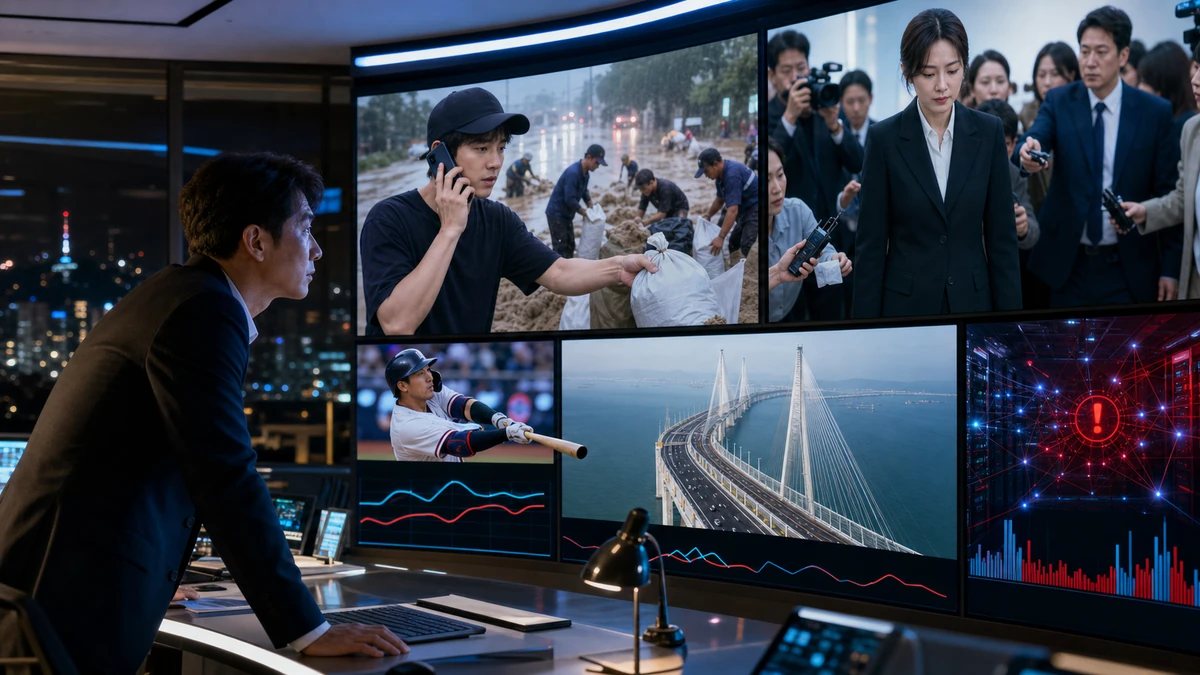
Image to help understand the article
A day of searches that says more than a day of news
If you want to understand what a country is worrying about at any given moment, you could do worse than looking at what people are typing into Google. In South Korea on Aug. 24, the list of fast-rising search terms did not center on one single national drama. Instead, it scattered across politics, celebrity philanthropy, sports, public safety, local government budgets, war fears abroad and a technology outage. That variety is the point.
According to Google Trends’ real-time rankings for South Korea, the biggest spikes included entertainer Kim Hee-chul, former first lady Kim Keon Hee, the baseball term batting average, a supplemental budget, Incheon Bridge, a possible Russian mobilization order, a service disruption involving Anthropic’s Claude chatbot, the Republic of Korea Marine Corps, nursing-related searches and mixed martial artist Choi Doo-ho. Google’s figures are approximate, relative measures of attention rather than hard audience counts. Still, they offer a useful snapshot of what cut through the noise at that moment.
For American readers, this kind of list may sound like a Korean version of trending topics on X, a Google “Year in Search” condensed into a single day, or the way cable news, ESPN, Reddit and local TV can all collide in one news cycle. What stands out in the South Korean case is how tightly national attention can move between very different registers: a celebrity donation for flood victims, remarks tied to a political investigation, a Korean star in Major League Baseball, a deadly bridge safety issue, and concerns about generative AI reliability. The list is less random than it looks. It reveals a society where celebrity still carries civic weight, where politics remains personalized, where sports statistics can become national talking points, and where everyday digital dependence now makes an AI outage newsworthy.
That mix also reflects a broader pattern in modern South Korea: the boundaries between pop culture, public life and state institutions are unusually porous. K-pop stars and TV personalities are not just entertainers. Baseball players are not just athletes. Infrastructure stories are not just local stories. And technology glitches are not mere inconveniences in one of the world’s most hyperconnected societies. A search list like this becomes a social weather report.
Just as important, several of these topics resonate beyond Korea. American baseball fans know Lee Jung-hoo. U.S. tech workers know Claude. U.S. companies do business in Korea and track its political stability, consumer sentiment and digital habits. Korean pop culture has become a durable part of the American entertainment economy. What Koreans search is increasingly not just a domestic curiosity. It can be a clue to where culture, commerce and public attention are headed in both countries.
Why Kim Hee-chul’s donation drew the biggest spike
The day’s most prominent individual search term was Kim Hee-chul, the veteran entertainer best known as a member of the K-pop group Super Junior and as a television personality. Reports said interest surged after coverage that he personally called to donate 100 million won, roughly tens of thousands of U.S. dollars, to help victims of heavy rain. Other headlines mentioned donations from singer Lim Young-woong and from an entertainment company, but the clearest trigger for Kim’s search spike appears to have been the report tied directly to his donation.
To American audiences, celebrity disaster giving is familiar terrain. Think of country stars mobilizing relief after Tennessee floods, Hollywood telethons after hurricanes, or athletes writing large checks after wildfires in California. What makes the Korean version a little different is the extent to which acts of public generosity by entertainers can become a stand-alone national conversation. In South Korea, celebrities are often held to a very high standard of public conduct, and charitable action is frequently treated not only as kindness but as a marker of sincerity, character and social responsibility.
That helps explain why a donation can become one of the country’s top search topics. In the Korean entertainment system, stars are intensely visible and scrutinized. Fans follow not only albums, dramas and variety shows, but also personal conduct, philanthropy and even gestures that imply humility or spontaneity. The report that Kim Hee-chul personally made the call to donate “without hesitation” matters in this context because it fits a Korean media language that emphasizes authenticity. It is not just that money was given; it is that the act appeared immediate and personal.
There is also the broader backdrop of seasonal flood damage. Summer rain disasters in South Korea often trigger national bursts of concern because of the country’s dense urban geography, mountainous terrain and vulnerability to sudden downpours. In that setting, celebrity donations can function almost like civic signals, drawing public attention back to communities in need. For media companies, those stories are clickable because they combine the emotional reach of entertainment with the urgency of disaster coverage.
American readers may be tempted to dismiss that as soft news. But it is better understood as a form of civic storytelling in a media market where pop culture figures often serve as social intermediaries. In the United States, Taylor Swift’s endorsement, LeBron James’ activism or Dolly Parton’s philanthropy can move conversation well outside the entertainment pages. South Korea’s ecosystem works similarly, though often with even more concentrated public attention.
Politics remains personal: Why Kim Keon Hee still commands searches
The other major person-centered search spike involved Kim Keon Hee, the wife of former President Yoon Suk Yeol. Reports highlighted remarks denying suspicions connected to what Korean coverage described as “Dior bag investigation texts.” Based on the summary available, the search rise appears linked most directly to remarks dismissing the idea that Kim Keon Hee was behind certain messages tied to the controversy. The precise authorship of the messages or the broader investigative record cannot be established from the material provided, and that uncertainty matters.
Even with those limits, the search interest is revealing. South Korean politics is often deeply personalized, sometimes in ways that can resemble the tabloidization of power in the United States. Spouses of presidents can become central political figures, not merely ceremonial ones. Allegations involving luxury goods, private influence or informal networks resonate strongly in Korea because they tap a longstanding public sensitivity to privilege, elitism and whether public office is being used in ways ordinary citizens cannot access.
For American readers, the nearest parallel may be the way investigations involving family members of prominent politicians can come to overshadow policy debate. The details differ, but the dynamic is recognizable: once politics is filtered through personality, text messages, gifts and questions of propriety, the story becomes easier for a broad public to follow and harder for political actors to control.
That also helps explain why one name can surge far above more technical public-affairs terms. In most countries, budget amendments or military commemorations rarely outperform controversy tied to a major political figure. South Korea is no exception. Search behavior suggests that when institutional disputes become legible through a face and a name, audiences engage more readily. The story becomes not only about law or procedure, but about trust.
This is part of a larger trend in Korea’s media culture, where political communication increasingly competes in the same attention economy as celebrity news. Scandal, image and relatability matter. That does not mean the underlying issues are trivial. It means that digital audiences often enter the issue through recognizable personalities, then decide whether the institutional substance is worth following further.
Baseball, Lee Jung-hoo and the globalization of a Korean sports conversation
One of the more telling entries on the list was not a person’s name but the word “batting average.” The apparent reason was a report that Lee Jung-hoo of the San Francisco Giants went hitless in a game against Boston, dropping his average to .289. Other coverage noted that his August batting average had dipped further. The fact that the trending query centered on the stat, not just the player, suggests Korean readers were tracking the numerical threshold itself.
That may sound like a niche baseball detail, but it captures something bigger about how Koreans follow athletes who make the jump to U.S. leagues. For Korean fans, Lee is not simply another MLB outfielder. He is part of a familiar national script: a domestic star heads to America, and every slump, streak and milestone becomes a referendum on adaptation, pressure and international standing. The number .289 matters because it marks movement, and movement is the story.
American fans know this dynamic from other directions. Japanese stars entering MLB have long been tracked not just as individual players but as symbols of how foreign talent translates into the American game. Korean fans now watch Lee through a similar lens, one shaped by pride, expectation and constant statistical monitoring. In a baseball culture where numbers are language, a drop below .290 can take on outsized symbolic meaning.
There is also a uniquely trans-Pacific element here. A Giants box score in the United States becomes a trending search in South Korea because MLB is no longer just a foreign league there; it is part of Korea’s own sports identity. That has commercial implications too. Korean broadcasters, advertisers and sports platforms all benefit when local interest in Korean players abroad stays high. American teams increasingly understand this. Signing a player from Asia can bring not only on-field value but also new media attention, merchandise sales and international audience engagement.
Lee’s search momentum on this day is therefore about more than one hitless night. It reflects how the Korean public now experiences American sports as partially domestic. That is a meaningful shift. Just as Premier League clubs learned that global fandom changes the significance of local results, MLB teams are learning that a Korean player’s routine stat line may travel far beyond the U.S. sports page.
What this means for the United States
For Americans, this Korean search snapshot is not just an interesting foreign-media artifact. It is evidence of how deeply intertwined the U.S. and South Korean attention economies have become. At least two of the day’s major search drivers were directly connected to American life and business: Lee Jung-hoo’s Major League performance and the disruption involving Claude, the AI service made by U.S.-based Anthropic. Even the entertainment and political stories carry implications for American companies, audiences and institutions that increasingly operate in Korea-facing markets.
Start with baseball. Lee Jung-hoo plays for a flagship American franchise in one of the country’s most internationally visible leagues. His nightly statistics are consumed in Korea almost as closely as domestic sports news, which means MLB is not simply exporting games; it is participating in Korea’s national conversation. For American sports executives, that matters. It strengthens the business case for deeper engagement in Korea, from media rights to sponsorships to targeted fan outreach. It also illustrates how Korean stars can expand the league’s footprint without the league itself changing much at all. One player’s batting average becomes a bridge between markets.
Then there is AI. Claude’s outage trended in Korea because generative AI tools are no longer confined to Silicon Valley engineers or American office workers. They are part of everyday professional and consumer life in a country that is often quicker than the U.S. to normalize new digital habits at scale. When a U.S. AI service fails in Korea, the story is not only about downtime. It is about trust in American platforms, dependence on foreign tech infrastructure and the rising expectation that AI products work like utilities rather than experiments.
That is a message U.S. companies should hear clearly. South Korea is one of the world’s most sophisticated test markets for digital products. If Korean users treat an AI outage as headline-worthy, American firms should assume reliability, transparency and customer communication are becoming competitive necessities, not premium features. U.S. tech companies often talk about global rollout; Korea shows what global accountability looks like.
The celebrity donation story also travels. American entertainment companies, labels, streamers and promoters increasingly work with Korean talent or compete alongside them. Korean audiences’ responsiveness to a star’s charitable gesture reflects a broader expectation that public figures carry social obligations. As K-pop and Korean television become more embedded in the U.S. market, American partners are effectively entering a culture in which reputation management, philanthropy and public conduct are tightly linked. That is not entirely different from Hollywood, but the intensity and speed of audience reaction in Korea can be striking.
Politically, the Kim Keon Hee search surge is a reminder that South Korea remains a high-attention democracy where controversies involving top figures can move quickly and shape public mood. For Washington, U.S. investors and multinational companies, domestic Korean political trust is not an abstract matter. South Korea is a treaty ally, a major technology producer and a central player in supply chains tied to semiconductors, batteries, autos and defense. Even when a search term appears narrowly scandal-driven, it sits inside a broader question of institutional confidence in one of America’s most important partners in Asia.
In short, Americans should read this trend list not as a curiosity from overseas but as a map of interdependence. Korean search behavior now intersects directly with U.S. sports, U.S. technology, U.S. entertainment strategy and U.S. foreign policy interests. The relationship runs both ways: American products shape Korean attention, and Korean attention increasingly shapes how American industries think about global audiences.
Local budgets, bridge safety and the search for practical information
Not every trending term was glamorous. Some of the most revealing were intensely practical. Searches rose around supplemental budgets as multiple local governments announced new spending packages, including measures connected to disaster response and support for residents. In another entry, Incheon Bridge trended after reports that authorities would install anti-fall facilities on a bridge that has been linked to repeated fatal falls since opening. The summary notes that specific figures differed across headlines, including the stated height of barriers and the number of deaths, so any single number should be treated cautiously here.
What matters more than the precise figures is the public response. Koreans were not only searching for celebrities and scandal; they were also searching for fiscal decisions and infrastructure safety. That combination says something important about digital news habits in a mature, wired democracy. Audiences do not separate “hard” and “soft” news as cleanly as editors often do. The same person can search a K-pop star’s donation, a former first lady’s controversy and a bridge safety intervention within the same hour. The attention economy looks chaotic, but it often reflects ordinary citizens trying to stay oriented in daily life.
For Americans, the parallels are easy to recognize. Search spikes around state budgets after storm damage, or around bridge safety after a string of deaths or accidents, would not feel out of place in the United States. What is notable in Korea is how efficiently local governance stories can be lifted into a national search stream. That is partly a function of the country’s smaller size and highly networked media environment. A municipal budget revision in one region can still register widely if it touches cost-of-living support or disaster preparedness.
The Incheon Bridge story is especially resonant because it sits at the crossroads of urban design, mental health, public safety and government accountability. In the U.S., similar debates have surrounded suicide barriers on major bridges, platform doors in transit systems and other “means restriction” interventions aimed at preventing deaths. When such stories trend, they often do so because they force a society to confront a painful question: when repeated tragedies become visible, how long can authorities delay physical prevention measures?
That this topic reached South Korea’s top search list suggests public demand for practical action, not just sympathetic rhetoric. Search behavior here functions almost like a referendum on whether institutions are responding adequately to known risks. In a moment otherwise crowded by celebrity and politics, that is easy to overlook. It should not be.
From Russia to the Marine Corps to nursing: a fragmented but meaningful public agenda
Several other trending terms were smaller but still revealing. Searches for a possible Russian mobilization order appear to have been driven by international coverage warning of that possibility rather than confirmation that such an order had actually been issued. Interest in the Republic of Korea Marine Corps was linked to regional reports about a commemorative event in Jeju honoring veterans and military spirit. Nursing-related searches were apparently tied to university admissions coverage, though the summary makes clear the connection was not fully explicit in the headline material provided. Choi Doo-ho, a Korean mixed martial artist known to many fight fans as “The Korean Superboy,” also appeared in the rankings, though the exact trigger was less clear because the available headline was truncated.
Looked at individually, these are minor blips. Looked at together, they suggest how broad the Korean search agenda has become. International security, military identity, higher education and combat sports all had enough traction to break into the same national top 10 as celebrity philanthropy and political controversy. That is a reminder that trending lists do not merely reward sensationalism. They also surface the connective tissue of everyday citizenship: parents looking at admissions, veterans following commemorations, fight fans checking a bout, readers monitoring war risk abroad.
For an American audience, the military references deserve a little context. South Korea’s armed forces occupy a much more immediate place in public consciousness than they do for most Americans because of the country’s security environment and mandatory military service for men. A Marine Corps commemorative event can carry civic symbolism beyond what a regional veterans’ gathering might typically command in the United States. Likewise, a search spike around a possible Russian mobilization order lands differently in South Korea, where the war in Ukraine is not geographically close but still speaks to broader anxieties about deterrence, alliances and regional instability.
The nursing-related search interest points to something quieter but equally important: the relentless social significance of education and career pathways in Korea. Even a vague admissions headline can stir attention because higher education choices are closely tied to household strategy, status and job security. In that sense, the trend list contains not just breaking news but also traces of longer-running structural concerns.
What to watch next in Korea’s search-driven attention economy
If there is a larger lesson in this one-day snapshot, it is that South Korean public attention is increasingly organized around crossover stories — topics that can move between civic importance and emotional immediacy. Celebrity giving matters because weather disasters matter. A politician’s spouse trends because institutions are judged through personalities. A batting average trends because Korea’s place in American sports now feels personal. An AI outage trends because digital tools have moved from novelty to necessity.
That is likely to continue. As Korean and American markets become more intertwined, more stories will carry this dual life: domestic in origin, international in consequence. U.S. tech outages will become Korean consumer stories. Korean athletes in American leagues will become trans-Pacific identity stories. Korean celebrity conduct will shape entertainment partnerships far beyond Seoul. And local Korean governance issues, from safety infrastructure to emergency spending, will increasingly be read by foreign investors and policy watchers as signals about social stability and state responsiveness.
For journalists, the challenge is not to overread a trending list. Search spikes are suggestive, not definitive. They reflect curiosity, confusion, concern and sometimes simple novelty. They do not tell us what people believe, only what they wanted to know more about in a given moment. But in a media environment where audience attention is fragmented and platform-driven, that is still valuable evidence.
On Aug. 24, South Korea’s rising searches painted a country that was not focused on just one thing. It was thinking about generosity and suspicion, performance and safety, local budgets and global war, commemorative identity and machine reliability. That patchwork may feel messy. It is also modern. Americans living through their own fractured news cycles should recognize it immediately.
And that may be the deepest U.S.-Korea connection here. The two countries now share not just alliances and trade, but a common experience of public life filtered through platforms, personalities and constant statistical feedback. In that world, a list of searches is never just a list. It is a portrait of what a society fears, admires, tracks and expects — and increasingly, those portraits are becoming legible across borders.
Comments
Post a Comment