
Image to help understand the article
A day of search spikes becomes a map of South Korea’s anxieties
One of the easiest ways to see what a country is worrying about on any given day is not to watch a speech or read a party platform. It is to look at what people are searching for online. In South Korea on Aug. 26, 2026, Google’s real-time trending list offered a revealing snapshot: political combat, defense-industry competition, questions over public appointments, celebrity gossip, sports drama and a smattering of local and international news all jostled for attention. The biggest pattern was not a single event so much as a national mood.
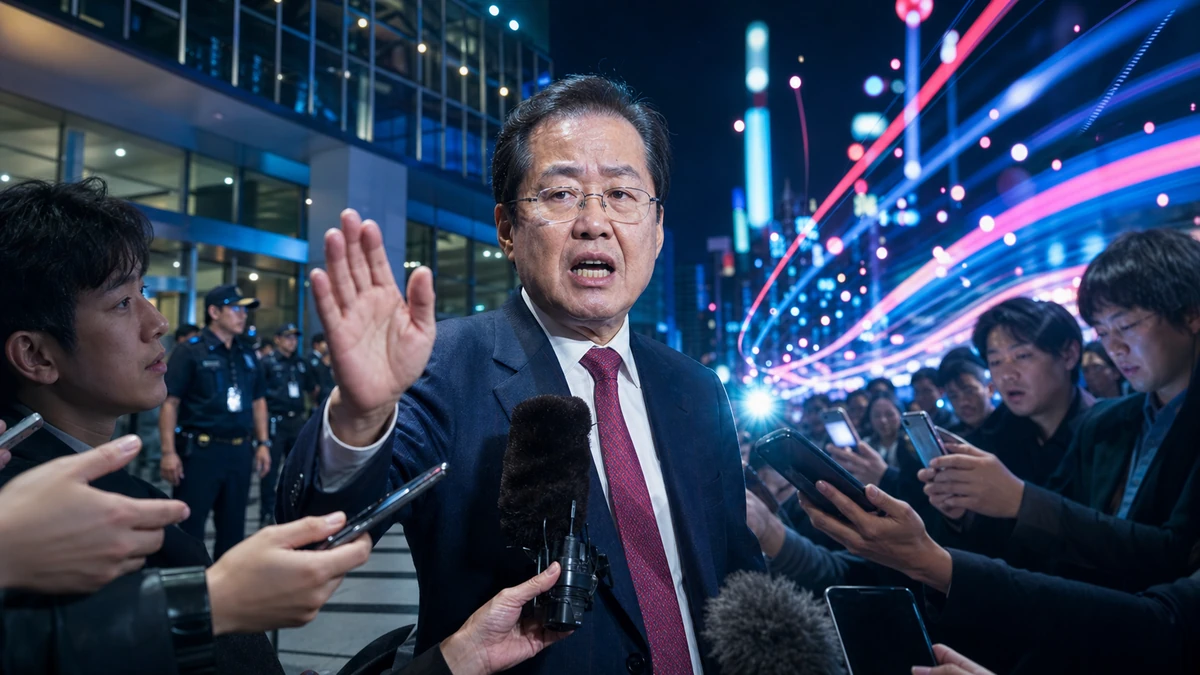
At the center of that mood was politician Hong Joon-pyo, whose name surged after headlines said he angrily pushed back against an investigation tied to what Korean media called the “Myeong Tae-gyun allegations.” The exact facts of the case were not established in the source material provided, and that limitation matters. What did become clear from the headlines was the tone: Hong publicly criticized police, accused the government of looking into him for a year and used strikingly personal language in the process. In other words, the search spike was driven less by a legal development Americans would recognize as a court filing or indictment than by the political theater surrounding an investigation whose contours were still murky.
That distinction is important for English-speaking readers unfamiliar with Korean media culture. South Korea’s digital news environment moves quickly, and search rankings often rise not only because of confirmed facts but because of confrontation, rhetorical escalation and a sense that a story signals something larger. Google’s figures here are also relative estimates, not a head count of how many people searched. They function more like a heat map of public attention than an election-style tally. Even so, when a political figure, a defense-industry debate and a failed military test all cluster near the top of the same list, it says something about what is capturing Korean attention at that moment.
The day’s trend lines suggest a country focused on power and competence: who is under scrutiny, who should be appointed, whether lawmakers can help domestic industry, and whether military technology can perform under pressure. Around those issues sat the familiar ingredients of modern media everywhere — celebrity relationship rumors, baseball confrontation, local family recreation and interest in a major American cultural institution. If that sounds eclectic, it is. But it is also how public attention works now, in Seoul no less than in New York or Los Angeles.
Hong Joon-pyo’s surge shows how Korean politics rewards confrontation
Hong’s rise to the No. 2 spot on the trending list, with a rough Google estimate of more than 5,000, reflects a recurring feature of South Korean politics: investigations often become political messages long before they become legal resolutions. The reporting summarized in the source does not allow a confident conclusion about the underlying allegations. It does, however, show how quickly the public responds when a politician frames an investigation as persecution, surveillance or factional combat.
For American readers, the closest comparison may be the way U.S. politicians respond to ethics inquiries, subpoenas or special counsel investigations by shifting the conversation from the substance of a claim to the legitimacy of the process. That does not mean the two systems are identical. South Korea’s political culture is shaped by a more compressed media cycle, stronger party polarization and a long history of corruption scandals that have touched presidents, business leaders and major institutions. Still, the broad rhythm is familiar: an investigation becomes a proxy fight over power, and search traffic surges because the audience senses a political showdown, not because the facts have been neatly settled.
Hong’s reported language was especially notable because it was personal and comparative, not merely procedural. The headline cited him saying he was not “foolish” like Seoul Mayor Oh Se-hoon, a remark that turns an investigative dispute into a layered intra-conservative jab. That kind of rhetoric matters in South Korea, where political figures often signal hierarchy, loyalty and strategic toughness through public language that can sound unusually direct to American ears. What may appear to a U.S. audience as theatrical overstatement is often part of an intensely personalized political contest in Korea.
The larger point is that search behavior is often less about legal clarity than about political drama. When details remain uncertain, audiences search to fill gaps: What is the allegation? Why is he so angry? Is this a faction fight? Is it tied to a broader campaign? Those questions drive traffic. They also reveal an underlying erosion of trust. In healthy political systems, institutions speak with enough credibility that citizens can wait for process. In more polarized environments, people search in real time because they assume that every investigation has a political backstory.
That is one reason this trend matters beyond one politician. It captures how South Korea’s public sphere increasingly resembles other high-pressure democracies in which the fight over narrative begins the moment an allegation surfaces. For journalists, that means distinguishing between what is known, what is being claimed and what is merely generating heat. For readers, it means understanding that a trending name is often evidence of uncertainty, not proof of guilt or innocence.
Defense and drones are not side stories in South Korea. They are central national questions.
If Hong’s surge showed the emotional temperature of Korean politics, the parallel rise of defense-related searches showed something more structural. “Defense industry” ranked high, and so did “suicide drone,” referring in this case to a loitering munition or self-destructing unmanned aircraft. The source summary said search interest was fueled by reports that lawmakers from rival parties jointly proposed six bills aimed at strengthening K-defense exports, while separate headlines pointed to a slowdown in South Korea’s defense-industry growth compared with surging orders for U.S. and German firms. Another set of reports said a domestically developed loitering munition failed in its first naval combat test, crashing shortly after launch from a ship.
Those may sound like separate stories, but together they describe the two pressures facing South Korea’s defense sector: policy ambition and technical execution. On one side, Seoul wants to turn its defense manufacturers into bigger global exporters. On the other, military technology still has to work outside the brochure, under real-world test conditions. That combination — industrial policy plus engineering reality — is increasingly familiar in countries trying to scale up strategic industries quickly.
South Korea’s defense push is not happening in a vacuum. The war in Ukraine, intensifying concern over Taiwan, North Korea’s ongoing military threat and a broader reordering of supply chains have all pushed middle powers to think harder about munitions, drones and industrial capacity. In recent years, “K-defense” has emerged alongside “K-pop,” “K-drama” and other Korean export brands, though with a far different audience and a much higher stake. For Seoul, weapons exports are not only a business opportunity; they are also part of a larger effort to prove technological sophistication, deepen partnerships and reduce strategic dependence.
That is why the failed drone test matters even if the program is retried. Failed tests are common in military development. The significance lies in how they are interpreted. A country trying to market itself as a top-tier defense supplier must show both innovation and reliability. A single unsuccessful test does not discredit an industry, but it does sharpen the tension between political messaging and performance. Lawmakers can package bills to support exports; the market will still ask whether systems meet expectations.
The bipartisan sponsorship of export-related legislation is also telling. In the U.S., it is common to hear defense framed through partisan lenses in budget debates but bipartisan language in strategic competition. South Korea appears to be showing a similar instinct here. When lawmakers from opposing camps collaborate on measures to boost defense exports, they signal that military manufacturing is being treated not merely as a security issue but as a national industrial strategy. That is a sign of maturity in one sense — strategic industries require policy continuity — but it also raises harder questions about oversight, transparency and whether export goals can outpace technical readiness.
What this means for the United States
For Americans, the most consequential part of this trend list is not the celebrity chatter or even the domestic Korean political fight. It is the combination of defense-industry debate and visible public interest in military technology. South Korea is one of America’s closest treaty allies, a major buyer and seller in the global arms market, and an increasingly important player in supply chains tied to semiconductors, batteries, shipbuilding and advanced manufacturing. When Korean lawmakers push new measures to strengthen defense exports, U.S. companies, defense planners and investors should pay attention.
There are at least three reasons. First, South Korea is no longer viewed simply as a customer under the U.S. security umbrella. It is also a competitor and partner in sectors that matter to Washington. American and Korean firms can align in some markets, especially where allied production capacity is a strategic asset. But they can also compete directly for contracts, as the source summary suggested in noting recent gains by U.S. and German defense firms while Korean growth eased. That dynamic will likely intensify as more countries seek affordable, quickly deliverable systems.
Second, the drone angle matters for the U.S. because loitering munitions and unmanned systems are no longer niche capabilities. The war in Ukraine helped normalize a battlefield in which relatively inexpensive, adaptable drones can have outsized impact. U.S. defense companies, Pentagon planners and congressional committees are all grappling with how quickly to scale production, shorten procurement cycles and absorb lessons from combat use. South Korea is wrestling with the same pressures. A failed test at sea is a reminder that allied countries are moving along similar development curves — and encountering similar engineering and doctrine hurdles.
Third, public attention in South Korea can shape alliance politics in ways Americans sometimes overlook. If Korean voters are increasingly focused on domestic defense performance and export competitiveness, Seoul may feel stronger pressure to invest in indigenous systems, sharpen its industrial policy and seek a larger independent role even while staying tightly aligned with Washington. That does not weaken the alliance by definition. In some cases it can strengthen it by broadening allied capacity. But it does change the balance of expectations. The U.S.-South Korea relationship is no longer just about deterrence on the peninsula; it is also about co-production, technology sharing, standards and who captures growth in a rapidly militarizing market.
There is also a softer U.S. link running through the trend list. The appearance of the John F. Kennedy Center among Korean search terms suggests that American cultural institutions still function as reference points abroad, even when the news is negative or confusing. The source summary said Korean search interest was stirred by reports of a steep drop in ticket and donation revenue after an effort to rename the institution, though the details could not be confirmed from headlines alone. Even so, the fact that Korean audiences were paying attention says something about America’s symbolic footprint. Koreans are not only consuming U.S. entertainment; they are tracking U.S. cultural politics as a barometer of broader change.
A mixed search list still tells a coherent story about media and society
At first glance, the rest of the trending terms look like the kind of miscellany that makes internet culture hard to interpret. There was public interest in a parliamentary resolution calling for the expulsion of Lee Jin-sook over controversy related to remarks on the May 18 Gwangju uprising, one of modern Korea’s most sensitive democratic touchstones. There was also a spike around Kim Min-seok after reports that he privately advised against appointing In Yo-han to lead the Red Cross. Meanwhile, entertainment coverage focused on reports surrounding actor Im Hyun-sik and renewed speculation about romance or remarriage involving actress Park Won-sook, speculation she denied. In sports, baseball player Kang Baek-ho drew attention after a tense on-field moment following a hit-by-pitch. Local news about a children’s water play area in Naepo New Town also surfaced, while a violent incident involving a man in his 20s generated search interest as well.
To treat these items as random would miss the point. Search lists are often where institutional seriousness and tabloid energy meet. That is true in the United States, where election stories and celebrity divorces routinely coexist on the same homepage, and it is true in South Korea. The more interesting question is why certain combinations recur. The answer usually has to do with the architecture of public attention. People search for politics when they sense power is shifting, for defense when they worry about national strength, for entertainment when familiar figures reflect changing social values, and for sports when a single image captures emotion better than a policy paper can.
In Korea, those categories often overlap more tightly than American readers may expect. Baseball is not just a pastime; it is one of the country’s central popular cultures, and dramatic player reactions can become national conversation. Relationship rumors involving older television figures are not only gossip; they also touch on attitudes toward remarriage, aging and public identity in a society that has changed quickly over the past generation. Parliamentary votes over historical controversies are not just legislative maneuvers; they tap into unresolved arguments over democracy, memory and who gets to define patriotism.
The result is a public sphere that can look hyperactive from the outside but is not necessarily shallow. The day’s search list shows Koreans moving fluidly between hard power, cultural symbolism and everyday life. Americans do the same, of course. The difference is that South Korea’s compressed geography, high digital saturation and intense media competition can make those shifts look faster and sharper.
How to read Korean trend data without overreading it
There is a temptation, especially for foreign observers, to treat trending data as a direct democratic signal: what the country cares about most. That is too simple. Google’s search counts here were provided as approximations, and relative popularity is not the same thing as verified significance. A spike can be driven by curiosity, alarm, confusion, outrage or sheer novelty. A term can trend because people support someone, oppose someone or simply do not understand what happened. Trend data is best read as evidence of attention, not judgment.
That caution is especially necessary when source material is limited to headlines. In this case, several subjects — including the allegations involving Hong, the practical state of Kennedy Center finances and the reasoning behind opposition to a reported appointment — were not fully established in the material provided. Responsible reporting requires saying so plainly. There is still value in the pattern, though. When multiple headlines about political retaliation, defense exports and military testing all rise together, they indicate a society keyed into competition: competition for office, for legitimacy, for contracts and for technological credibility.
That is why this South Korean trend list matters beyond one day in August. It points to a broader shift in what is commanding national attention. South Korea remains globally famous for culture exports, but its public conversation is increasingly occupied by state capacity and strategic industry. That does not mean pop culture has disappeared from the agenda. It means K-pop and K-drama now coexist with K-defense and with a more openly contested politics of investigation, memory and appointment power.
For the United States, that should be a familiar and useful lesson. Allies are not static. South Korea is not only the country Americans know through hit Netflix shows, sold-out concerts and beauty brands. It is also a politically intense democracy, an ambitious arms exporter, a test case for how middle powers build industrial muscle under security pressure and a public that closely watches both its own institutions and America’s. The search bar, on some days, captures that complexity better than any official statement does.
What to watch next is not whether one name stays on a trending list. It is whether the themes behind the list harden into longer-term patterns: more Korean political battles centered on investigative legitimacy, more policy support for strategic exports, more scrutiny of military technology performance and continued public appetite for stories that link domestic developments to global power shifts. If those patterns continue, Americans will need to understand South Korea not just as a cultural phenomenon, but as a country where politics, industry and alliance strategy are increasingly intertwined.


0 Comments