
Image to help understand the article
A blockbuster courtroom drama with a deeper political afterlife
More than a decade after its release, the South Korean film “The Attorney” still stands as one of the clearest examples of how popular entertainment can become a national argument about democracy, state power and the obligations of ordinary professionals. Released in December 2013, the movie drew 11,375,438 viewers in South Korea, placing it among the country’s biggest box-office hits and making it what Koreans call a “10 million movie” — a term that is more than hype. In the South Korean market, where the total population is roughly 50 million, crossing 10 million admissions signals a level of cultural penetration comparable to the kind of wide, cross-demographic impact an American blockbuster might have when it breaks out far beyond its expected audience.
But “The Attorney” was never just a commercial success. It was also a film rooted in one of modern South Korea’s most sensitive political histories: the years of authoritarian rule, anti-communist crackdowns and the use of national security laws to police dissent. The movie, directed by Yang Woo-suk in his feature debut, is set in 1980s Busan and follows Song Woo-seok, a tax lawyer whose life changes after he agrees to help defend a young man accused under South Korea’s National Security Law. The story is based on the Burim case, and on the early legal career of Roh Moo-hyun, the former South Korean president who, before entering politics, became widely known for his work as a human rights lawyer.
For American readers, the easiest comparison may be to a legal drama that uses one courtroom fight to ask a much larger question: What is a lawyer for? Is the law mainly a tool for success inside the system, or can it become a language for challenging the system itself? In that sense, “The Attorney” operates less like a conventional biopic than like a moral and civic origin story. It begins not with a saint, but with a man focused on money, status and professional advancement. That choice matters. The film’s argument is not that heroes are born pure. It is that people can be changed by what they witness when the abstractions of politics become the concrete suffering of someone they know.
That helps explain why the movie endured. South Korean audiences did not simply reward a familiar courtroom formula. They embraced a story about civil liberties, abuse of power and the distance between the ideals written into a constitution and the realities of state authority. Its best picture win at the 35th Blue Dragon Film Awards in 2014 reinforced that it was not merely a box-office sensation but a major cultural event. What remains striking today is that a film centered on detention, restricted visitation, alleged torture and the legal meaning of “the state” became mass entertainment. In any country, that is notable. In a U.S. media environment where civics often struggles to attract broad audiences outside election cycles, it is especially worth paying attention to.
From ambitious tax lawyer to reluctant rights advocate
The most revealing thing about Song Woo-seok is that he is not introduced as a crusader. At the start, he is portrayed as practical, class-conscious and somewhat cynical, the kind of successful professional who sees student protesters less as idealists than as troublemakers. He criticizes activists as if they are simply avoiding the hard work of ordinary life. That characterization gives the film a stronger dramatic foundation than a more obvious saintly portrait would have. Instead of asking viewers to admire him from the first scene, it invites them to watch a transformation.
The turning point comes through a deeply ordinary relationship. A woman who runs a soup restaurant he frequents asks for help. Her son, Park Jin-woo, has disappeared for a month and is later found facing trial on charges of violating the National Security Law. She says she was not even allowed to see him. In Korean storytelling, food establishments often function as social crossroads, not just businesses but spaces of neighborhood intimacy and informal loyalty. The restaurant owner is not a distant political symbol; she is part of Song’s daily life. That makes her plea harder to ignore, and it anchors the drama in a recognizably human bond rather than an abstract ideological debate.
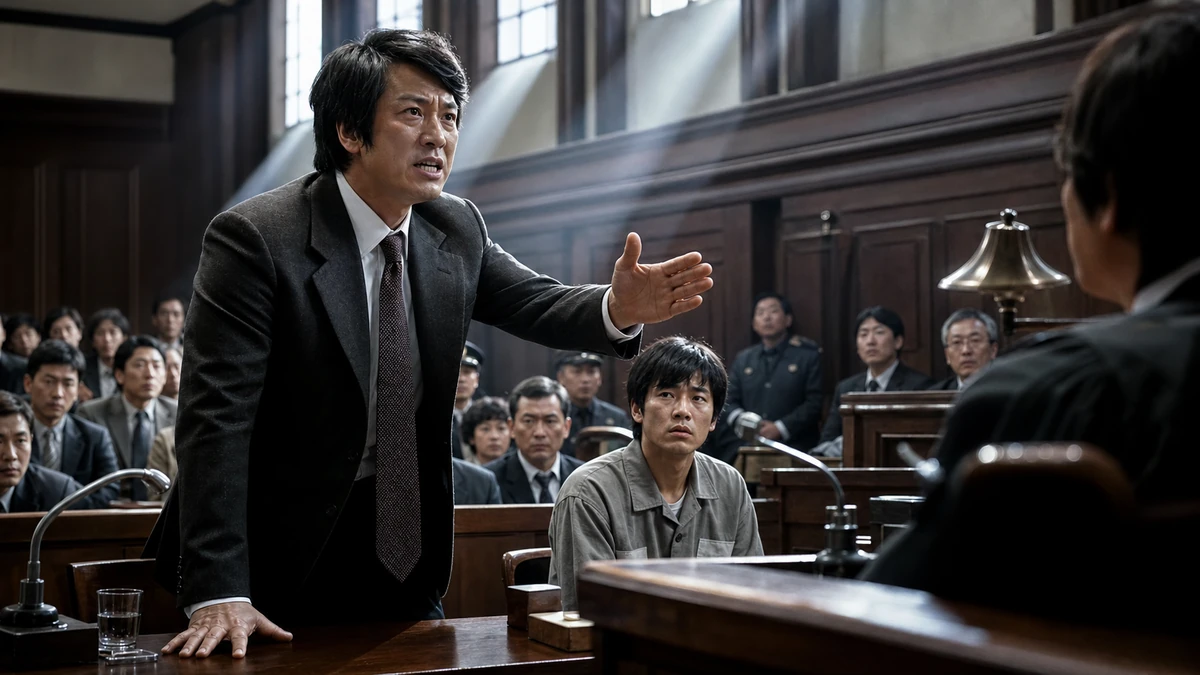
When Song finally visits the young detainee, the film delivers the moment that reorients both the character and the audience. The young man appears mentally shattered, repeating the same words, with dark bruises covering his back. The mother reacts with fury and grief. Song, who had previously maintained emotional distance, immediately understands that this is not a routine prosecution. It is a confrontation with violence carried out under legal cover. The state may call it a security case, but what he sees suggests something else: a citizen who appears to have been brutalized while supposedly under the protection of formal procedure.
That structure — the awakening of conscience through direct encounter — is one reason the film connects so powerfully. It does not ask viewers to master the intricacies of South Korean political history before caring. It asks them to recognize what happens when a person who has prospered within a system comes face to face with evidence that the system can crush the powerless. From there, the courtroom drama becomes more than a contest of legal arguments. It becomes the story of a professional deciding whether expertise is morally neutral. Song’s choice to become the young man’s attorney marks the beginning of a broader shift: away from law as a ladder for personal advancement and toward law as a defense against state abuse.
That kind of transformation is legible far beyond Korea. American audiences have seen versions of it in films about whistleblowers, civil rights lawyers, investigative reporters and public defenders — people who begin inside a career structure and end up questioning its assumptions. The emotional engine is familiar: a comfortable worldview gives way when lived evidence becomes impossible to explain away. “The Attorney” taps that universal dynamic while remaining firmly anchored in a specifically Korean history.
The Korean history behind the film, and why it needs explaining abroad
To understand why “The Attorney” struck such a nerve in South Korea, it helps to understand the political landscape it evokes. The film is set in the 1980s, a period when South Korea was not yet the robust democracy Americans know today through Samsung, K-pop, Oscar-winning films and military alliance headlines. It was still emerging from an era of authoritarian rule in which anti-communism was not simply a national ideology but also a tool that could be used to justify surveillance, detention and prosecutions against critics and activists.
At the center of the film is the National Security Law, one of the most controversial legal instruments in modern South Korea. For foreign readers, it can sound technical, even obscure. In practice, it has long been entangled with larger debates over free expression, due process and how far a state can go in the name of defending itself against ideological enemies. Because South Korea remains formally at war with North Korea, separated only by an armistice rather than a peace treaty, national security politics have always carried unusual weight. That helps explain why accusations framed in security terms can carry such force. But the film asks whether the language of security can also be used to suppress citizens whose real offense is political nonconformity.
The courtroom exchanges highlighted in the story summary get to the heart of that question. Song asks how reading and discussing books could be judged a violation of national security. When the state’s side answers, in effect, that the state makes that determination, Song pushes back with a larger civic challenge: What is the state? He then invokes a central line from South Korea’s constitution, which says sovereignty belongs to the people and all state authority comes from them. His answer is blunt: the state is the people.
That moment matters because it shifts the argument from narrow criminal procedure to constitutional legitimacy. It is not only about whether one defendant is guilty or innocent. It is about whether a government can claim to embody the nation while violating the rights of the very citizens from whom its authority is supposed to flow. In American terms, it is the kind of argument that resonates with foundational constitutional rhetoric familiar from U.S. debates over civil liberties: the idea that governments derive legitimacy from the governed, and that rights are not gifts from rulers but constraints on power.
The film’s historical power also comes from timing. By 2013, when “The Attorney” was released, South Korea had been a democracy for decades, but the political memory of authoritarianism remained vivid. Many Koreans alive then had direct memory, family memory or institutional memory of the crackdowns, censorship and intimidation that shaped the late 20th century. So the movie was not merely a period piece. It was a contemporary society revisiting its democratic origin story through the familiar, emotionally accessible form of a courtroom film.
That helps explain why overseas viewers should resist seeing it as only a Korean historical artifact. The movie belongs to a broader global tradition in which democracies use culture to revisit their own moments of legal failure. Americans have long done the same, whether through stories about McCarthyism, Jim Crow, Japanese American incarceration during World War II or post-9/11 civil liberties debates. The details differ, but the core tension is recognizable: states insist they are acting to preserve order, while later generations ask what those actions cost and whom they harmed.
Why the film became a phenomenon, not just a successful release
There is a reason “The Attorney” became a “10 million movie” instead of remaining a respected but niche legal drama. The story operates on several levels at once. It offers the emotional clarity of a personal awakening, the suspense of a courtroom contest, the social accessibility of everyday relationships and the moral force of a political reckoning. In commercial terms, that is a potent mix. Viewers do not have to arrive with prior expertise in Korean legal history to follow it. They can enter through family loyalty, outrage at visible cruelty or the universal appeal of watching someone discover courage under pressure.
Just as important, the film makes institutional critique feel intimate. The restaurant owner’s plea, the bruises on her son’s body and the restrictions on visitation turn systemic abuse into lived experience. Audiences are often more willing to engage with difficult political material when it is filtered through the fate of characters who feel specific and ordinary. In that way, “The Attorney” resembles some of the most effective American films about public institutions: stories that do not begin with theory but with one family, one defendant, one school, one newsroom or one workplace where larger national contradictions become visible.
Its success also says something about South Korean cinema. By 2013, the industry had already shown it could produce technically accomplished genre films that competed with Hollywood at home. But “The Attorney” demonstrated the power of a domestically grounded political drama to reach a mass audience without shedding complexity. That matters because one of the enduring misconceptions in the United States is that international hits travel mainly through spectacle, horror, thriller mechanics or music-driven fandom. “The Attorney” is evidence that Korean film’s global relevance also lies in its ability to turn local history into compelling civic drama.
The movie’s awards recognition matters here too, even if the confirmed honor cited in the source is limited to best picture at the Blue Dragon Film Awards. Commercial reach and institutional recognition do not always overlap. In this case, they did. That suggests the film occupied a rare cultural space: a work that was broadly popular yet also serious enough to be treated as an important artistic statement. For analysts of Korean popular culture, that overlap is one marker of how the so-called Korean Wave, or Hallyu, has matured. It is not only about export-ready pop products. It also includes films and series that revisit Korean society’s own fault lines and trust audiences to follow them.
What this means for the United States
For American audiences and companies, “The Attorney” is a reminder that Korean cultural imports are no longer confined to catchy pop singles, survival dramas or prestige auteur cinema. U.S. viewers increasingly encounter Korean storytelling across the full range of genres, including legal drama, historical political narratives and works that require more context than a simple subtitle track can provide. That shift has implications for streaming platforms, distributors, critics and cultural institutions in the United States.
First, there is a market lesson. American companies that license or promote Korean content often prioritize titles with obvious crossover hooks: romance, thriller premises, dystopian competition or youth culture appeal. But films like “The Attorney” point to another audience — viewers interested in democratic institutions, modern history and comparative politics. In an American media environment shaped by ongoing fights over courts, executive power, protest rights and the role of lawyers in public life, a Korean courtroom drama about the meaning of constitutional sovereignty is not as culturally distant as it might once have seemed. The challenge for U.S. distributors is not whether such stories can connect; it is whether they are framed in ways that help audiences grasp the stakes without flattening the history.
Second, the film highlights how the U.S.-South Korea relationship is often discussed too narrowly. Americans typically hear about the alliance in terms of troops, trade, semiconductors, North Korea or summit diplomacy. Those issues remain central, but cultural products like “The Attorney” offer another window into the alliance: they show how South Korea understands its own democratic journey and how it remembers the abuse of state power. That matters for Americans because alliances are not sustained by military hardware alone. They are also sustained by public understanding — by knowing what values a partner country claims, how it argues about them internally and what historical experiences shape its political reflexes.
Third, there is an interpretive lesson for U.S. audiences. Americans often consume Korean content either as entertainment detached from politics or as a symbol of Korea’s soft power success. “The Attorney” resists both simplifications. It suggests that some of the most revealing Korean works are those that dig into contested domestic memory. For U.S. critics and viewers, that means taking Korean political history seriously rather than treating it as background scenery. The rise of Korean film and television in America has created an opportunity for more substantive cultural literacy — one that goes beyond learning a few food terms or recognizing a handful of stars.
Finally, the movie invites comparison with the American legal imagination. In the U.S., courtroom dramas have long served as battlegrounds for national debates, from race and civil rights to press freedom and military justice. “The Attorney” belongs in that broader conversation. It is a Korean film, yes, but its central concerns — whether state institutions can be trusted, whether national security language can mask abuse and whether one lawyer’s moral awakening can matter — are fully legible to an American public living through its own arguments about democracy’s guardrails.
A trend in Korean storytelling: memory, accountability and the mainstreaming of civic drama
Seen from 2024 and beyond, “The Attorney” looks less like an isolated hit and more like part of a larger pattern in Korean storytelling. South Korean film and television have repeatedly shown a willingness to revisit politically painful subjects through accessible dramatic forms. Rather than segregating civic memory into textbooks, documentaries or art-house projects, the industry has often woven it into mainstream narratives that invite broad public participation. That is one reason Korean popular culture can feel unusually layered to foreign audiences: a movie may function at once as entertainment, political memory work and an argument about the present.
In “The Attorney,” that layering is visible in the way the film treats legal procedure as moral theater. The courtroom is not simply where evidence is sorted. It is where a society debates whether the government has confused itself with the nation. The prison visitation scene is not just character motivation. It is a concrete demonstration of what happens when rights become conditional. And the protagonist’s personal growth is not merely inspirational. It models a larger question asked again and again in Korean civic narratives: what does an ordinary person do after seeing how institutions behave at their worst?
That pattern matters now because audiences in the United States and elsewhere are paying closer attention to the political intelligence of Korean media. The international success of later Korean works has trained viewers to expect class analysis, institutional critique and social allegory from Korean creators. “The Attorney,” though earlier than some of the titles that transformed Korea’s standing in U.S. popular culture, fits neatly into that trajectory. It demonstrates that the Korean Wave is not only a phenomenon of style, export strategy or celebrity charisma. It is also a phenomenon of narrative confidence — the confidence to tell stories that trust viewers to engage with law, history and moral ambiguity.
For analysts watching the next phase of Korean soft power, that is what bears watching. Will more historically grounded civic dramas find distribution and discussion in the United States? Will American critics broaden the canon of Korean imports beyond the handful of titles already familiar to prestige audiences? And will streaming services invest in the contextual framing needed to help U.S. viewers appreciate stories that emerge from specific Korean legal and political histories? Those questions matter because cultural exchange is not just about volume. It is about depth.
Why “The Attorney” remains timely
The continuing relevance of “The Attorney” lies in the simplicity of the moral challenge it poses. A lawyer who once treated law as a route to comfort encounters a case that makes neutrality impossible. A mother asks for help. A young man appears physically and psychologically broken. The state insists it is acting in the name of security. The courtroom becomes the place where someone finally asks the most basic democratic question: who is the state supposed to serve?
That question never really expires. It applies in every democracy that prides itself on constitutional order while periodically testing the limits of dissent, detention and due process. It applies whenever governments describe extraordinary power as necessary, and whenever citizens are asked to trust institutions that operate behind closed doors. And it applies especially in countries, like both South Korea and the United States, where patriotism is often invoked from competing directions — sometimes to defend authority, sometimes to challenge it.
For American readers coming to the film now, “The Attorney” is worth seeing not because it offers easy parallels or interchangeable history, but because it shows how another democracy remembers a time when legal forms were used to discipline political life. Its popularity in South Korea suggests that audiences there were not simply interested in nostalgia or biography. They were interested in a story about what happens when a professional class figure stops asking what is profitable and starts asking what is right.
That is why the film remains larger than a single case or a single era. It dramatizes the moment when personal success collides with public conscience. It turns constitutional language into something felt rather than merely quoted. And it reminds viewers that sometimes the most consequential political changes begin not with a speech or a movement, but with one person deciding that what he has seen can no longer be explained away. In South Korea, that story drew more than 11.3 million viewers. In the United States, it deserves to be read as part of a broader transnational conversation about memory, rights and the fragile distance between law and justice.


0 Comments