
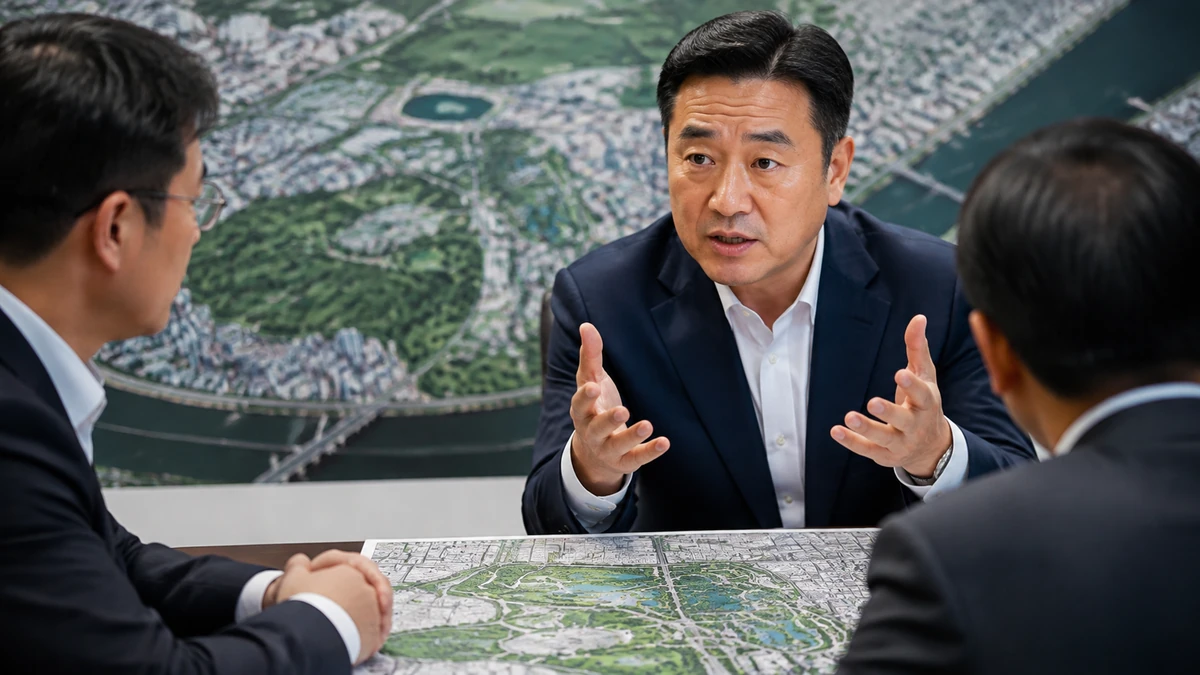
Image to help understand the article
Seoul’s latest land fight is really about what kind of global city it wants to be
A political fight in Seoul over whether to consider part of Yongsan Park for housing development may sound, at first glance, like a local zoning dispute. It is not. The clash has quickly become a larger argument about memory, urban identity and the value of public land in one of the most expensive and tightly packed metropolitan areas in the world.
Officials in Yongsan District, following objections from the Seoul city government, have pushed back strongly against the idea of reviewing Yongsan Park as a possible housing supply site. Their argument is not simply that the city needs more trees or that residents prefer open space to apartment towers. It is that Yongsan Park occupies a singular place in modern Korean history: a long militarized area in the heart of the capital that is only now, after roughly 120 years, being returned for civilian use.
That history gives the site a weight that is difficult to capture in a standard real estate debate. To many South Koreans, Yongsan is not just a blank parcel in central Seoul. It is land marked by imperial occupation, Cold War geopolitics, the long U.S. military presence on the Korean Peninsula and, more recently, a democratic promise that this strategically important ground would eventually become a public space for the nation.
So when national officials discuss the possibility of evaluating the broader park area for housing, opponents hear something more than a supply-side policy proposal. They hear a challenge to a civic idea: that some urban spaces should be defined not by how many units can be built on them, but by what they say about a country’s priorities.
The debate is unfolding at a time when housing affordability remains a pressing issue in greater Seoul, where prices and access have shaped elections, public frustration and family planning. But the resistance from local officials suggests the issue has already moved beyond apartment counts. The real question is whether Seoul will treat one of its last major central open spaces as a short-term policy instrument or as a long-term national asset.
Why Yongsan Park carries unusual symbolic weight in South Korea
For American readers, it may help to think of Yongsan Park not as an ordinary municipal park but as a site where several layers of national history overlap. The land was used for military purposes for generations, including during Japan’s colonial rule over Korea and later as the base area for U.S. Forces Korea. In South Korea’s public imagination, that makes Yongsan both deeply historical and intensely political.
That context matters because the Korean term often used around Yongsan Park is closer to the idea of a national symbolic space than a neighborhood green. Opponents of housing development are making the case that the land should be understood as a public inheritance, not simply a development opportunity. In practical terms, they are arguing that the site’s value lies in collective use, historical reflection and urban breathing room.
The idea of a “national park” inside a capital city can sound unusual in the United States, where national parks are typically associated with Yellowstone or Yosemite rather than Washington or New York. But Americans do understand the larger principle. The National Mall in Washington, for example, would not be judged only by how many buildings could theoretically be placed there. Its value comes from symbolism, accessibility, ceremony and the way it anchors national memory. Central Park in Manhattan, likewise, has long been defended not because New York lacks pressure to build, but because the park’s existence itself helps define what New York is.
Yongsan Park occupies a comparable place in the Korean debate, even if the historical details are different. It is seen by many as one of the few remaining chances in central Seoul to create a truly expansive public space that reflects the country’s past and future at once. That is why local officials have objected so sharply to framing the area primarily through the lens of housing supply.
The district government’s position also points to a broader Korean concern about how state-led development has shaped the modern city. South Korea’s rapid growth was built, in part, on aggressive urban transformation. That produced economic gains and dense housing, but it also left a legacy of displacement, uneven public space and recurring battles over who cities are for. In that sense, Yongsan has become a test case for whether Seoul can resist the instinct to convert every premium site into a development answer.
The housing shortage is real, but so is the cost of building over civic space
None of this means the housing argument is frivolous. It is not. South Korea’s capital region faces genuine affordability problems, and governments are under constant pressure to show they are expanding supply. In that environment, any large central parcel inevitably attracts attention. Policymakers are expected to identify land, move quickly and signal seriousness to a market that often reacts as much to political messaging as to completed construction.
That helps explain why Yongsan Park entered the conversation at all. In a city where land is scarce and demand is relentless, a major centrally located site can appear, on paper, to be a tempting option. Housing advocates can plausibly argue that symbolic value should not completely override urgent material need, especially for younger households squeezed out of ownership or forced into long commutes.
But the core objection from opponents is that this framing is too narrow. Once a major public green space is compromised, it is extraordinarily difficult to replace. Apartment units can be added elsewhere over time, through rezoning, redevelopment, transit-linked density or changes to underused commercial districts. A large, centrally located park with historic meaning is much harder to recreate after it is carved up.
This is the part of the debate that resonates in cities around the world. Urban planners increasingly argue that dense cities need both housing and meaningful public space, not one at the expense of the other. Parks are not decorative extras. They shape heat resilience, walkability, mental health, tourism appeal and the everyday quality of life that makes cities globally competitive.
That logic has only grown stronger in the post-pandemic era, when cities from London to Los Angeles have been forced to reconsider how much open space residents need and what counts as essential urban infrastructure. The old model that treated parks as pleasant but secondary has weakened. In many major cities, access to nature, historic landscapes and noncommercial gathering places is now seen as part of economic strategy as much as quality-of-life policy.
That is why the Yongsan Park dispute matters beyond the number of apartments that might or might not be built there. It represents a collision between two legitimate public needs: more housing and more durable civic space. The political challenge is that both sides can claim to be acting in the public interest, and both are responding to real pressures. The difference is time horizon. Housing targets tend to be immediate and measurable. The value of a park unfolds over decades.
What this means for the United States
For Americans, the Yongsan argument is more than a distant planning dispute in an allied capital. It offers a revealing look at how South Korea, one of the United States’ closest partners in Asia, is thinking about development, public land and national identity at a moment when the two countries are increasingly linked not just by security, but by business, culture and urban influence.
The United States has a direct historical connection to Yongsan because of the long presence of U.S. forces there. That means the site is not just Korean in memory; it also sits inside the larger story of the U.S.-South Korea alliance. As land once tied to the American military footprint is reimagined for civilian use, the choices South Korea makes carry symbolic significance about what comes after the alliance’s most visible physical infrastructure. The transition from military zone to civic space can be read as part of a broader maturation in the relationship: still allied, but less physically defined by occupation-era geography and more by shared strategic interests.
There is also a practical American angle. U.S. companies in architecture, landscape design, environmental remediation, urban consulting and smart-city technology all watch flagship redevelopment projects in Seoul closely. South Korea is a major market, and Seoul’s planning decisions often ripple across the region as examples of what a high-density Asian democracy considers best practice. If Yongsan Park is preserved and built out as a major civic landscape, that could encourage further interest in public-space design and heritage-centered urban development. If, instead, development logic overtakes symbolic planning, that sends a different message about what pressures even wealthy global cities cannot resist.
American audiences should also recognize a familiar tension. The United States has its own recurring fights over whether public land, historic spaces or underused civic property should be converted into housing. From battles over golf courses in Los Angeles to arguments over office-to-residential conversion in New York and preservation fights in Washington, the central question is similar: When affordability is urgent, what places remain off-limits, and why?
There is no perfect American equivalent to Yongsan Park, but the underlying dilemma is easy to understand. Imagine a future debate over whether part of the National Mall, Governors Island’s civic core or a major historic military site being repurposed for public use should be opened to residential development because a housing shortage has become severe. Many Americans would acknowledge the pressure for more homes while still resisting the loss of symbolic public ground.
For U.S. fans of Korean culture, the debate also underscores something often missed in the global spread of K-pop, Korean film and Korean television: South Korea’s cultural power does not come only from exports. It also comes from how Korean cities stage everyday life. The appeal of Seoul in dramas, travel media and tourism branding depends in part on the city’s ability to balance intensity with openness, hyperdevelopment with texture and modernity with memory. Parks, historic landscapes and public gathering spaces are part of that image. American travelers, students and businesses engaging with Korea are not just consuming content; they are encountering an urban model.
A turning point in how Seoul defines competitiveness
The most important thing to watch is whether Yongsan Park is treated as an exception or as a precedent. If it remains firmly protected, that would suggest South Korean policymakers are willing to say that urban competitiveness in the 21st century is not measured only by how efficiently land can be monetized. It would imply that open space, historical continuity and public access are now understood as strategic assets in their own right.
If the opposite happens, and the park becomes increasingly available for housing logic, that would reflect a different conclusion: that even Seoul’s most symbolically charged land cannot withstand the pressure of the capital region’s housing crisis. Such a move would not simply alter one neighborhood. It would signal that no site is too historically loaded or civically important to be folded into the supply debate.
That matters because global cities compete for more than investment. They compete for residents, students, tourists, multinational offices and cultural prestige. In that competition, parkland and public memory are not sentimental add-ons. They shape how a city is experienced and how it is marketed to the world.
Seoul has spent years building itself as a city of technology, culture and design. It has become a destination for American tourists, a key stop for global brands and an object of fascination for audiences who know it through streaming hits and social media. But world cities also need signature public places that communicate confidence beyond commerce. Paris has the Seine and its monumental core. New York has Central Park. London has its royal parks and preserved commons. Seoul’s decisions about Yongsan will help determine whether it can create a comparably legible civic landscape in the center of the capital.
The district government’s opposition, and the similar stance from Seoul city officials, suggests that at least some Korean leaders understand the stakes in those terms. They are not merely contesting a land-use proposal. They are arguing over the standard by which Seoul should judge itself. Is success the maximum extraction of urban value from scarce land? Or is it the ability to reserve some of the most valuable land for public life precisely because it is valuable?
Why this debate will outlast the current controversy
Even if the immediate proposal goes nowhere, the Yongsan dispute is likely to endure as a marker of a larger transition in South Korean policy thinking. For decades, the country’s development story was defined by speed: build fast, urbanize fast, modernize fast. The next stage may be defined less by acceleration than by selective restraint. Which places should remain open? Which histories should be materially preserved? Which urban experiences make Seoul stronger in the long run?
Those are not easy questions, and they are not uniquely Korean. They are the same questions facing many successful cities that have become victims of their own desirability. The more dynamic and globally connected a city becomes, the more pressure there is to maximize every parcel. Yet the cities that remain most livable and most admired are often the ones that protect a few spaces from that logic.
That is why Yongsan Park has become more than a local issue. It is a referendum on whether Seoul can convert a once-closed military landscape into an enduring democratic commons, and whether South Korea is prepared to treat public space as a core component of national prestige rather than an obstacle to growth.
For Americans following Korea primarily through headlines about technology, security or pop culture, this may seem like a quieter story. In fact, it reveals something fundamental about the country’s next chapter. A nation that transformed itself at extraordinary speed is now debating what deserves to be left unbuilt. In a century defined by climate stress, housing anxiety and the global competition for talent, that may be one of the most consequential urban questions any democracy can ask.
And for the United States, where similar trade-offs increasingly shape local politics, Yongsan is a reminder that allied countries are wrestling with the same essential challenge: how to add homes without stripping cities of the very civic spaces that make them worth living in. Seoul’s answer will matter in Korea first. But it will also be watched, closely, in other capitals that are trying to decide what progress should look like when there is almost no room left to build.


0 Comments