Image to help understand the article
A homecoming years in the making
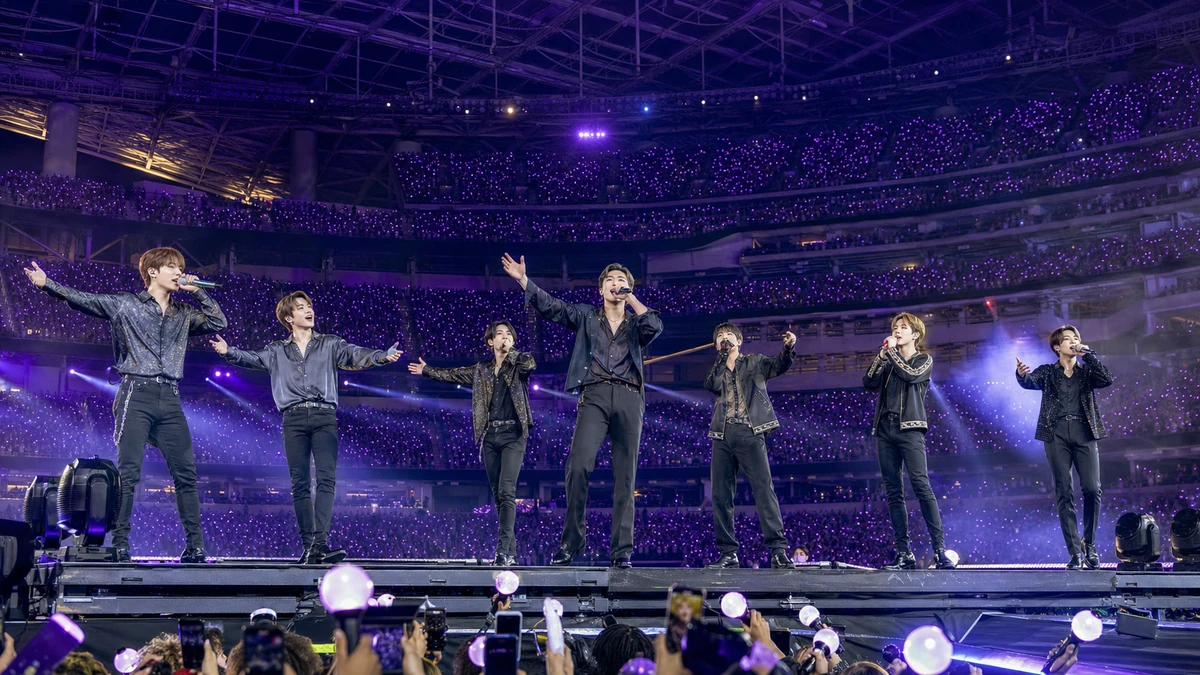
Nearly five years after its last Los Angeles concert, BTS returned to Southern California with a performance that felt bigger than a routine tour stop. On Sept. 1 local time, the group took the stage at SoFi Stadium and performed before roughly 70,000 fans, according to the Korean news agency Yonhap. For many in the crowd, the night was not just about finally seeing the world’s most famous K-pop group again in Los Angeles. It was about measuring how far both BTS and its audience have traveled together.
That helps explain why this show carried unusual emotional weight. BTS had last performed in Los Angeles in 2021, before a long gap that included the members’ military service obligations in South Korea and a pause in full-group activity. In the intervening years, the group’s place in global pop culture only became more entrenched. But absence matters in fandom, and in live music especially. A return concert after nearly five years is not consumed like any other entertainment event; it is experienced as reunion, proof of continuity and, for some fans, a marker of personal time passed.
Yonhap’s on-the-ground reporting described a stadium filled with fans turning the wait into noise, singing along in unison and transforming anticipation into release. That collective singalong matters in K-pop culture in a way that may not be immediately obvious to American readers. Korean fans often use the term ttechang, which refers to a large-scale, coordinated singalong by the audience. It is more than enthusiastic cheering. It is a form of participation with its own discipline, memory and emotional force, closer to a chorus that the crowd has rehearsed through years of immersion in the music.
In Los Angeles, the scale of that participation became part of the story. So did the setting. This was not simply BTS returning to a major American market. It was BTS returning to a city that played an important role in the group’s earliest ambitions. In 2014, when the members were still in the first year of their career, they came to Los Angeles to study hip-hop. At that point they were not being welcomed by civic institutions or packing NFL-sized venues. They were handing out flyers themselves on the street to promote performances and introducing themselves to a market that barely knew their name.
Twelve years later, the contrast was hard to miss. The same city that once required them to hustle for attention now greeted them as a global attraction. The Los Angeles City Council declared a “BTS Week” to mark the world tour, and City Hall was illuminated in red. For fans who know the group’s history, the symbolism practically explained itself: the city where BTS once sought a foothold had become a place that formally celebrated its arrival.
Why Los Angeles matters in the BTS story
Los Angeles has long functioned as one of the most important American gateways for Korean pop culture. It is home to one of the largest Korean American communities in the United States, a center of the music and entertainment business, and a city where global trends are often tested before they spread nationwide. For K-pop acts, success in Los Angeles can signify more than ticket sales. It can represent entry into the broader American cultural conversation.
That is one reason BTS’ relationship with Los Angeles stands out. Their history there mirrors the arc of K-pop’s evolution in the United States. In the early 2010s, Korean acts still tended to be treated as niche imports, popular among diaspora audiences and highly committed online fan communities but peripheral to mainstream American music institutions. BTS emerged during that period. Its early Los Angeles appearances were tied to hustle, outreach and subcultural momentum rather than establishment recognition.
Now, that equation looks different. A full stadium of fans in Inglewood is one measure of growth, but the broader shift is institutional. The city is not merely hosting BTS; it is publicly embracing the group as a cultural event. That kind of recognition would have been difficult to imagine a decade ago, when K-pop’s American footprint was much smaller and often interpreted through novelty. Today, BTS no longer needs to be explained in the same way, even if the meanings of its music still do.
There is also a deeper narrative at work. American pop history is full of artists returning to symbolic cities after a rise to fame: a band playing its hometown arena after years on the road, a breakout singer headlining the club district where they once auditioned, a hip-hop star filling a venue in the neighborhood where they used to pass out mixtapes. BTS’ Los Angeles concert fits that emotional template, even if the path is transnational. Americans understand comeback stories and glow-up narratives. The details here are Korean and global, but the dramatic structure is familiar.
What makes the BTS version distinctive is that Los Angeles is not the group’s hometown. It is, instead, a city that became part of its origin myth abroad. That gives the concert an added resonance. This was not simply a triumphal return to a profitable market. It was a revisiting of an early proving ground, a place where ambition was once raw and uncertain.
How “Arirang” crossed the language barrier
The concert’s most revealing moment, according to Yonhap, may have come not from spectacle alone but from the audience’s response to “Arirang,” the Korean folk melody woven into the tour’s concept and performance. During the song “Body to Body,” when the melody of “Arirang” stretched across the stadium, fans in different sections softly sang along. In a venue built for blockbuster entertainment, an old Korean tune became a shared language.
For readers in the United States, “Arirang” may need some explanation. It is one of Korea’s best-known traditional songs, or more accurately a family of songs and variations that carry deep emotional meaning across generations. It is often associated with longing, separation, endurance and a kind of bittersweet resilience. If an American comparison is needed, think less of a single pop standard and more of a folk melody that sits close to the cultural memory of a nation, something with the emotional familiarity of “Amazing Grace” in certain settings, but with a distinctly Korean historical and social resonance.
What is striking here is not merely that BTS referenced “Arirang.” Korean artists have long drawn on traditional motifs. The more significant point is that the song appears to have functioned in Los Angeles not as a museum piece or a heritage display, but as living music. Fans did not just watch while a Korean cultural symbol was presented to them. They joined in. That distinction matters.
In many cross-cultural performances, tradition is framed as something to be explained before it can be appreciated. Here, the melody seems to have worked on a more immediate emotional register. Audience members from different linguistic and national backgrounds followed it together, collapsing the distance between stage and crowd. That is one reason the moment deserves attention beyond fan-service narratives. It suggests that K-pop’s globalization is entering a more layered phase, one in which audiences are not only consuming polished exports but also participating in cultural forms that are more specifically Korean.
This is an important development because K-pop’s early international success was often tied to its most legible global features: sleek choreography, visual precision, multilingual hooks, social media intimacy and genre blending familiar to U.S. listeners. But the “Arirang” moment hints at something more mature. Rather than sanding down Korean specificity for overseas audiences, BTS appears able to bring that specificity into a U.S. stadium and still produce mass participation.
That does not mean every audience member understood the history of the melody in scholarly terms. They did not need to. Pop culture often moves ahead of formal explanation. Fans learn by repetition, by community, by emotional association and by wanting to belong. In that sense, the soft chorus around “Arirang” may say as much about fandom as it does about music. It shows how global fan communities become interpreters of culture, carrying symbols across borders in ways institutions rarely can.
The fandom economy on display
The stories fans brought into the stadium were also part of the larger picture. Yonhap reported that some attendees created their own outfits to commemorate member Jung Kook’s birthday, including cupcake-themed costumes and accessories bearing Korean birthday wishes. Others traveled after already seeing the group in another city, treating the Los Angeles stop not as a one-off purchase but as one chapter in a longer journey.
That kind of repeat attendance is often misunderstood by outsiders as simple consumer excess. In reality, it is central to the modern fandom economy, and K-pop has become one of its most advanced forms. Fans do not merely buy a ticket and passively receive a product. They produce their own meaning around the event through clothing, banners, coordinated chants, social media documentation and travel plans built around tour routes. Every stop acquires a local texture even when the set list is similar.
American pop audiences do this too, of course. Taylor Swift’s Eras Tour turned friendship bracelets into a visible ritual and made repeat attendance its own kind of subculture. Deadheads built an entire way of moving through music around following a band from city to city. Comic-Con attendees have long shown how fandom and costume can merge into performance. What K-pop adds is a particularly high level of organization and emotional synchronization, built through years of online connection and collective practice.
That matters economically as well as culturally. A stadium concert by a group like BTS is not confined to ticket revenue. It activates hotels, restaurants, ride-share demand, merchandise sales, fan events and social media attention that spills into local business districts. Cities understand this increasingly well. When a local government publicly embraces a major artist’s visit, it is not only acknowledging cultural prestige. It is also recognizing the measurable value of fan tourism.
In BTS’ case, fan commitment appears unusually durable. One fan cited by Yonhap said she had mistakenly missed using one ticket because of a date mix-up, then purchased another because the concert remained worth it. Another, a fan since 2015, had already attended the Las Vegas stop but still did not want to miss Los Angeles. Those anecdotes are small on their own, but together they illustrate a core reality: BTS fandom is not driven only by novelty or scarcity. It is sustained by relationship, ritual and memory.
That is a powerful engine, and it helps explain why the group’s live return feels larger than a single entertainment headline. In a fragmented media era, where attention is hard to hold and audiences often cycle quickly through trends, a fandom capable of maintaining intensity over years of interruption is itself a major story.
What this means in the United States
For the United States, the Los Angeles concert underscores how thoroughly Korean pop culture has moved from the margins into the mainstream of American entertainment life. That does not mean every K-pop release dominates U.S. radio or every Korean act can fill a stadium. It does mean that the old framing of K-pop as a temporary craze no longer holds up. BTS’ return to SoFi Stadium after nearly five years, with around 70,000 fans in attendance, is evidence of a market with staying power.
American companies have been adapting to that reality for years. Concert promoters, streaming services, record labels, fashion brands and social media platforms all now treat K-pop as a serious part of the business landscape. BTS has been central to that shift. The group helped prove that Korean-language music could command chart power, intense fan mobilization and brand value in the United States without fully assimilating to American norms. That lesson has shaped how U.S. entertainment companies think about global audiences more broadly.
There is also a diplomatic and cultural dimension. South Korea and the United States have a long alliance built on security, trade and geopolitics, but cultural exchange increasingly shapes how ordinary people experience that relationship. For many younger Americans, Korea is no longer encountered primarily through headlines about North Korea or military strategy. It is encountered through music, television, film, food, fashion and digital culture. BTS has been one of the most visible drivers of that change.
The Los Angeles performance therefore says something about soft power, though that term can sometimes feel too abstract. A more grounded way to put it is this: Korean culture now creates major public gatherings in American cities on its own terms. When tens of thousands of U.S.-based fans sing along not only to charting songs but to a melody rooted in Korean tradition, that is cultural influence in a concrete form.
For American artists and executives, there is also a practical takeaway. The U.S. music industry has increasingly emphasized direct fan relationships, premium live experiences and communities that extend beyond the song itself. BTS and K-pop more broadly have excelled at those strategies. The group’s Los Angeles return is a reminder that fan engagement is not an accessory to the product; it is part of the product. American companies studying how to build loyalty in a crowded market are likely to keep looking at K-pop’s playbook, even as they adapt it to local habits.
At the same time, the concert suggests that American audiences are more comfortable with cultural specificity than old industry assumptions once allowed. The success of Korean-language songs, Korean artists and Korean narrative worlds in the U.S. points to a broader shift in consumption. Viewers and listeners do not always need translation into American cultural codes before they commit. They are often willing to meet the material where it is, especially when fandom helps provide the bridge.
More than a comeback concert
It would be easy to reduce the Los Angeles show to a celebratory milestone: BTS came back, the stadium sold out, the fans were ecstatic. All of that is true. But the larger significance lies in what the night revealed about time, scale and cultural movement.
First, it highlighted the durability of BTS as a collective story. In pop music, hiatus can be dangerous. Audiences drift, tastes shift and the emotional center can weaken. Yet the long gap since the group’s previous Los Angeles concert seems to have intensified, not diminished, the sense of connection. The cheers described by Yonhap were not just for a hit-making act returning to the stage. They were for a relationship resuming in public.
Second, the concert demonstrated how cities and artists can grow into each other. The same Los Angeles that once served as an uncertain training ground now functions as one of the defining sites of BTS’ global narrative. That is not a generic success story. It is a reminder that global pop culture is built through repeated encounters between artists and places, each changing the meaning of the other over time.
Third, the “Arirang” singalong suggests a next chapter in the Korean Wave, or Hallyu, the term used to describe the global spread of South Korean popular culture. The first phase of Hallyu in America often centered on discovery and breakout: Americans realizing that Korean entertainment could be stylish, addictive and commercially formidable. A later phase involved normalization, as Korean acts and content became regular features of U.S. media life. What this Los Angeles concert points toward is something more integrated: a phase in which specifically Korean cultural elements can circulate inside mainstream American spaces without losing their identity.
That is why this event matters beyond BTS fans. It offers a snapshot of a broader cultural trend in motion. A group that once handed out flyers on Los Angeles streets now inspires an official city celebration and a stadium-wide response to a Korean folk melody. That arc says something about fame, certainly. But it also says something about the audience, the city and the changing terms of global culture in the United States.
For now, the world tour continues through Los Angeles in the first week of the month, linking the group’s past and present in the same city. What to watch next is not simply how many tickets BTS can sell, though those numbers will remain enormous. The more interesting question is how much further Korean cultural specificity can travel in the American mainstream, and how many more fans will be willing not just to watch it, but to sing along.
Comments
Post a Comment