South Korea’s U-23 soccer team is chasing a fourth straight Asian Games gold. For the U.S., it’s another sign of how deeply Korean sports now matter b
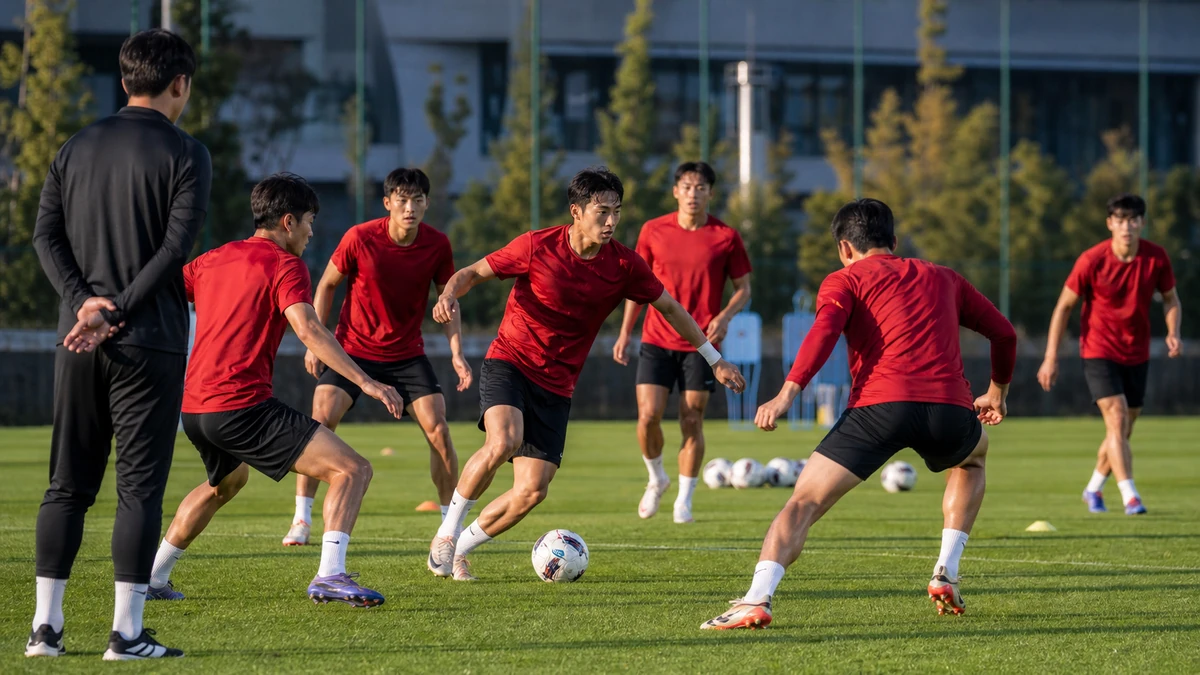
Image to help understand the article
South Korea opens a new cycle with an old expectation: win gold
South Korea’s under-23 men’s soccer team has begun training in the central city of Cheonan with a clear, unusually blunt objective for the 2026 Asian Games in Aichi and Nagoya, Japan: win the tournament and extend one of the most durable streaks in Asian soccer. Korea has taken gold in men’s soccer at the last three Asian Games, starting with the 2014 event in Incheon, and now enters this cycle trying for a fourth consecutive title — a feat no country has achieved in the competition.
That kind of run can be hard for American readers to place because the Asian Games do not have a direct U.S. equivalent. The event is a continent-wide, Olympic-style multi-sport competition held every four years, with prestige that can vary by sport but often carries enormous national significance. In soccer, the tournament does not quite match the World Cup or Olympics in global profile, yet in South Korea it still commands intense attention. For Korean fans, it is both a medal event and a measuring stick for the nation’s player pipeline.
This week’s opening training session, then, was more than a routine camp for young players. It was the first public step in a campaign shaped by expectation, scrutiny and a recent sense of disappointment around the senior national team. Coach Lee Min-sung framed the team’s uneven preparation not as a warning sign but as a lesson, describing the setbacks as a kind of medicine — a Korean expression suggesting that hardship, though bitter, can ultimately strengthen a team.
The message is straightforward: Korea believes it still has the talent base to rule this tournament, but it also knows the old formula cannot simply be assumed. The challenge now is to turn reputation into cohesion quickly, with a roster split across domestic clubs and European leagues and with little time to build chemistry before meaningful games begin.
Why this tournament carries more weight in South Korea than outsiders may realize
To understand the pressure on this team, Americans need some cultural context. In South Korea, men’s soccer at the Asian Games has long carried stakes that go beyond a medal count. Under Korean law, athletes who win certain major international honors can receive exemptions or alternative arrangements related to the country’s mandatory military service system. That makes the event especially consequential for elite male players in their early 20s, not only as a sporting milestone but as a career-defining opportunity.
That reality helps explain why South Korea often treats the Asian Games with a level of seriousness that can surprise overseas audiences. A U-23 roster in this setting is not merely developmental. It is frequently built to win now, often with top prospects, carefully chosen overage players and international-based talent folded in when possible. The standard is not “compete well.” The standard is gold.
That expectation has grown only sharper because this will be South Korea’s first major international stage after a disappointing men’s World Cup campaign in 2026 ended without a place in the knockout rounds. For a country that has spent decades positioning itself as one of Asia’s soccer powers — and that still draws identity from its 2002 World Cup semifinal run as co-host — falling short on the biggest stage tends to amplify pressure on whatever national team appears next.
So even though this is an age-group side, the emotional burden is larger than the roster sheet suggests. The team is being asked to defend a dynasty, restore confidence after a senior-team letdown, and offer a preview of whether the next generation of Korean players is ready for bigger roles. In that sense, the camp in Cheonan is not just the start of preparation for one tournament. It is an audition for the future direction of Korean soccer.
What went wrong earlier this year — and why the criticism matters now
South Korea’s coaching staff is not coming into this camp from a position of complete comfort. Earlier this year, the team reached the semifinals of the AFC U-23 Asian Cup, a result that looks respectable on paper but did not convince many observers. Korea advanced from a difficult group, yet performances against Iran, Lebanon and Uzbekistan drew criticism for lacking fluency and control. Then came a 1-0 semifinal loss to Japan, whose squad was reportedly made up of players younger than Korea’s age band.
That detail mattered. In a rivalry as emotionally loaded as South Korea versus Japan — one shaped not only by sport but by history, politics and national pride — losing to a younger Japanese side only sharpened the sense that Korea was underperforming relative to its talent. It was not viewed simply as a bad day. It was taken as evidence that the team still had not found the structure, rhythm or collective identity expected of a tournament favorite.
Lee’s explanation has been that the previous stages of preparation functioned partly as an evaluation process, closer to sorting through options than fielding a finished team. That may sound like a coach buying time, but it also reflects a real challenge in modern international soccer. Youth national teams often have fragmented calendars, limited training windows and players scattered across leagues with conflicting priorities. Chemistry, particularly in a side asked to press, transition and attack at speed, cannot be assumed.
Still, the criticism is meaningful because it points to a broader question facing Korean soccer. For years, the country has produced technically sound, tactically disciplined players who can adapt well to structured systems. But as more prospects move abroad earlier, and as domestic clubs juggle their own demands, assembling a coherent national-team style on short notice becomes harder. The issue is not a lack of individual quality. It is whether that quality can be synchronized under pressure.
That is why Lee’s insistence on “our soccer” matters. He is trying to shift the focus away from reacting to opponents and toward establishing a recognizable Korean approach — one based on collective movement, tempo and discipline rather than nerves. If the team can do that in the group stage, doubts from earlier this year may begin to fade. If not, the same criticism will return fast.
A split roster, a short runway and the familiar problem of modern international soccer
The opening sessions in Cheonan featured 14 players from the K League, South Korea’s top domestic professional circuit, with Europe-based players expected to join later in Japan. That staggered arrival is common in the modern game, but it creates a practical problem for any coach trying to prepare for a tournament in a compressed window. Domestic players can establish the base shape and tone in training, yet some of the most influential attacking pieces may not be present until late.
Among the players expected to join are rising talents such as Bae Jun-ho, Yang Min-hyuk and Kim Ji-soo, names increasingly familiar to followers of the Korean player pipeline into Europe. Their inclusion underscores how South Korea now develops players across two parallel ecosystems: a domestic league that remains central to formation and minutes, and an overseas network where elite prospects test themselves in faster, more physical environments.
The challenge is integrating those worlds quickly. A team with K League regulars, Europe-based prospects and an overage “wild card” player can look excellent on paper. But tournament soccer is not won on paper. It is won through timing: when to press, when to drop, how quickly to circulate the ball through midfield, and how reliably players read one another under stress. Those details are hard to build when not everyone arrives together.
That is where experience becomes important. Lee Gi-hyuk, who played all three group-stage matches for South Korea at the 2026 World Cup and joins as an overage selection, gives the team an older presence and a player who has already experienced elite pressure. Midfielder Kang Sang-yun, meanwhile, represents another kind of value: a player who has been around major-tournament environments and is now expected to become a key on-field connector rather than just a supporting figure.
His stated role — balancing defense and attack so teammates can play more comfortably — may sound modest, but for this team it is probably essential. In youth and age-group soccer, much attention goes to star attackers and overseas names. Yet tournaments are often decided by whether a midfield can control spacing, close transition lanes and keep early matches from turning frantic. Korea’s group, with Qatar and Saudi Arabia, offers little margin for slow starts. Because only the top two teams advance from the three-team group, every match carries knockout-level weight.
What this means for the United States and American soccer audiences
For American readers, South Korea’s U-23 campaign might seem remote at first glance. The United States does not compete in the Asian Games, and youth tournaments in Asia do not usually lead a sports lineup in New York, Los Angeles or Chicago. But ignoring this story would mean missing a larger development in global sports: Korean soccer, like Korean pop culture, is no longer a niche interest abroad. It increasingly exists inside a transnational market that includes U.S. fans, American broadcasters, European clubs with U.S. audiences and brands that market athletes across continents.
The clearest entry point for Americans is familiar: Son Heung-min. Even readers who do not follow Asian soccer closely often know Son as a Premier League star for Tottenham Hotspur and one of the most visible Korean athletes in the world. His generation helped normalize the idea that Korean players belong in top European competitions. The next generation now benefits from that pathway. When prospects in a U-23 camp are already attached to European clubs or being monitored by them, American fans are no longer watching a purely regional story. They are watching part of the global talent economy.
That matters to U.S. soccer for several reasons. First, American clubs, scouts and analytics departments increasingly track talent development across Asia, including South Korea, Japan and increasingly Southeast Asia. Second, the commercial side of the sport has become deeply interconnected. A breakout Korean player can affect not only transfer markets but U.S.-facing media coverage, sponsorship strategy, preseason tours and merchandise sales among Asian American communities and broader fan bases. Third, the U.S. co-hosted the 2026 World Cup and is positioning itself as a long-term hub in the global soccer business. Understanding who the next wave of internationally marketable players may be is part of that landscape.
There is also a more direct sporting comparison. In the United States, youth national teams are often discussed in terms of “the pipeline” — which teenagers or under-23 players might become the next national-team regulars, who is getting minutes in Europe, and whether the federation is building something durable rather than chasing one tournament result. South Korea is dealing with the same question, just under different cultural pressures. The parallel is easy to recognize for Americans who followed how U.S. Soccer talked about generational turnover before and after recent World Cups.
For American audiences shaped by the rise of Korean dramas, K-pop, Korean food and Korean consumer brands, there is also a broader cultural takeaway. Korea’s global influence is no longer confined to entertainment and tech. Sports are part of that export story, too. Korean baseball has already built pockets of visibility in the U.S., especially after ESPN carried KBO games during the early months of the pandemic. Soccer is further along in one sense because it is plugged into the Premier League, Bundesliga and other leagues Americans already follow. A successful U-23 cycle deepens that story by introducing the next cast of names.
More than a medal chase, this is a stress test for Korea’s next generation
The most interesting part of this campaign may be what it reveals about succession. South Korea has enjoyed a long stretch of credibility in Asian soccer, supported by a stable development culture, intense fan expectations and an ability to produce players who fit disciplined systems. But every soccer nation eventually confronts the same issue: how to move from one defining generation to the next without losing identity or results.
This U-23 team sits right on that fault line. Some players are already competing abroad. Others are still proving themselves in the K League. A few have felt the orbit of the senior national team without fully becoming fixtures there. Together they represent the tier just below stardom — the group a country turns to when it needs its future to stop being theoretical.
That is why the campaign has meaning beyond whether South Korea wins another gold medal. If the team succeeds while playing coherent, confident soccer, it will reinforce the idea that Korean soccer’s structure remains healthy despite recent frustrations. If it struggles, questions will grow about whether the nation is still converting prospect quality into team quality at the rate it once did.
Lee’s framing of earlier disappointment as useful medicine captures that fork in the road. It is a culturally resonant phrase, but it also works as a strategic statement. Coaches often say losses are learning opportunities. The harder part is proving that the lesson changed something concrete: pressing triggers, positional spacing, passing tempo, role clarity. Those are the invisible details that separate a collection of promising players from a tournament champion.
And that, in the end, is what makes this story bigger than a first day of training in Cheonan. South Korea is trying to defend a regional dynasty, absorb the aftershocks of a disappointing World Cup, and present a new generation as worthy heirs to one of Asia’s most demanding soccer traditions. For U.S. readers, the lesson is not simply that another Korean team expects to win. It is that Korea’s sports system, much like its entertainment industry, now operates in a global spotlight where development, branding, audience interest and national identity all overlap.
When the team reaches Japan for the Asian Games, the games themselves will decide whether the roster can meet that burden. But the broader trend is already visible. South Korea is treating youth soccer not as a sideshow but as a strategic national project, and the rest of the soccer world — including the United States — has reason to pay attention.
What to watch next as the tournament approaches
Three questions are likely to define the run-up to the Asian Games. The first is whether South Korea can establish a stable midfield identity quickly enough to control matches rather than merely survive them. The second is how smoothly Europe-based players integrate once they arrive, especially in the attack, where chemistry and timing are hardest to fake. The third is psychological: whether the pressure of a fourth straight title run sharpens the team or tightens it.
None of those questions has an immediate answer in an opening training camp. But together they explain why this roster matters beyond its age label. The team is not merely defending a title. It is trying to prove that South Korea’s next wave can carry the responsibilities that come with representing one of Asia’s most globally visible sporting brands.
For Americans, that makes this a familiar kind of sports story even if the setting is less familiar: a proud program trying to hand off power from one generation to the next without dropping its standard. In that sense, whether you follow K League prospects, Premier League stars, or simply the broader rise of South Korea on the world stage, this is a development worth tracking.
Comments
Post a Comment