Why IU’s Concert Film Reissues Matter Beyond Korea: What an 18th Anniversary Rerelease Says About K-pop, Theatrical Events and the U.S. Market
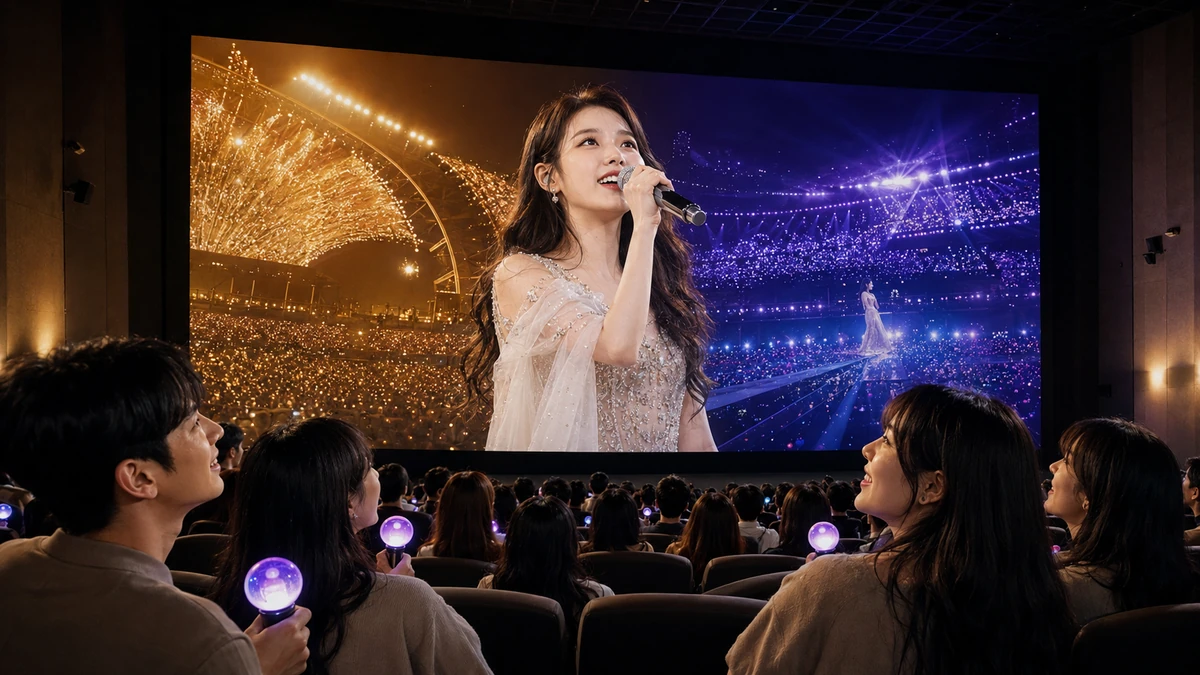
Image to help understand the article
A Korean pop anniversary becomes a theater event
In South Korea, an artist anniversary is not always marked by a new single, a television special or a glossy retrospective package. Sometimes it is marked by a return to a shared room: the movie theater. That is the idea behind the planned rerelease of two concert films by IU, one of South Korea’s most durable and influential solo stars, as Korean exhibitor-distributor CGV stages a two-week theatrical revival tied to the singer’s 18th debut anniversary.
According to the Korean news report, CGV ICECON will rerelease “IU Concert: The Golden Hour” on Sept. 9 and “The Winning” on Sept. 16, exclusively at CGV theaters in Korea. The scheduling is deliberate. Rather than treating the films as isolated fan-service screenings, the company is presenting them one week apart so audiences can revisit two different eras of IU’s live career in sequence: first, a 2022 Seoul stadium concert preserved as her first concert film; then, a 2024 performance tied to two major milestones, her first world tour and her 100th concert overall.
For American readers, it may help to think of this less as a simple rerelease and more as the kind of curated event programming U.S. theaters increasingly rely on when superhero franchises, prestige dramas and streaming libraries no longer dominate audience attention in the same way. In the United States, concert movies have become an important part of the theatrical business, from major pop-event releases to limited screenings that turn cinemas into gathering places for devoted fan communities. What CGV is doing with IU suggests Korea is moving further in that same direction, but with a distinct K-pop logic: the concert film is not just a souvenir of a live performance. It is part of the artist’s long-term storytelling.
That is what makes this news more than a niche fan update. It points to a broader entertainment trend in Korea and beyond, where the life of a concert no longer ends when the lights go up in the arena. Instead, the performance becomes reusable intellectual property, a piece of audience memory and, increasingly, a theatrical product that can be resold, reframed and experienced again under new circumstances.
Why these two films matter in IU’s career
The significance of the pairing begins with the milestones each film represents. “The Golden Hour” captures IU’s Sept. 17-18, 2022 concerts at Seoul Olympic Stadium, one of the country’s marquee large-scale venues. The film carries special weight because it was her first concert movie. In practical terms, that means it was the first time one of her live shows was formally translated into a feature-style theatrical experience rather than remaining a memory for those who attended in person or watched clips later online.
The second title, “The Winning,” documents performances held Sept. 21-22, 2024. According to the summary, those shows represented both IU’s first world tour and her 100th concert. That combination matters. In pop careers, there is a difference between success and endurance, and between domestic fame and scalable international reach. A first world tour signals expansion beyond a home market. A 100th concert signals accumulated longevity and a body of work substantial enough to sustain repeated large-stage reinvention.
Put together, the two films create a before-and-after portrait of artistic scale. One marks the beginning of IU’s concert-film archive. The other marks an artist operating from a stronger global footing. That is why CGV’s staggered release strategy is smart. It gives fans a narrative arc rather than a single commemorative date. Viewers are invited to compare not just set lists or costumes, but the evolution of stage design, crowd interaction, performance pacing and the overall language of a large Korean pop concert.
In American terms, imagine if a theater chain paired an earlier career-defining arena film from a major singer-songwriter with a later film marking that artist’s first true global touring phase, then framed the screenings as a way to watch the live persona grow over time. The pitch would not simply be nostalgia. It would be continuity. That appears to be the deeper logic here.
The 18th anniversary framing adds another layer. In Korean entertainment culture, milestone anniversaries often function as moments of inventory. They are opportunities for artists, agencies and fans to take stock of what has been built together over time. This is especially important in K-pop and adjacent Korean fandom culture, where audience participation is not passive. Fans do not merely consume content; they help sustain chart performance, event turnout, merchandising ecosystems and the emotional memory of an artist’s career. By bringing these films back to theaters now, the anniversary is being celebrated not only with memory, but with a communal act of rewatching.
More than a replay: How concert films became a second life for live music
One of the most interesting parts of the Korean report is its insistence that a rerelease should not be understood as a simple rerun. That distinction matters. A concert on the night it happens and a concert film seen later in a theater are not identical experiences. They activate different forms of attention.
At the original live show, the audience experiences scale, sound pressure, atmosphere and the unpredictability of a real-time performance. In a cinema, the viewer gains something else: selective focus. Cameras capture facial expressions, stage movement, crowd light patterns and transitions that many people in a stadium cannot fully see. The film preserves not just the songs, but a particular interpretation of the event. The viewer is no longer choosing where to look; the director and editor are guiding that choice.
This is one reason concert films have become more valuable in the streaming era rather than less. At first glance, it might seem odd that fans who can watch endless clips on their phones would still pay for a theater screening of a performance they may already know well. But the appeal lies in the change of format. A theater transforms familiar material into an event again. It also restores collectivity. Watching alone at home is not the same as laughing, singing softly, reacting and remembering in a room full of people who share the same investment in the artist.
The Korean summary makes exactly that point when it notes that fans who missed the original concert can discover it belatedly, while those who attended can revisit and verify their own memories. That dual audience is crucial. A rerelease works because it serves both access and nostalgia at once. It opens the archive to newcomers and deepens the bond for longtime fans.
There is also a strategic business reason this matters now. Live music has become increasingly expensive and difficult to access, whether because of geography, scheduling or ticket costs. Turning concerts into premium filmed events creates another tier in the fan economy. The artist’s stage can continue to generate attention and revenue after the live dates end, without requiring a new production from scratch. In that sense, the concert film has moved beyond bonus content. It is now a durable asset.
That appears to be one of the core messages embedded in this IU rerelease plan. These films are being presented as records worth revisiting years later, not ephemeral add-ons attached to an album cycle. In a media environment obsessed with constant novelty, that is a notable shift.
The technology matters: From standard screens to sensory cinema
The rerelease strategy also highlights something else happening in Korea’s exhibition business: the use of premium theater formats to differentiate the concert film experience. According to the summary, “The Winning” will be available not only in standard 2D, but also in SCREENX and 4DX formats. For U.S. readers unfamiliar with those names, they are part of a growing category of enhanced cinema presentations designed to make the theater feel more immersive and less interchangeable with home viewing.
SCREENX extends the image across side walls in some auditoriums, broadening the field of view beyond the front screen. 4DX combines motion seats with environmental effects. The exact value of such formats is often debated, and not every movie benefits equally from them. But concert content is one area where the logic is easy to understand. A live performance is already designed to overwhelm the senses. Premium formats promise to translate at least some of that intensity into a cinema setting.
In the United States, theater chains have long experimented with premium large formats, motion seating and special-event branding as ways to persuade audiences that leaving the couch is still worth it. Korea has often been more aggressive and sophisticated in this space, particularly through companies tied to CJ and CGV, which have helped develop exhibition technologies that later become global talking points. When a Korean concert film like IU’s is programmed in SCREENX or 4DX, it is not just fan targeting. It is also product testing for a theater industry searching for repeatable event categories.
That is important because the theatrical business in both Korea and the U.S. is under similar pressure. Ordinary releases must compete with streaming convenience. Concert movies answer that challenge by offering what streaming usually cannot: synchronized communal excitement. Premium formats push that even further. They tell audiences they are not simply watching a recording; they are buying access to a different mode of feeling the material.
Of course, this kind of immersion works best when the underlying fan relationship is already strong. It is hard to build a premium-format event around an artist people feel neutral about. IU’s appeal in Korea, and among many international fans, makes her a natural candidate for this treatment. The rerelease is therefore also a reminder that star power now extends across platforms. The same artist identity that fills concerts can sustain theatrical windows, alternate formats and anniversary-driven reactivations of older material.
What this means for the United States
For American audiences and companies, the IU rerelease is less important as a single booking decision in Korea than as a signal about where the global music-and-cinema business is heading. The U.S. market has already seen how powerful eventized concert films can be when they are marketed as communal experiences rather than straightforward documentaries. Korean entertainment companies, which are often quick to systematize fan engagement across merchandise, digital content, touring and social platforms, appear to be refining that model in their own way.
That matters for several reasons. First, the American fan base for Korean pop culture is no longer a fringe phenomenon. K-pop tours, Korean film festivals, specialty theatrical screenings and Korean-language releases have all established a measurable presence in the United States. Not every Korean artist can command a national multiplex rollout, but a proven fan base can support targeted theatrical events in major cities and college-heavy markets where fandom is organized and vocal.
Second, U.S. exhibitors and distributors are likely paying attention to how Korean companies package repeat viewings. The striking part of this IU plan is not simply that two existing films are coming back. It is that they are being sequenced to tell a story of artistic progression. That approach could be adapted easily in the American market, whether for Korean artists, American pop acts or cross-border distribution strategies. Instead of treating concert films as one-weekend novelties, exhibitors can frame them as chapters in an ongoing fan relationship.
Third, the U.S.-Korea entertainment relationship has become increasingly reciprocal. American audiences do not just import Korean content; American companies study Korean audience behavior, fan management and event design. Korean firms, in turn, have become more adept at translating domestic success into exportable formats. If concert films continue to perform as theatrical events, the line between music release, cinema booking and fandom activation will grow even blurrier. That has implications for U.S. theater chains looking for dependable specialty programming and for American labels thinking about how to preserve and monetize live performances beyond streaming clips.
There is also a softer cultural point here. American readers who are less familiar with Korean fandom may assume rereleases are purely commercial. They are commercial, certainly, but they also serve a social purpose. Fans gather not only to consume a product, but to mark time together. In Korean pop culture, anniversaries can function like civic rituals within a fandom: moments to remember, compare eras and reaffirm belonging. U.S. fan communities do this too, of course, but the Korean entertainment industry often packages the ritual more deliberately. That packaging itself may be one of the country’s most exportable media skills.
If IU’s films were ever positioned for broader American theatrical circulation, the audience would likely include more than die-hard fans. It would also include moviegoers increasingly accustomed to seeing theaters host things other than standard film releases: live broadcasts, anniversary screenings, behind-the-scenes specials and fandom-centered event cinema. In that sense, Korea is not moving away from the U.S. model. It is competing within the same global shift, and in some ways helping define it.
Why the timing matters after canceled live plans
The emotional context of this rerelease also matters. The Korean report notes that IU recently canceled a scheduled concert in Goyang because of a health issue involving the Eustachian tube, and that the release of her sixth full-length album was delayed as well. That means the rerelease arrives at a moment when fans had expected new offline activity and instead are facing an interruption.
Handled carelessly, a rerelease under those conditions could look like a substitute product designed to paper over disappointment. But the framing in the Korean report is more careful than that. It suggests these screenings should be understood as an independent cultural experience rather than an exaggerated replacement for a canceled concert or delayed album. That distinction is important for both ethical and business reasons. Fans are often sensitive to the difference between a meaningful archival offering and a stopgap marketing tactic.
In this case, the films appear to stand on their own because they document fully realized milestones from 2022 and 2024. They already have historical value within IU’s performance career. Their return to theaters does not create that value; it reactivates it. For fans, this can offer a way to stay connected to the artist’s stage work without pretending that a cinema screening is equivalent to a new live event.
There is a broader lesson here for the global music industry. As artists face scheduling disruptions, health concerns and increasingly complex touring economics, recorded live performance archives become more important. They allow a career to remain visible during pauses without demanding the physical strain of constant new appearances. For artists with deep catalogs and strong fan communities, the archive itself becomes part of the present-tense business model.
That may be one of the clearest takeaways from the IU case. The modern concert is no longer only a night in a venue. It is also a future library item, ready to be recirculated when timing, technology or audience feeling makes it newly resonant.
What to watch next in K-pop and event cinema
The most revealing part of this story may be what it suggests about the next stage of K-pop’s global media strategy. For years, industry discussion focused heavily on albums, charts, streaming, social media virality and international touring. Those remain essential. But a quieter infrastructure is maturing alongside them: filmed live performance as a premium, repeatable cultural format.
If that trend continues, fans should expect more anniversary-driven rereleases, more differentiated theatrical formats and more careful programming that turns an artist’s back catalog into a chronological viewing experience. That could mean paired screenings, limited event runs tied to career milestones or specialized format launches aimed at the most committed segment of an audience. Korea’s exhibition ecosystem is especially well positioned for this because it already treats cinemas as venues for event culture, not just movie consumption.
For American companies, the question is not whether concert films can work. That has already been answered. The more pressing question is how to make them work repeatedly, across artists and across tiers of fame. Korea’s answer appears to be curation, fandom literacy and technological enhancement. A concert film succeeds not just because the performer is famous, but because the release is shaped as an occasion with narrative meaning.
That is exactly what the IU rerelease embodies. The numbers attached to it, 18 years since debut, a first concert film, a first world tour, a 100th concert, are not empty promotional badges. They are organizing devices that help fans and casual observers understand why these performances matter now. In a crowded content marketplace, context is often the difference between background noise and an event.
For readers in the United States, the larger lesson is straightforward. Korean pop culture’s influence is no longer confined to music charts, streaming recommendations or social media fandoms. It increasingly shapes how entertainment itself is packaged, archived and resold. IU’s two-film rerelease in Korea may seem, at first glance, like a local anniversary celebration. In reality, it is also a case study in how modern pop stardom extends beyond the stage, beyond the original screening and beyond national borders.
That makes this less a story about revisiting the past than about testing the future. If audiences keep showing up to experience yesterday’s concerts as today’s communal events, then the concert film is no longer secondary to the live show. It is becoming one of the main ways pop history is written, monetized and shared.
Comments
Post a Comment