‘Ode to My Father’: The Korean Blockbuster That Turned One Man’s Life Into a Portrait of Modern History
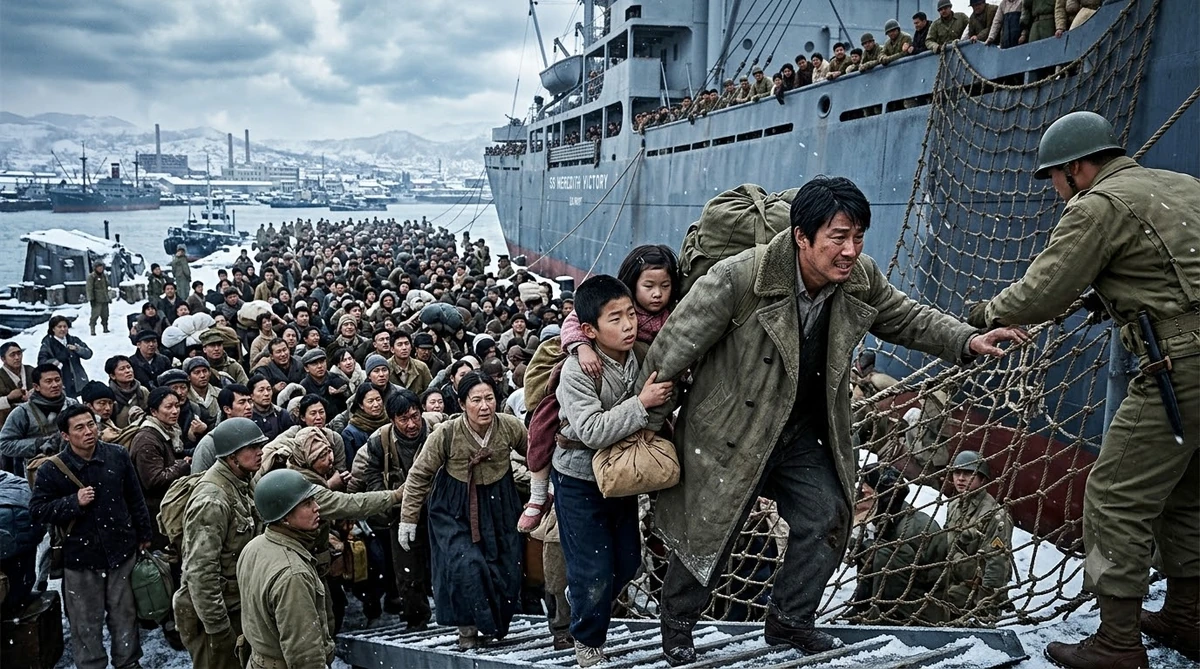
Image to help understand the article
A family story spanning Korea’s turbulent 20th century
South Korean director Yoon Je-kyoon’s 2014 drama Ode to My Father follows an ordinary man whose personal struggles mirror some of the defining moments of modern Korean history.
The film begins with the 1950 Hungnam Evacuation during the Korean War, when a young boy named Deok-soo is separated from his father and younger sister while fleeing North Korea. His father entrusts him with protecting the family and tells him they should reunite at Busan’s “Kkotbunine,” a small shop run by relatives. That promise becomes a lifelong responsibility for Deok-soo.
As an adult, Deok-soo gives up his own dreams to support his family. He travels to West Germany as a coal miner in the 1960s to help pay for his younger brother’s education, later marries Young-ja, a Korean nurse he meets there, and eventually goes to Vietnam during the war era. The story also follows his search for family members separated during the Korean War and his efforts to preserve the family business that represents his father’s final promise.
A record-breaking Korean box office success
Released on Dec. 17, 2014, Ode to My Father became one of South Korea’s biggest box office hits. The 126-minute drama surpassed 10 million admissions on Jan. 13, 2015, becoming the 11th Korean film to reach that milestone and the second such success for Yoon, following his disaster film Haeundae.
According to the Korean Film Council’s KOBIS box office system, the film had drawn 14,198,690 viewers by March 1, 2015, generating about $96 million in domestic revenue. It remained a major cultural event in South Korea, eventually ranking among the country’s highest-grossing films.
A film that connected with Korean immigrants overseas
The film also reached Korean communities abroad. It opened in Los Angeles on Dec. 31, 2014, before expanding to 43 cities across the United States and Canada, including New York, Chicago, Toronto and Vancouver. Many early viewers in Los Angeles were first-generation Korean immigrants in their 50s and older, the same generation represented in the film’s story.
For Korean Americans, the film’s themes of war displacement, migration and sacrifice reflected experiences shared by many families who left Korea during periods of upheaval.
Recognition, debate and a tribute to a generation
Ode to My Father received multiple awards, including Best Picture and Best Director at the 52nd Grand Bell Awards, South Korea’s major film awards ceremony. Actor Hwang Jung-min won Best Actor, while Oh Dal-su received Best Supporting Actor.
The film also sparked debate in South Korea. Some critics argued that it portrayed the country’s authoritarian-era industrialization too positively, while others viewed it as a story about family sacrifice rather than politics. The movie’s success was widely linked to its emotional appeal among older audiences who saw their own experiences reflected on screen.
Yoon Je-kyoon said he wanted to create a family film about parents who sacrificed for their children and hoped the movie could help different generations better understand one another. The film’s promotional message described it as “the greatest story of the most ordinary father.”
Comments
Post a Comment