Image to help understand the article
From Seoul to Europe’s Avant-Garde
Nam June Paik, the Korean-born artist widely regarded as the founder of video art, spent his career dismantling boundaries: between music and visual art, nature and technology, performance and broadcasting. Born July 20, 1932, in Seoul, Paik became a composer, provocateur and pioneering electronic artist whose work anticipated a world connected by screens.
Paik studied piano and composition while attending school in Seoul. He later studied in Hong Kong before moving with his family to Japan during the Korean War. At the University of Tokyo, he concentrated on music and philosophy and wrote his graduation thesis on composer Arnold Schoenberg.
He moved to Germany in 1957, studying Western architecture and composition at universities in Munich and Cologne before continuing at the Freiburg Conservatory of Music. A pivotal encounter came in 1958, when he met American experimental composer John Cage at a summer music program in Darmstadt. Paik drew inspiration from Cage’s freewheeling approach and willingness to disrupt traditional ideas about music.
Breaking Instruments and Performance Rules
Paik’s early performances were confrontational by design. In a 1959 work dedicated to Cage, he combined musical collage with the destruction of a piano. He smashed a violin in one performance, cut off Cage’s necktie in another and used his ink-covered head and tie to make marks on a scroll in “Zen for Head.” Paik later described those early works as displays of shock, expressionism, romanticism, climax and surprise.
In 1962, he joined Fluxus, an international avant-garde movement whose artists challenged conventional distinctions among music, theater and visual art. Working alongside figures including George Maciunas and Joseph Beuys, Paik staged experimental events and performances that earned him a provocative label in the German press: a “cultural terrorist from the East.”
At the same time, he was studying electronics and exploring whether television — then largely treated as a household appliance and mass-broadcast medium — could become an artistic tool.
Thirteen Televisions and a New Art Form
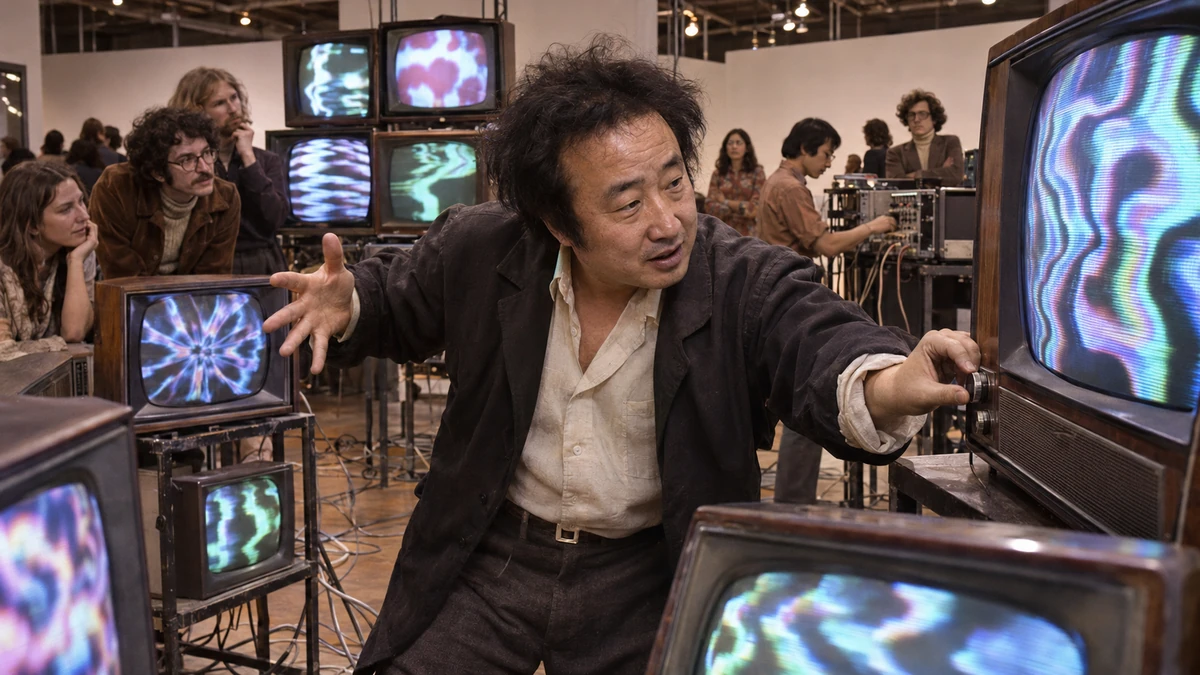
Paik presented his first solo exhibition, “Exposition of Music — Electronic Television,” at a gallery in Wuppertal, Germany, in 1963. The show used 13 altered television sets to turn sound into images, offering an early model for what became known as video art. Musical installations, a severed cow’s head, damaged mannequins and participatory works shared the space.
The following year, Paik built “Robot K-456,” a humanoid machine designed to walk and defecate, and moved to New York. In 1965, he used a Sony portable video recorder to film the pope’s visit to the city and screened the footage soon afterward at Café Au Go Go. The event has been cited as a formal starting point for video art, alongside his 1963 exhibition.
Paik also began a celebrated collaboration with American cellist Charlotte Moorman, combining music, video and performance. Moorman was arrested in 1967 after performing topless in Paik’s “Opera Sextronique,” setting off a public controversy. For “TV Bra for Living Sculpture” in 1969, she wore a bra made from two small television monitors weighing about 6.6 pounds. During a July 20 performance, the screens carried images of the Apollo 11 moon landing.
From TV Buddha to Satellite Art
Working with engineer Shuya Abe, Paik developed a video synthesizer in 1969 that allowed electronic images to be combined and manipulated. By the mid-1970s, he was expanding video into large installations. “TV Buddha” placed an image associated with spiritual stillness in dialogue with electronic technology. Other works paired television sets with fish tanks, plants and representations of the moon, joining natural forms with the machinery of modern life.
Paik also brought experimental video onto American public television through New York’s WNET and Boston’s WGBH. On Jan. 1, 1984, he expanded his stage to a global communications network with “Good Morning, Mr. Orwell.” The live satellite broadcast connected WNET with the Centre Pompidou in Paris, as well as participants in San Francisco and Seoul.
The program featured Cage, Beuys, Laurie Anderson, Peter Gabriel, Allen Ginsberg and Yves Montand. Including rebroadcasts, it reached an estimated 25 million viewers worldwide. Conceived as a rebuttal to the grim technological future depicted in George Orwell’s “1984,” the project was followed by other international broadcasts, including “Bye Bye Kipling” and “Wrap Around the World.”
Monuments to the Screen Age
In 1988, Paik created “The More, the Better” for South Korea’s National Museum of Modern and Contemporary Art. Built from 1,003 television sets, the tower stands about 61 feet tall, measures nearly 25 feet across and weighs 16 tons. A 1992 Paik exhibition at the museum’s Gwacheon branch drew 200,000 visitors and featured “My Faust,” a 13-part series addressing subjects including agriculture, the environment, economics and autobiography.
Paik shared the Golden Lion for best national pavilion at the 1993 Venice Biennale, where he represented Germany with Hans Haacke. His video robots drew on the nomadic cultures of northern Eurasia and included figures associated with Genghis Khan, Marco Polo and Dangun, the legendary founder of Korea’s first kingdom.
He later helped launch the Gwangju Biennale and played a decisive role in establishing the Korean Pavilion at the Venice Biennale. In 1995, he unveiled “Electronic Superhighway: Continental U.S., Alaska, Hawaii,” an installation made with 313 television monitors, neon and steel that turned the map of the United States into a glowing electronic landscape.
A Korean-Born Pioneer With a Global Legacy
Paik continued working after suffering a stroke in 1996. His major 2000 retrospective at New York’s Solomon R. Guggenheim Museum included “Jacob’s Ladder” and “Three Elements,” works that pushed his practice into laser art.
Across his career, Paik incorporated elements of Zen Buddhism, shamanism, the I Ching and Taoism into a futuristic body of work joining art and science. He received honors including the Fukuoka Asian Culture Prize, South Korea’s Ho-Am Prize in the Arts, the Kyoto Prize and the Gold Crown Order of Cultural Merit.
Paik died of age-related causes at his Miami home on Jan. 29, 2006. His remains were divided among Seoul, New York and Germany — three centers in the international life of an artist who changed how the world understood television and moving images.
Comments
Post a Comment