
A K-pop milestone becomes a civic event
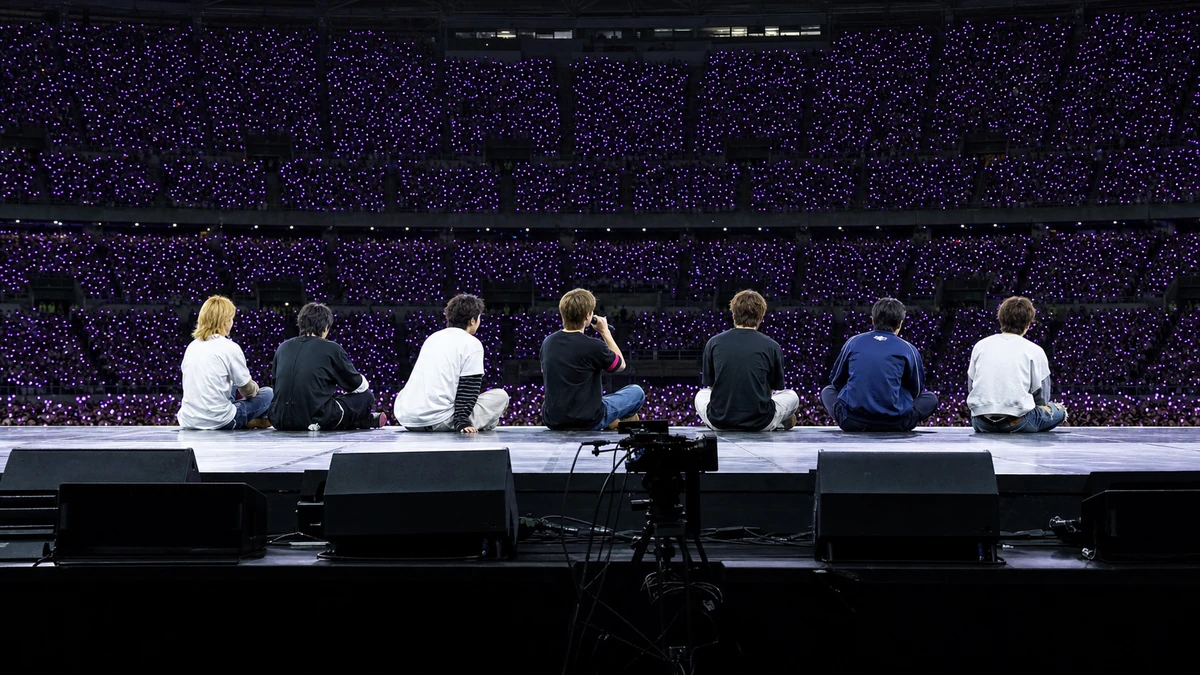
BUSAN, South Korea — On a humid June night in South Korea’s second-largest city, BTS did something few pop acts can do at this stage of a career measured in global records, stadium tours and cultural influence: The group made a massive concert feel intimate. Performing Saturday at Busan Asiad Main Stadium as part of its world tour “ARIRANG,” BTS celebrated the 13th anniversary of its debut with about 55,000 fans, known collectively as ARMY, transforming what might otherwise have been just another high-wattage stadium date into something closer to a shared ritual.
The timing mattered. June 13 is not just another stop on the calendar for BTS fans. It is the date the seven-member group debuted in 2013, a touchstone that has become part of the fandom’s annual cycle, much the way sports fans mark opening day or Americans might circle the anniversary of a beloved album release that changed a generation. In Busan, that anniversary was observed not online or in fan forums but in person, inside one of South Korea’s major sports venues, with tens of thousands of people singing, cheering and, at one point, effectively serenading the group with a birthday song.
According to South Korean news reports, BTS member Jin told the crowd, “Seeing ARMY enjoy themselves is the greatest birthday gift for us.” It was a line that captured the emotional grammar of the night. The stars were onstage, but the message was directed outward, back to the people who have sustained BTS through more than a decade of industry upheaval, military service interruptions, solo projects and the extraordinary pressure of being the most internationally recognized act ever to emerge from South Korea.
For American readers accustomed to seeing BTS through the lens of Billboard rankings, sold-out U.S. stadium dates or White House appearances, the Busan concert offered a reminder that the group’s global identity is inseparable from its local roots. This was not simply a Korean act returning home between international obligations. It was a Korean act using a major home-country stage to reaffirm where its story began and why that origin still matters.
That distinction helps explain why this concert has resonated beyond the usual K-pop headlines. It was not just a celebration of longevity. It was a statement about place, language and cultural identity — and about the unusual bond between a homegrown group and a worldwide fan base willing to travel across borders to participate in that story.
Why Busan matters
To understand the symbolism of the night, it helps to understand Busan itself. For Americans unfamiliar with South Korea beyond Seoul, Busan is often introduced as the country’s biggest port city, a southern metropolis with beaches, seafood markets, mountains and a distinctly different rhythm from the capital. If Seoul is the political and media center, Busan often reads as more coastal, more open and, in cultural imagination, a city with its own swagger. It is also fully capable of hosting events on an international scale, with major sports facilities and a tourism infrastructure built to absorb waves of visitors.
BTS last held a major concert in Busan in October 2022 with “Yet To Come in Busan,” an event that carried enormous emotional weight because it came just before the group’s military-service era began to reshape its public schedule. In South Korea, mandatory military service for most able-bodied men is a central fact of public life, and it has long shaped the careers of male entertainers. For BTS fans, that 2022 show became associated with uncertainty, a pause and the beginning of a new chapter.
That makes this return, nearly three years and eight months later, more than a convenient tour routing decision. It creates a before-and-after frame. Fans who were in Busan in 2022 have now seen the city become a marker in the group’s timeline: one concert linked to a looming hiatus, another linked to a mature anniversary celebration. The geography itself carries memory.
There is another reason Busan matters. One of the subtler but increasingly important developments in K-pop is the way major acts can turn not only countries but specific cities into destinations for fandom pilgrimage. In the United States, music tourism has long clustered around places like Nashville, Austin, Los Angeles or New Orleans, where scenes and identities are tied to sound. K-pop adds another layer: Fans travel not just for a genre but for a specific artist’s symbolic relationship to a place. A BTS concert in Busan is not interchangeable with a BTS concert elsewhere. It carries the energy of a home-country event and the prestige of being part of a collective fan memory.
In that sense, Saturday’s performance was not only a concert but a cultural magnet, drawing international visitors into a Korean city and allowing them to experience South Korea beyond the typical Seoul-centered itinerary. That kind of soft power has become one of K-pop’s most durable side effects.
The meaning of “ARIRANG” beyond a tour title
The title of BTS’ current world tour, “ARIRANG,” adds another layer that American audiences may not immediately recognize. “Arirang” is the name of Korea’s most famous traditional folk song, one that carries deep emotional and cultural resonance. There are many regional variations, but broadly speaking, the song evokes themes of longing, separation, endurance and national identity. For Koreans, the word does not function merely as a decorative heritage reference. It signals a shared cultural memory.
That matters because K-pop is often misunderstood abroad as a genre that simply repackages American pop formulas with sharper choreography and more elaborate fan engagement. There is some truth in the global DNA of the industry; K-pop has always been hybrid. But what has helped the biggest acts endure is not just their ability to imitate international trends. It is their ability to export specifically Korean language, imagery and emotional codes without sanding them down for easy foreign consumption.
Reports from the venue noted that some international fans arrived wearing hanbok, the traditional Korean dress, in keeping with the show’s concept and album imagery. That scene, while visually striking, is also culturally revealing. It suggests that global fandom is not merely consuming catchy songs detached from context. Instead, many fans are actively participating in a Korean cultural framework, learning its symbols and wearing them publicly. That is a different model from the old assumption that global success requires local identity to be diluted.
For years, U.S. pop music largely set the terms of global mainstream culture. Foreign acts seeking crossover success were often expected to smooth out accents, references and aesthetics that seemed too specific. BTS helped reverse that equation. They proved that specificity can be an asset. Songs in Korean could top American charts. Speeches partly delivered in Korean could move audiences in Las Vegas or New Jersey. A tour named after a traditional Korean folk song can now fill stadiums while inviting international fans to meet Korean culture on its own terms.
The Busan show appeared to embody that idea. The “ARIRANG” framework was not a policy statement or an official campaign. It was a creative concept. But creative concepts matter in pop culture because they signal what artists believe their audience is ready to understand. In this case, BTS seemed to be saying that their Korean identity is not an obstacle to global reach. It is central to it.
A global fandom, gathered in the heat
Outside the stadium, the scale of that global reach was visible long before the lights went down. South Korean reports described the area around Busan Asiad Main Stadium filling early in the day despite temperatures hovering near 86 degrees Fahrenheit. Fans came from around the world, many dressed in coordinated outfits, carrying light sticks and stopping for photos that doubled as proof of pilgrimage. Stadium concerts often create temporary communities. K-pop concerts, especially those tied to major anniversaries, can feel more like pop-up cities.
That distinction is worth dwelling on. In the United States, fandom is often treated as a subculture or niche passion, but K-pop fandom operates with the infrastructure of a social movement: coordinated travel, visual identifiers, multilingual communication networks and a shared ceremonial vocabulary. The light stick is not just merchandise. It is a badge. The anniversary is not just a date. It is a commemorative event. The concert grounds are not just a queue. They are a space where people enact belonging.
One fan from the Philippines, identified in local coverage as Christine, traveled to Busan with friends to celebrate BTS’ 13th debut anniversary. Others told reporters that BTS had been a source of comfort during difficult periods of their lives. Those testimonials may sound familiar to anyone who has followed pop fandom in the streaming age, but they land differently in the BTS context because of the group’s long-running emphasis on emotional candor, self-worth and mutual support between artist and audience.
That dynamic has helped ARMY evolve into one of the most organized fan communities in modern music. BTS fans do not just listen. They mobilize. They fundraise, translate, archive, stream, travel and, perhaps most importantly, convert private feeling into public action. In Busan, that action took the shape of presence. Fans crossed borders to stand in the same heat, in the same city, on the same date, for a group anniversary that has become globally legible.
It also underscored how concerts function in K-pop as more than revenue-generating tour stops. They are immersive spaces where fandom performs itself. The clothing, call-and-response chants, photo trading, banners and synchronized cheering all create a dense layer of participation around the music. The show onstage matters, but so does the social world built around it. That wider atmosphere is part of what makes a BTS concert feel less like a consumer event and more like a collective happening.
What BTS said about home
If the visual story of the night was global, the verbal story was insistently local. According to South Korean reports, the members thanked fans for carrying them through 13 years and emphasized that, despite the group’s worldwide popularity, there is something uniquely meaningful about performing in South Korea. They made a point of identifying themselves as Korean and speaking about the joy of being onstage in their own country, in their own cities.
That may seem obvious. Of course a Korean group would feel at home in Korea. But in the context of global entertainment, such statements carry weight. International fame has a way of flattening identity, turning artists into export brands. BTS has spent years navigating that tension. To many Americans, they are global celebrities first, Koreans second, because global success is often the frame through which foreign artists are introduced in U.S. media. Yet their own self-presentation frequently reverses that order.
When BTS says there is nothing better than performing in Korea, they are not rejecting international fans. They are placing global success in a grounded narrative. Home is not a backdrop to fame; it is the source of meaning that fame amplifies. That sensibility may be one reason the group has managed to maintain unusually strong loyalty across different eras of its career. Fans are not simply buying into a polished universal product. They are engaging a story that remains anchored in language, nation and lived cultural context.
For American audiences, there is a useful comparison in how artists from places with strong regional identities often talk about going back home. Think of Bruce Springsteen invoking New Jersey, or Beyoncé centering Houston, or country artists framing Nashville not just as an industry hub but as part of their artistic DNA. BTS operates on a much more transnational scale, but the instinct is similar. Place is not incidental. It is part of the emotional contract with the audience.
That contract was especially visible on an anniversary date. A debut anniversary in K-pop is often treated with a seriousness that may surprise outsiders. It is not simply a nostalgic marker. It is a recurring civic holiday inside the fandom, complete with messages, special content, charity drives and commemorative gatherings. When an actual concert falls on that exact day, the result is intensified. Fans are not merely attending a performance; they are participating in a milestone, almost like attending a reunion and a festival at once.
The long life of BTS and the durability of K-pop
The Busan concert also pointed to a larger industry question: What does longevity look like in K-pop? The genre has often been associated with speed — quick turnarounds, youth-driven concepts and relentless competition. Acts debut constantly, and only a handful sustain top-tier relevance across a decade. BTS has not only sustained it; the group has expanded the scale of what long-term success can mean for a Korean act.
Thirteen years is a significant milestone in any corner of pop music. In K-pop, where the system often prizes novelty, it is especially notable. Longevity here is not just a matter of avoiding breakup rumors or releasing new material. It depends on whether fans continue to generate meaning around the group year after year. Saturday’s show suggested that they do. The concert linked multiple timelines at once: the 13-year arc since debut, the nearly four-year gap since the last Busan show and the current “ARIRANG” tour that began in Goyang, near Seoul, in April.
That layered sense of time is part of BTS’ power. The group’s music and image have changed repeatedly, but the surrounding narrative has remained legible to fans: growth, return, continuity, gratitude. ARMY has helped maintain that continuity by treating each chapter as part of a broader shared history. In practical terms, that means a ticket is never just a ticket. It is entry into a story the audience has helped write.
There is an economic dimension here as well. In the streaming era, recorded music alone rarely explains an artist’s full influence. Live performance, fan travel and citywide cultural spillover matter enormously. A major BTS concert can alter hotel demand, restaurant traffic, local transit patterns and the international visibility of a host city. That is one reason governments and tourism bodies pay close attention to top-tier K-pop events. They do not simply entertain. They move people — literally and financially.
Busan offered a vivid case study. Tens of thousands of attendees packed a stadium, while the surrounding neighborhoods absorbed the energy of a globally networked fan base. The city became part stage, part marketplace and part emotional landmark. For a nation that has steadily expanded its cultural exports through film, television, beauty, food and music, these moments matter. They show how Korean popular culture continues to convert artistic influence into real-world movement.
What the night says about Korean culture’s global future
In the broadest sense, BTS’ anniversary concert in Busan was about a paradox that has become central to the Korean Wave: The more culturally specific Korean pop culture remains, the more globally compelling it can become. That is not always how globalization was supposed to work. Conventional wisdom long held that wider audiences demanded simplification and familiarity. K-pop has increasingly challenged that assumption.
BTS is perhaps the clearest example. The group’s success has not depended on erasing Korean language or identity. Instead, millions of fans have accepted the invitation to learn, adapt and participate. They sing along in Korean. They recognize references that would have once seemed too local to travel. They fly to Korean cities to mark symbolic dates. In Busan, some even dressed in traditional clothing associated with the tour’s Korean-themed concept.
The concert therefore functioned as both celebration and evidence. It celebrated 13 years of BTS. It also offered evidence that the engine of K-pop’s global staying power is not just spectacle, though spectacle remains part of the appeal. It is the relationship between rootedness and reach. BTS can fill a stadium in South Korea with fans from around the world not despite being unmistakably Korean, but in large part because of it.
For American readers trying to understand why BTS still commands such extraordinary devotion, that may be the most useful takeaway. This is not simply fandom inflated by social media metrics or chart campaigns, though those exist. It is fandom sustained by a sense of participation in a living cultural exchange. On one level, Saturday’s event was a birthday party for a band. On another, it was a demonstration of how pop culture now travels: not as a one-way export from the West to the rest, but as a multidirectional conversation in which audiences willingly cross linguistic and cultural boundaries.
As of June 14, the day after the concert, the image that lingers is simple: a Korean group in a Korean city, on the anniversary of its Korean debut, celebrated by tens of thousands of people from many countries who came precisely because that local meaning mattered. In an era when global fame can often feel detached from place, BTS used Busan to make the opposite point. The bigger they become, the more powerful the return home can be.


0 Comments