Mamamoo returns as a full group with ‘4WARD,’ signaling more than a comeback in K-pop’s fast-moving world
A reunion single with a larger message
Mamamoo, one of South Korea’s best-known vocal girl groups, is releasing a new special single titled “4WARD” on Friday, marking its first new song as a four-member group in three years and eight months. In the language of K-pop, that alone qualifies as major news. But the significance of this release goes beyond the arrival of another track in a crowded global pop marketplace. For fans in South Korea and abroad, the single is being read as a clear sign that Mamamoo is not simply revisiting its past. It is reasserting itself as a complete group at a time when many long-running K-pop acts are better known for solo projects, contract questions or occasional nostalgia-driven reunions.
That distinction matters. Mamamoo debuted in 2014 and built its reputation on powerful live vocals, a confident stage presence and a catalog that stood out in an industry often driven by high-concept visuals and tightly engineered group identity. Over the years, each of its four members — Solar, Moonbyul, Wheein and Hwasa — has also developed an individual career and public persona. In American terms, this is the point where many pop groups start to resemble a collection of successful solo brands that sometimes happen to share a history. What makes “4WARD” notable is that Mamamoo is making the opposite argument: that the group itself still has something distinct to say.
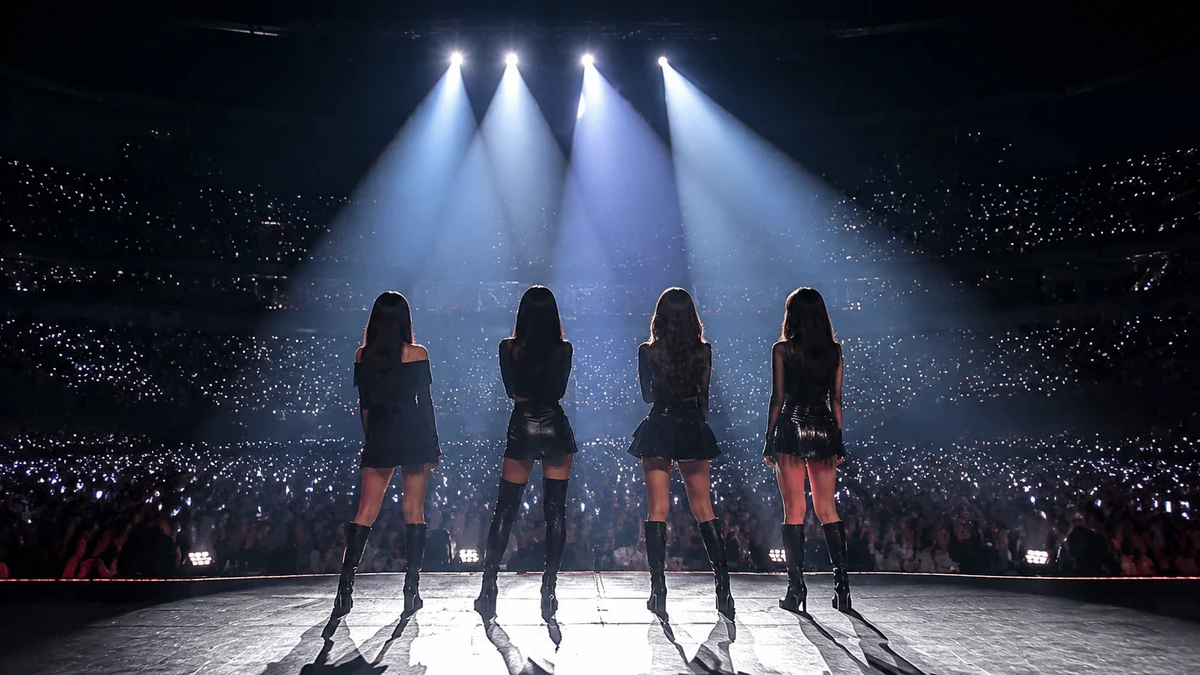
The release comes ahead of a new world tour that will begin in Seoul later this month, giving the single an added sense of purpose. Rather than serving as a standalone digital drop, “4WARD” appears designed as the opening statement of a larger return to the stage. In K-pop, that kind of sequencing is rarely accidental. A song release, a tour title, teaser imagery and fan messaging often work together as parts of a single narrative. Here, the message is unusually direct. Mamamoo is moving forward, and it is doing so together.
For American readers less familiar with Korean entertainment culture, it is worth pausing on one phrase that comes up often in coverage like this: “full group.” In Korean, the term “wanjeonche,” often translated loosely as “complete group” or “full-member lineup,” carries emotional and commercial weight. It means more than all members being physically present. It suggests continuity, loyalty and the preservation of a shared identity despite the pressures of time, changing careers and an unforgiving industry cycle. In other words, this is not being framed merely as a comeback. It is being framed as proof of endurance.
That is one reason the story is resonating. K-pop is famous for speed: fast debuts, fast chart cycles, fast trend turnover. In that environment, a group returning after a lengthy gap as all four original members can carry the force of an event, especially when the act in question already has a decade-long history. Mamamoo’s new single is being introduced not only as new music, but as a statement about what lasts.
Why the title ‘4WARD’ matters in K-pop storytelling
The single’s title is doing a lot of work before listeners even hear the song. “4WARD” combines the number four — representing the group’s four members — with the English word “forward.” It is a simple bit of wordplay, but in the context of K-pop branding, it functions as more than a clever title. It tells the audience how to understand the project: four members, one direction, no attempt to hide the symbolism.
That may sound obvious, but pop titles in South Korea often serve as compact storytelling devices, particularly when a release is tied to a broader comeback campaign. Numbers, colors, repeated motifs and visual cues are frequently used to reinforce a group’s identity or mark a new era. In this case, the “4” is not decorative. It is the point. The group is foregrounding the fact that Mamamoo’s core meaning begins with its four-person structure, even after a period in which those members have pursued separate schedules and independent artistic paths.
For an American comparison, imagine if a long-running group like Destiny’s Child or Fifth Harmony returned after years apart and explicitly built the title of its new release around the idea of the original lineup and its next chapter. The title itself would become part of the headline, because it would tell fans this is not just another song. It is a mission statement. That is essentially what Mamamoo is doing here.
The title also signals a refusal to get stuck in retrospective mode. A lesser reunion effort might lean entirely on memory, inviting fans to relive a golden era without promising much beyond recognition and comfort. “4WARD,” by contrast, is built around motion. The word “forward” implies progression, not museum curation. Even if the song inevitably carries emotional weight because of the long gap, its branding suggests the group does not want this moment understood as a backward glance at old glories. It wants the reunion to feel current.
That idea is especially important in K-pop, where the difference between a legacy act and an active act can narrow quickly. Groups with long careers often face two questions when they reunite: Do they still feel convincing as a unit? And why now? Mamamoo’s title offers an answer before the chorus even begins. The group remains centered on the bond among four members, and the reason for coming back now is to start the next phase together.
A song about relationships, not just return-on-investment
The title track, “4 Flower,” has been described as a medium-tempo pop song built around textured guitar and dense drum sounds. On paper, that may not sound like the sort of bombastic production often associated with splashy K-pop comebacks. But that restraint may be the point. Rather than treating the reunion as a one-night spectacle, the group appears to be grounding it in the musical traits that made Mamamoo resonate in the first place: warmth, vocal chemistry and emotional clarity.
The song’s central image is that of flowers that bloom brightly and fade, yet remain connected through one shared root. It is an image that works on multiple levels. At the most immediate level, it speaks to the relationships among the four members, who have spent years balancing individual careers with group history. More broadly, it touches on a theme that travels well across borders and industries: that time changes circumstances, but not necessarily the bonds that give a group its shape.
What is striking here is that the group’s relationship is not being left in the background as offstage lore for fans to infer. It is being placed at the center of the song’s message. In many pop comebacks, the story surrounding the release — chart expectations, album sales, ticket demand, media appearances — can overshadow the music itself. Mamamoo’s framing suggests a different emphasis. The emotional and relational logic of the group is not a side note. It is the text.
That approach gives the single a kind of maturity that can be difficult to manufacture in pop. Mamamoo is no longer a rookie act trying to prove it belongs. Nor is it pretending that time has stood still. Instead, it is making time part of the narrative. The values that remain unchanged, the relationships that endure and the confidence to acknowledge distance without treating it as damage all suggest an act that understands its own history and knows how to turn that history into meaning.
For American readers, there is something familiar in that instinct. Some of the most effective reunion records in U.S. pop and rock have not succeeded because they reproduced youth exactly as it once sounded. They succeeded because they allowed experience to shape the music. The appeal was not simply, “Remember us?” It was, “We are still us, and now we can tell that story differently.” Mamamoo appears to be aiming for something similar, within the distinct machinery of K-pop.
The weight of a 3-year, 8-month gap
In ordinary pop terms, three years and eight months might not sound dramatic. In K-pop, it can feel like an era. The industry’s pace is notoriously unforgiving, and major groups often release music several times a year during peak activity. New acts debut constantly. Trends in sound, styling and platform strategy shift at dizzying speed. Under those conditions, a long gap in full-group releases does more than create anticipation. It raises real questions about whether a group’s center of gravity still exists.
That is why Mamamoo’s return is being interpreted not just as a reappearance, but as a redefinition. The elapsed time invites scrutiny. Are the members still aligned? Does the public still view the group as a living entity rather than a completed chapter? Can the act return on terms that feel relevant rather than obligatory? “4WARD” seems constructed to answer each of those questions with a carefully organized yes.
It also helps that Mamamoo is not returning from obscurity. The group has a deep catalog, name recognition and a place in the history of third-generation K-pop — the cohort of artists who helped push Korean pop further into the global mainstream before the current wave of younger acts took over. Songs such as “You’re the Best,” “Yes I Am” and “Starry Night” helped define Mamamoo’s image as a group capable of marrying vocal performance with personality, humor and polish. Those hits do not guarantee a meaningful present. But they do create a foundation from which a return can matter right away.
Still, the new single’s framing suggests that Mamamoo does not want to rely too heavily on familiar songs alone. The emphasis is less on recreating peak-charting moments than on explaining what the group means now. That is a subtle but important difference. In a culture industry built around measurable performance — streams, sales, first-week milestones, sold-out venues, social media metrics — Mamamoo is pushing another metric to the front: durability of connection.
That message also speaks to the fan culture surrounding K-pop. Fans are not only consumers of songs; they are participants in long emotional timelines. They follow members through solo debuts, television appearances, contract changes, military service in the case of male idols, public controversies and personal evolution. A full-group release after a long gap is often experienced less like a routine product launch and more like the restoration of a shared rhythm. Mamamoo’s return taps into that emotional economy while giving it a polished artistic frame.
The world tour turns one song into a larger cultural event
The single’s impact is likely to be amplified by what comes next. Mamamoo is set to open its new “4WARD” world tour in Seoul from July 19 through July 21 at Olympic Hall in Olympic Park, one of the capital’s most recognizable indoor concert venues for Korean pop music. For domestic audiences, that setting carries symbolic weight. For international audiences, the larger takeaway is that this comeback is not confined to streaming platforms or music-show performances. It is designed to lead directly into live performance, where Mamamoo has long been especially strong.
That matters because live concerts remain central to the way K-pop extends itself globally. An album release may begin in Seoul, but the modern K-pop business model assumes that music, video content, fan engagement and touring form a continuous pipeline. A comeback is not only about charting in South Korea. It is about reactivating a worldwide audience through a series of local encounters in arenas and theaters from Asia to North America.
The article summary does not list the overseas cities on the schedule, but the intent is clear. Mamamoo is preparing to reconnect with international fans as part of the same project represented by the single. In practical terms, that means “4WARD” is functioning as both music release and invitation. It introduces the emotional concept of the comeback while pointing toward the place where that concept will be tested and felt most directly: the stage.
For American fans, the tour component may be where the story becomes most tangible. K-pop can sometimes appear, from a distance, to be a digital ecosystem of music videos, TikTok clips and fan translations. But much of its staying power in the United States has come from a simple fact familiar to any concertgoer: live performance creates loyalty. Mamamoo, whose reputation has long rested on stage command and vocal ability, is particularly well positioned to benefit from that. A new single may reignite attention, but a successful world tour can reestablish a group’s authority.
There is also a broader industry lesson here. Korean entertainment stories often become globally interesting not because a song is released, but because of the integrated way releases are used to create multi-city cultural events. One track becomes an era. One title becomes a tour brand. One reunion becomes an international itinerary. That ecosystem is part of what makes K-pop such a durable export. Mamamoo’s return fits squarely into that model, while also standing out because it is grounded in the emotional language of reunion rather than merely the logistics of promotion.
What Mamamoo’s comeback says about aging, longevity and identity in K-pop
Mamamoo’s return also arrives at a moment when the K-pop industry is still figuring out how to talk about longevity. The business has historically been optimized for novelty. Young acts debut early, trends move quickly and public attention can be intensely concentrated on what is newest. Yet the global expansion of K-pop over the last decade has produced a different challenge: what happens when major groups survive long enough to need a second, third or fourth act?
Mamamoo offers one possible answer. Instead of denying the passage of time, it is incorporating that time into the group’s self-definition. The single’s themes of unchanging values and enduring relationships suggest a model of K-pop maturity that is less about clinging to permanent youth than about translating history into emotional authority. That may sound abstract, but it matters in practical terms. A veteran group that can convincingly narrate its own continuity has more room to remain artistically and commercially relevant.
This is where the Korean concept of “wanjeonche,” or full-group activity, becomes especially revealing. In the United States, audiences may be more accustomed to bands and vocal groups drifting in and out of collective activity with little expectation that everyone remain perfectly synchronized. In South Korea, however, the return of all members under the same banner often carries an almost ceremonial charge. It is taken as evidence that the relationships at the heart of the act have survived an industry that routinely pulls artists in separate directions.
That does not mean these reunions are purely sentimental. They are also strategic. A recognizable group name still has market power. A full-member comeback can energize fandoms, attract media attention and create a clear hook for touring. But to dismiss that entirely as branding would miss the cultural point. In K-pop, where the public is asked to invest in personalities and group chemistry as much as in songs, the restoration of the whole can feel meaningful in its own right. Mamamoo appears to understand that dynamic and to be leaning into it thoughtfully.
It also helps that the group’s musical identity has always felt somewhat sturdier than trend alone. Mamamoo was never defined solely by one viral gimmick or one fleeting visual concept. Its reputation has been built over time, in part, on the sense that its members can really sing and can really perform — a quality that tends to travel well when trends shift. That gives the group more freedom to return with a message centered on substance and relationship rather than shock value.
Why this story resonates beyond Korea
For readers in the United States and other English-speaking markets, Mamamoo’s comeback is a useful reminder that K-pop’s global appeal is not only about discovering the next sensation. It is also about watching how established acts adapt, endure and redefine themselves over time. Just as American pop audiences follow reunion tours, legacy albums and the reinvention of artists who first broke through years earlier, K-pop fans are increasingly invested in the long arcs of the genre’s most influential groups.
That is part of why this story feels bigger than a routine entertainment update. A four-member group debuting in 2014, returning with a single that foregrounds unity and moving quickly into a world tour is not just releasing a song. It is making an argument about continuity in a genre built on constant turnover. It is saying that connection can be as compelling as novelty, and that a mature act can still generate fresh interest without pretending to be brand new.
Mamamoo’s hit songs helped secure its place in Korean pop history. But what makes “4WARD” newsworthy now is not just the memory of those hits. It is the way the group is using this moment to describe itself in the present tense. The emphasis on the four members, on forward movement, on shared roots and on live performance suggests an act that knows exactly what its audience is looking for: reassurance that the chemistry still exists, and evidence that it still matters.
Whether “4WARD” becomes a major commercial milestone will be measured soon enough in streams, sales and ticket demand. But the more immediate significance of the release lies elsewhere. In one of the world’s fastest-moving pop industries, Mamamoo is staking a claim that some things do not need to move fast to remain meaningful. A group can pause, change, branch out and still return as itself. In that sense, this comeback is not just about a new single. It is about what it means for a K-pop group to last.
And for an international audience that has often been introduced to Korean pop through spectacle, scale and constant acceleration, that may be the most compelling part of the story. Mamamoo’s latest release offers a different kind of K-pop narrative — one built not on surprise alone, but on memory, trust and the decision to keep going together.
Comments
Post a Comment