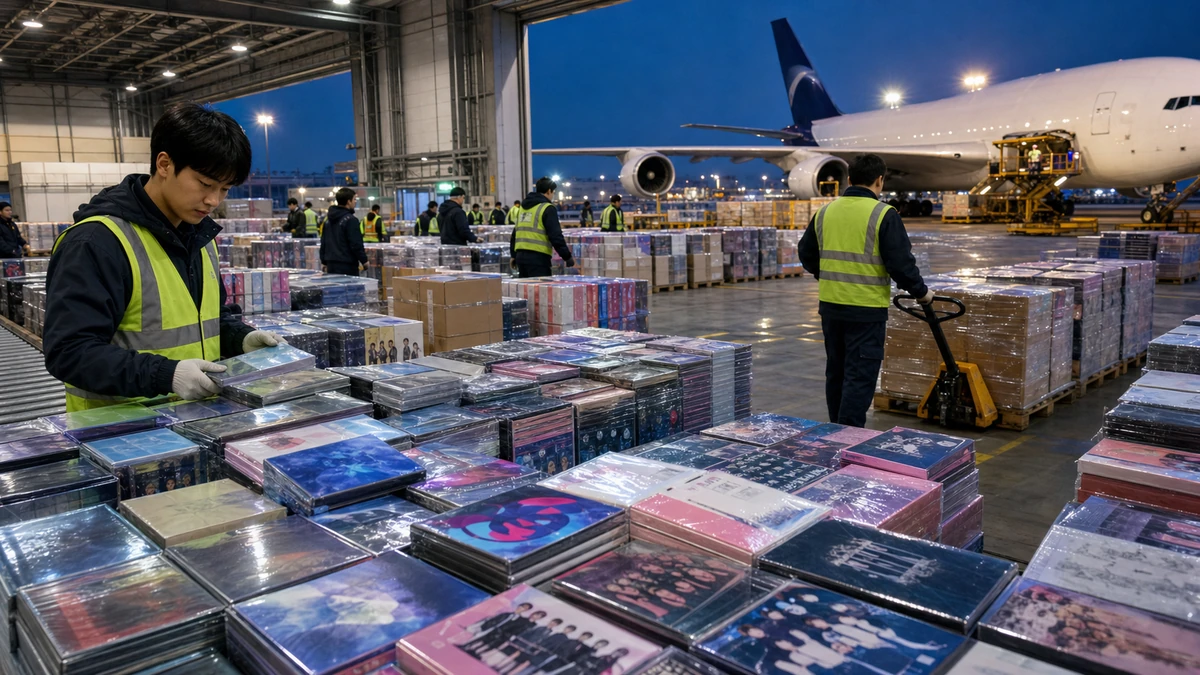
K-pop’s comeback story is showing up in customs data
K-pop’s global reach is often measured in ways Americans have grown used to seeing: Billboard rankings, YouTube views, Spotify streams, sold-out arena dates and social media trends that ricochet across TikTok and Instagram. But one of the clearest signs yet that the genre’s commercial momentum has surged again in 2026 comes from a less glamorous place: trade statistics.
South Korea’s album exports totaled $257.478 million from January through June, according to official trade data released July 17 by the Korea Customs Service, the country’s customs agency. That is a 125 percent jump from the same period a year earlier and the largest first-half total on record.
In plain terms, the value of Korean albums shipped overseas more than doubled in six months. The timing is not especially mysterious. The first half of 2026 was marked by high-profile returns from marquee K-pop acts including BTS and BLACKPINK, helping reignite a business that depends not only on digital attention but also on fans’ willingness to spend real money on physical products.
That last point matters. In the American music business, physical albums long ago became a niche product compared with streaming, with vinyl carving out a premium collector market and CDs largely fading from everyday relevance. K-pop works differently. Physical albums remain central to the industry’s economics and fan culture. Albums are not just music containers; they are collectibles, often packaged with elaborate artwork, photo books, randomized photo cards and other extras that turn a release into a merch event.
So when Korea’s export numbers rise this sharply, it is not merely a technical trade story. It is a measure of how deeply fan enthusiasm is converting into purchases across borders. And because those exports are tied to real goods leaving Korea for overseas buyers, the numbers offer a grounded counterpoint to the hype-driven metrics that usually dominate music coverage.
The rebound is also visible in volume. Physical album sales in the first half climbed back to 55 million units, indicating that both the money earned from exports and the number of albums sold moved upward at the same time. That parallel rise suggests something more durable than a viral moment. It signals that the renewed attention around K-pop is feeding directly into consumer buying behavior.
Why physical albums still matter in K-pop
For readers outside Asia, especially in the United States, the notion of an album boom in 2026 may sound like a throwback. American listeners have largely moved into an on-demand streaming ecosystem where the song, playlist and algorithm matter more than the full album package. K-pop has resisted that shift more than most sectors of the global music business.
One reason is structural. K-pop agencies do not just release music; they build immersive fandom ecosystems. Fans often buy multiple versions of the same album because each edition may include different photographs, packaging concepts or collectible inserts. Randomized photo cards, in particular, have become a cornerstone of fan culture, functioning almost like a cross between baseball cards and limited-edition merchandise. Fans trade them, resell them and hunt for favorite members the way collectors pursue rare variations.
Another reason is emotional. In K-pop, buying a physical album is often treated as an act of support, not simply consumption. Fans see purchases as a direct contribution to an artist’s success, whether through chart performance, sales milestones or symbolic showings of loyalty. That is especially true during major comeback cycles. In K-pop terminology, a “comeback” does not necessarily mean returning from obscurity. It refers more broadly to a new promotional cycle built around a fresh release, often supported by television appearances, music videos, fan events and tour announcements.
This helps explain why export value and unit sales are watched so closely in South Korea. The export figure reflects how much Korean-made album product actually entered overseas markets. The sales figure shows how many physical copies fans bought. They are not identical measures and should not be treated as interchangeable, but when both rise together, industry analysts see it as a sign of broad-based health.
That appears to be what happened in the first half of this year. The market was not just buoyed by online chatter or a few headline-grabbing chart placements. Fans were buying albums in large quantities, and those albums were crossing borders in record amounts.
The United States becomes the biggest export market
The most striking development in the new data may be where those albums are going. For years, Japan has been one of the most dependable overseas markets for Korean pop music, thanks to geographic proximity, long-standing cultural exchange and a robust physical-media culture of its own. But in the first half of 2026, the United States moved into the top spot.
Korean album exports to the United States reached $74.118 million, the largest total among all destination countries. China ranked second at $61.177 million, and Japan came in third at $45.612 million.
For the American music market, that ranking is notable on several levels. The United States is already one of the world’s largest music economies, but it has not historically functioned the same way as East Asian markets when it comes to physical albums. That K-pop is now sending more album export value to the United States than to Japan suggests American demand is not just broad but materially strong.
The shift also says something about how K-pop has evolved from a niche fandom interest into a more stable part of the U.S. entertainment landscape. There was a time when Korean pop acts were treated in much of the American press as novelty crossovers, internet sensations or isolated success stories. That framework has become harder to sustain. K-pop groups now routinely chart in the United States, tour major arenas and stadiums, collaborate with Western artists and command fan communities that look increasingly permanent rather than fad-driven.
The first-half numbers reinforce that idea with something more concrete than cultural buzz. If Billboard placement shows attention, import value shows transaction. American fans are not only listening. They are buying enough physical product to push the United States ahead of Japan in Korea’s export ledger.
That does not mean Japan suddenly matters less. Far from it. Japan remains one of K-pop’s foundational overseas markets and still accounted for tens of millions of dollars in album exports in the first half alone. But the latest figures suggest demand in the United States expanded with unusual force, large enough to reorder the league table.
BTS helps power the surge, but the story is bigger than one group
Any honest reading of the first-half boom has to start with BTS. The group released its fifth full-length studio album, “ARIRANG,” in March, its first new album in three years and nine months. That kind of gap matters in K-pop, where release cycles are often far more frequent than in Western pop. A long-awaited group return from the biggest Korean act in the world was bound to trigger a commercial wave.
The album did more than generate fan anticipation. It reached No. 1 on Billboard’s main singles chart and main albums chart, an achievement that underscored BTS’ continuing command of the American market. In April, the group launched a world tour beginning in Goyang, a city in Gyeonggi province just northwest of Seoul that often serves as a major concert hub for large-scale Korean events.
That sequence, album release, chart dominance, then an enormous world tour, illustrates how the K-pop business machine works at full power. A comeback builds anticipation. Strong chart performance draws broader public attention and media coverage. Tour activity converts that attention into live-event demand, merch sales and renewed fan engagement. Physical album buying sits in the middle of all of it, as both a revenue source and a visible expression of fandom.
Americans may think of this as analogous to the way a Taylor Swift or Beyonce album can ignite touring, fashion, online discourse and a wider consumer ecosystem. But K-pop’s infrastructure is even more tightly organized around that cycle, with releases often designed from the outset to drive collectible purchasing and fan participation.
Still, the first-half rebound should not be reduced to BTS alone. BLACKPINK, another globally dominant K-pop act, was also cited as part of the broader return of top-tier artists this year. When multiple major acts are active at once, their combined visibility can lift the whole market, not just their own catalog sales. Fans who return for one headline act often reengage with the wider K-pop ecosystem, exploring newer groups, buying related merchandise and fueling interest across labels.
That is one reason analysts watch category-wide trade figures alongside artist-specific achievements. A smash comeback from one group can produce a spike. A simultaneous rise in export value and total physical sales across the sector suggests a larger recovery in market energy.
A multi-market business, not a one-country fad
The top three markets, the United States, China and Japan, show how diversified K-pop’s export base has become. Those are three very different music environments with distinct languages, consumer habits and political contexts. Yet all three generated tens of millions of dollars in Korean album imports during the first half.
That matters because it undercuts one of the oldest assumptions about international pop exports: that they are vulnerable to the tastes of a single region. K-pop certainly has deep roots in East Asia, and Japan in particular has long been essential to Korean entertainment companies. China has also been an enormous source of fan demand, though that market has often been complicated by political tension and regulatory shifts.
The new figures show that K-pop’s physical business is no longer anchored to one external market. Instead, it looks more like a multi-pole global network. If demand is strong in North America, East Asia and parts of Europe at the same time, the industry is less dependent on one country’s mood, rules or spending cycle.
This is especially important for understanding the difference between global visibility and global infrastructure. Plenty of songs go viral internationally. Far fewer genres build a reliable cross-border retail machine that can move hundreds of millions of dollars in goods. K-pop has done that, and its export map increasingly resembles that of a mature global consumer business rather than a passing pop trend.
There is also a cultural lesson here. K-pop is rooted in the Korean language, Korean entertainment training systems and fan practices that developed in a local context. Yet those origins have not prevented the genre from traveling. In some ways, they are part of the appeal. Fans are not necessarily demanding that K-pop become culturally neutral. They are often drawn to the very things that make it distinct, synchronized group performance, highly concept-driven releases, serialized fandom engagement and a different relationship between artist and audience than the one many Western pop fans are used to.
Europe’s presence shows how wide the map has become
The list of top 10 export destinations also included Germany, Taiwan, Hong Kong, the Netherlands, the United Kingdom, France and Poland. For K-pop watchers, that lineup is another important clue about the industry’s current shape.
Europe has long played a visible but uneven role in K-pop’s expansion. European fans were often highly active online, but for years the region did not always receive the same touring attention or retail infrastructure as North America or East Asia. The fact that multiple European countries now appear among the top destinations for Korean album exports suggests the continent’s physical-buying audience is both real and geographically dispersed.
Germany and the Netherlands are notable not only as consumer markets but also as logistical gateways, places through which goods can move efficiently across the European Union. The United Kingdom and France reflect large entertainment markets with active fandom communities. Poland’s presence is perhaps the clearest sign that K-pop demand is no longer confined to Western Europe’s biggest capitals. It is reaching further across the region.
For an American audience, the comparison may be the difference between a movie opening only in New York and Los Angeles and a movie that proves it can sell tickets in cities and suburbs across the country. Once a cultural product spreads beyond prestige hubs and into a broader geographic base, it starts to look less like a specialty import and more like a mainstream market category.
That does not mean K-pop has become culturally identical across these markets. Fan behavior still varies widely. Retail access differs. Local chart systems and media ecosystems shape how acts break through. But the export data show a common denominator: in many different places, fans are paying for Korean-made physical albums in significant numbers.
What the rebound says about the future of K-pop
The first-half totals alone do not guarantee where 2026 will end, and trade figures should always be read with some caution. Export value and physical sales are strong indicators, but they do not tell the whole story of profitability, nor do they map perfectly onto domestic consumption versus international resale channels. Still, taken at face value, the numbers suggest real momentum.
The underlying logic is straightforward. If album exports are at a first-half record, if unit sales have rebounded to 55 million, and if the biggest names in the business are once again in active release-and-tour cycles, then the industry has a credible shot at restoring the sense of scale it enjoyed during its biggest recent boom years.
For American entertainment observers, the larger takeaway may be this: K-pop is no longer best understood as a digital-first youth phenomenon measured mainly by fandom noise online. It is also a formidable export business with a global supply chain, premium collectible culture and a consumer base willing to spend heavily on physical goods in the streaming era.
That combination is unusual. In the United States, music executives have spent years trying to figure out how to turn fandom into durable, high-margin purchasing behavior beyond subscriptions and concert tickets. K-pop has built one of the clearest answers anywhere in the world. It has made the album, an object many in the West treated as obsolete, feel valuable again.
If the first half of 2026 is any guide, the next phase of K-pop’s global rise may be less about proving it can command attention and more about demonstrating how deeply that attention can be monetized across continents. BTS and BLACKPINK may be the headline engines, but the more significant story is the market structure now visible underneath them: a multi-region, export-driven business whose audience spans the United States, East Asia and Europe at once.
That is why a customs report out of Seoul matters far beyond trade circles. It offers a snapshot of where the Korean Wave stands today, not just as culture, but as commerce. And right now, that picture looks bigger, broader and more resilient than it did a year ago.
Comments
Post a Comment