
Image to help understand the article
A stadium spectacle that was about more than nostalgia
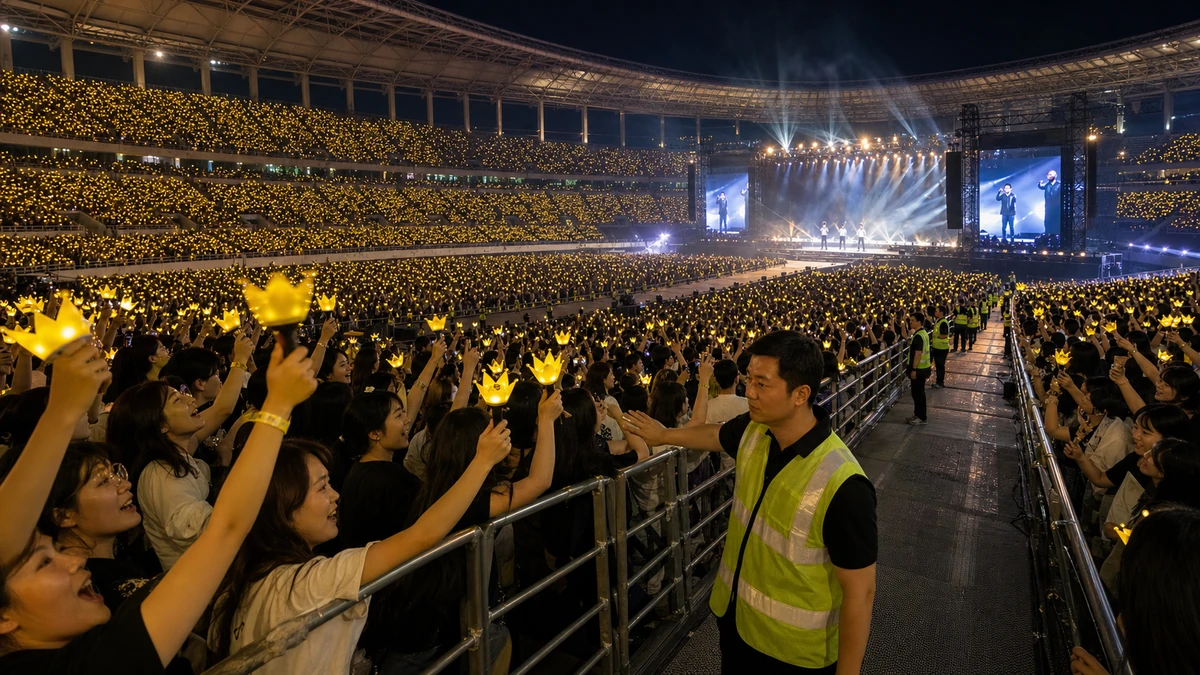
When the South Korean group BigBang marked its 20th anniversary with a three-day run at Goyang Stadium outside Seoul, the headline number was easy to grasp: roughly 100,000 people attended between Aug. 21 and Aug. 23. For any pop act, that is a statement of lasting drawing power. For BigBang, one of the acts most closely associated with K-pop’s rise from a regional industry into a global business, it was also a reminder of how deeply the group’s music still resonates across generations of fans.
But the more revealing part of the story may be what did not happen. City officials in Goyang said the event ended without a single safety accident, despite summer heat, heavy crowding and the difficult logistics of moving tens of thousands of people into and out of one venue each night. In an era when live music is judged not only by the performance on stage but by the fan experience from arrival to departure, that result matters.
For American readers who may know K-pop mainly through chart success, social media fandom or sold-out arena tours, BigBang occupies a foundational place in the modern Korean music industry. Debuting in the mid-2000s, the group helped define the blend of hip-hop influence, polished pop production, visual branding and fan community that later became central to K-pop’s export strategy. An anniversary show for a group like that is not simply a reunion-style celebration. It is a stress test of how far the live-events business around K-pop has matured.
That is what made the Goyang concerts notable. The event functioned as both a celebration of one of South Korea’s most durable pop brands and a real-world demonstration of how Korean authorities, venue operators and concert organizers now handle mega-events. According to the account summarized from Korean reporting, officials treated extreme heat and crowd density as the two primary risks, coordinated among city authorities, police, firefighters and organizers, and adjusted operations in real time after observing where people concentrated on the first night.
That kind of flexibility can sound procedural and unglamorous. In reality, it is now one of the most important parts of the live entertainment business. The modern blockbuster concert is no longer judged only by the set list, stage design or artist charisma. It is judged by whether fans can enter, wait, watch, leave and get home safely. The Goyang shows suggest that in South Korea, the production side of K-pop is increasingly being matched by a serious and adaptive approach to public safety.
Why crowd management has become part of the K-pop product itself
The Korean summary makes a point that should be familiar to anyone who has watched the global concert business evolve in recent years: the key risks in a large outdoor event are not confined to what happens on stage. They exist in every space fans occupy, from transit links and entrance gates to concourses, exits and the surrounding streets after the lights come up.
That may sound obvious, but it reflects a broader shift in how successful music events are planned. The old benchmark for a major concert was whether the artist filled the venue and delivered a memorable performance. The newer benchmark includes something more operational: whether organizers can manage human movement at scale. In Goyang, officials reportedly reviewed the organizer’s heat-response measures ahead of time, inspected entrance and exit routes and identified likely bottlenecks before crowds arrived. During the concert run, related agencies shared information in real time and responded as conditions changed.
That approach matters especially in K-pop, where fandom behavior can intensify logistical challenges. Fans often arrive early, line up for merchandise, coordinate in groups, take part in synchronized fan projects and cluster around preferred exits or transportation points. Because K-pop concerts can attract everyone from longtime adult fans to teenagers and families, the audience may include people with very different levels of endurance and event experience. Add midsummer heat to that equation and even minor delays can become more serious.
The Goyang concerts appear to have recognized that heat and crowd flow are not separate issues. A tired, overheated audience leaving an event at once can turn inconvenience into danger quickly. Long waits, narrow choke points and sudden surges are all more difficult to manage when tens of thousands of people have spent hours outdoors or in packed seating areas. By treating those risks as connected rather than isolated, organizers addressed a reality of modern stadium events that is increasingly relevant worldwide.
There is also a larger business lesson here. As K-pop scales internationally, its competitive advantage is not just in music production or fan engagement but in systematizing the entire live experience. A smooth entry process, clear signage, staggered exits and real-time adjustments are not secondary details. They shape whether fans leave feeling exhilarated or exhausted, safe or uneasy. In that sense, operations have become part of the product.
This is one reason South Korea’s concert sector deserves attention beyond entertainment headlines. The country has spent years building an ecosystem where government agencies, transit systems, venue managers and private organizers routinely interact around high-density public events. That does not guarantee flawless outcomes, and no event model eliminates risk altogether. But it does create a framework in which preparation and adaptation are treated as central, not optional.
What changed after night one — and why that may be the most important detail
The most telling part of the Korean reporting was not the attendance figure. It was the decision to revise exit operations after the first show. Officials observed that audiences were concentrating near the north and east gates at the end of the first night, then adjusted exit routes on the second and third nights to match actual crowd behavior.
That sounds simple. It is not. In many large events, organizers treat the pre-event plan as the plan, even when live conditions reveal weaknesses. What happened in Goyang suggests a more data-driven model: watch how real people move, identify where predictions were wrong, and change the operation immediately rather than waiting for a postmortem after the entire run is over.
According to the summary, officials also managed density in real time, directed people toward alternate routes and used a five-stage sequential exit system rather than releasing everyone at once. That kind of phased departure can be frustrating for attendees who want to beat traffic, but it reduces the sudden load on gates, stairways, concourses and nearby streets. In practical terms, it can be the difference between orderly dispersal and dangerous compression.
For American audiences, there is a useful parallel in the way sports stadiums and major music festivals increasingly use crowd analytics, variable routing and staggered movement plans. The technology and terminology may differ from venue to venue, but the principle is familiar: the smartest safety plan is not static. It must respond to what the crowd is actually doing.
That point is especially relevant because anniversary concerts often bring a broader and less predictable audience mix than a standard tour stop. BigBang’s 20th anniversary was likely not just a gathering of current super-fans. It was also, as the Korean summary suggests, a meeting place for longtime listeners and newer generations. In American terms, think of the difference between a routine arena date and a major legacy event that attracts original fans, curious younger listeners and people treating the night as a cultural moment. Those audiences do not all move the same way or use the venue the same way.
The fact that Goyang officials treated the three concerts not as isolated events but as a continuous safety-management process may be the clearest sign of how the live-events sector is evolving. The first night became a source of operational intelligence. The second and third nights became opportunities to apply it. That is less dramatic than a surprise guest appearance or a viral encore clip, but it is arguably the real story.
For the United States, K-pop’s safety playbook now matters too
This is where the story crosses the Pacific. K-pop is no longer a niche import in the United States. It is part of the American live entertainment business, with Korean acts selling out arenas, headlining festivals, partnering with U.S. promoters and building fan communities that behave differently from traditional pop audiences in ways that venues must understand. What happens in South Korea’s biggest concerts increasingly has implications for American companies, American venues and American fans.
That is true at a basic commercial level. U.S. promoters, ticketing platforms, security vendors and venue operators are all part of the K-pop touring pipeline. When a Korean act comes to Los Angeles, New York, Chicago or Atlanta, the fan expectations formed in Seoul, Busan or Goyang do not disappear. American audiences now expect many of the same things K-pop fans elsewhere expect: tightly organized merchandise operations, fan-focused communication, carefully timed entry and exit, and a sense that the event is designed around the crowd’s actual behavior rather than around generic stadium assumptions.
It also matters at a more sobering level. The American concert industry has spent the past several years confronting hard questions about crowd safety, emergency planning and the limits of one-size-fits-all event management. U.S. readers do not need a long explanation of why. Recent history has made clear that when crowd dynamics are misunderstood or ignored, the consequences can be severe. Against that backdrop, a zero-accident mega-concert in South Korea is not just a local success story. It is part of a broader global conversation about what competent large-scale event management should look like.
There is another U.S. angle here: Korean entertainment companies increasingly operate like global media firms, and their standards travel with them. If a promoter wants to host top-tier K-pop acts successfully in America, understanding the operational culture around those acts becomes a business necessity. The same goes for U.S. municipalities and venue authorities that hope to attract more international entertainment events. Coordination across police, fire departments, transit agencies and private organizers is not uniquely Korean, of course. But the Goyang example shows how central that coordination has become to the K-pop model.
American fans, too, have a stake in this. K-pop audiences in the United States are famously committed, organized and digitally connected. They line up early, trade updates in real time and often travel across state lines for major shows. That makes them an economically valuable audience, but also one that benefits from thoughtful planning. A concert culture built around intense engagement requires operations designed for that intensity.
For U.S.-Korea ties more broadly, stories like this illustrate something often overlooked in discussions of cultural diplomacy. The Korean Wave is not only about music, television and beauty brands. It is also about systems, standards and know-how. South Korea’s influence grows when its entertainment products succeed abroad, but also when its methods of producing and managing those products are seen as effective, modern and exportable. In that sense, the Goyang concerts were a quiet showcase of Korean institutional competence as much as pop spectacle.
BigBang’s milestone points to a larger trend in Korean pop
BigBang’s 20th anniversary also says something about where K-pop is in its life cycle. For years, the genre was often discussed in the United States as a youth phenomenon: fast-moving, internet-native and driven by novelty. That description captured part of the story but missed another one. K-pop is now old enough to have legacy acts, multigenerational audiences and anniversary events that function less like flash-in-the-pan comebacks and more like major cultural landmarks.
That maturation changes the economics and the logistics of the business. A 20th-anniversary concert is not just about fan service. It is about proving durability in an industry known for rapid turnover. If tens of thousands of people still show up for a group two decades after debut, that signals long-tail value — catalog value, touring value, brand value and nostalgia value. U.S. entertainment companies understand this model well. American pop and rock have long relied on legacy touring as a major revenue engine. K-pop now appears to be entering its own version of that phase.
But the Korean version comes with its own features. The industry has always combined intense fan culture with high production standards and tightly coordinated promotional systems. As first- and second-generation acts age into legacy status, the challenge is not only to preserve interest but to scale these shows safely for audiences that are both broad and emotionally invested. BigBang’s Goyang run suggests that Korean organizers understand that challenge.
It also underscores the idea that influence today is measured not just by cultural export but by operational repeatability. Can an industry produce a spectacular event once? Many can. Can it do so across multiple nights, with large crowds, in punishing summer weather, while learning from live conditions and maintaining control? That is a different benchmark, and one increasingly tied to global competitiveness.
In practical terms, what to watch next is whether this kind of safety-forward, adaptive management becomes standard language around major K-pop tours, both in Korea and abroad. Will more venues publicize phased exit systems? Will fan communications put greater emphasis on heat protocols and route guidance? Will U.S. promoters working with Korean acts begin adopting more visible versions of the same practices? Those are not glamorous questions, but they may shape the future of the market as much as any chart position.
The real takeaway is that spectacle and discipline are no longer opposites
It is tempting to read a story like this as a straightforward victory lap: a beloved group drew a huge crowd, thrilled its fans and wrapped without incident. All of that is true. But the more useful way to read it is as evidence of a shift in what counts as excellence in the global concert business.
For years, K-pop built its international reputation on precision — synchronized choreography, polished visuals, highly managed branding and intense fan engagement. What the Goyang concerts suggest is that precision now extends beyond performance. It includes how a city and a concert organizer anticipate heat risk, how quickly they revise an exit plan after the first night, and how they decide that a few extra minutes of waiting are worth preventing dangerous bottlenecks.
That matters because scale can create illusions. A crowd of 100,000 can look like pure triumph from a distance. Up close, it is a complex public-safety challenge. Turning that scale into a celebratory memory instead of a cautionary tale requires discipline, coordination and humility about what cannot be left to chance. The reporting from Korea indicates that those qualities were present in Goyang.
For American readers, the story is worth attention not simply because BigBang remains a major name in K-pop, though that is part of it. It is worth attention because the future of global live entertainment will belong to industries that can combine emotional intensity with operational control. South Korea’s concert sector is making a case that it understands both sides of that equation.
In the end, the image that lingers is not only the roar of a 20th-anniversary crowd for one of Korea’s defining pop groups. It is the quieter achievement behind the scenes: thousands of people arriving, celebrating and leaving without a safety accident, even in heat and heavy congestion. In a music economy where fan trust is as valuable as ticket sales, that may be one of the most important performances of all.


0 Comments