Toronto moves to temporarily rename a street ‘BTS Boulevard’ as the K-pop group’s North American tour turns into a civic event
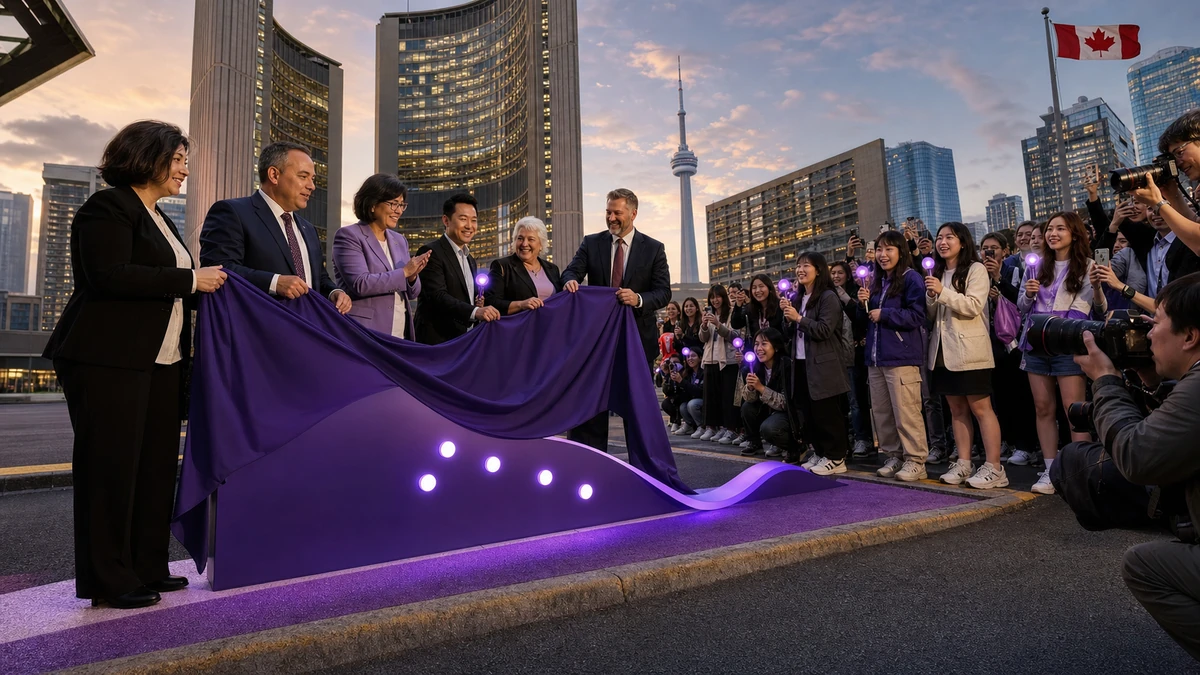
Image to help understand the article
A K-pop tour stop becomes a city matter
When a major pop act comes to town in North America, the usual signs are easy to spot: sold-out hotels near the venue, long lines at merch stands, packed restaurants and fans in coordinated outfits filling downtown streets. What is less common is a city council stepping in to make the visit part of official civic language. That is what is unfolding in Toronto, where city officials have moved to temporarily name part of a roadway “BTS Boulevard” to coincide with the group’s upcoming concerts there, a sign of how far the cultural and economic reach of BTS now extends beyond the stadium gates.
According to the Korean news summary and reporting cited from Yonhap, Toronto’s city council recently reviewed and approved a measure tied to BTS’s North American tour that would apply the temporary “BTS Boulevard” name to part of a city road from local time July 21 through Aug. 23. The timing aligns with BTS’s scheduled performances in Toronto on July 22 and 23 at Rogers Stadium. City leaders are also seeking to have those dates recognized as “BTS Weekend,” broadening the group’s visit from a pair of concerts into something closer to a citywide celebration.
For American readers, the closest comparison may be the way some U.S. cities throw their full weight behind major events like the Super Bowl, Taylor Swift’s Eras Tour, a championship parade or a marquee convention. Buildings light up in themed colors. Local leaders issue proclamations. Transit systems and tourism boards adjust messaging. Streets around arenas become part of the spectacle. What stands out in Toronto is not simply the enthusiasm, but the fact that a K-pop tour stop has become a matter of official municipal action, complete with procedural votes and discussions over the use of the artist’s name in public signage.
That may sound symbolic, but symbols matter in pop culture, especially when they are endorsed by government institutions. A temporary street name is more than a welcome banner. It signals that a city sees the artist not just as entertainment for ticket buyers but as a recognizable cultural force with meaning for the broader public. In this case, BTS is being treated less like a visiting act and more like an event that the city itself wants to help stage.
The decision also reflects the unusual scale of BTS’s global fandom, known as ARMY, and the ways that fandom increasingly shapes tourism, local business traffic and the public mood around live events. In an era when cities compete for attention and visitor spending, hosting a BTS concert is not merely about filling seats in a stadium. It is about drawing travelers, social media coverage and international visibility. Toronto’s move suggests local officials understand that dynamic clearly.
Why Toronto’s move matters beyond fan service
There is an important difference between a city welcoming fans with themed decorations and a city considering a formal road name tied to an artist. The first is marketing. The second is governance. That distinction helps explain why this story has drawn attention in Korea and across the global K-pop fan community. BTS’s name is not just being used on posters, temporary installations or unofficial fan projects. It is being discussed in the language of city administration.
That is noteworthy because public naming carries weight. Street names, even temporary ones, become part of how residents and visitors navigate space. They appear on maps, in photos, in local news coverage and on city-issued materials. In practical terms, “BTS Boulevard” gives fans a visible rallying point. In symbolic terms, it tells the public that BTS has become a cultural marker legible beyond the fan base.
For years, K-pop was often framed in North America as a niche import, popular online and among dedicated communities but still peripheral to the mainstream. That description has become increasingly outdated, and Toronto’s action is one more reminder why. BTS has spent the better part of the last decade redefining what global pop success can look like for a Korean act, topping U.S. charts, selling out stadiums, addressing the United Nations and building one of the most organized and visible fan communities in the world. A city council vote tied to the group’s visit does not happen in a vacuum; it sits atop years of commercial success and cultural normalization.
It also captures a change in how public institutions are learning to interact with fandom. Once seen as mostly private or online enthusiasm, fandom is now part of local economies and public planning. Cities know that visitors do not simply arrive, watch a show and leave. They eat out, ride transit, book rooms, visit neighborhoods and post their experiences in real time. A carefully branded public welcome can amplify all of that. In that sense, “BTS Boulevard” functions as urban hospitality as much as pop symbolism.
There is another layer here that will be familiar to anyone who follows modern entertainment law: a superstar’s name is also intellectual property. Toronto’s interest in using “BTS” in a public-facing way is not merely a matter of goodwill. The Korean summary notes that discussions are underway with BigHit Music regarding approval to use the group’s name in connection with the road naming and the proposed “BTS Weekend” designation. That detail may seem technical, but it points to the highly managed nature of global entertainment brands. Even a city government cannot simply assume it can publicly brand space with a world-famous act’s name without consultation.
The North American leg of ‘ARIRANG’ and the rise of the destination concert
BTS is currently in the middle of its new North American tour, titled “ARIRANG,” with stops that include New York, Baltimore, Arlington, Texas, and Toronto. For many fans, these dates are not isolated concerts but travel anchors around which full trips are built. That is a familiar pattern in the United States, where major tours increasingly operate as destination events. Fans fly across state lines for Beyoncé. They plan group trips around Coachella. They book entire weekends around a Swift show. K-pop has very much entered that same ecosystem.
What makes the BTS version especially potent is the global makeup of the fan base and the culture of participation that surrounds the group. Fans often organize banner projects, themed meetups, cup sleeve events at cafes, dance gatherings, charity drives and trading sessions for albums and photocards. For the uninitiated, photocards are collectible portrait cards packaged with albums and merchandise, and they are central to K-pop’s collector culture. These activities can transform an ordinary concert weekend into something that feels more like a pop-culture convention spread across a city.
That is where the proposed “BTS Weekend” label becomes significant. It acknowledges what fans already know: the event begins long before the lights go down in the stadium. It starts at the airport, at the hotel lobby, in neighborhoods where fans gather, on transit routes to the venue and in pop-up spaces across the city. By potentially naming the weekend itself, Toronto is recognizing the full social footprint of a BTS stop, not just the performance hours listed on a ticket.
The tour title, “ARIRANG,” carries its own cultural resonance. “Arirang” is widely recognized as the title of a traditional Korean folk song, often described as an unofficial anthem of Korean identity and emotion. While there are many regional variations, the name generally evokes ideas of longing, resilience, separation and collective memory. For American readers, the simplest parallel is to think of it as the kind of folk standard whose meaning extends beyond music into national feeling, though no single U.S. song is a perfect equivalent. Using “ARIRANG” for a world tour suggests a conscious link between global spectacle and Korean cultural heritage, a reminder that even as K-pop is highly modern and commercial, it often draws symbolic power from older cultural references.
That mix of tradition and global branding is one reason BTS continues to command such unusual attention. The group is not just exporting songs. It is exporting a broader cultural experience in which Korean language, symbolism and fan practices travel alongside mainstream pop production. When cities like Toronto lean into that experience, they are effectively participating in the wider phenomenon often called the Korean Wave, or Hallyu, the term used to describe the global spread of South Korean entertainment and culture.
From Hallyu to City Hall
For much of the past two decades, Hallyu in North America was measured in rising streaming numbers, sold-out shows, the popularity of Korean dramas on Netflix and the increasing visibility of Korean food, beauty products and fashion. Now, it is also showing up in local government behavior. That is what makes the Toronto development especially striking. It is one thing for fans to transform a neighborhood for a weekend. It is another for a city’s official institutions to codify part of that excitement in resolutions, designations and public language.
In the United States, politicians and local officials frequently issue ceremonial proclamations for sports teams, community leaders, veterans or hometown celebrities. Music acts may get a “day” in their honor, and entertainment districts are often temporarily dressed for major events. But for a non-Western pop group to inspire that kind of formal welcome in North America still carries symbolic force because it marks a shift in who is assumed to belong at the center of public culture.
This is not just about representation in the abstract. It is about who has enough pull to move systems. Toronto’s action suggests that BTS’s audience is visible enough, organized enough and economically important enough that the city sees value in publicly embracing the group. That is a measure of cultural power. And because BTS is a Korean act performing primarily within a distinctly Korean pop system, the message reaches beyond the band itself. It speaks to the broader normalization of Asian pop culture in English-speaking public life.
There is also a diplomatic undertone, even if informal. Pop culture has long functioned as a form of soft power, shaping how countries are perceived abroad. South Korea’s government did not create BTS’s fandom, and city councils are not issuing foreign policy statements when they welcome a concert. Still, the result is similar in one respect: Korean culture becomes more familiar, more legible and more celebrated in everyday North American settings. A temporary road name may seem small, but repeated moments like these build the sense that Korean cultural exports are not special exceptions. They are part of the mainstream calendar.
That shift is especially visible in multilingual, multicultural cities like Toronto, where officials are often more attuned to global cultural movements and diasporic audiences. Toronto has long prided itself on presenting itself as an international city. Embracing a phenomenon like BTS is consistent with that identity. It tells residents and visitors alike that the city understands where popular culture is headed, not just where it has been.
The legal and branding questions behind the welcome
Even as the headlines center on fan excitement, the Toronto case also offers a revealing look at the mechanics behind modern celebrity branding. The Korean summary makes clear that some parts of the plan have moved further than others. The road-naming measure was reviewed and approved by city council, while discussions over use of BTS-related intellectual property are still ongoing. In other words, the enthusiasm is real, but the execution requires negotiation.
That process underscores how tightly controlled top-tier entertainment brands have become. The letters “BTS” are instantly recognizable around the world, but that recognition is precisely why they must be managed carefully. A city may want to honor the group, yet it still needs clarity on what kinds of official public uses are permitted, how the name can appear and under what conditions. For readers used to seeing corporate sponsorships woven into everything from stadium names to halftime shows, this is the same basic principle: a famous name has value, and value is administered.
It is also a reminder that K-pop, for all its emotional intensity and community spirit, is deeply professionalized. Agencies such as BigHit Music do not simply oversee music releases and tour logistics. They manage global brands with legal, commercial and reputational considerations across multiple jurisdictions. As K-pop grows, these behind-the-scenes negotiations become more visible. Cities want to collaborate. Tourism bodies want to market events. Fan communities want official recognition. The artist’s management must balance welcome, control and consistency.
The careful distinction between what has been approved and what remains under discussion matters journalistically as well. In fandom-heavy stories, speculation can quickly outpace fact. Here, the confirmed elements are that Toronto city council has acted on the road-naming measure and that requests tied to “BTS Weekend” and name usage are being discussed. That does not guarantee every proposed detail will appear exactly as fans imagine it. But it does confirm that the city’s interest is not hypothetical. It has already entered formal channels.
For cities watching from the sidelines, Toronto may become a case study. If the branding and legal issues are resolved smoothly, other municipalities hosting major K-pop events may adopt similar strategies. Temporary place-making around concert weekends could become a standard part of the playbook, much as fan zones, branded transit wraps and venue district activations have become standard in sports and other forms of live entertainment.
What this says about BTS’s place in North American culture
BTS has long been a commercial powerhouse, but stories like this point to a broader truth: the group now occupies a level of cultural visibility in North America that invites civic participation, not just consumer response. A sold-out show proves demand. A city-backed naming effort suggests recognition. It says the artist has moved beyond fandom into public consciousness in a way officials believe ordinary residents will understand, or at least notice.
That is not something every international star achieves. Plenty of artists tour successfully through North America without leaving any civic imprint. Their shows are profitable, widely attended and quickly forgotten outside entertainment coverage. BTS has repeatedly shown an ability to generate a different kind of footprint, one that blends music, internet culture, identity, activism and tourism. The result is a touring model that operates partly as performance and partly as public event.
American audiences have seen versions of this before with homegrown megastars. When Bruce Springsteen turns a concert into a local happening in New Jersey, or when Swifties reshape the economy of a downtown district for a weekend, the effects are obvious. What is different here is that the driving force is a Korean group whose success depends not on crossing over by shedding its identity, but by bringing that identity with it. BTS did not become globally influential by pretending not to be Korean. The group’s language, aesthetics and cultural cues remain central to its appeal.
That point matters because it helps explain why the story resonates beyond entertainment. In previous eras, international pop acts often succeeded in the United States to the extent that they adapted to American norms. K-pop has challenged that assumption. Fans have shown they are willing, even eager, to meet artists where they are, learning terminology, engaging with Korean-language content and participating in a fan culture that is not built entirely around Western expectations. A city like Toronto recognizing BTS in official terms reflects that changed landscape.
It also points to how cultural prestige works in 2025. Influence no longer flows in only one direction from American and British pop centers outward. It is increasingly networked. Korean acts shape trends in Los Angeles and New York. Streaming platforms flatten some of the old gatekeeping that once determined who could become a household name. Social media lets fans create momentum that local institutions eventually have to respond to. “BTS Boulevard” is, in that sense, not just a clever civic gesture. It is evidence of a new map of pop-cultural power.
For fans, the experience begins before the encore
One reason the Toronto plan has landed so strongly is that it speaks directly to how fans experience live music now. A concert is no longer a self-contained evening. It is content, travel, fashion, community and memory-making wrapped into a single package. Fans document arrivals, venue lines, restaurant stops, outfit changes and post-show gatherings. They are not just attending a performance. They are inhabiting a temporary world.
“BTS Boulevard,” if implemented as envisioned, gives that world a physical address. It creates a place fans can photograph, share and use as a common point of reference. In a fandom that is profoundly international, that kind of simple, readable branding matters. The term works across languages. The name “BTS” stays intact, while “Boulevard” and “Weekend” are easy for travelers and locals alike to understand. No detailed explanation is needed for the symbolism to land.
That accessibility is part of why such designations are effective. They translate fan culture into civic language without losing immediacy. A visitor from Seoul, Dallas, São Paulo or London can see the sign and instantly understand what it marks. That is valuable in a touring ecosystem built on global circulation, where fans cross borders for shared experiences and then rebroadcast those experiences online to millions more.
Whether Toronto’s full vision is realized exactly as proposed will depend on the ongoing discussions over rights and implementation. But even at this stage, the core story is clear. BTS’s “ARIRANG” tour is creating scenes that extend beyond the stage, and North American cities are increasingly willing to meet that energy in official ways. For a long time, fans transformed urban space from the ground up. Now, in places like Toronto, city governments are stepping in to help shape the welcome.
That may be the clearest sign yet of where K-pop stands in North America. It is no longer merely a trend to be observed from outside or a subculture to be explained at a distance. In cities preparing for BTS, it is becoming part of the public script itself, written into weekends, roads and the shared language of civic celebration.
Comments
Post a Comment