
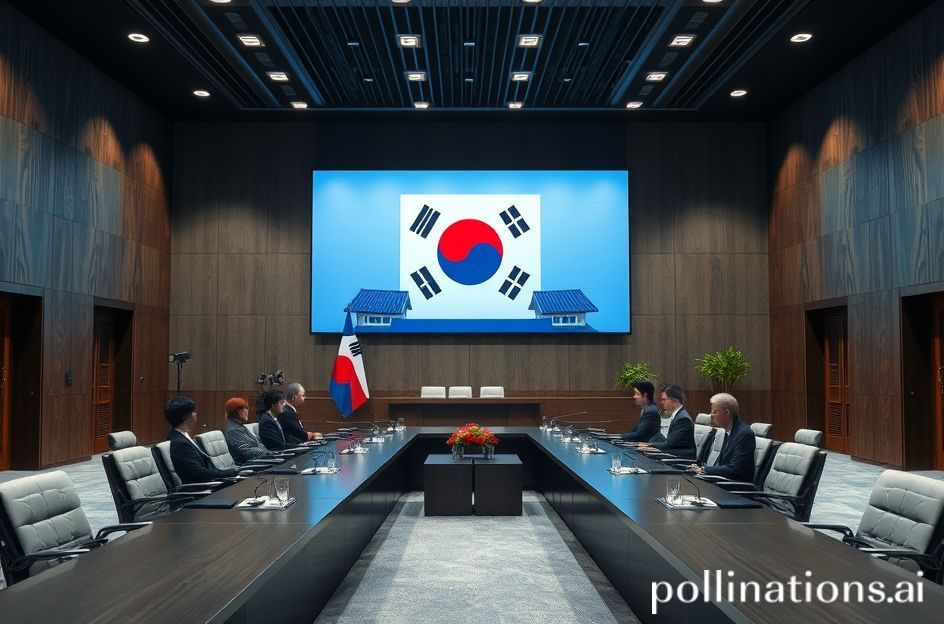
South Korean President Lee Jae-myung officially launched the National AI Strategy Committee on September 8, 2025, positioning himself as chairman in a bold move to establish South Korea as one of the world's three leading AI superpowers. The inaugural meeting, personally chaired by President Lee, unveiled the comprehensive "AI Action Plan" while simultaneously addressing major governmental reforms including prosecutorial restructuring and organizational overhauls.
For American readers unfamiliar with South Korea's recent political landscape, President Lee Jae-myung took office in 2025 following the impeachment and removal of his predecessor, Yoon Suk-yeol, in April 2025. This transition marked a dramatic shift in South Korean politics, with Lee's administration now pursuing an ambitious reform agenda that includes dismantling traditional power structures while embracing technological innovation.
The committee launch represents more than organizational restructuring—it signals a fundamental transformation in South Korea's political priorities. Unlike the American system where AI policy is distributed across multiple agencies, South Korea is creating a centralized presidential committee that directly reports to the nation's leader, demonstrating the strategic importance placed on artificial intelligence development.
Prosecutorial Reform and Government Restructuring: A Political Power Play
The AI committee launch coincides with Lee's aggressive pursuit of prosecutorial reform, including the controversial proposal to abolish South Korea's prosecutor's office entirely. Acting Prosecutor General Noh Man-seok recently acknowledged prosecutorial misconduct, stating officials are "deeply reflecting on their mistakes," but firmly opposed eliminating supplementary investigations, calling them "the prosecutor's duty."
For American readers, imagine if a US president proposed eliminating the Department of Justice following a contentious impeachment process—this gives perspective on the magnitude of Lee's proposed reforms. South Korea's prosecutorial system has historically wielded significant independent power, similar to how the FBI operates in the United States, but with even broader investigative authority.
The tension between Lee's reform agenda and prosecutorial resistance reflects deeper structural issues in South Korean governance. Political analysts view prosecutorial reform as both Lee's campaign promise and a matter of political survival, particularly given the role prosecutors played in his predecessor's downfall. Former President Yoon Suk-yeol's impeachment stemmed partly from his declaration of emergency martial law on December 3, 2024, which ultimately led to his removal from office and subsequent legal troubles.
Beyond prosecutorial reform, Lee's administration is pursuing a comprehensive government reorganization including splitting the Ministry of Economy and Finance—equivalent to dividing the US Treasury Department. This represents a systematic approach to restructuring power dynamics within South Korean government, moving beyond simple personnel changes to fundamental institutional reform.
The simultaneous launch of the AI Strategy Committee alongside these reforms suggests Lee's administration is pursuing a dual strategy: dismantling existing power structures while building new institutions focused on future-oriented policies. This approach parallels how transformational leaders often create new power centers while challenging established ones.
Inter-party Dialogue and Parliamentary Audit Preparations
President Lee hosted a luncheon meeting on September 8 with Democratic Party leader Jeong Cheong-rae and People Power Party leader Jang Dong-hyeok at the presidential office. This meeting, framed as open dialogue on current issues, appears strategically timed ahead of the 2025 parliamentary audit scheduled for mid-October.
The parliamentary audit, scheduled to run from October 13-31 (three weeks), serves a function similar to congressional oversight hearings in the United States, but with broader scope and more concentrated timing. For American readers, imagine if congressional oversight hearings were compressed into a three-week period with comprehensive examination of all government departments simultaneously.
Lee's Democratic Party aims to pass prosecutorial reform and media reform (anti-fake news) legislation before the Chuseok holiday on September 25-26. This timeline suggests a strategic approach to securing major legislative victories before facing parliamentary scrutiny—similar to how US presidents often pursue ambitious agendas early in their terms before midterm elections.
Political observers expect this parliamentary audit to be particularly significant as Lee's first major legislative examination since taking office. The audit will likely focus on three key areas: prosecutorial reform, AI strategy implementation, and government organizational restructuring. The comprehensive nature of these reforms makes them particularly vulnerable to opposition criticism.
Recent polling shows President Lee's approval rating at 56.0%, marking three consecutive weeks of increases. This upward trend provides political capital for his reform agenda and may influence the dynamics during the parliamentary audit. The positive reception of future-oriented policies like the AI Strategy Committee appears to be contributing to this approval boost.
Simultaneously, the administration announced plans to supply 1.35 million housing units in the Seoul metropolitan area over five years, demonstrating Lee's attempt to balance technological innovation with immediate economic concerns. This dual focus on AI advancement and housing supply mirrors how successful political leaders address both future opportunities and present challenges.
The strategic timing of the AI committee launch, government reforms, and housing policy announcements suggests careful political choreography designed to maximize public support while minimizing opposition resistance. For American observers, this resembles how transformational presidencies like Roosevelt's New Deal combined multiple policy initiatives to create momentum for systematic change.
As South Korea positions itself for AI leadership globally, these political developments will be closely watched by international partners, particularly the United States, which views South Korea as a crucial ally in technological competition with China. The success or failure of Lee's reform agenda may influence not only South Korean domestic politics but also broader geopolitical dynamics in East Asia.
Original article (Korean): 이재명 대통령, 국가인공지능전략위원회 출범으로 AI 3대 강국 도약 선언


0 Comments