

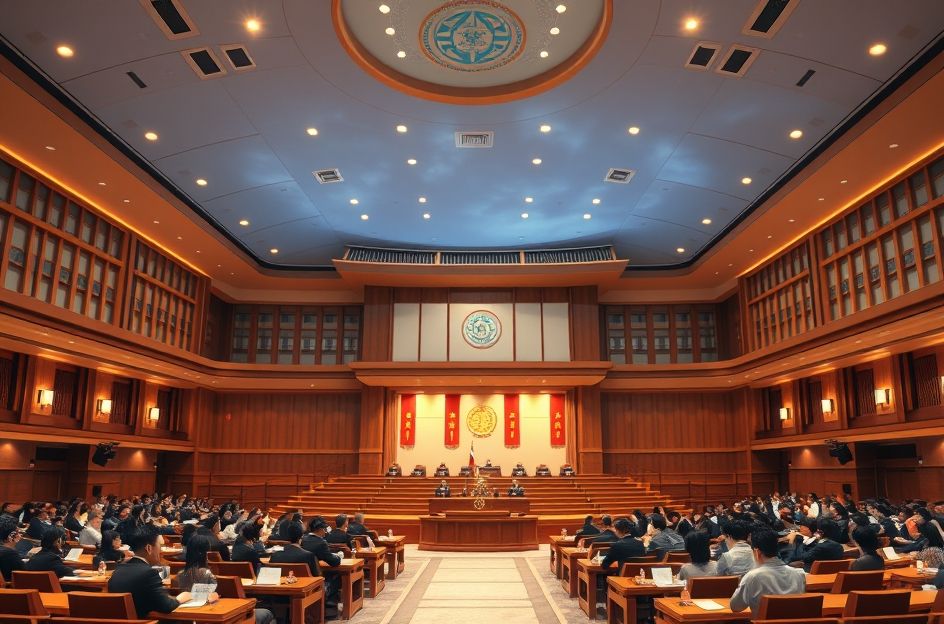
South Korea's ruling Democratic Party held a grand 70th anniversary ceremony at the National Assembly on September 19, declaring a new "party member sovereignty era" that aligns with President Lee Jae-myung's vision of "people's sovereignty." The ceremony, attended by party leadership including Chairman Jeong Cheong-rae and National Assembly members, marked a commitment to building the next century of the party's history.
For American readers, this celebration represents a significant milestone in South Korean democratic politics. The Democratic Party, currently the majority party in the National Assembly, has been instrumental in South Korea's democratic transition since the country's democratization in the 1980s, much like how the Democratic and Republican parties have shaped American democracy over centuries.
Chairman Jeong Cheong-rae emphasized in his commemorative speech, "Let us create a 100-year history of the Democratic Party that breathes together with citizens and party members." He specifically defined the "party member sovereignty era" not as a mere slogan but as "a new paradigm for substantial party-government operations."
Lee Jae-myung Government's Rising Approval and Strengthened Party-Government Cooperation
President Lee Jae-myung's approval rating has reached 60% according to a Gallup Korea poll conducted from September 16-18, marking a 2 percentage point increase from two weeks prior. This represents a consistent upward trend since the Lee administration took office, indicating growing public support for policy initiatives. For American readers familiar with presidential approval ratings, this 60% figure is notably strong, comparable to approval ratings enjoyed by popular U.S. presidents during their honeymoon periods or successful policy implementations.
The Democratic Party's support also stands at 41%, significantly ahead of the opposition People Power Party's 24%. This political landscape reflects a unified government scenario similar to periods in American politics when one party controls both the presidency and Congress, enabling more streamlined policy implementation. The 22nd National Assembly's majority status has been particularly effective in advancing legislative priorities that resonate with public opinion.
National Assembly Floor Leader Kim Byung-ki stated, "Through party-government cooperation with the Lee Jae-myung administration, we will continue to produce policy results that citizens can feel," emphasizing focus on "deriving visible results in economic recovery and social integration." This approach mirrors successful periods of American governance when unified party control led to significant legislative achievements like the New Deal or Great Society programs.
The Korean political system differs from the American system in that the president is directly elected but relies heavily on National Assembly support for legislative success. Unlike the American separation of powers, Korean presidents need strong party backing in the legislature to implement their agenda effectively, making this Democratic Party unity particularly significant for policy success.
Cybersecurity Response and Government Oversight Role
The Democratic Party has also taken an active response to recent large-scale hacking incidents affecting telecommunications and financial institutions. Democratic Party and Cho Kuk Innovation Party members from the National Assembly's Science, Technology, Information and Broadcasting Communications Committee conducted on-site inspections at hacked companies on September 19 afternoon, visiting KT at 2:30 PM and Lotte Card at 3:20 PM to assess damage and response measures.
For American readers, this oversight function is similar to how Congressional committees investigate cybersecurity breaches affecting major American companies or government agencies. The role of legislative oversight in cybersecurity has become increasingly important in both countries as digital infrastructure becomes more critical to national security and economic stability.
This legislative oversight represents the National Assembly's strengthened monitoring and supervision functions regarding government cybersecurity policies. A committee member emphasized, "Serious incidents involving large-scale leaks of citizens' personal information are recurring," adding, "We will thoroughly examine whether the government's cybersecurity policies are being implemented effectively." The government also announced through a joint briefing by the Ministry of Science and ICT and Financial Services Commission that it would prepare fundamental countermeasures at the pan-governmental level.
The cybersecurity challenges facing South Korea mirror those confronting the United States, where major data breaches at companies like Equifax, Target, and government agencies have led to increased Congressional oversight and regulatory responses. Both countries are grappling with balancing innovation in the digital economy with robust cybersecurity protections for citizens' personal information.
As the Democratic Party marks its 70th anniversary, it has clearly stated its commitment to pursuing more democratic and transparent party operations through the party member sovereignty era, while contributing to stable governance through cooperation with the Lee Jae-myung administration. Chairman Jeong Cheong-rae affirmed this commitment, stating it will serve as "the starting point for writing a new 100-year history."
This political milestone comes at a time when South Korean democracy continues to mature and evolve, much like American democracy has developed over more than two centuries. The emphasis on "party member sovereignty" reflects a broader global trend toward more participatory democracy, similar to grassroots movements that have shaped American political parties throughout history.
Original Korean article: https://trendy.storydot.kr/democratic-party-70th-anniversary-ceremony-sep19/
Original Article (Korean): Read in Korean


0 Comments