
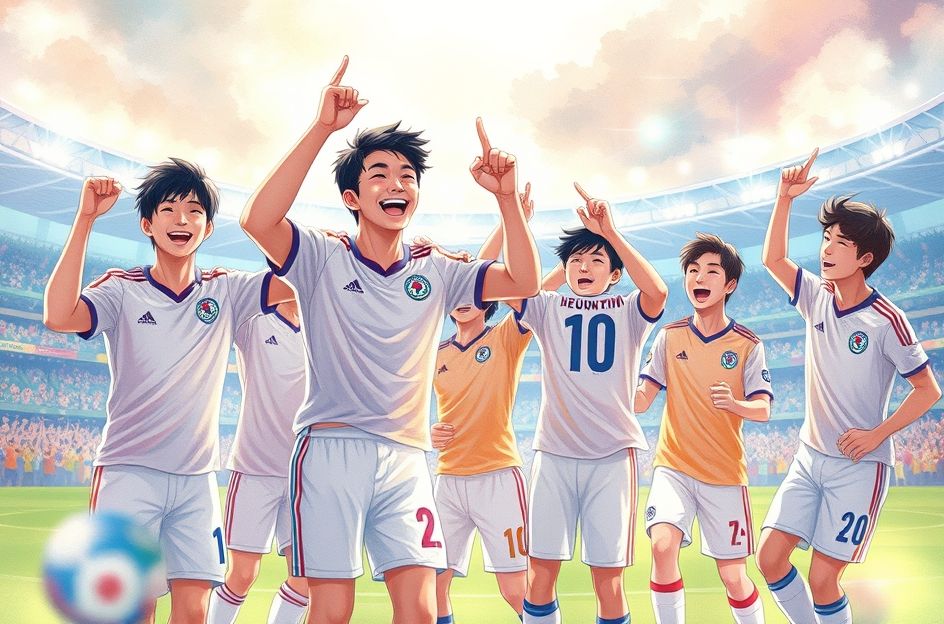
South Korean football is experiencing a remarkable momentum shift as both its senior and youth national teams prepare for crucial international competitions. In a weekend that highlighted the country's football prowess at multiple levels, Hong Myung-bo's senior squad delivered a commanding 2-0 victory against the United States in New Jersey, while the promising U-20 team departed for Chile to compete in the 2025 FIFA U-20 World Cup.
Son Heung-min Leads Senior Team to Victory Over USA
For American soccer fans, the September 7th match at Red Bull Arena represented more than just a friendly—it was a measuring stick against one of Asia's most consistent footballing nations. South Korea's 2-0 victory over the United States showcased the tactical sophistication and individual brilliance that has made them a regular World Cup participant since 1986, a streak unmatched by most countries globally.
The match dynamics would be familiar to American audiences who follow Major League Soccer, where several Korean players have made significant impacts. Son Heung-min, currently playing for Los Angeles FC after his legendary tenure at Tottenham Hotspur, demonstrated why he's considered one of Asia's greatest-ever players. His 18th-minute opener came from a perfectly weighted through ball by Lee Jae-sung, showcasing the kind of precision passing that American soccer analysts often cite when discussing the technical gap between MLS and top European leagues.
The goal itself—Son's 52nd in 135 international appearances—puts his scoring record in perspective for American readers: it's equivalent to scoring roughly once every 2.6 games over an 11-year international career, a consistency rate that would make him a legend in any sport. For context, that's a better international scoring rate than many celebrated American athletes achieve in their respective sports.
The second goal, scored by Lee Dong-kyung in the 43rd minute with a delicate backheel finish assisted by Son, demonstrated the creative flair that has become synonymous with modern Korean football. This wasn't just about individual talent—it reflected a philosophical evolution in Korean soccer that American coaches and players have increasingly studied and adopted.
Perhaps most significantly for American audiences, this match marked the international debut of Jens Castrop, a German-born player of mixed heritage who became the first overseas-born mixed-race player to represent South Korea's men's national team. This development reflects the increasingly global nature of international football, similar to how American sports have embraced diverse backgrounds and dual nationals in recent decades.
Understanding South Korea's Football Infrastructure
To appreciate this victory's significance, American readers should understand South Korea's unique position in world football. Unlike the United States, where soccer competes with established major leagues (NFL, NBA, MLB), football is South Korea's undisputed national sport. The Korea Professional League (K League) has been nurturing talent since 1983, creating a domestic pipeline that consistently feeds top European clubs.
The victory over the US extends South Korea's historical advantage in this matchup to 6 wins, 3 draws, and 3 losses—a record that might surprise American soccer fans who assume their country's rapid MLS growth translates to immediate international success. This result came after an 11-year, 7-month gap since their last meeting, highlighting how infrequently these two nations face each other despite both being regular World Cup participants.
U-20 Team: The Future of Korean Football
While the senior team celebrated in New Jersey, South Korea's next generation was embarking on their own journey to Chile for the 2025 FIFA U-20 World Cup. For American sports fans familiar with college athletics' importance in developing talent, the U-20 World Cup serves a similar function for international football—it's where future stars announce themselves on the global stage.
The 21-player roster reflects South Korea's systematic approach to youth development. Unlike American sports where high school and college systems dominate youth development, South Korea's academy system directly feeds professional clubs. The squad includes nine players from K League 1 (the top division), ten from K League 2, one university player, and notably, Kim Tae-won from Portuguese club Portimonense—representing the growing trend of Korean players developing in European academies.
Coach Lee Chang-won's squad composition tells a story of careful planning: 16 players born in 2005, four from 2006, and one from 2007. This age distribution ensures the team maintains competitive balance while building toward future cycles—a long-term thinking approach that American sports organizations increasingly admire and attempt to replicate.
The team faces Ukraine, Paraguay, and Panama in Group B, with matches beginning September 28. For American soccer fans, Paraguay represents familiar opposition—the same team that eliminated the US in the 2007 U-20 World Cup semifinals. Ukraine, despite ongoing conflicts, continues producing remarkable young talent, while Panama has emerged as a regional power following their senior team's 2018 World Cup appearance.
Global Implications and Cultural Context
These developments occur as South Korea positions itself for the 2026 World Cup, which will be co-hosted by the United States, Canada, and Mexico. Playing in American venues gives Korean players valuable experience in the stadiums where they'll compete in two years. Red Bull Arena, where they defeated the US, will host World Cup matches, making this victory even more meaningful.
For American audiences, South Korea represents what sustained investment in football infrastructure can achieve. Their consistent World Cup qualification since 1986, regular production of players for Europe's top leagues, and systematic youth development offer lessons for American soccer's continued evolution. The fact that Korean players increasingly choose MLS as a destination (like Son's move to LAFC) reflects the league's growing global reputation.
As Son Heung-min noted post-match: "The players showed confident play, the kind of football they wanted to play. That's what makes me happiest and represents our biggest achievement. We'll continue working hard to show improved performances with each call-up." This philosophy of expressive, confident football—rather than merely defensive or physical play—mirrors the attractive, attacking style American soccer increasingly embraces.
The convergence of senior team success and youth development suggests South Korean football's golden generation isn't ending but rather evolving. For American soccer, which has experienced its own youth revolution, South Korea's model demonstrates how sustained excellence across age groups creates a virtuous cycle of improvement and international competitiveness.
Original Korean article: 한국 축구의 힘찬 전진, 성인팀 미국전 완승과 U-20 월드컵 출격


0 Comments