
Trump's Tariff Policy Reshapes Korea-US-Japan Trilateral Diplomacy
President Donald Trump's aggressive tariff policies are dramatically transforming the diplomatic landscape of Northeast Asia, creating unprecedented challenges for the Korea-US-Japan trilateral partnership. As of September 2025, South Korea faces a 25% reciprocal tariff while Japan confronts a 24% rate, pressures that extend far beyond mere economic concerns to demand fundamental restructuring of the three-nation cooperation framework. For American readers, this situation is comparable to how NAFTA renegotiations affected US relationships with Canada and Mexico, but with added security dimensions given the North Korean nuclear threat.
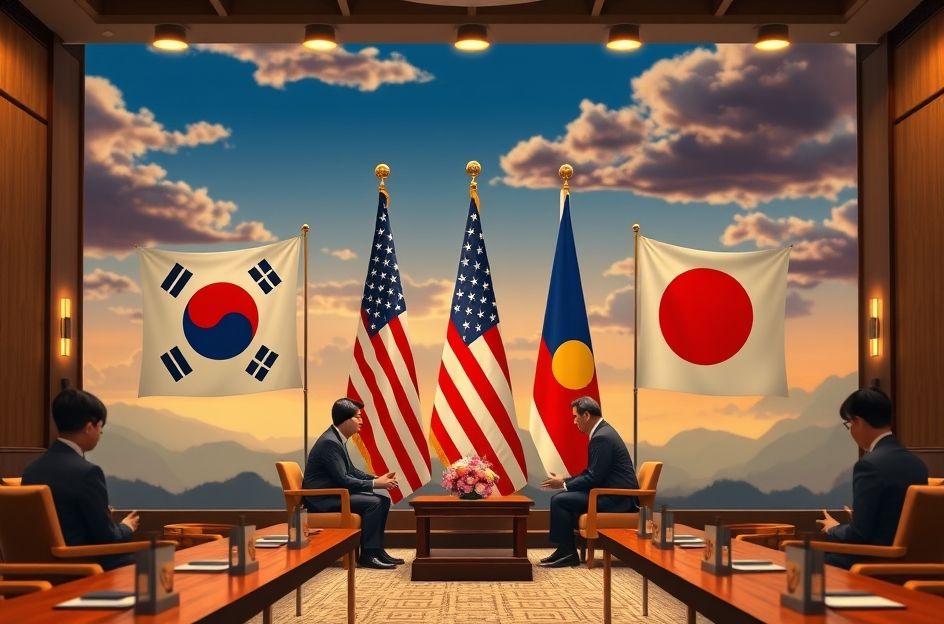
Korea-US-Japan Trilateral Diplomacy Summit Meeting
The current tariff dispute emerges as President Lee Jae-myung reaches his 100-day milestone, presenting the first major test of his administration's "pragmatic diplomacy centered on national interests" approach. For American readers unfamiliar with Korean politics, Lee Jae-myung assumed the presidency in June 2025 following a campaign that promised to restore South Korea's diplomatic standing after years of political instability. His pragmatic foreign policy mirrors aspects of Nixon's realpolitik, prioritizing tangible national benefits over ideological consistency.
According to the US Trade Representative's office, Trump's administration has announced reciprocal tariffs on over 60 countries, with South Korea and Japan receiving rates of 25% and 24% respectively, second only to China's 54%. These high tariff rates reflect the similar conditions both countries share: significant trade surpluses with the United States, major export industries like automobiles, and comparable geopolitical circumstances as key US allies in East Asia. To put this in American perspective, these tariffs are equivalent to the steel and aluminum tariffs imposed during Trump's first term, but applied across a much broader range of products including electronics, machinery, and consumer goods worth approximately $180 billion in combined annual trade.
Japan's $550 Billion Investment Strategy and Korea's Response
During the February 7th Washington summit, Japanese Prime Minister Ishiba Shigeru secured tariff concessions by promising $550 billion in US investments, despite initial tensions where Trump called Japan "very rude" and faced strong Japanese pushback. This diplomatic breakthrough, achieved after eight ministerial-level meetings, resulted in automobile tariff reductions from 25% to 12.5%, setting an effective car tariff rate at 15%. For American readers, this $550 billion commitment is comparable to the entire annual GDP of Belgium, representing one of the largest foreign investment pledges ever made to the United States.
The Japanese success story provides crucial insights for Korean policymakers. Japan's approach combined substantial economic commitments with strategic patience, weathering Trump's provocative rhetoric while maintaining negotiating leverage through G7 coordination and US business community support. For American readers, this mirrors how Canada successfully navigated USMCA negotiations by engaging with US state governors and business leaders while maintaining federal-level diplomatic pressure.
South Korea's response follows President Lee Jae-myung's multilayered approach under his "national interest-centered pragmatic diplomacy" doctrine. A Blue House official stated that while Treasury Secretary Scott Bessent had indicated reciprocal tariff deferrals were possible, President Trump's current strong tone has created heightened tension, making predictions difficult after July 9th. This uncertainty reflects the fluid nature of US policy toward South Korea, where security cooperation considerations compete with trade grievances.
Strengthening Trilateral Cooperation as a Breakthrough Strategy
The Lee administration is pursuing a strategy that actively utilizes Korea-Japan coordination in addition to Korea-US channels to address the trade dispute. During the first Korea-Japan leadership phone call on June 9th, both countries agreed to strengthen coordination within the Korea-US-Japan cooperation framework. For American readers, this approach resembles how the US coordinates with allies through NATO and other multilateral frameworks to present unified positions on global challenges.
The security dimension remains crucial to this trilateral relationship. The US-Japan summit reaffirmed the principle of North Korea's complete denuclearization and maintained the three-nation coordination system. This represents strategic calculation to ensure security cooperation continuity despite trade pressures. For American readers, the North Korea threat can be compared to the Cuban Missile Crisis in terms of direct security implications, making the peninsula's stability a core US national security interest that transcends trade disputes.
A Foreign Ministry official emphasized that "Japan's strategic approach in negotiations with the US provides significant implications for us," adding that "while building on the ROK-US alliance, securing leverage through multilateral cooperation is crucial." This reflects the reality that middle powers like South Korea and Japan must leverage institutional frameworks to maximize their influence with superpowers, similar to how European nations use EU coordination to engage with the United States on trade issues.
President Lee's participation in the G7 summit and emphasis on strengthening Korea-US-Japan cooperation represent this multilateral approach in action. The G7 participation, significant for demonstrating South Korea's restored diplomatic status, allows Seoul to coordinate positions with other major economies facing similar US trade pressures, including Germany and Japan.
As the second half of 2025 unfolds, the Northeast Asian diplomatic landscape is being reshaped around US tariff policies, with South Korea and Japan managing trade conflicts with America through different approaches while simultaneously pursuing cooperation and competition with each other. The success of Lee Jae-myung's pragmatic diplomacy will depend on maximizing national interests within this complex diplomatic environment, potentially determining whether the Korea-US-Japan trilateral cooperation framework can evolve beyond tariff disputes into a stronger strategic partnership capable of addressing 21st-century challenges including China's rise, technological competition, and climate change.
For American readers, the outcome of these negotiations will significantly impact US strategic interests in the Indo-Pacific region, where maintaining strong alliances with both South Korea and Japan remains essential for containing North Korean aggression and competing effectively with China's growing influence.
Source: Original Korean article


0 Comments