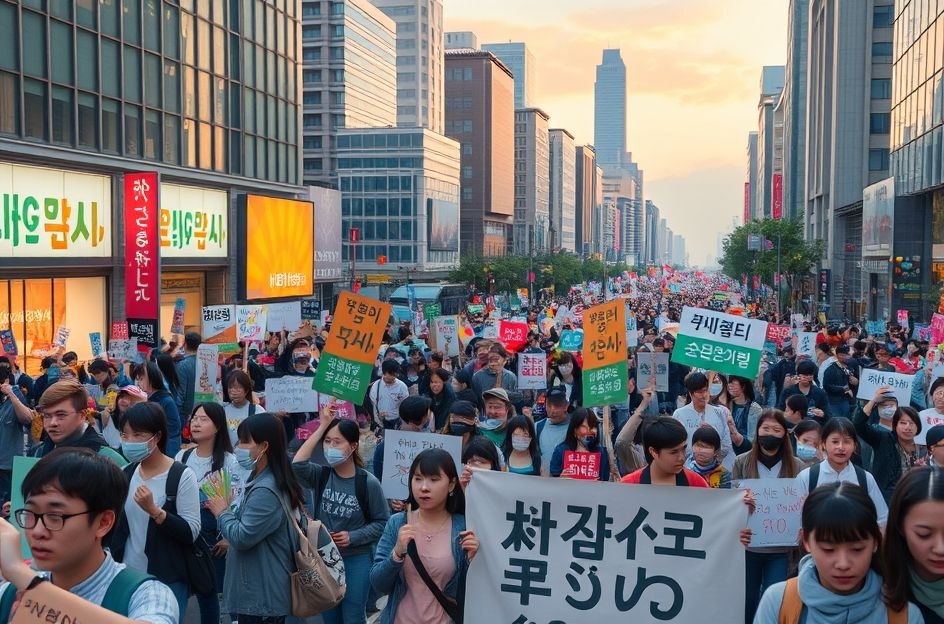
927 Climate Justice March: 20,000 Rally in Downtown Seoul as Youth-Led Movement Demands Aggressive Climate Action and Intergenerational Equity
Approximately 20,000 people gathered in downtown Seoul on September 27, 2025, for the "927 Climate Justice March," demanding more aggressive climate policies from the government through mass mobilization demonstrating unprecedented youth-led environmental activism in South Korea where climate concerns have historically ranked lower in public priorities compared to economic growth, national security, and employment issues—shifting political landscape reflecting younger generation's recognition that climate crisis represents existential threat requiring immediate transformative policy responses rather than incremental adjustments compatible with continued fossil fuel dependence and carbon-intensive development pathways that characterized Korea's rapid industrialization during 1960s-2000s when economic growth consistently superseded environmental protection in policymaking calculations, with government and industry dismissing environmental regulations as luxury concerns affordable only after achieving developed-nation prosperity levels through manufacturing export growth and energy-intensive heavy industries including steel, petrochemicals, shipbuilding, and automotive production that propelled Korea from war-devastated poverty to affluent OECD membership within single generation.
The march, organized to protest what activists characterize as tepid climate action failing to match scientific consensus on required emissions reduction timelines and call for bolder carbon neutrality measures aligned with 1.5°C warming limitation goals established by Paris Agreement and subsequently reinforced through IPCC special reports demonstrating catastrophic consequences of exceeding temperature thresholds, proceeded from Seoul Plaza adjacent to City Hall through Gwanghwamun Square where historic pro-democracy candlelight demonstrations overthrew President Park Geun-hye in 2016-2017 and past relocated Presidential Office in Yongsan District to National Assembly complex in Yeouido—roughly 5-kilometer route intentionally designed to symbolically connect three branches of Korean government (executive, legislative, municipal) while occupying public spaces demonstrating protesters' determination to maintain sustained pressure through visible mass mobilization rather than merely submitting petitions or engaging in behind-closed-doors policy negotiations that activists argue have produced inadequate responses insufficient for addressing climate emergency requiring war-mobilization-scale resource deployment and economic restructuring comparable to World War II industrial conversions or COVID-19 pandemic emergency responses when governments suspended normal policy constraints to address immediate existential threats.
For American readers familiar with youth climate activism including Sunrise Movement protests, Greta Thunberg-inspired school strikes, and progressive Democrats' Green New Deal legislative proposals emphasizing simultaneous climate action and economic justice through massive public investment programs creating green jobs while phasing out fossil fuel industries, Korean climate movement displays similar generational dynamics where younger cohorts express frustration with previous generations' inadequate climate responses and demand immediate aggressive action despite economic disruption costs that older generations more concerned with maintaining current living standards and employment stability might find unacceptable—intergenerational conflict reflecting fundamental tension between short-term economic interests and long-term survival imperatives that characterizes climate politics globally as societies struggle to overcome collective action problems, discount rate biases favoring present consumption over future welfare, and entrenched fossil fuel industry political power resisting policy changes threatening profitable business models built on carbon emissions.
Youth Generation Leads Climate Action with Intergenerational Justice Framing
The march's most striking demographic feature was overwhelming youth participation with over 60% of participants aged 10-30 according to organizer surveys and visual observation, including substantial high school and middle school student contingents who attended despite potential school disciplinary consequences and academic record concerns in Korea's intensely education-focused culture where school attendance and behavioral compliance significantly impact university admission prospects determining lifetime career trajectories—willingness to accept these risks indicates profound climate anxiety among younger generation recognizing they will inherit decades of escalating climate disruptions while having minimal responsibility for historical emissions accumulated during industrialization periods when previous generations enjoyed fossil-fuel-powered prosperity without internalizing environmental costs or considering intergenerational equity implications of resource depletion and atmospheric carbon loading creating warming commitments lasting centuries beyond initial emission events.
Youth organizations including University Student Climate Action Network (coordinating 45 university campus chapters nationwide through federated structure), Youth Climate Emergency Action (mobilizing high school and middle school students through social media networks and peer organizing), and Korean Youth Climate Litigation Group (pursuing constitutional challenges arguing government climate inaction violates citizens' fundamental rights to livable environment) spearheaded organizational logistics including march route police coordination, media outreach generating television broadcast coverage and newspaper features, and sophisticated social media campaigns accumulating 28 million combined impressions across Instagram (visual protest photos resonating with youth users), Twitter/X (real-time march updates and political commentary), and TikTok (short-form video content emotionally conveying climate urgency through personal testimonies and creative protest footage) that dramatically expanded awareness beyond march participants to broader Korean public including older demographics less engaged with climate issues but exposed to march coverage through mainstream media coverage amplified by social media virality.
Kim Min-ji (pseudonym for privacy protection, though actual identity known to organizers), Seoul National University junior studying environmental science, articulated prevailing generational perspective among youth protesters: "Our generation will spend next 50-60 years living with escalating climate crisis consequences—more frequent extreme weather destroying infrastructure and agriculture, food system disruptions causing malnutrition and famine, mass climate refugee movements triggering geopolitical instability, potential civilizational collapse if warming exceeds 3-4°C triggering tipping points including ice sheet disintegration, permafrost methane release, and Amazon rainforest dieback creating runaway warming beyond human control. We can no longer tolerate slow government action prioritizing short-term economic growth over long-term survival when scientific consensus demonstrates immediate transformative action required to avoid catastrophic outcomes." This framing strategically positions youth as victims of previous generations' policy failures, creating moral pressure complicating government and industry responses by casting emissions reduction opponents as perpetrators of intergenerational injustice rather than reasonable actors balancing competing priorities.
High school students held signs reading "We want a future to live in" and "Adults, take responsibility"—slogans emphasizing intergenerational justice themes and youth desperation about climate futures determined by current policy decisions made by older generations who won't experience worst consequences of inadequate climate responses but whose political and economic power dominates policymaking processes marginalizing youth voices despite their disproportionate stake in long-term outcomes. This youth-led movement mirrors similar activism in United States and Europe, reminiscent of Greta Thunberg's "Fridays for Future" school strike movement that mobilized millions globally and shifted political discourse on climate urgency, but with distinctly Korean characteristics emphasizing intergenerational responsibility concepts deeply rooted in Confucian cultural values traditionally emphasizing elders' obligations toward younger generations and reciprocal duties between age cohorts—cultural resources that youth activists strategically deploy to legitimize demands for aggressive climate action as fulfillment of traditional moral obligations rather than radical departure from Korean values.
Diverse Coalition Building Beyond Youth Environmental Activists
Beyond youth environmental activists, march demonstrated successful coalition-building across traditionally separate advocacy domains that have historically operated independently or even antagonistically when environmental protection conflicted with labor's employment concerns or religious institutions' focus on spiritual rather than political issues. Environmental groups including major Korean NGOs with decades of advocacy experience provided organizational capacity and institutional credibility complementing youth activists' energy and social media sophistication. Labor unions including Korean Confederation of Trade Unions and Federation of Korean Trade Unions, Korea's two primary national labor federations representing combined 2.5 million workers, emphasized "just transition" demands that workers currently employed in coal mining, fossil fuel power generation, internal combustion engine automotive manufacturing, and other carbon-intensive industries receive comprehensive retraining programs preparing them for green economy employment, income support during transition periods preventing household financial crises, and priority placement in renewable energy installation, electric vehicle production, building energy retrofit, and other green job creation initiatives rather than being discarded as economic casualties of climate policy—union focus reflecting organized labor's traumatic experience during Korea's 1990s-2000s industrial restructuring when hundreds of thousands of shipbuilding, steel, and traditional manufacturing workers lost jobs through automation and foreign competition, creating lasting anxiety that climate transition could replicate those dislocations without proper social safety nets.
Religious organizations from Buddhism (Korea's second-largest religious denomination), Protestantism (largest at ~20% of population), and Catholicism presented joint interfaith statement characterizing climate response as fundamental moral and religious obligation transcending partisan political divisions—theological framing invoking environmental stewardship concepts, intergenerational responsibility principles, and preferential option for poor populations most vulnerable to climate impacts as religious imperatives rather than merely political policy preferences, with religious institutions' social credibility and organizational infrastructure providing legitimacy and mobilization capacity complementing youth activists' social media sophistication and labor unions' workplace organizing in multi-pronged advocacy strategy. Cultural artists contributed street performances, musical presentations, and installation artworks transforming march from purely political demonstration into hybrid cultural festival-protest creating family-friendly atmosphere encouraging broader public participation beyond hardcore activists while maintaining serious policy messaging through artistic expression conveying climate urgency and social justice themes accessibly to general audiences potentially alienated by technical scientific discourse or confrontational protest tactics.
Government Response and Policy Implications
Following the march, Presidential Office issued cautious statement acknowledging "the seriousness of citizens' climate concerns reflected in today's demonstration" and promising to "review concrete policy measures addressing reasonable demands within bounds of economic feasibility and technological readiness"—diplomatic language attempting to validate protesters' concerns while maintaining flexibility to reject specific policy demands deemed economically disruptive or politically infeasible given opposition from fossil fuel industries, heavy manufacturing sectors, and conservative political constituencies prioritizing economic growth and employment stability over aggressive climate action. However, environmental groups immediately criticized Presidential response as "rhetorical acknowledgment without substantive commitments or implementation timelines, representing same delay tactics that have characterized government climate policy for past decade while emissions continued rising and climate impacts intensified, demonstrating government prioritizes fossil fuel industry profits and short-term economic indicators over scientific warnings and younger generation's survival imperatives."
Climate activists demand four specific policy changes with measurable targets and enforcement mechanisms: First, advancing coal power phase-out completion date from currently-planned 2050 to 2040, with immediate accelerated retirement of aging coal plants rather than allowing continued operation through mid-century while constructing new renewable capacity in parallel—timeline acceleration reflecting activists' assessment that 2050 phase-out incompatible with 1.5°C warming limit requiring net-zero emissions globally by 2050, meaning developed nations like South Korea must achieve carbon neutrality substantially earlier to allow developing nations additional transition time. Second, increasing 2030 national greenhouse gas emissions reduction target from current 40% below 2018 baseline to 50% reduction—enhanced ambition aligning South Korea with European Union's 55% reduction commitment. Third, dramatically expanding renewable energy investment through dedicated "Green New Deal Fund" with ₩50 trillion ($37.5 billion) initial capitalization. Fourth, introducing carbon taxes starting at ₩50,000 per ton CO2-equivalent and comprehensive climate justice legislation establishing enforcement mechanisms and legal accountability for inadequate climate responses.
Whether government will accept these demands remains uncertain, but sustained momentum of climate movement with ability to mobilize 20,000 protesters suggests it will significantly influence South Korea's climate policy direction through continued pressure campaigns including weekly demonstrations, civil disobedience escalation, and coordination with international climate activism creating reputational costs for laggard climate policies while building domestic political coalitions supporting aggressive climate action despite economic transition costs and fossil fuel industry opposition.
Source: Korea Trendy News
Comments
Post a Comment