
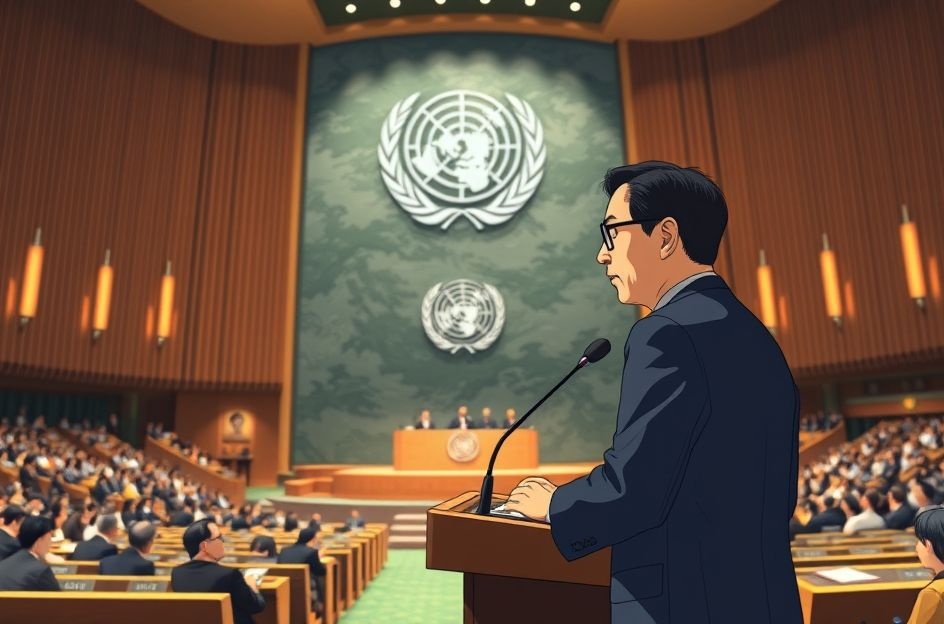
President Lee Jae-myung Addresses UN General Assembly, Proposes 'Climate Justice Fund' and Technology Transfer Mechanisms
South Korean President Lee Jae-myung delivered a keynote address at the 80th United Nations General Assembly in New York on September 26, 2025 (local time), presenting "Climate Justice" as centerpiece of South Korea's enhanced global diplomatic engagement and drawing international attention through comprehensive policy proposals addressing historical emissions responsibility, North-South equity concerns, and practical implementation mechanisms for supporting developing nations' climate adaptation and mitigation efforts—speech representing South Korea's strategic positioning as bridge between developed and developing nation blocs in climate negotiations where industrialized countries resist binding financial commitments while vulnerable nations demand compensation for climate damages disproportionately harming populations contributing minimally to cumulative historical emissions that caused current warming.
This address marks South Korea's declaration of intent to play leadership role in international climate governance beyond previous participation as mid-tier developed nation following major powers' negotiating positions, instead proactively shaping climate justice discourse and offering concrete financial contributions and technology transfer programs that could catalyze broader international cooperation currently stalled by developed-developing nation disagreements over responsibility allocation, financing mechanisms, and implementation timelines—diplomatic initiative reflecting President Lee's progressive political orientation emphasizing multilateral cooperation, environmental sustainability, and global solidarity contrasting with nationalist conservative approaches prioritizing narrow national economic interests over international climate obligations.
For American readers familiar with U.S. climate policy debates where Republicans typically oppose international climate agreements citing economic competitiveness concerns and sovereignty constraints while Democrats support multilateral engagement though with varying ambition levels regarding financial commitments and emissions reduction targets, South Korean climate politics display somewhat different dynamics where both major party coalitions support Paris Agreement participation and carbon neutrality commitments (reflecting broad social consensus on climate urgency transcending partisan divisions), but disagree substantially on implementation speed, economic transition costs, and international financial obligations—partisan divide more focused on domestic policy implementation details rather than fundamental acceptance of climate science or international cooperation principles that remain contested in American politics despite overwhelming scientific consensus and observable climate impacts intensifying globally.
Three Major Proposals Operationalizing Climate Justice Principles
President Lee emphasized that climate change transcends mere environmental issue classification to constitute fundamental justice matter where developing nations and vulnerable populations who contributed minimally to historical greenhouse gas emissions through limited industrialization and low per-capita consumption patterns are experiencing most severe climate consequences including devastating floods destroying agricultural systems and displacing millions, unprecedented droughts causing crop failures and water scarcity affecting billions, intensifying tropical cyclones with wind speeds and precipitation volumes exceeding historical records, and coastal inundation from sea level rise threatening low-lying island nations with complete territorial elimination—catastrophic impacts reflecting profound injustice requiring international solidarity and coordinated action for adequate resolution rather than allowing market mechanisms or voluntary initiatives to address crisis demanding government intervention and resource redistribution on scale unprecedented in peacetime international cooperation.
President Lee proposed three interconnected initiatives establishing institutional mechanisms and financing streams operationalizing abstract climate justice principles into concrete implementation programs: First, establishment of dedicated "Climate Justice Fund" with developed nations contributing financial resources calibrated to their historical cumulative carbon emissions rather than current annual emissions or GDP levels—contribution formula explicitly recognizing that atmospheric carbon accumulation causing current warming primarily resulted from industrialized countries' fossil fuel consumption during 19th-20th century economic development when climate impacts weren't understood or considered in energy system decisions, creating moral obligation for historically high-emitting nations to fund developing countries' climate adaptation infrastructure, disaster response capacity, agricultural resilience programs, and renewable energy transitions enabling economic development without replicating carbon-intensive industrialization pathways that created climate crisis developed nations now demand developing countries avoid despite lacking financial resources for expensive clean energy technologies and infrastructure investments.
Second, comprehensive technology transfer programs enabling developing nations to pursue simultaneous green economic growth and carbon neutrality implementation rather than facing false choice between continued poverty or fossil-fuel-powered development—knowledge sharing initiative would provide renewable energy technologies (solar panel manufacturing, wind turbine installation, battery storage systems), energy efficiency innovations (building insulation materials, industrial process optimizations, transportation electrification), and climate-resilient agricultural techniques through mechanisms including intellectual property rights waivers for essential climate technologies (potentially controversial among technology-exporting developed nations concerned about commercial competitiveness), technical training programs educating developing nation engineers and scientists in clean technology deployment and maintenance, and collaborative research partnerships developing technologies specifically suited to developing nation contexts including tropical climate conditions, limited electrical grid infrastructure, and constrained financial resources requiring low-cost solutions rather than capital-intensive systems optimal for wealthy countries but unaffordable in resource-constrained environments.
Third, strengthening "loss and damage" compensation mechanism agreed upon at COP28 (2023 Dubai climate summit) but lacking adequate financing commitments or implementation procedures converting abstract agreement into actual financial support flowing to vulnerable nations experiencing irreversible climate damages beyond adaptation capacity including permanent island territory loss from sea level rise, glacier-fed river system collapse destroying water resources supporting millions, coral reef ecosystem death eliminating fishing industries and coastal protection functions, and permafrost infrastructure failure rendering Arctic communities uninhabitable—damage categories requiring compensation rather than adaptation assistance because no feasible adaptation measures can prevent these losses already locked in by historical emissions and current warming trajectories regardless of aggressive future emissions reductions that can limit additional warming but cannot reverse damage already caused by atmospheric carbon concentrations elevated above pre-industrial levels.
International Reception and South Korea's Climate Diplomacy Expansion
President Lee's proposals received significant applause from developing nation representatives, particularly African and Southeast Asian delegations experiencing severe climate impacts while contributing less than 10% of cumulative historical emissions concentrated among industrialized nations including United States (25% of historical emissions), European Union countries (22%), China (13%, though primarily recent rather than historical), and Russia (6%)—emissions distribution creating clear moral case for disproportionate financial responsibility among historically high-emitting nations that climate justice advocates argue should fund developing nation climate responses through mandatory contributions rather than voluntary aid subject to annual budgetary political debates in donor countries where domestic spending priorities frequently supersede international assistance commitments when fiscal constraints emerge or political opposition mobilizes against foreign aid expenditures.
UN Secretary-General António Guterres praised South Korea's proposals as "concrete implementation plan for climate justice moving beyond abstract principles toward operational mechanisms with specified financing levels, technology transfer procedures, and accountability frameworks"—endorsement providing diplomatic credibility and potentially catalyzing support from other developed nations that might view South Korean leadership as face-saving mechanism allowing them to increase climate finance commitments without appearing to capitulate to developing nation demands, instead framing enhanced contributions as supporting allied nation's diplomatic initiative rather than yielding to pressure from opposing negotiating bloc.
President Lee's UN speech represents South Korea's strategic expansion into global climate diplomacy leadership role building on country's established international profile as successful development model (rapid industrialization lifting population from post-war devastation to affluent OECD membership within single generation), technological capabilities in key clean energy sectors (world's leading battery manufacturers supplying global electric vehicle transition, advanced semiconductor production enabling renewable energy control systems, hydrogen fuel cell development for transportation and industrial applications), and geographic positioning as bridge between developed and developing nations (recently-developed economy understanding both industrialization imperatives and sustainability concerns, Asian nation culturally and economically connected to developing regions while politically aligned with Western democratic alliances).
Having committed to achieving carbon neutrality by 2050 and reducing greenhouse gas emissions 40% below 2018 levels by 2030 (ambitious though not most aggressive targets globally—European Union targeting 55% reduction by 2030, some Nordic countries pursuing faster timelines), South Korea positions itself as credible climate leader balancing economic development concerns with environmental responsibility rather than either developing nation resisting emissions constraints or developed nation lecturing others while maintaining high per-capita emissions. Country's announcement of $10 billion commitment to proposed Climate Justice Fund over five-year period (approximately $2 billion annually representing 0.1% of Korean GDP, substantial though modest relative to climate finance needs estimated at hundreds of billions annually) combined with technology transfer programs sharing renewable energy, battery, and energy efficiency innovations with developing nations through partnerships, licensing agreements, and capacity-building initiatives demonstrates concrete action backing rhetorical commitments—implementation follow-through often lacking when developed nations make climate finance pledges subsequently unfulfilled or redirected through accounting mechanisms inflating reported contributions beyond actual new financial flows.
Source: Korea Trendy News


0 Comments