South Korea Fills Final Table Tennis Spots for 2026 Asian Games, Showcasing a System Built on Pressure and Depth
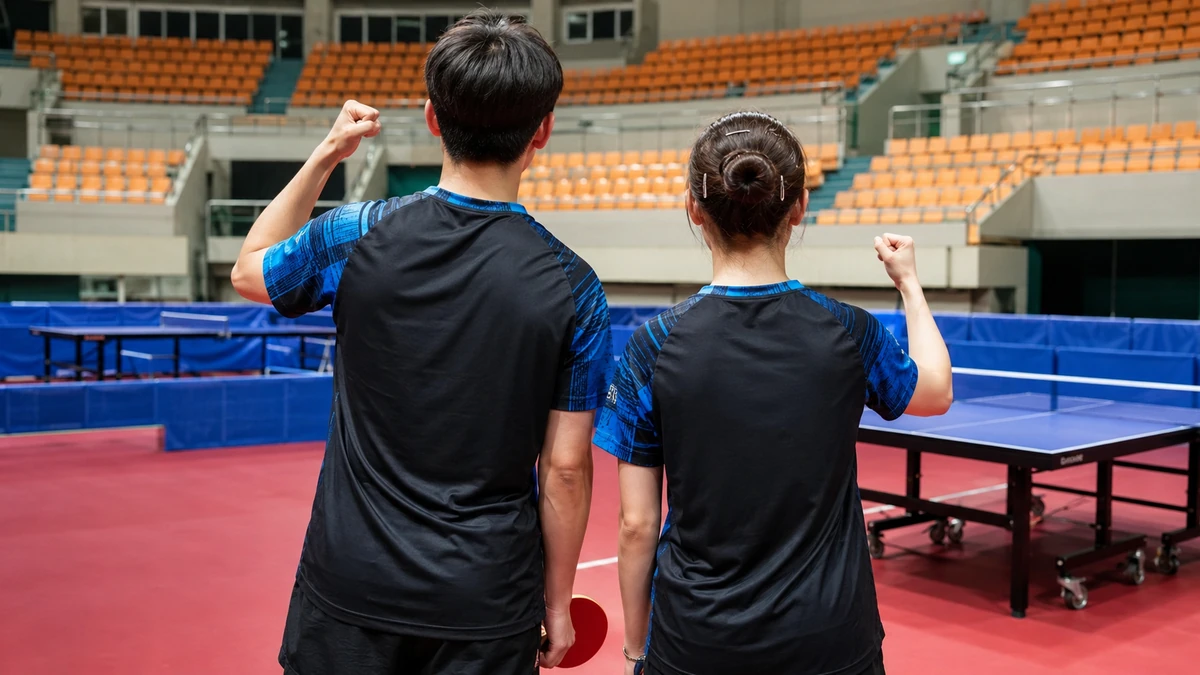
South Korea’s last open roster spots came down to one day, one tournament and no margin for error
In a country where table tennis still carries the weight of national memory, two players earned more than tournament wins this week. Park Gyuhyeon and Park Gahyeon captured the final open places on South Korea’s national team for the 2026 Asian Games and the Asian Table Tennis Championships, surviving a high-pressure selection event that functioned as both tryout and gut check.
According to Yonhap News Agency, the decisive second-stage tournament was held Tuesday at the national training center in Jincheon, a sports complex in central South Korea that serves roughly the way the U.S. Olympic & Paralympic Training Center does in Colorado Springs: a place where national-team dreams are sharpened, and sometimes broken, under institutional lights.
Park Gyuhyeon, who plays for Mirae Asset Securities, won the men’s bracket. Park Gahyeon, representing Korean Air, won the women’s side. Each claimed the final available place on the national team roster, meaning South Korea’s lineup for major upcoming continental competition is now effectively complete.
That may sound like a simple personnel update, but in Korean sports culture, and especially in table tennis, the last seat on a national team can carry oversized significance. This was not a ceremonial addition to a settled roster. It was a fight for the final entry point into one of the most competitive national-team pipelines in Asia. In a single-elimination environment, one off match could end the dream. Winning meant not only playing well but handling the kind of pressure that selectors, coaches and fans remember.
To “wear the Taegeuk mark,” as Korean media often put it, means to represent the country with the red-and-blue symbol from the South Korean flag on the uniform. For American readers, it is roughly the emotional equivalent of making Team USA, but with an added layer that is common in East Asian sports systems: national-team selection is often a defining professional milestone, not just an occasional honor. In a sport like table tennis, where Asian competition is fierce and international reputations can change quickly, a final roster spot can alter both a player’s career and a country’s tactical options.
It also matters because South Korea is not a fringe table tennis nation. It is one of the sport’s traditional powers, even if it competes in a region dominated by China and challenged by Japan. That means internal competition can be almost as difficult, emotionally and strategically, as parts of the international calendar itself.
Park Gyuhyeon’s run completed the men’s team
On the men’s side, Park Gyuhyeon defeated Lim Yuno of the Korea Armed Forces Athletic Corps, 3-1, in the final to secure the last berth. The Korea Armed Forces Athletic Corps may be unfamiliar to many American readers, but its presence reflects a distinct feature of South Korea’s sports system. Because South Korean men are generally subject to compulsory military service, the military fields elite sports teams that allow athletes in some disciplines to continue training and competing while fulfilling service obligations.
That context gives the bracket an added layer of meaning. This was not merely a club competition. It brought together players from a cross-section of Korea’s institutional sports world: corporate teams, military squads and company-backed programs that function as the backbone of elite development. The structure is different from the American model, where college athletics and private clubs often serve as the main pipeline. In South Korea, employers, state-linked bodies and military units can all become part of an athlete’s competitive ecosystem.
Park Gyuhyeon’s path underscored the difficulty of the assignment. He opened the quarterfinals with a tight 3-2 win over Jang Hanjae, also from the Armed Forces Athletic Corps. That result suggested early strain and little room to settle into the tournament. In the semifinals, he found another gear, beating Kang Dongsu of Samsung Life Insurance 3-0. Then in the title match, he closed out Lim 3-1.
The score progression tells a story familiar to anyone who follows postseason sports. A narrow escape can either expose vulnerability or trigger composure. For Park Gyuhyeon, it seemed to do the latter. He survived the most precarious stage, then looked steadier as the day moved on. By the final, he had demonstrated not just shot-making ability but a wider competitive range — the capacity to win ugly, to win cleanly and then to finish under spotlight conditions.
His reward is a place alongside a more established men’s core that includes Jang Woojin, Lim Jonghoon, Ahn Jaehyun and Oh Junsung. Those names are already well known to Korean table tennis followers. Park Gyuhyeon’s addition gives the team a slightly different profile: not only proven names, but also a player arriving through a direct pressure test. In team construction terms, that matters. A roster is not just a ranking list; it is a mix of forms, temperaments and possible combinations for singles and doubles play.
For U.S. readers, the easiest parallel might be a player making the last spot on a basketball World Cup roster or the final seat on an Olympic relay pool — someone who may not be the headline star but could shape lineups, match strategy and practice intensity in ways outsiders often miss.
Park Gahyeon’s steadiness filled the women’s final opening
If Park Gyuhyeon’s route looked like a pressure climb, Park Gahyeon’s tournament run projected a different kind of authority. She defeated Lee Da-eun of the Korea Racing Authority 3-1 in the women’s final, earning the last available spot on the national team and putting a finishing touch on a highly controlled day.
The Korea Racing Authority, despite its name, is a public institution in South Korea that also operates sports teams. That may sound unusual from an American vantage point, but it is another example of how South Korea’s elite sports structure spreads across companies, public agencies and quasi-governmental organizations. Athletes are often employed by or attached to these organizations, which provide salaries, facilities and stable competitive settings.
Park Gahyeon’s earlier matches were especially convincing. She beat Yoo Yerin of POSCO International 3-0 in the quarterfinals and then swept Yoo Siu of Hwaseong City Corporation 3-0 in the semifinals. POSCO International is part of a major Korean corporate group, while Hwaseong City Corporation is tied to a municipal public entity. Again, the names themselves tell part of the story: elite Korean table tennis is embedded in institutions, not just free-floating clubs.
By the time she reached the final, Park Gahyeon had not dropped a game. That made the last match a different kind of challenge. Athletes who cruise through early rounds sometimes find the final emotionally awkward; the tension rises, the stakes become explicit and the finish line can feel farther away than it looks. Instead, Park Gahyeon stayed composed, winning 3-1 and avoiding the kind of late unraveling that selection tournaments can produce.
Her performance resonated not because it was flashy in the abstract, but because it was complete. Two 3-0 victories showed control. The 3-1 result in the final showed adaptability once the resistance stiffened. If Park Gyuhyeon’s day illustrated survival and adjustment, Park Gahyeon’s illustrated sustained command.
That distinction matters in table tennis, where matches are short, momentum can flip quickly and the mental strain of every point is amplified by the sport’s pace. A player does not have the luxury of easing into rhythm over long stretches the way a baseball hitter or tennis player might. Every set is a small pressure cooker. In a national-team trial, that sensation is magnified.
Why these selection tournaments matter so much in South Korean sports
The tournament results offer a window into something bigger than two individual breakthroughs. They reveal how South Korea’s table tennis system works, and why internal competition is so intense. In the United States, many fans are used to leagues, seasons and playoffs serving as the primary measure of athletic worth. National-team selections certainly matter, but for many sports they are intermittent events layered on top of a much larger domestic commercial structure.
In South Korea, especially in Olympic and Asian Games sports, national-team status can sit much closer to the center of an athlete’s professional identity. The domestic ecosystem is robust, but it is also deeply connected to international representation. Making the roster means access, prestige and often a stronger claim to future opportunity.
That helps explain why the summary of these matches reads with so much dramatic weight. There was only one remaining place in the men’s group and one in the women’s group. Everyone involved understood what that meant. This was not a broad developmental camp in which several good performances could be rewarded. It was closer to sudden-death selection. One player would emerge; everyone else would be left outside the frame.
The Korean phrase often used around this kind of moment implies more than “making the team.” It carries the sense of finally putting on the national colors after enduring a long, competitive climb. In U.S. sports language, one might call it earning the jersey. In South Korea, that symbolism tends to feel even sharper because the national team is such a visible vessel for public pride, especially ahead of marquee events like the Asian Games.
There is also a strategic reason these last-place battles attract attention. In table tennis, roster depth can change the shape of a team event. The final player selected may not be the No. 1 star, but that athlete can affect doubles pairings, practice quality, matchup flexibility and the internal competitive environment that sharpens the entire squad. Coaches do not just choose the most famous names; they choose the mix that can survive a tournament.
That is one reason Korean sports fans often treat national-team trials as serious events in their own right. The stakes are not hypothetical. They are immediate and structural.
A sports system built by companies, public agencies and the military
One of the most striking elements in the roster race is the list of affiliations attached to the players’ names. Mirae Asset Securities. Korean Air. Samsung Life Insurance. POSCO International. The Korea Exchange. The Korea Racing Authority. A city corporation. A military sports unit. To an American reader, it may look less like a traditional club tournament and more like a bracket populated by employers.
That impression is not wrong.
South Korea has long relied on company-backed and institution-backed teams to develop and sustain athletes in a range of non-global-mega-sports — that is, sports outside the commercial reach of soccer, baseball or the NBA-style entertainment machine. Table tennis is one of the clearest examples. Companies and public entities fund teams, hire players and support training in exchange for prestige, visibility and a measure of civic or corporate identity.
The arrangement has advantages. It creates a relatively stable environment for athletes. It distributes development across the country. And it can preserve depth in sports that might otherwise struggle financially. It also produces fierce internal competition because talent is spread across multiple well-supported entities rather than concentrated in one dominant club.
There are trade-offs, too. Institution-based systems can sometimes appear opaque to outsiders, and they do not always map neatly onto the club loyalties Americans are used to. But in selection tournaments like this one, the benefits become obvious: the pool is deep, the players are hardened by serious domestic competition and the final roster spots are earned through meaningful resistance.
For male athletes, the military layer adds another uniquely Korean dimension. Mandatory service affects career timelines in ways American sports fans may not immediately appreciate. The presence of the Armed Forces Athletic Corps in an elite bracket is a reminder that athletic careers in South Korea often run alongside civic obligations. That does not reduce the sporting level; in many cases it heightens the sense that every opportunity must be seized when it appears.
Seen that way, Park Gyuhyeon’s win over a military-team opponent and Park Gahyeon’s run through players from corporate and public-agency teams are not just bracket details. They are evidence of a broader athletic ecosystem that is structurally different from the U.S. model but no less competitive.
The scores themselves tell the story of pressure
Sportswriting sometimes leans on numbers without stopping to interpret them. Here, the numbers are the story.
In a table tennis selection event, the difference between 3-2, 3-1 and 3-0 is not merely arithmetic. A 3-2 match is a survival narrative, the kind that suggests tension from the opening exchanges to the last point. A 3-0 victory usually signals command — a match in which one player imposed terms before doubt could spread. A 3-1 result often lives somewhere in between: control with resistance, superiority that still had to be asserted.
Park Gyuhyeon’s day contained all three moods. He edged through the quarterfinals 3-2, dominated the semifinals 3-0 and then sealed the final 3-1. The progression suggests a player who steadied as the tournament deepened, one who may have needed an early escape to settle his nerves before playing his cleanest table tennis later on.
Park Gahyeon’s sequence was almost the mirror image in tone. She swept the quarterfinals and semifinals, then won the final 3-1. That pattern evokes a player who entered in command and maintained enough composure to finish once the pressure became unmistakable.
For readers who do not follow table tennis closely, it can help to think of these outcomes the way basketball fans think of a close one-possession escape versus a comfortable double-digit win — except compressed into a much faster format. Table tennis is a game of tiny margins and fast emotional turns. A couple of loose points can swing a set. A set can swing a match. A match, in this case, swung an international future.
That is why Korean coverage of such events often treats the scorelines as emotional shorthand. They reveal not just who won, but how the pressure landed and how the winner answered it.
What this means for South Korea heading toward the Asian Games
The 2026 Asian Games in Aichi and Nagoya, Japan, will matter deeply to South Korea for reasons that go beyond table tennis. The Asian Games function in much of Asia the way a blend of the Pan American Games and a regional Olympics might function in the Western imagination: a major multi-sport event, rich in national pride and regional rivalry, where medal standings are watched closely and performances can shape an athlete’s legacy.
In table tennis, the Asian Games are especially unforgiving because the continent houses the sport’s deepest concentration of elite talent. To make South Korea’s team, then, is to survive a funnel that is already selective before the international draw even appears.
The men’s roster now includes established names and a late-emerging addition in Park Gyuhyeon. The women’s side, with Park Gahyeon taking the final open place, gains a player who looked balanced and composed when the selection process narrowed to its sharpest point. That does not guarantee results in 2026, and cautious reporting requires saying so plainly. A successful trial does not automatically translate to podium success against Asia’s strongest opposition.
But it does say something important about readiness. South Korea did not fill these final seats by default or reputation. It filled them through concentrated domestic competition. That tends to matter in sports where lineup flexibility, confidence under pressure and match toughness are as valuable as raw talent.
For American audiences more familiar with the global branding of Korean pop culture than the mechanics of Korean amateur and Olympic sports, this is also a useful reminder: South Korea’s international footprint is not limited to entertainment exports or a handful of globally televised leagues. It also includes highly organized, deeply competitive systems in sports that remain central to national prestige even when they receive less attention in the United States.
And in that sense, the story of Park Gyuhyeon and Park Gahyeon is not only about two individual victories. It is about what those victories reveal. A national program left one seat open on each side, demanded that athletes fight for it in a winner-take-all setting and watched two players deliver under pressure. For South Korea, that is not just selection. It is a statement about depth, discipline and the belief that a roster should be completed by competition, not assumption.
By the end of the day in Jincheon, the last pieces were in place. The names of the winners may have started as the final blanks on a team sheet. Now they are part of the structure South Korea will carry into one of Asia’s biggest sporting stages.
Comments
Post a Comment