South Korea’s Iran Signal After the Namu Ship Attack Exposes a Hard Truth About Trade, Diplomacy and the Strait of Hormuz
A shipping attack far from home becomes a test of statecraft
For South Korea, a country whose economic success rests heavily on ships, trade routes and imported energy, the fire aboard the Korean vessel Namu in the Strait of Hormuz was never likely to remain a narrow maritime incident. But the story has now taken on a sharper political edge after Seoul effectively pointed to Iran as the actor behind the attack, transforming what might once have been treated as an ambiguous overseas emergency into a broader diplomatic and national security challenge.
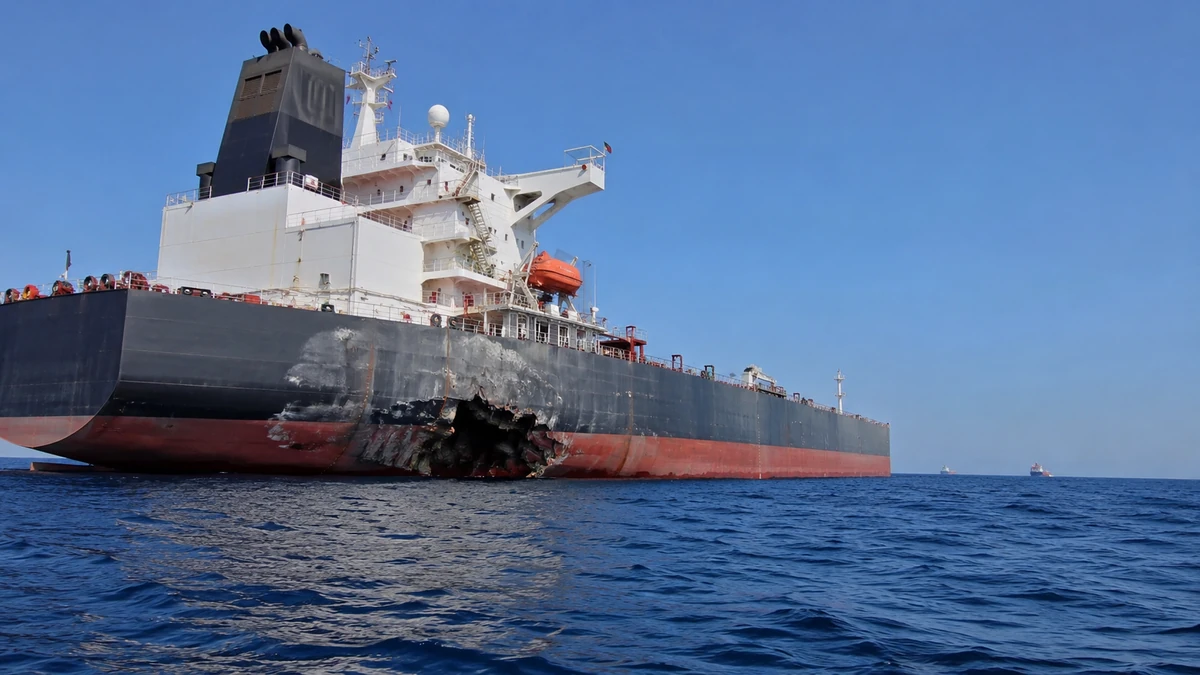
According to the South Korean government’s joint investigation, the blaze that broke out aboard the Namu on April 4 in the strategically vital waterway was caused by a strike from an unidentified flying object. Authorities said investigators documented a massive breach in the lower part of the hull, measuring roughly 16 feet wide and 23 feet deep. Those details matter because they move the discussion beyond routine shipping hazards or mechanical failure. They suggest force, intent and a level of risk with implications far beyond one ship.
Then came the more politically loaded step. On April 27, the South Korean government was widely understood to have effectively identified Iran as the responsible party, even if it stopped short of the bluntest possible public wording. In diplomatic practice, that distinction matters. Governments often calibrate their language carefully, especially when the alleged perpetrator is a powerful regional actor and the setting is one of the world’s most tense maritime corridors. But even a carefully phrased accusation carries consequences.
For American readers, the closest parallel may be the way Washington has historically handled attacks on commercial shipping in the Persian Gulf or the Red Sea: technical evidence first, public attribution later, and all of it filtered through a larger concern about escalation, energy prices, alliance politics and freedom of navigation. South Korea now finds itself in a similar bind, albeit with fewer military options and a different diplomatic posture. The attack on the Namu is forcing Seoul to answer a difficult question: How forcefully can a middle power defend its ships and citizens without making an already volatile regional picture even more dangerous?
That question is not abstract. South Korea is one of the world’s most trade-dependent advanced economies. Its export-driven model depends on open sea lanes in the same way the U.S. economy depends on secure interstate highways, rail links and ports. When a Korean vessel is hit in the Strait of Hormuz, it is not only a foreign policy matter. It touches energy security, supply chains, domestic politics and the credibility of the state itself.
Why the Strait of Hormuz still matters to the world
To understand why this case has drawn such attention in South Korea, it helps to understand the geography. The Strait of Hormuz is one of the planet’s most important energy chokepoints, a narrow passage connecting the Persian Gulf to the Gulf of Oman and the Arabian Sea. A significant share of the world’s oil and liquefied natural gas moves through it. If Americans think of the Suez Canal as a symbol of global trade vulnerability, the Strait of Hormuz carries even greater strategic weight because of its direct relationship to energy markets and regional military tensions.
South Korea, like Japan and many European economies, remains deeply exposed to instability there. It imports most of its energy, and a serious disruption in Gulf shipping can ripple through Korean industry, shipping insurance costs and consumer prices. For a country whose manufacturers make everything from cars and petrochemicals to semiconductors and ships, maritime stability is not a side issue. It is infrastructure, even if that infrastructure lies thousands of miles away.
That is part of what makes the Namu episode so consequential. An attack in the Strait of Hormuz is not simply an overseas event happening to a Korean company. It is an attack on a vessel operating in a corridor essential to the functioning of the South Korean economy. In practical terms, it raises questions about whether Seoul can protect its shipping interests in an increasingly militarized environment. In symbolic terms, it asks whether South Korea is willing to publicly name a responsible actor when the evidence points in a politically sensitive direction.
For years, Asian trading powers have tried to navigate Middle East tensions with extreme caution. They buy energy from the region, maintain ties across rival camps, and generally avoid rhetoric that could entangle them in local power struggles. South Korea has followed that model too. It has economic relationships to preserve, citizens and crews to protect, and little interest in being drawn into a binary choice among regional rivals. That is precisely why Seoul’s effective identification of Iran matters. It suggests the evidence, or the political pressure to acknowledge it, became too significant to ignore.
In another era, such an incident might have remained in the realm of quiet diplomacy. Today, however, shipping attacks are read through the lens of global supply chain fragility, geopolitical competition and the political expectation that democratic governments will be transparent about threats. South Korea, which has grown more assertive on the world stage in recent years, is under pressure to show it can respond like a major trading state, not merely absorb risk and move on.
The evidence changes the conversation
At the center of the story is the government’s investigative finding. Seoul’s foreign ministry previously disclosed that the fire aboard the Namu was tied to a strike from an unidentified flying object, and that on-site investigators recorded the damage with photographs. Officials described the hull rupture as substantial, with dimensions that strongly indicate a violent external impact. In any investigation involving shipping, precise physical evidence matters because it shapes the range of plausible explanations. A large hull breach below the vessel is not easily explained away as an onboard accident.
That does not mean every technical question has been settled in public. Governments often withhold some intelligence or forensic information, especially when revealing too much could compromise sources, military analysis or diplomatic maneuvering. Still, the public release of damage details served an important purpose. It moved the event into a category where inaction or vagueness becomes harder to defend politically.
This is often how maritime security stories evolve. At first, officials are cautious, sometimes to a fault. They gather images, statements from crew, sensor data and assessments from relevant ministries. Then, as the factual picture sharpens, the political burden shifts. Once authorities conclude an attack was likely external, questions arise about attribution. If attribution points toward a state or a state-linked actor, then the issue is no longer just about maritime safety. It becomes a test of diplomatic credibility.
That appears to be the inflection point South Korea has reached. By effectively naming Iran, Seoul has altered the character of the incident. The government is no longer only describing damage; it is signaling political judgment. In international affairs, judgment is itself a form of action. Even when phrased cautiously, it tells allies, adversaries, insurers, shipping companies and domestic voters how seriously the state views the matter.
There is also a broader international audience. Countries that depend on maritime commerce watch how other states respond to attacks in disputed or tense waters. If a major trading nation like South Korea treats a strike on one of its ships as an isolated mishap, that sends one signal. If it publicly frames the event as an attack connected to a known regional actor, that sends another. The difference can influence future deterrence, coalition-building and even market behavior.
Seoul’s diplomatic dilemma is bigger than one ship
The South Korean government now faces a predicament familiar to middle powers but particularly acute for nations whose prosperity depends on stable trade and measured diplomacy. On one hand, it must demonstrate that an attack on a Korean vessel is not acceptable and will not be buried under euphemism. On the other, it must avoid language or actions that could worsen tensions in the Middle East, endanger other Korean ships or cut off channels of communication.
That balancing act helps explain why Seoul’s public language has been so careful. In Korean political culture, as in many diplomatic systems, tone matters almost as much as substance. A government may decide that the facts require strong internal conclusions while still choosing public phrasing designed to preserve room for de-escalation. This often frustrates domestic critics, who see restraint as weakness. But from a foreign ministry’s perspective, wording is not cosmetic. It is part of the policy.
American readers may recognize the logic from U.S. debates over how to describe hostile actions by Iran, Russia, China or nonstate armed groups. Should officials use the most direct language possible? Or should they leave themselves space to negotiate, coordinate with partners and avoid committing to an escalatory path before all consequences are understood? Those arguments are not unique to Washington. South Korea is having its own version now.
The challenge is intensified by South Korea’s position in the international system. Unlike the United States, it does not maintain the same level of power projection in the Gulf. Unlike countries in the Middle East, it does not shape regional security dynamics from within. Yet it has real stakes, real shipping exposure and real public expectations. That creates a classic mismatch between interests and leverage. Seoul must protect assets in a high-risk zone where it has limited ability to unilaterally impose outcomes.
There is also the matter of consistency. If South Korea wants to be seen as a serious global actor — a nation whose economic size and diplomatic profile increasingly exceed the Korean Peninsula alone — then its response to incidents like this will be scrutinized. How a government talks about evidence, attribution, responsibility and deterrence becomes part of its international identity. The Namu case therefore does not only concern one shipping lane. It speaks to how South Korea wants to operate in a world where economic security and foreign policy are deeply intertwined.
In that sense, the incident reflects a broader trend. Countries that once separated trade from geopolitics more cleanly no longer have that luxury. Energy routes, semiconductor supply chains, sanctions, shipping insurance and military deterrence now overlap. South Korea is hardly alone in this, but the Namu case makes the point vividly: an event at sea can quickly become a referendum on diplomatic clarity and strategic maturity.
Domestic politics in South Korea reveal different expectations
The attack has also produced divergent reactions in South Korean politics, underscoring that foreign policy crises are rarely judged only on strategic grounds. Opposition and governing politicians alike have used the incident to argue about speed, tone and accountability. Those disputes can sound highly specific to Korean politics, but the pattern will be familiar to Americans: one side says the government must be tougher and clearer; another says responsibility should be demanded but prudence still matters.
Lawmakers from the liberal Democratic Party called for a stronger expression of regret toward Iran and urged an apology and responsible measures. Conservatives in the People Power Party, meanwhile, criticized the timing of the government’s disclosure and suggested the administration had been too slow and too cautious in how it handled the announcement. The disagreement is not only partisan theater, though there is certainly some of that. It reflects genuine uncertainty about what the public expects from a government confronting an attack abroad.
South Korea’s political environment gives these questions extra weight. The country’s modern democracy is highly competitive, media-driven and responsive to perceptions of governmental competence. In that atmosphere, the handling of an overseas security incident can become a proxy for larger judgments about leadership. Did the government move quickly enough? Was it too timid? Was it protecting national interests or trying to avoid political risk? Those are the kinds of questions that can shape a controversy long after the original event.
There is also a cultural dimension worth explaining for readers outside Korea. South Korean public discourse often places a premium on the government’s willingness to defend national dignity, especially in external disputes involving security, sovereignty or harm to citizens. This does not mean the public uniformly favors escalation. Rather, it means there is intense sensitivity to whether the state appears decisive and respectful of national honor. When critics say the government’s response was too careful, they are not merely debating semantics. They are debating the visible expression of state resolve.
At the same time, Korean governments are acutely aware that public overreaction can box them into rigid positions. That is why crises sometimes produce language that sounds, to foreign audiences, both precise and oddly restrained. Officials may be sending two messages at once: domestically, that the state has established the facts; internationally, that it is still seeking to manage consequences. The Namu case fits that pattern. The evidence was released in a way that formalized the seriousness of the attack, yet the wording appears to have been crafted to avoid foreclosing diplomatic flexibility.
What this means for shipping, energy and global supply chains
If the Namu attack had involved a country less dependent on maritime trade, it might have remained primarily a foreign policy story. In South Korea’s case, it is also an economic security story. The country is one of the world’s largest exporters, and its industrial base depends on steady inflows of energy and raw materials and steady outflows of finished goods. Maritime disruption anywhere along major routes can raise costs, delay deliveries and increase uncertainty for businesses already navigating a turbulent global economy.
That matters not only for Koreans but for consumers and companies elsewhere. South Korea is deeply integrated into supply chains that touch the United States and Europe. When Korean shipping faces higher insurance premiums, route adjustments or risk calculations tied to Middle East instability, the downstream effects can show up in manufacturing schedules, freight costs and product availability. From automobiles to electronics, Korean industry sits in the middle of many global production networks. An attack on a Korean ship in Hormuz is thus not merely a bilateral issue between Seoul and Tehran; it is part of a larger system of commercial vulnerability.
The incident also comes at a time when businesses and governments are more sensitive than ever to chokepoint risk. The pandemic exposed how quickly logistics breakdowns can affect everyday life. Conflicts in the Red Sea and elsewhere have further underscored how shipping insecurity can ripple across continents. For many Americans, the phrase “supply chain” became familiar through empty store shelves, delayed goods and inflation. In that context, a Korean ship being struck in one of the world’s key energy corridors is not a distant regional matter. It is another reminder that the global economy runs on sea lanes that are both indispensable and fragile.
For South Korea, the policy implications may extend beyond this case. Officials will likely face renewed pressure to strengthen maritime risk monitoring, deepen coordination with partners and review how quickly the government can communicate with the public when vessels are threatened abroad. Shipping companies, too, may revisit route security measures, crew protocols and insurance arrangements. While one incident does not rewrite maritime policy on its own, it can accelerate changes already under discussion.
There is a strategic communication element here as well. By elevating the Namu case from a technical investigation to an official diplomatic issue, Seoul is signaling that attacks on Korean commercial assets will not be normalized. That message is aimed not just at one country but at any actor who might calculate that civilian shipping in contested waters makes for an easy target. Whether the signal strengthens deterrence is another question. But silence would have sent a signal too.
The next test is not only what Seoul knows, but how it speaks
The most important phase of the Namu case may still lie ahead. The technical findings are significant, and the effective attribution to Iran has shifted the political terrain. But what often shapes the long-term meaning of such episodes is the government’s diplomatic follow-through. Will Seoul maintain its current line, sharpen it, or seek a quieter path once the domestic political heat subsides? Can it insist on protecting Korean shipping while still avoiding a rhetorical spiral that complicates broader regional relations?
That is the heart of the matter. In foreign policy, especially in crisis management, words are not merely descriptive. They can reassure markets, calm allies, provoke adversaries or expose hesitation. South Korea’s task now is to prove that caution and clarity are not mutually exclusive. That is harder than it sounds. Too much softness invites criticism that the government is hedging in the face of aggression. Too much force can narrow diplomatic options in a region where miscalculation carries enormous costs.
For global readers, the Namu incident is worth watching because it illustrates the intersection of three defining forces of this era: the vulnerability of global trade, the political risks of attribution and the rising expectation that economically powerful democracies must articulate clear principles when their interests are attacked. South Korea is often discussed in American media through the lenses of North Korea, semiconductors, K-pop or its alliance with the United States. Those are important subjects, but this case highlights another reality: South Korea is also a major maritime trading state whose fortunes are tied to the stability of distant waterways.
That broader perspective is essential. The country’s response to an attack in the Strait of Hormuz is not a side story to Asian affairs. It is a window into how modern middle powers navigate a world where economics and security are inseparable. The Namu case shows that when a ship burns in a strategic chokepoint, the damage is measured not only in steel and fire. It is measured in diplomatic choices, political narratives and the credibility of a state trying to defend its interests without helping ignite a larger crisis.
South Korea has now made clear that it sees the attack as more than an unexplained maritime mishap. The world will be watching to see whether it can turn that judgment into a coherent policy line — one that protects its ships, reassures its public and signals resolve without losing control of the message. In a narrow waterway that carries a large share of the world’s energy, even carefully chosen words can have long wakes.
Comments
Post a Comment