A weather delay reshapes the leaderboard, not the race
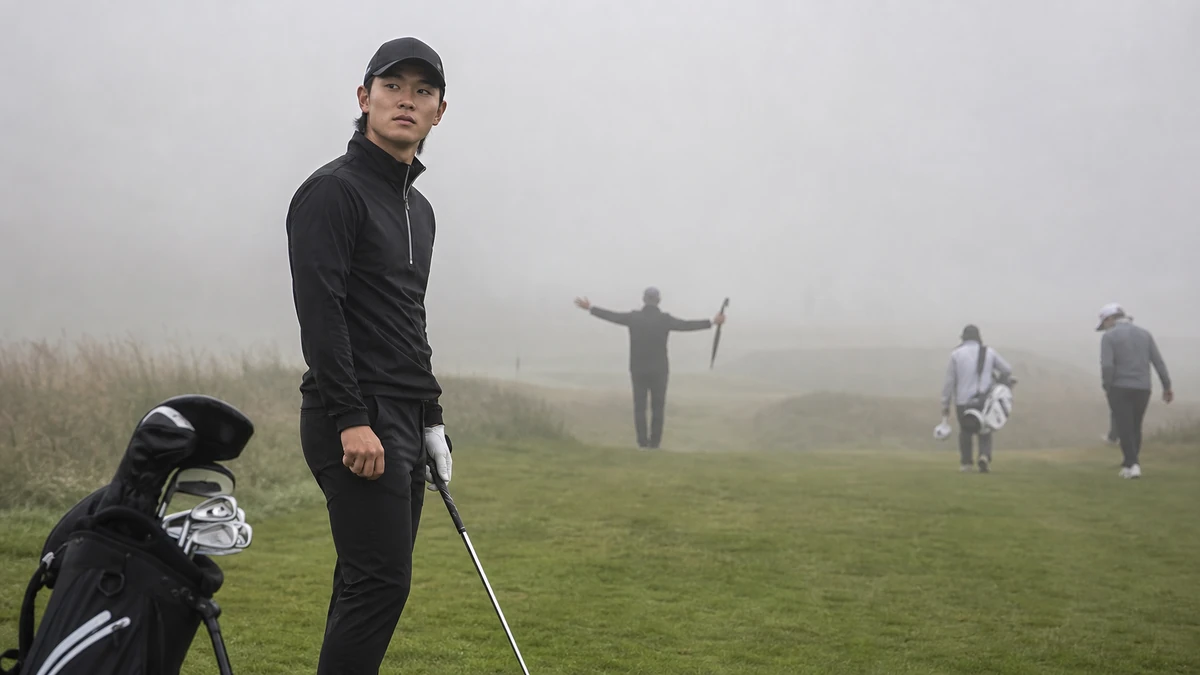
Tom Kim’s Saturday at the Genesis Scottish Open was the kind of sports story that can look more dramatic on a leaderboard than it really is on the course. The South Korean star began the third round tied for the lead, then saw his name slide into a tie for ninth after heavy fog at The Renaissance Club in North Berwick, Scotland, brought play to a halt. On paper, that sounds like a stumble. In context, it is anything but.
When the round was suspended because of dense fog, Kim was 9-under for the tournament through seven holes of his third round. He had not made a birdie, but he also had not given shots away. That left him only two strokes behind co-leaders Matt Fitzpatrick of England and Michael Thorbjornsen of the United States, who reached 11-under. In a tournament packed tightly at the top, that gap is small enough to vanish in a hole or two.
For American sports fans used to following suspended baseball games, rain-delayed NFL kickoffs or weather-affected rounds at events like The Players Championship, the key distinction here is simple: Kim’s position on the board changed faster than his actual standing in the competition. Other players finished more holes and posted lower numbers while Kim was still stuck in an unfinished round. In golf, especially in an event interrupted by weather, ranking and reality are not always the same thing.
The Scottish Open, co-sanctioned by the PGA Tour and DP World Tour, is more than another stop on the summer calendar. It is one of the final major tuneups before the British Open, and it draws an international field to links-style conditions that test patience as much as power. That made Saturday’s interruption especially notable. Fog did not just delay play. It froze an evolving contest in mid-scene, leaving Kim’s week suspended between momentum and uncertainty.
For now, the most important number is not his place on the leaderboard. It is the two-shot deficit. Kim remains close enough that the tournament can still turn on his remaining holes in the third round, not just whatever happens on Sunday.
Why Tom Kim matters to American readers
Kim, known in Korea as Kim Joo-hyung, has become one of the most recognizable young South Korean athletes on the global stage. American golf fans know him as one of the sport’s brightest rising figures: charismatic, emotional and unafraid of pressure. Still only in his early 20s, he has already built a profile that stretches well beyond golf diehards, thanks to multiple PGA Tour victories, Presidents Cup appearances and a style that feels more modern than reserved.
That matters because South Korea’s sports export machine has often been discussed in terms of established icons: figure skater Yuna Kim, soccer star Son Heung-min or the global dominance of K-pop groups like BTS and Blackpink. In golf, the country has long produced elite women players, from Pak Se-ri to Inbee Park and Jin Young Ko, whose success helped make South Korea one of the sport’s most important pipelines. On the men’s side, however, the breakthrough stories have been less frequent and often more closely watched at home.
Kim represents a new kind of Korean sports celebrity: globally fluent, commercially appealing and immediately legible to fans in the United States, Britain and Asia alike. He is part of a generation of Korean athletes who move comfortably in international media spaces while still carrying the expectations of a sports culture that pays close attention to national representation abroad.
That last point can be easy for American audiences to miss. In South Korea, the performances of athletes competing overseas are often covered not just as personal achievements but also as markers of the country’s place in global sports. When a Korean player contends at a PGA Tour event in Scotland one week before the British Open, it resonates beyond golf circles. It becomes part of a larger national conversation about excellence, visibility and pride.
So while Saturday’s delay may read as a routine tournament update in the United States, it lands differently in Korea, where Kim’s progress is followed with the intensity Americans might reserve for a young NBA star making a playoff run or a U.S. tennis player surviving the second week at Wimbledon.
From co-leader to tied for ninth: the math behind the movement
The most misleading part of Saturday’s story is the drop from tied for first to tied for ninth. In many sports, that kind of fall suggests a major mistake, a collapse or at least a damaging stretch of play. Here, it mostly reflected how compressed the leaderboard had become and how unevenly the third round unfolded once the fog interrupted the schedule.
Kim entered the day tied with Rory McIlroy, one of the biggest names in the sport and a player Americans know as a perennial major contender. Through seven holes, Kim stayed at 9-under overall. That was enough to keep him in striking distance, but it was not enough to hold off movement from others in the field who had a chance to play further into their rounds before the stoppage.
Fitzpatrick, the former U.S. Open champion, and Thorbjornsen, one of the promising young Americans trying to establish himself at the highest level, moved to 11-under and into a share of the lead. Because so many players were clustered near the top, a difference of one or two strokes created a large swing in listed position. Golf fans see this often at crowded tournaments: the leaderboard can look volatile even when the actual separation between players is minimal.
That volatility was underscored by McIlroy’s day. He played eight holes and made three bogeys, falling to 6-under and sliding all the way into a tie for 25th. Compared with that, Kim’s start was quietly solid. He did not push forward, but he also avoided the kind of damage that can destroy a weekend.
There is a lesson in that contrast. In elite golf, especially under difficult conditions, survival can be as valuable as aggression. American viewers who have watched U.S. Opens at Oakmont or Shinnecock Hills know the pattern well: the player who keeps the card clean while others leak shots is often better positioned than someone whose round looks flat in the moment. Kim’s seven-hole stretch did not offer fireworks, but it preserved possibility.
And because his round remains unfinished, the tie for ninth is not a final verdict on the third round. It is a snapshot taken before the scene is over.
Fog, links golf and the challenge of rhythm
If there was a dominant force in the third round, it was not a golfer. It was the weather. Scotland’s coastal courses are famous for conditions that can make even top professionals look uncertain. Wind is usually the main character in links golf, but fog can be just as disruptive, especially when visibility drops to the point that safe and fair competition becomes impossible.
The Renaissance Club sits in East Lothian, a stretch of Scottish coastline known for historic golf and shifting weather. For American readers, think of it as a place where the environment is not background scenery but an active participant. One minute the setting looks postcard-perfect. The next, the course can become a test of patience, adaptability and nerve.
Dense fog affects more than scheduling. It breaks competitive rhythm. Golfers prepare for rounds with carefully calibrated routines: warm-ups, yardage plans, mental pacing, even meal timing. A mid-round stoppage forces players to shut that process down and then try to restart it later, sometimes the next day, with the same level of feel and concentration they had before.
That can be particularly tricky for players who were either building momentum or trying to recover from a slow start. Kim’s case sits somewhere in between. He was not making a charge when play stopped, but neither was he unraveling. The interruption denied him a chance to turn a steady beginning into something more aggressive over the remaining 11 holes. At the same time, it may have spared players from pressing too hard in poor conditions.
Because weather delays leave players at different points in their rounds, the leaderboard becomes harder to interpret. Some players have more chances left to gain ground. Others have already posted numbers and can only wait. That is why Kim’s seven completed holes matter as much as his score. He still has more than half of the third round left to play, which means his Saturday effectively remains unfinished business.
For broadcasters and fans, that creates a different kind of tension. Instead of moving cleanly from the third round into Sunday storylines, the tournament resumes with the middle chapter still incomplete. It is less a sprint to the finish than a race interrupted by a red light.
What the leaderboard says about Sunday’s possibilities
The suspended round leaves the Scottish Open in a wide-open state. Fitzpatrick and Thorbjornsen share the lead at 11-under, but neither has separated from the pack. Kim sits at 9-under with 11 holes left in his third round, close enough that a brief hot stretch could put him right back in the center of the tournament.
That matters because golf leaderboards can flip quickly when a player still has so much course left in front of him. A pair of birdies would erase the deficit. Even one timely birdie before the round ends could dramatically shift the conversation heading into the final round. In other words, Kim does not need a miracle. He needs a productive finish to a round that, due to fog, is being played in installments.
The larger field adds intrigue. Fitzpatrick is a proven contender who has won on big stages and knows how to manage pressure. Thorbjornsen represents an American storyline worth watching, a young player trying to translate promise into a breakthrough on an international stage. McIlroy, though he slipped badly early in the round, remains the kind of player who can produce a burst that changes the entire event if conditions allow.
Kim’s advantage is that he has already shown through two rounds that he belongs at the top of this leaderboard. Getting to co-leader status was not accidental. It reflected the quality of his ball-striking, his comfort in a strong field and his ability to navigate a course designed to expose impatience. Those things do not disappear because of seven par holes and a weather stoppage.
For American audiences looking ahead to the British Open, this is also a revealing test. The Scottish Open often functions like a dress rehearsal for links golf’s biggest week. A player who stays poised through weather delays, uneven momentum and a crowded leaderboard is showing more than scoring ability. He is showing the kind of temperament that matters at Royal Portrush, St. Andrews or any other major venue where conditions can shift by the hour.
Kim’s weekend, then, is not just about whether he wins this event. It is also about the kind of signal he sends before the sport’s oldest championship.
A Korean star carrying expectations beyond the fairways
In South Korea, Kim’s position on this leaderboard carries an emotional weight that can be hard to replicate in the United States unless a country feels underrepresented in a sport. Golf is deeply followed in Korea, but public attention often spikes when a Korean player contends in a major international event. The focus becomes collective, not merely individual.
That cultural context helps explain why the distinction between “tied for ninth” and “two shots back” matters so much. Korean sports coverage, particularly around athletes overseas, tends to track momentum in granular detail. A rank drop can sound alarming. But fans who understand golf, and particularly a weather-interrupted golf tournament, know that a suspended round requires a more careful reading.
Kim’s ability to hold 9-under through the interruption may ultimately prove just as important as the birdies he did not make. In Korean sports culture, there is a strong appreciation for grit, discipline and the ability to withstand pressure without visible panic. Those qualities are often praised with as much enthusiasm as explosive success. A stable stretch in difficult conditions is not always glamorous, but it can fit that narrative of resilience.
For Korean golf fans, there is another layer as well: continuity. Kim’s emergence suggests that South Korea’s place in world golf is not confined to one generation or one side of the sport. While the nation’s women players have long driven the strongest success stories, Kim offers men’s golf a new focal point, one with the talent and personality to attract a broader global following.
American audiences have seen similar effects when a single athlete becomes a bridge between sports communities. Think of Ichiro Suzuki expanding Major League Baseball’s relationship with Japanese fans or Yao Ming deepening the NBA’s connection to China. Kim is not on that scale globally, but he is becoming a meaningful connector between Korean sports culture and the international golf audience.
The real test comes when play resumes
When the Scottish Open resumes, the question will not be whether Kim can reclaim the optics of being tied for the lead. It will be whether he can turn a paused round into a renewed push. He returns with 11 holes left in the third round, a two-shot gap to the leaders and a tournament that remains highly unsettled.
That is a far more encouraging setup than the ranking alone suggests. He has not played himself out of contention. He has not handed away strokes. He is still within a range where one strong sequence can reshape the weekend. In golf terms, he remains very much in the fight.
There is also a psychological opening here. After a stoppage, the feel of a round often resets. Players who were fading can regroup. Players who were surging can cool off. The next stretch becomes less about what happened before the horn and more about who can adapt fastest when the round restarts. Kim, who has built a reputation for energy and emotional steadiness, may be well suited to that kind of reset.
For fans in the United States, this is the kind of international sports story that rewards a closer look. It is not simply about a player from South Korea slipping down a European leaderboard. It is about a young global star navigating one of golf’s most unpredictable environments, with a genuine chance to reassert himself before the final round.
For fans in Korea, it is a moment of suspended anticipation. The fog may have halted play, but it did not settle the outcome. Kim’s tournament is still alive, still close and still capable of turning quickly. In a crowded Scottish Open defined by weather and volatility, that may be the most important fact of all.
Comments
Post a Comment