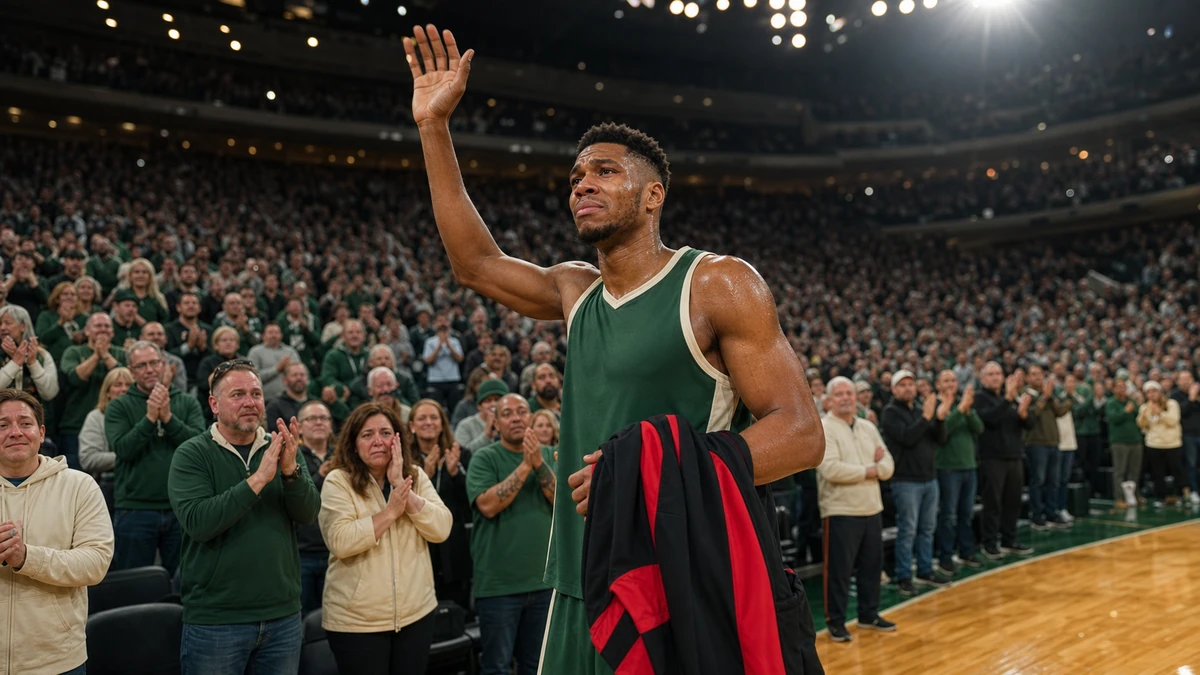
A franchise cornerstone closes a defining chapter
Giannis Antetokounmpo, the player who came to embody the Milwaukee Bucks for more than a decade, has delivered an emotional farewell to the city and fan base he helped transform, after his trade to the Miami Heat became official under NBA rules.
In a social media video released as the deal was finalized, Antetokounmpo described Milwaukee not simply as the place where he played professional basketball, but as home. He said the city is where his children were born and where he became the person he is today, a message that landed with unusual force because it spoke to something deeper than the usual churn of modern sports transactions.
For American sports fans, there is a familiar rhythm to star departures. LeBron James leaving Cleveland the first time, Derek Jeter retiring in New York, Tom Brady eventually parting ways with New England — those moments resonate because they mark the end of an era, not just the movement of talent. Antetokounmpo’s exit from Milwaukee belongs in that category. This is not a case of a productive veteran changing teams in the late stages of a career. It is the departure of the player most closely associated with the Bucks’ modern identity, a superstar whose rise was intertwined with the city’s own sense of pride and relevance on the national stage.
According to the terms outlined in the Korean report, Milwaukee is sending Antetokounmpo and Bobby Portis to Miami in exchange for Tyler Herro, three additional players and four draft picks. The framework of the trade had reportedly been agreed to last month, but it only became official on the date allowed by league procedures. That distinction matters in the NBA, where fans often hear about deals well before they can be formally completed. Until the paperwork is finalized and league rules are satisfied, a blockbuster trade exists in a kind of suspended reality — widely discussed, heavily analyzed, but not yet real in the official sense.
Now it is real. And with that, one of the NBA’s most meaningful long-term partnerships — a superstar and a small-market franchise growing together — has come to an end.
Why Milwaukee’s reaction is about more than basketball
Milwaukee is not Los Angeles or New York. It does not naturally command the sports spotlight in the way the country’s largest media markets do. That is part of why Antetokounmpo’s connection to the city became so powerful. In many American sports towns outside the glamour markets, fans do not just root for stars; they invest them with civic meaning. A player who stays, commits and wins becomes part of the city’s story.
That is what happened with Antetokounmpo. Drafted by the Bucks in 2013, he spent 13 seasons wearing one uniform. In today’s NBA, where player movement is constant and roster turnover can feel relentless, that kind of continuity carries emotional weight. Fans watched him grow from a young international prospect into one of the league’s defining stars. They watched him evolve physically, technically and emotionally. They watched him become a champion. And because he did all of that in Milwaukee, he became something more than an elite player: he became a symbol of what the Bucks could be.
When Antetokounmpo said, “Milwaukee is my home,” he was speaking a language American sports fans understand immediately. Cities often attach themselves to athletes who appear to return that affection sincerely. It matters when a player talks about family, roots and belonging. It matters when he frames a city not as a stop on a career path but as the place that shaped him.
That kind of bond is especially meaningful in the Midwest, where sports identity is often woven tightly into local identity. In cities like Milwaukee, Green Bay, Cleveland or Indianapolis, loyalty remains a prized virtue. Fans tend to remember not only championships but commitment: who embraced the city, who stayed through difficult seasons, who seemed to understand what the place meant to its people. Antetokounmpo did that for Milwaukee. His farewell hurts because it feels personal, even if everyone involved understands that professional sports is also a business.
That tension — between emotion and calculation — is what gives this story its power. On paper, the trade is about assets, roster construction and competitive timelines. In reality, for many fans, it is also about saying goodbye to the face of a generation.
The numbers tell one story. The 2021 title tells another.
Antetokounmpo’s Milwaukee resume is impressive on its own terms. Over 13 seasons with the Bucks, he averaged 24.1 points, 9.9 rebounds, 5.0 assists, 1.2 blocks and 1.1 steals per game, according to the report. Those figures capture the range of his game. He was not simply a scorer or rebounder, not merely a defensive presence or transition force. He was the player through whom multiple phases of the game flowed.
For readers who may not follow basketball closely, those statistics help explain why his departure is so significant. Nearly 24 points per game marks him as a primary offensive engine. Nearly 10 rebounds per game underscore his presence around the basket. Five assists per game show he was not just finishing plays but creating them. Add in blocks and steals, and the picture is of a player who influenced almost every possession. In sports talk-radio shorthand, this is what Americans mean when they say a player “does it all.”
But statistics, while important, do not fully explain Antetokounmpo’s place in Milwaukee history. The deeper source of his symbolism is the 2021 championship. In American sports culture, titles are memory-making machines. They become shorthand for entire eras. Fans do not just remember the standings or the averages; they remember where they were when the confetti fell, whom they hugged, which call they heard on television or radio, what it felt like to believe their team had finally reached the top.
That championship changed Antetokounmpo’s standing permanently. Plenty of stars put up gaudy numbers. Fewer deliver a title. In a city like Milwaukee, a championship does more than validate talent — it binds the athlete to the community in a durable way. The player is no longer just excellent; he becomes part of the local mythology.
That helps explain why his goodbye has felt different. A star can leave and still be respected. A champion who delivered one of the biggest moments in franchise history leaves behind something closer to shared memory. His story is woven into weddings, family gatherings, neighborhood bar conversations and the small rituals by which sports fandom becomes intergenerational. Parents who watched the title run will tell those stories to children who were too young to understand it in real time. Antetokounmpo’s legacy in Milwaukee is secure because it is attached not just to production, but to joy.
What Miami is getting in a player of rare scale and versatility
For the Heat, this trade is as much about identity as it is about talent. Miami is acquiring one of the league’s most recognizable and decorated frontcourt stars, a player whose size, athleticism and all-around game make him a franchise-altering presence. The report describes him as a “big man,” which in basketball language refers to a player with the size and physical profile to dominate near the basket, protect the rim and control interior play. In the modern NBA, however, Antetokounmpo’s value extends far beyond traditional big-man duties. He can attack off the dribble, create for teammates and impact both ends of the floor.
That kind of versatility is rare, and it is one reason his movement resonates beyond the United States. Antetokounmpo, who is Greek, has long represented the global character of the NBA. The league may be American, but it increasingly functions as an international entertainment product and cultural ecosystem. Fans in Seoul, Athens, Lagos and Manila can all see themselves reflected in the stories of players who arrived from elsewhere and became stars on the sport’s biggest stage.
Miami, meanwhile, is one of the NBA’s most recognizable brands, a franchise that has often blended glamour with discipline. For many Americans, the Heat evoke a specific image: a team associated with star power, pressure and the expectation of contention. Adding a player of Antetokounmpo’s stature fits squarely within that identity. It gives Miami not just elite production, but a new focal point, the kind of player around whom a championship argument can be built.
That said, it is important not to overstate what can be known before games are played. The Korean report is careful on this point, and so should any responsible account be. It is fair to say Miami has acquired a massive name and a proven body of work. It is not yet possible to say exactly how his role will look, how quickly chemistry will develop or whether the trade will deliver the sort of postseason success fans inevitably imagine when a blockbuster lands.
Still, in a league driven by stars, there are only a handful of moves each year that genuinely shift the emotional geography of the NBA. This is one of them.
What Milwaukee receives, and why draft picks matter so much
From Milwaukee’s perspective, the return underscores the scale of what it took to move a player of Antetokounmpo’s stature. The Bucks receive Tyler Herro, three additional players and four draft picks. Even without every player named in the source material, the structure alone tells a clear story: Milwaukee did not simply exchange one star for another. It chose a package that mixes immediate roster help with future flexibility.
For readers less familiar with the NBA, draft picks can sound abstract compared with recognizable players. But in American basketball, they are among the most valuable forms of long-term capital. A draft pick is not just the right to select an incoming player. It is also a tool for future trades, roster planning and financial management. In the broadest sense, draft picks represent possibility. They allow a team to rebuild, reload or reposition itself depending on how the next few seasons unfold.
The inclusion of four picks signals that Milwaukee is not treating this as a small adjustment. This is a major reset of assets, even if the franchise is not necessarily entering a full teardown. In practical terms, the Bucks are giving up certainty — they know exactly what Antetokounmpo has been — in exchange for a blend of present contributors and future opportunities. That is always a difficult trade-off, particularly when the player leaving is the one fans most identify with the franchise.
Herro’s arrival will draw significant attention because he is the most prominent incoming name mentioned in the report. But the broader point is structural. Milwaukee appears to be trying to create a new balance after an era built around one overwhelming centerpiece. That does not mean replacing Antetokounmpo one-for-one, which would be impossible in the emotional sense and difficult in the basketball sense. It means redistributing value across multiple roster spots while expanding the team’s options down the line.
American front offices often speak about “the next chapter” when moving on from a franchise icon. That phrase can sound cold to fans in the first shock of a trade. But it is often an accurate description of how teams think. Windows open and close. Rosters age. Cap structures tighten. Managers look for ways to keep an organization viable after the peak years of a particular core. This trade, as described, suggests Milwaukee is confronting exactly that kind of pivot.
The timing of the official deal matters in sports journalism
One of the subtler but important parts of this story is the timing. The trade was reportedly agreed upon last month, but it only became official on the date permitted by NBA regulations. To casual fans, that may sound like a technicality. In journalism, it is not.
American sports coverage often distinguishes sharply between an agreement in principle, a reported deal and an officially completed transaction. Those are not interchangeable terms. A reported agreement may be highly reliable, but the formal status of a move still matters because league rules govern when teams can finalize trades, register contracts and announce completed transactions. That is why the official date becomes the true news peg — the moment on which the story can be framed as completed rather than pending.
This distinction is especially important in a global media environment, where NBA stories are consumed across time zones, languages and news cycles. A Korean reader encountering this news, for instance, is reading about an American sports league through Korean time notation and reporting conventions. An American audience, by contrast, may focus more instinctively on the procedural milestones of league business. Translating the significance of the timing for an English-speaking audience means explaining not just that the trade happened, but why it became formally reportable now.
That is also why Antetokounmpo’s farewell message hit when it did. Athletes often wait until transactions are official before making public comments, even if the likely outcome has been known for weeks. Doing so avoids awkward reversals and respects the reality that, in professional sports, a deal is only a deal once the league says it is.
In other words, the emotional closure and the bureaucratic closure arrived together. That coincidence gave the story its full force: the transaction was finalized, and the face of the franchise spoke directly to fans at the same moment the separation became irreversible.
A global sports story with a distinctly local ache
There is a reason this story traveled from American basketball into Korean news coverage and, from there, into broader international conversation. It contains all the elements that make sports legible across cultures: a beloved star, a loyal city, a career-defining run, a championship memory and a sudden turn toward a new future. You do not need to be from Wisconsin, or even from the United States, to understand what it means when a hometown hero says goodbye.
At the same time, the emotional core of this story is intensely local. Milwaukee fans will remember the specifics — the seasons, the playoff runs, the way Antetokounmpo represented the city nationally, the feeling that the Bucks had a player who belonged to them in more than a contractual sense. American sports culture places enormous weight on these bonds, especially in cities that often feel overlooked by coastal media attention. When a star embraces such a city and then wins there, the relationship becomes unusually resilient.
That is why fans are likely to remember both the numbers and the words. The statistics establish greatness. The championship confirms legacy. But the phrase “Milwaukee is my home” is what makes the departure human. It reminds fans that, for all the money and business logic involved, sports still derives much of its power from attachment — to place, to memory and to the idea that a team can stand in for a community’s emotional life.
For Miami, the future begins with enormous promise and equally enormous scrutiny. For Milwaukee, the challenge is different. It must figure out how to honor what Antetokounmpo meant while moving forward without the player who defined the franchise’s recent era. That is never easy, and it rarely happens without grief.
But if this goodbye says anything, it is that the connection between Antetokounmpo and Milwaukee is not erased by a trade. In American sports, certain relationships survive the transactions that end them. They remain part of the local civic story, replayed in highlight packages, remembered in bars and living rooms, invoked whenever fans talk about the players who truly mattered.
Antetokounmpo now opens a new chapter in Miami. Milwaukee, meanwhile, begins the difficult work of imagining itself after Giannis. The trade is official. The era is over. The memory, however, is unlikely to fade anytime soon.
Comments
Post a Comment