
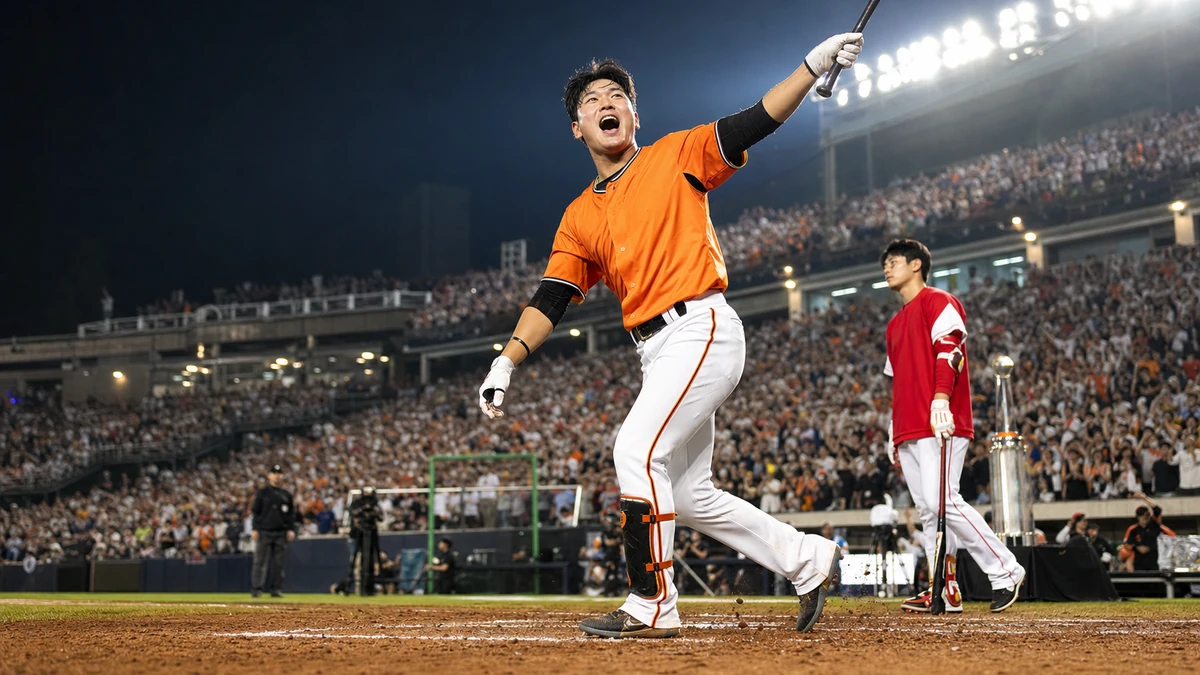
A slugfest under the lights in Seoul
SEOUL — On a summer night at Jamsil Baseball Stadium, one of South Korea’s most recognizable sports stages turned into something familiar to American baseball fans: part All-Star showcase, part county-fair power display, part pressure-cooker theater. By the end of it, Kang Baek-ho — one of the Korean Baseball Organization’s best-known sluggers — had claimed his first KBO All-Star Home Run Derby title, beating SSG Landers veteran Oh Tae-gon in an extra round that gave the event the kind of finish television producers dream about.
The victory came Thursday during the eve-of-game festivities for the 2026 Shinhan SOL Bank KBO All-Star Game, an annual midsummer celebration that serves a role in South Korea similar to Major League Baseball’s All-Star week in the United States. There are differences in style, pacing and local fan culture, but the appeal is instantly legible to anyone who has watched a Derby in the U.S.: towering drives, rapid-fire swings, crowd noise building with every deep fly, and the tension that comes when a format built for fun suddenly becomes fiercely competitive.
According to the Korean news agency Yonhap, Kang outlasted Oh in the final after regulation swings were not enough to separate them. That detail mattered as much as the trophy itself. Home run derbies are often described as exhibitions, but when the outcome comes down to an extra round, the event stops feeling like a scripted festival and starts looking like a real test of poise. Every participant has power. The winner is usually the hitter who can stay mechanically sound while adrenaline spikes and fatigue sets in.
Kang did more than win. He also produced the night’s longest home run at 145 meters, or roughly 476 feet, a distance that would draw gasps in any ballpark from Los Angeles to New York. In the process, he swept both the headline result and the most visceral one. Fans may remember the trophy, but they are just as likely to remember the ball that seemed to hang forever before disappearing deep into the Seoul night.
For a Korean baseball audience, Kang’s first Derby crown adds a fresh line to the resume of a player already associated with impact hitting. For American readers less familiar with the KBO, the moment offered a useful window into what makes South Korean baseball distinctive: polished spectacle, emotionally engaged crowds, and an All-Star culture where celebration and serious competition coexist without apology.
Why this mattered beyond an exhibition
In baseball, the phrase “first title” can sound routine. It rarely is. Kang’s victory was his first in the KBO’s All-Star Home Run Derby, and that carries a particular kind of status. A player can be known as a dangerous hitter in regular-season games and still never win a Derby. The skills overlap, but they are not identical. Game power is about timing, pitch recognition and situational hitting. Derby power is about repeating the same explosive swing again and again with almost no margin for mental drift.
That distinction helps explain why Thursday’s result landed as more than a side note. Kang was not simply the best hitter over a long season or even the hottest slugger for one night. He was the player who best handled a format designed to magnify pressure in short bursts. Unlike a regular game, where a batter can reset between plate appearances, a Derby demands immediate rhythm. A mistimed swing or two can disrupt momentum. A hitter pressing for distance can lose control of the barrel. And when the final goes to extras, the challenge becomes as psychological as it is physical.
Oh, Kang’s opponent in the final, made sure there would be no easy coronation. The fact that regulation ended without a winner captured the closeness of the contest better than any adjective could. In a Derby, ties do not just reflect equal power. They reflect equal composure. Oh forced Kang to keep answering, extending the suspense and turning the final into the kind of duel that elevates an event from entertaining to memorable.
That dynamic is part of what the KBO’s All-Star weekend tries to offer. Like its American counterpart, it is a break from the grind of the season, a chance for fans to enjoy stars outside the usual win-loss stakes. But Korean sports festivals, especially baseball events, often lean harder into the fusion of ceremony, fan service and true competitive ambition. The result is not a contradiction. It is the point. Players smile, wave, participate in themed festivities — and then, when the contest begins, they plainly want to win.
For Kang, winning his first Derby in that environment likely means more than the prize list suggests. The trophy confirms not just raw strength but a kind of stage command. He became, for one night, the face of the event rather than merely one of its attractions.
The 145-meter shot and the universal language of power
If there is one sports image that translates instantly across borders, it is a baseball launched an improbable distance. Fans do not need to know Korean, the KBO standings or the details of the event format to understand what a 145-meter home run means. The arc, the crowd reaction and the sheer violence of contact tell the story on their own.
Kang’s longest drive traveled 145 meters, a mark that put him first in the distance category and underscored why he was the defining hitter of the night. In American terms, that is about 476 feet — the kind of blast that gets replayed on highlight shows, dissected by announcers and measured against the dimensions of famous parks. It is long enough that fans instinctively begin comparing it to Derby moonshots at Coors Field or batting-practice displays by MLB sluggers.
Distance in a Home Run Derby is not the same as total dominance, but it carries a special symbolic weight. The Derby is, in many ways, baseball reduced to its most cinematic act. You are not just trying to win; you are trying to produce moments. The farthest ball becomes a shorthand for the night’s mythology. It is the swing people describe later to friends who were not there.
That Kang paired the longest home run with the overall title made the performance feel complete. He was not a one-swing wonder who briefly stole the spotlight before fading. He had the biggest shot and the staying power. In a contest where a single blast can swing momentum but consistency still matters, that combination made him the clear centerpiece.
There is also a broader reason Korean baseball officials and broadcasters like to highlight distance. It gives casual fans, including international audiences, an easy entry point. Statistics can be contextual. Batting averages and OPS require background. But “the ball traveled 145 meters” needs little translation. It is spectacle as data, and data as spectacle.
Kang’s reward reflected that dual achievement. In addition to the 10 million won winner’s prize — about several thousand U.S. dollars at current exchange rates — he received home appliances tied to the event’s sponsors, including a Bespoke AI AirDresser for winning the Derby and an LG PuriCare air purifier for recording the longest home run. To American readers, that mix of cash and branded consumer goods may sound quirky, but it is a familiar feature of South Korean promotional culture, where major sporting events often intertwine competition with highly visible corporate sponsorships.
The teammate behind the swings
One of the more revealing details of Kang’s night involved a player who was not the one driving the ball out of the park. Han Jun-su of the KIA Tigers served as the batting pitcher, throwing the tosses Kang would try to turn into home runs. In the box score of memory, the slugger gets the glory. But anyone who has watched a Derby closely knows the pitcher-to-hitter connection can shape the entire event.
This is true in the United States and true in South Korea. The Derby looks simple from the stands: lob the ball, swing hard, repeat. In practice, it depends on fine calibration. The hitter wants the ball at a preferred height, pace and location, time after time. The batting pitcher must supply a rhythm that lets the slugger stay balanced without rushing. Too high, too low, too quick, too inconsistent — any of that can break the sequence and force the batter into adjustment mode.
That Kang and Han clicked so effectively mattered. Han, according to the event summary, was rewarded with a pair of Bose Ultra headphones, a small but notable acknowledgment that the Derby is not purely an individual showcase. It is collaborative performance hidden inside an individual award. The slugger’s name is on the trophy, but the setup man helps build the path there.
There is another dimension here that American readers may find especially interesting. Kang and Han do not play for the same club during the regular season. Kang suited up for the Hanwha Eagles in this All-Star setting, while Han is with the KIA Tigers. During the season, they are competitors in the same league ecosystem. At the All-Star festivities, they effectively became temporary teammates.
That temporary alliance reflects a hallmark of All-Star culture in Korea. These events are meant to soften normal rivalries just enough to let players create something entertaining together. The point is not to erase club loyalties but to suspend them for a night in service of a larger baseball festival. A hitter from one team and a helper from another joining forces for a title becomes part of the event’s charm. It highlights a collective spirit that is often central to Korean sports presentation, even inside an individual competition.
For fans, that matters because it changes how they read the event. They are not only watching who wins. They are watching relationships, chemistry and improvisation among players who are usually divided by uniform colors and pennant races. Kang’s victory, then, was also a small demonstration of how the KBO turns its All-Star week into a shared production.
What KBO All-Star culture looks like to American eyes
To understand why a Home Run Derby in Seoul can generate real buzz, it helps to understand the place baseball occupies in South Korea. The KBO is the country’s top professional baseball league and one of the most established sports institutions in Asia. While it does not command the same global visibility as MLB, it has a devoted domestic following, intensely loyal fan bases and a game-day atmosphere that many American visitors find more coordinated and more participatory than what they are used to at home.
Korean baseball crowds are known for organized cheering sections, fight songs, chants and percussion-driven support that can continue for innings at a time. At a venue like Jamsil Baseball Stadium in Seoul, the experience can feel closer to a hybrid of baseball and college football pageantry than the more subdued hum of a typical major league regular-season crowd in the U.S. That energy matters during a Derby, where each swing needs audience reaction to build drama.
The event Thursday took place as part of the All-Star Game eve celebration, the pregame festival before the main midsummer showcase. In American terms, think of the day before MLB’s All-Star Game, when fans settle in for the Home Run Derby and related events that can sometimes become as anticipated as the game itself. The KBO’s version works similarly, though with a distinctly Korean emphasis on sponsor integration, ceremonial presentation and fan engagement.
That blend was visible in the prizes, the staging and the framing of the contest as both entertainment and achievement. It was also visible in the role of KBO Commissioner Heo Gu-yeon, who presented Kang with the trophy afterward. Such presentations are common everywhere in sports, but in South Korea they often carry a formal polish that reinforces the sense that even exhibition events are part of the league’s official historical record.
There is a useful American parallel here. When Pete Alonso won multiple MLB Home Run Derby titles, the story was not just about practice-power swings in July. It was about a player building a separate All-Star identity, one connected to spectacle and fan memory. Kang’s first Derby crown occupies a similar lane. It adds a layer to how he is seen — not only as a dangerous hitter in games that count, but as a star capable of owning the league’s brightest exhibition stage.
And that matters in a country where baseball stars are public figures with broad recognition. KBO players do not merely perform for die-hard fans. The biggest names move through a wider entertainment and commercial ecosystem, making events like the Derby valuable as both sports competition and public branding opportunity.
A dramatic finish that says something about Korean baseball now
It would be easy to dismiss an All-Star Home Run Derby as a pleasant footnote in the middle of a long season. Thursday’s final suggested something bigger. Kang’s extra-round win over Oh showed why the KBO continues to build cultural momentum at home and draw curiosity abroad. The league understands that modern sports audiences want more than standings. They want moments.
This Derby produced several of them: a tense final that needed overtime, a first-time champion breaking through, a 145-meter blast that served as the night’s signature image, and a cross-team partnership that helped explain how these events function behind the scenes. None of that changes the pennant race. But it does shape the emotional texture of the season.
For Korean fans, the night likely reinforced Kang’s status as a marquee power hitter and gave Hanwha supporters another reason to celebrate one of their biggest stars. For neutral fans, it delivered what an All-Star festival should deliver — high-level skill stripped of regular-season caution and condensed into pure, easy-to-follow drama. For outsiders, especially American readers who may know Korea more through pop culture exports like K-pop, Korean dramas and Oscar-winning films, it was a reminder that the country’s sports culture is just as developed, stylized and compelling in its own way.
There is a larger Asian sports story here as well. Leagues across the region are increasingly aware that a great highlight can travel farther than a box score. A mammoth home run in Seoul can circulate globally within minutes, reaching fans who have never watched a KBO game. That does not automatically create international fandom, but it does create recognition. Recognition is how broader interest starts.
Kang’s performance was especially well suited to that kind of circulation because power is such a universal baseball currency. You do not need a primer on league history to appreciate a hitter surviving a tense extra round and then being revealed as the author of the longest drive of the night. In a media environment built on short clips and immediate reactions, the Derby gives leagues like the KBO a format tailor-made for export.
Still, for all the talk of global appeal, the event’s deepest meaning remained local. It happened in Jamsil, before Korean fans, within a Korean baseball tradition that prizes both showmanship and collective atmosphere. The cheers that followed Kang’s winning swings were not delivered for an international audience. They were for a home crowd that understands exactly what it means when a feared slugger finally captures a title that had eluded him.
By the time the ceremony arrived and Kang posed with the trophy after receiving it from the commissioner, the night’s narrative was already settled. He had not merely won a contest. He had seized the role of the evening’s central character. The cash prize, the sponsored appliances and the official photos all confirmed the result, but the real takeaway was simpler and more enduring: on one of Korean baseball’s biggest summer stages, Kang Baek-ho delivered the kind of pressure performance that makes exhibition sports feel, for a few electric minutes, every bit as meaningful as the games in the standings.
That is why this result resonated. It was festive without being frivolous, commercial without losing authenticity, and local in setting while universal in impact. For an American audience looking to understand why Korean baseball matters, Thursday’s Derby in Seoul offered a persuasive answer. Start with the extra-round drama. Stay for the 476-foot blast. And notice how a league often overshadowed internationally still knows exactly how to put on a show.


0 Comments