A city famous for speed is making room for a slower start
SEOUL — In a city better known for crowded subways, rapid-fire workdays and a culture that often prizes efficiency above all else, the Seoul city government is making an unusual pitch to residents: Slow down, step outside and treat the early morning as time to move your body.
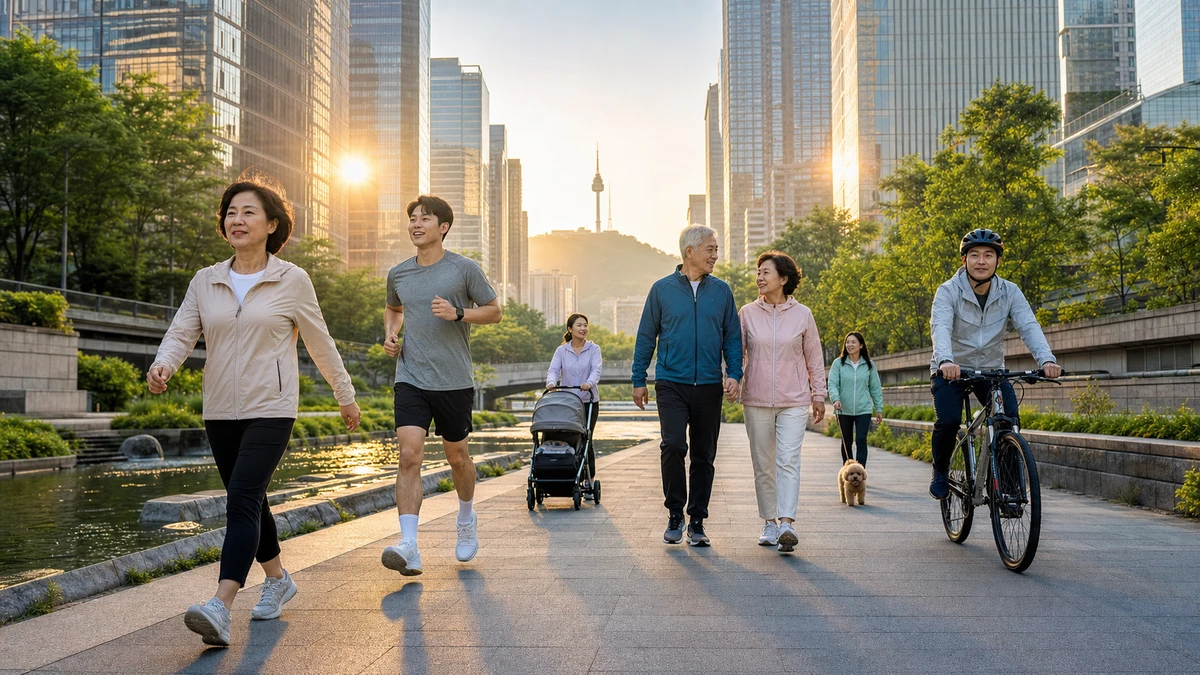
Starting this weekend, Seoul will resume the second-half schedule of its public morning exercise program, called “Swimyeom Swimyeom Morning,” or more naturally, “Take It Easy Morning.” The phrase “swimyeom swimyeom” in Korean suggests doing something at an unhurried, manageable pace — not lazily, but without strain. That idea is central to the program’s design. It is not a race series, a boot camp or a citywide challenge to log miles on a leaderboard. Instead, it invites people to walk, jog, bike, push a stroller or even bring a dog along on designated routes through central Seoul.
On the surface, the program may sound like one more municipal wellness event, the sort of initiative many big cities roll out with good intentions and mixed follow-through. But Seoul officials are presenting it as something broader: an experiment in turning ordinary urban space and ordinary daily routines into health infrastructure. In other words, rather than asking residents to carve out extra time, buy special gear or summon elite motivation, the city is trying to make exercise fit into the flow of everyday life.
That matters in Seoul, one of the world’s most densely populated and intensely scheduled capitals. It also resonates well beyond South Korea. From New York to Los Angeles to London, city dwellers face many of the same barriers to regular exercise: long commutes, desk jobs, fatigue, crowded schedules and the low-grade psychological hurdle of feeling like exercise has to be serious, sweaty and time-consuming to count. Seoul’s bet is that if you lower those barriers enough, more people will start moving — and keep moving.
The city said the morning program drew a strong response during its pilot operation earlier this year and will now move into more regular operation. That shift, from one-off event to recurring schedule, may be the most important detail. Public health experts have long known that habits are built not through occasional campaigns but through repetition, convenience and social acceptance. A city can host a flashy 10K and generate headlines. It takes something else entirely to make physical activity feel as routine as grabbing coffee on the way to work.
For American readers, the closest comparison may be the spread of “open streets” programs, car-free Sundays, park runs or local walking clubs that turn public space into a low-pressure venue for exercise. But Seoul’s framing is distinctly Korean in one respect: It is aimed at softening the burden of self-improvement in a society where pressure — academic, professional and social — often runs high. The message here is not that residents should train harder. It is that they should move more gently, more often and with less mental friction.
Why “take it easy” is the point, not a slogan
The most telling part of the program may be its name. In the United States, public fitness campaigns often lean on the language of goals, discipline and transformation: crush your step count, train for summer, no excuses. Seoul’s “Take It Easy Morning” moves in the opposite direction. It suggests that sustainable health may begin not with ambition, but with permission — permission to start small, to move at your own pace and to participate without performing.
That distinction is especially meaningful in South Korea, where health and appearance are often wrapped into a broader culture of self-management. Gym memberships, specialized diets, hiking culture and organized runs are all popular, particularly in urban areas. But those activities can carry their own social expectations. New exercisers may feel intimidated by fitness spaces or reluctant to join events that seem geared toward serious runners and cyclists.
By emphasizing participation over performance, Seoul is trying to redefine what counts as exercise in public life. A parent pushing a stroller is not treated as separate from a morning jogger. A resident walking a dog is not outside the frame of health activity. Someone who simply wants a brisk walk before work belongs on the route just as much as a recreational runner.
That broad invitation reflects a growing understanding in public health: The biggest gains often come not from turning active people into athletes, but from helping inactive or time-strapped people incorporate modest movement into daily routines. Walking, light jogging and casual cycling are not glamorous, but they are accessible. They do not require training plans or premium equipment. Done consistently, they can improve cardiovascular health, energy, sleep and mood.
In that sense, the program is almost an anti-fitness fitness initiative. It strips away the pressure that can keep people from starting in the first place. No one has to hit a target pace. No one has to look the part. No one has to pretend a weekday morning is the ideal moment for heroic self-reinvention. They just have to show up in comfortable clothes and move in a way that feels realistic.
That may sound modest, but modesty is exactly what makes the concept potentially durable. Behavioral science has repeatedly shown that when a habit feels too costly in time, effort or self-consciousness, people are less likely to stick with it. Seoul’s program appears designed around the opposite principle: Keep the threshold low enough that exercise stops feeling like an extra chore and starts feeling like a possible part of normal life.
How Seoul is reimagining the city itself as a health space
Perhaps the most interesting policy idea behind the program is not the activity itself, but the setting. “Take It Easy Morning” is built around courses in central Seoul, using the city’s streets, walking paths and open urban spaces as places for movement. That may seem obvious in a city that already has sidewalks and riverfront paths, but it signals a deeper shift in how local governments think about public health.
Traditionally, exercise is imagined as something that happens in designated facilities: gyms, stadiums, recreation centers, indoor tracks. Seoul is instead treating the urban landscape itself as a kind of health platform. If people already pass through these spaces on their way to work, school or errands, the thinking goes, then those same spaces can be used more deliberately to encourage activity.
For global cities, that is a practical response to a common problem. Urban residents often cite lack of time and lack of convenient space as the main reasons they do not work out. But time and space are closely connected. When exercise requires a separate trip, a fee, special clothing and a block of uninterrupted hours, it becomes easy to postpone. When the city integrates movement into ordinary routes and familiar locations, the burden drops considerably.
Seoul officials have said they plan to continue identifying additional downtown courses while taking operating results and seasonal conditions into account. That may sound like bureaucratic language, but it points to a real issue: outdoor exercise is highly sensitive to weather, safety and comfort. Seoul’s summers are humid and intense. Winters can be bitterly cold. The rainy season complicates everything from footing to attendance. A route that works beautifully in October may be unappealing or even unsafe in July.
In American terms, think of how differently a waterfront run feels in San Diego compared with one in Chicago in January, or how a family stroller walk changes when heat advisories are in effect. If cities want movement to become habitual, they have to design for real human conditions, not idealized ones. That means shade, accessibility, route clarity, convenience and flexibility matter just as much as motivational messaging.
Seoul’s effort also reflects a broader urban policy trend: treating public space as multifunctional. A sidewalk is not just for transit from point A to point B; it can also support health, sociability and quality of life. A riverside path is not merely scenic; it can function as an everyday wellness asset. In crowded cities, where land is limited and residents’ schedules are fragmented, that kind of dual use may be one of the most realistic ways to improve population health without building entirely new infrastructure.
The real target is not fitness enthusiasts. It is everyone else.
One reason the Seoul program stands out is that it does not appear to be built for people who are already deeply invested in exercise. Those people, after all, generally find ways to stay active. They join gyms, run with clubs, cycle on weekends or fit workouts into packed schedules because movement already has a place in their identity.
The harder public policy challenge is reaching people who want to be healthier but are held back by the ordinary pressures of life. That includes office workers who leave home early and come back late, older adults who want low-impact activity, caregivers whose schedules revolve around children and residents who feel out of place in formal fitness settings. By explicitly welcoming strollers and pets, Seoul is signaling that exercise does not have to be detached from caregiving or daily obligations. It can happen alongside them.
That inclusiveness may be especially significant in South Korea’s urban lifestyle. Seoul is a city where long work hours have historically been common, apartment living is the norm for many residents and public space is heavily shared. Family routines can be tightly coordinated, and free time may be scattered rather than abundant. In that context, a rigid model of fitness — drive to a gym, dedicate an hour, change clothes, shower, commute onward — can be unrealistic for large parts of the population.
For American readers, this is not entirely unfamiliar. Many U.S. cities are grappling with a similar rethinking of wellness, particularly after the pandemic pushed more people to walk neighborhoods, use parks and search for lower-pressure ways to stay active. The lesson many communities learned is that people are more likely to move when the activity feels socially normal, geographically close and financially accessible.
Seoul’s program also seems calibrated to reduce a subtler barrier: emotional resistance. Starting a new exercise habit can be psychologically expensive. People may worry that they are out of shape, too old, too busy or too inconsistent to “count” as someone who exercises. A program built around leisurely, repeatable movement offers a different entry point. It tells residents that the city values participation itself, not athletic achievement.
That message could be particularly powerful if the program remains visible and recurring. The more often residents see neighbors walking, jogging, biking or pushing strollers in a shared morning space, the more exercise becomes part of the social landscape rather than a private struggle. Public habits, after all, are contagious. People are more likely to do what looks normal around them.
What this says about Seoul’s changing view of public health
There is a larger policy story underneath the city’s announcement. Seoul is not presenting morning movement as a substitute for medical care, nor is it claiming that a few walks can solve complex health problems. But the initiative suggests a public-health philosophy that puts more weight on prevention and everyday maintenance rather than focusing only on treatment after problems arise.
That approach is increasingly important in aging, high-income societies where chronic conditions tied to inactivity, stress and sedentary work can place mounting pressure on health systems. It is also politically practical. Compared with major hospital expansions or expensive treatment programs, encouraging low-cost physical activity through public space can be relatively inexpensive while still producing broad benefits if participation is strong.
City official Kim Myung-joo, who oversees tourism and sports-related policy for Seoul, said the government would continue using spaces across the city to create environments where residents can enjoy morning exercise in everyday life without feeling burdened. The key phrase there is “without feeling burdened.” In many countries, public messaging about health can unintentionally pile one more obligation onto already overwhelmed people. Seoul appears to be trying to do the opposite: frame exercise as relief rather than duty.
That is not just a matter of tone. It reflects a deeper understanding of how habits form. Grand resolutions can spark interest, but low-friction routines are what last. If the city can make regular movement feel nearby, familiar and forgiving, it may improve the odds that residents keep coming back after the novelty wears off.
There is also a symbolic element. Seoul is often portrayed abroad as hypermodern, hyperconnected and relentlessly fast — a capital of K-pop, advanced transit, digital convenience and around-the-clock activity. All of that is true. But this program presents a different image of the city: one that makes room for a slower rhythm inside the machinery of urban life. That may be part of why the initiative is easy for international audiences to understand. Almost every major city is wrestling with the same contradiction — how to make life efficient without making it physically stagnant.
Whether Seoul’s approach becomes a model will depend on details that are not yet fully public, including route design, turnout, weather adaptations and long-term participation. Still, the concept itself is noteworthy. It recognizes that health behavior is shaped not just by individual willpower, but by the built environment, social norms and the texture of daily life.
Why a local Seoul program has a global lesson
For readers outside South Korea, especially in the United States, the most useful takeaway may be surprisingly simple: good public health policy does not always begin with sophisticated technology or major spending. Sometimes it begins by asking a practical question. What if the path people already use could also become the place where they start taking care of themselves?
That is the quiet ambition of Seoul’s “Take It Easy Morning.” It is trying to turn the city’s ordinary morning pathways into a soft on-ramp for healthier living. Not everyone will run. Not everyone will bike. Some will just walk. Some will come with children. Some will come with dogs. Some may show up once and never return. But if enough residents discover that exercise can be woven into the day rather than bolted awkwardly onto it, the program may succeed on its own terms.
There is a tendency in modern wellness culture — in Korea, in America and nearly everywhere else — to make health feel complicated, branded and expensive. Seoul’s new push suggests another possibility. A city can encourage movement by lowering the emotional and logistical stakes. It can tell people that short, repeatable, unglamorous activity still matters. It can treat public space as a partner in prevention. And it can recognize that the first challenge for many adults is not maximizing performance. It is simply getting started.
That may be the clearest reason this story is worth watching. Seoul is not merely scheduling another civic event. It is testing whether a major metropolis can reshape its culture, one morning at a time, by making exercise feel less like an ordeal and more like a normal way to begin the day. In a world full of tired workers, crowded cities and public-health systems searching for preventative answers, that is not just a local experiment. It is a question many places may soon be asking for themselves.
Comments
Post a Comment