20,000 Participate in '927 Climate Justice March' in Downtown Seoul as Youth-Citizen Solidarity Expands
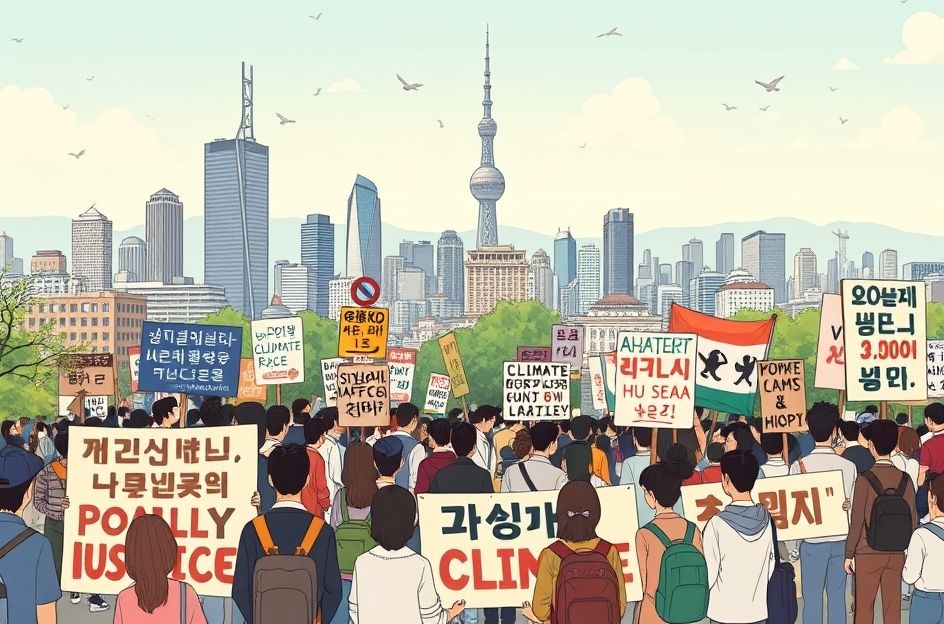
20,000 Participate in '927 Climate Justice March' in Downtown Seoul: Youth-Led Coalition Demands Aggressive Carbon Neutrality Measures and Just Transition Policies
On the afternoon of September 27, 2025, a large-scale climate justice demonstration drew approximately 20,000 participants according to organizer estimates through downtown Seoul's historic protest route from Seoul Plaza adjacent to City Hall, proceeding northward through Gwanghwamun Square where massive candlelight demonstrations overthrew President Park Geun-hye in 2016-2017, past the relocated Presidential Office in Yongsan District, and concluding at National Assembly complex in Yeouido—roughly 5-kilometer march route intentionally designed to symbolically connect three branches of Korean government (executive, legislative, and municipal) while demonstrating protesters' determination to physically occupy public spaces demanding policy responses to climate emergency that scientific consensus increasingly characterizes as requiring immediate transformative action to avoid catastrophic warming scenarios exceeding 2°C above pre-industrial baseline temperatures.
The march, titled "927 Climate Justice March" referencing September 27th date that organizers selected to coincide with United Nations General Assembly climate week when international attention focuses on climate policy discussions among world leaders, represented coordinated action across 42 civil society organizations including youth environmental groups, labor unions, religious organizations, progressive political parties, and academic institutions that have coalesced around increasingly urgent demands for Korean government to abandon what protesters characterize as "tepid incrementalism" in climate policy implementation, instead demanding rapid coal power phase-out, dramatic renewable energy expansion, comprehensive carbon taxation, and "just transition" social safety net programs ensuring coal miners, automotive workers, and fossil fuel industry employees aren't economically devastated by necessary but disruptive energy transition policies.
For American readers, this climate activism surge mirrors patterns observed during U.S. youth climate movement's emergence following 2018-2019 Sunrise Movement protests, Greta Thunberg-inspired school strikes, and Green New Deal policy debates where Representative Alexandria Ocasio-Cortez and Senator Ed Markey proposed comprehensive climate and economic justice legislation addressing both carbon emissions reduction and inequality amelioration simultaneously—dual focus reflecting progressive climate activists' analysis that climate change disproportionately harms low-income communities and developing nations while fossil fuel industry profits concentrate among wealthy shareholders, therefore necessitating policy responses redistributing economic costs and benefits equitably rather than allowing market-driven transitions that might reduce emissions while exacerbating inequality through job losses, energy price increases, and regressive carbon taxation where fixed-dollar carbon taxes consume larger percentages of poor households' income compared to wealthy households capable of absorbing price increases without lifestyle modifications.
Youth Generation Leadership and Diverse Coalition Building
The march's most striking demographic characteristic was overwhelming youth participation with organizer surveys indicating over 60% of demonstrators aged 10-30 years old, including substantial contingents of middle school and high school students who attended despite concerns about school absence penalties—willingness to accept these risks despite Korea's education-obsessed culture indicates profound generational anxiety about climate futures that current youth cohort will inherit from previous generations' decades of inadequate emissions reduction action. Youth organizations including University Student Climate Action Network (representing 45 universities nationwide), Youth Climate Emergency Action (high school and middle school student coalition), and Korean Youth Climate Litigation Group (pursuing legal strategies including constitutional challenges arguing government has duty to protect citizens' fundamental rights to livable environment) spearheaded organizational logistics including march route coordination, media outreach generating broadcast coverage, and social media campaigns that accumulated 28 million combined impressions across Instagram, Twitter, and TikTok platforms.
Kim Min-ji (27 years old), master's student at Seoul National University Graduate School of Environmental Studies who helped organize the demonstration, articulated generational framing prevalent among youth protesters: "Our generation will spend the next 50-60 years living with escalating consequences of climate breakdown—more frequent extreme weather events, food system disruptions, mass climate refugee movements, potential civilizational collapse if warming exceeds 3-4°C. We can no longer afford government delay prioritizing short-term economic growth over long-term survival. Previous generations enjoyed decades of fossil-fuel-powered prosperity while externalizing environmental costs onto future generations. That injustice demands immediate corrective action regardless of transitional economic disruptions."
Beyond youth environmental activists, march demonstrated successful coalition-building across traditionally separate advocacy domains. Major labor unions including Korean Confederation of Trade Unions and Federation of Korean Trade Unions sent official delegations emphasizing "just transition" demands that workers employed in fossil fuel industries receive comprehensive retraining programs, income support during transition periods, and priority placement in green economy job creation initiatives—union focus reflecting organized labor's historical experience during Korea's 1990s-2000s industrial restructuring when shipbuilding, steel, and traditional manufacturing sectors shed hundreds of thousands of jobs through automation and foreign competition, creating deep-seated anxiety that climate transition could replicate those traumatic dislocations without proper policy safeguards.
Religious participation brought additional moral authority with representatives from Buddhism, Protestantism, and Catholicism presenting joint interfaith statement characterizing climate response as fundamental moral and religious obligation transcending partisan political divisions. Cultural artists contributed street performances, musical presentations, and installation artworks transforming march from purely political demonstration into hybrid cultural festival-protest creating family-friendly atmosphere encouraging broader public participation beyond hardcore activists.
Concrete Policy Demands and Governmental Response
March organizers presented four core policy demands with specific implementation timelines: First, advance coal power phase-out completion date from currently-planned 2050 to 2040, with coal-fired power plant capacity reduction beginning immediately—acceleration reflecting activists' assessment that 2050 timeline incompatible with 1.5°C warming limit. Second, strengthen 2030 national greenhouse gas emissions reduction target from current 40% reduction below 2018 baseline to 50% reduction—enhanced ambition aligning South Korea with European Union's 55% reduction commitment. Third, dramatically expand renewable energy investment establishing dedicated "Green New Deal Fund" with ₩50 trillion ($37.5 billion) initial capitalization. Fourth, enact comprehensive carbon tax legislation imposing escalating fees on emissions starting at ₩50,000 per ton CO2-equivalent ($37.50) and rising automatically to ₩150,000 ($112.50) by 2035.
Presidential Office issued cautious statement following march acknowledging "the seriousness of citizens' climate concerns" and promising to "review concrete policy measures"—response language environmental groups immediately dismissed as "non-committal rhetoric lacking specific commitments or timelines, representing same delay tactics that have characterized government climate policy for past decade." Climate Justice Action announced continued escalatory pressure including weekly demonstrations, civil disobedience campaigns potentially including office building occupations and transportation infrastructure blockades if government fails to announce substantive policy shifts by December 2025.
Source: Korea Trendy News
Comments
Post a Comment