A daughter’s arrest in South Korea suitcase case raises deeper questions about family violence, isolation and missed warning signs
A shocking arrest, and a harder story beneath it
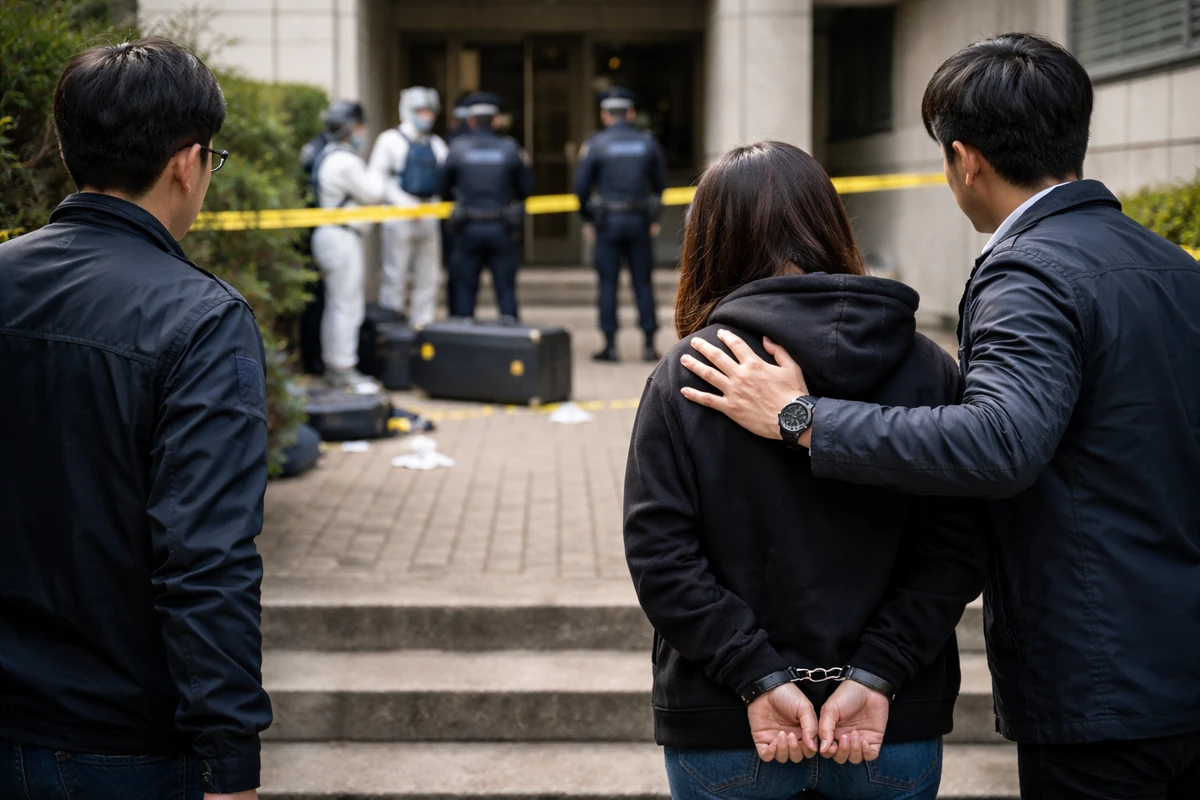
Police in South Korea say they have urgently detained a woman in her 20s on suspicion of abandoning her mother’s body after it was placed in a suitcase, a case that has stunned the country not only because of its gruesome details, but because it appears to have unfolded inside one of the most private spaces in any society: the home.
Authorities announced the arrest April 1, identifying the victim as a woman in her 50s and the suspect as her adult daughter. As in any early-stage criminal investigation, some of the most important facts are still unresolved. Police have not yet publicly established the exact cause of death, when the woman died, whether there had been a physical confrontation beforehand, or whether anyone else may have been involved. For now, the allegation that appears clearest is that investigators believe the body was moved and abandoned, and that the circumstances were serious enough to justify an emergency arrest.
In the United States, a case involving a body hidden in luggage would immediately trigger cable-news headlines and true-crime chatter online. South Korea is no different in its capacity for public shock. But the reason this case has drawn such intense attention goes beyond the suitcase itself. It touches a broader anxiety in modern South Korea, one that American readers may also recognize: What happens when family conflict, mental strain, financial pressure and social isolation build behind closed doors until tragedy erupts?
That is the question hanging over this case. In many cultures, including Korea’s, family is often spoken of as the first and most reliable safety net. Parents are expected to sacrifice for children, and children, especially as parents age, are often expected to repay that care with support and loyalty. Yet those same expectations can make family life harder to examine from the outside. The home can be a place of protection, but it can also become a sealed environment where conflict festers unseen.
For American audiences, the broad outline may sound familiar even if the cultural specifics differ. Across the U.S., fatal cases tied to caregiving burden, untreated mental illness, domestic abuse or economic desperation often produce the same public response: disbelief that no one intervened earlier. South Korea’s latest case appears to be generating a similar reckoning.
It is important to be careful here. An arrest is not a conviction. And in South Korea, as in the U.S., rumors often spread far faster than verified facts in the opening days of a criminal case. Still, the incident has already forced a difficult discussion about whether violence and coercion inside families are too often dismissed as private matters until the damage is irreversible.
What investigators are likely to focus on next
In a violent-crime investigation, the first essential question is the most basic one: How did the victim die? That determination shapes everything that follows. If forensic examiners conclude the death was caused by blunt force, strangulation, drugs, suffocation or some other external factor, investigators may consider more serious charges. If the evidence suggests the woman died first and the concealment or disposal of the body came afterward, the legal picture could look different. The current allegation related to abandoning the body may be only the starting point.
South Korean police, much like their counterparts in the United States, will try to separate a suspect’s statements from physical evidence. That means building a timeline from multiple sources: the scene itself, surveillance footage, cellphone location records, financial transactions, transportation records and any digital evidence recovered from devices. If a suitcase was used to move the body, investigators will also want to know when it was obtained, where it was used, whether it was moved by one person or more than one, and what route was taken.
This kind of fact pattern is especially suited to modern forensic work. South Korea is one of the world’s most heavily wired societies, with dense urban surveillance, extensive smartphone use and digital payment records that can help reconstruct movement with striking precision. That does not guarantee an easy case, but it does mean investigators often have more tools than simple witness statements. A body’s location, the timing of transit, CCTV images from apartment buildings or streets, ride-hailing history and even convenience-store purchases can become crucial puzzle pieces.
Emergency arrest, meanwhile, has a specific meaning. It generally reflects investigators’ belief that there may be a risk of flight or destruction of evidence and that immediate detention is necessary. It does not mean the most serious allegation has already been proved. In both South Korea and the U.S., the public can sometimes misread an arrest announcement as the end of the story. In reality, it is the beginning of the evidentiary phase, when autopsy findings, search-and-seizure results and digital forensics often matter more than initial public assumptions.
There is another investigative track that tends to receive less attention but may prove just as important in the long term: the victim’s living conditions before her death. Was there a history of reported conflict? Had neighbors heard repeated disturbances? Was there contact with social services, a local mental health center, medical providers or apartment management? Those questions do not decide criminal guilt on their own, but they can help explain whether warning signs were present and overlooked.
That distinction matters. A criminal case is about establishing responsibility for a specific act. A public-safety response is about understanding whether there were points where intervention might have prevented the situation from spiraling. In the opening days of a high-profile case, those two discussions often get blurred together. They should not.
Why family violence can remain hidden so long
One reason cases like this hit such a nerve is that they challenge a comforting assumption: that danger is easiest to spot when it comes from strangers. In reality, many of the gravest risks are concentrated inside intimate relationships. In the U.S., domestic violence experts have long argued that abuse is not merely a private dispute; it is a public-safety issue. South Korea has been moving in that direction, too, but the transition is incomplete, especially when the people involved are an adult child and a parent rather than a spouse or a minor child.
That gap is important. Much of the public discussion around family abuse in both countries has centered on familiar categories: child abuse, elder abuse or intimate partner violence. But relationships between adult children and parents often fall into a grayer zone. Who is dependent on whom may shift over time. A parent may provide housing but rely on the child for daily care. An unemployed or financially unstable adult child may depend on a parent economically while also exerting control inside the home. Illness, disability, depression, resentment and long-running emotional conflict can all complicate the power dynamic.
In South Korea, those tensions have been sharpened by social change. The country’s rapid modernization created enormous prosperity, but also intense competition, high housing costs, job insecurity for younger adults and a fraying of traditional support structures. More families find themselves living together longer under strain, especially when an adult child is struggling with employment, mental health or social withdrawal, while an older parent faces health concerns or caregiving needs. None of that leads inevitably to violence, of course. But it can create the kind of pressure-cooker environment that social workers and criminologists worry about.
American readers might compare it to a household in which an aging parent and an underemployed adult son or daughter are living together in prolonged economic stress, with few outside relationships and no regular contact with counselors or social services. If the household becomes increasingly isolated, even serious warning signs can go unnoticed. Neighbors hear arguments but assume it is a family matter. Relatives drift away. Medical or welfare contacts are fragmented. By the time police are involved, the crisis has become catastrophic.
Experts often cite several repeating risk factors in such cases: chronic conflict rather than one-time disputes; social isolation; controlling behavior; caregiving exhaustion; untreated mental illness; and financial coercion or dependency. Another warning sign is what some specialists describe as the normalization of disappearance — when a person is not seen or heard from for days, yet no one acts because the family is already socially cut off. That idea is usually discussed in connection with elderly people living alone, but it can apply inside shared households as well.
The broad lesson is uncomfortable but necessary. Not every troubled family is dangerous, and it would be irresponsible to suggest otherwise. But repeated threats, isolation, unexplained absence and escalating conflict should not be brushed aside simply because the people involved are related. Family bonds can conceal risk as effectively as they provide care.
South Korea’s social safety net, and where it can fail
Whenever a crime like this surfaces in South Korea, public attention quickly turns to the same question: Why did no institution step in sooner? The answer is usually not that no one knew anything. It is that different institutions knew different fragments, and those fragments were never connected.
A local government office may know a household is under financial strain. A clinic may know someone stopped coming for treatment. Apartment management may have received noise complaints or noticed unusual patterns, such as accumulating trash, unpaid fees or a resident no longer being seen. Police may have had a prior call that did not lead to charges. A neighborhood mental health center may have had only limited contact. On paper, each piece looks incomplete. Together, they may describe a household in trouble.
This is not unique to South Korea. In the U.S., too, tragedies often prompt postmortems showing that schools, hospitals, police, social workers and relatives each had part of the story but no one had a full picture. What stands out in the Korean context is how much the country still relies on family as an informal welfare system, even as demographic and economic pressures have made that model harder to sustain.
Korea’s aging population, low birthrate and rising number of socially isolated households have already pushed policymakers to rethink what community care should look like. But many systems are still built around more traditional assumptions: that abuse is easiest to detect when it involves children, that caregiving roles are clear-cut, and that family members will look after one another in ways outsiders need not monitor closely. Adult parent-child households can slip through those cracks because the roles are unstable and the distress signals do not fit neatly into one category.
There is also the matter of privacy and social stigma. In South Korea, as in many societies, neighbors may hesitate to report repeated conflict because they fear being seen as intrusive. Public authorities may be cautious about intervention in what appears to be an internal family matter. Mental health remains a particularly sensitive area. Although awareness has improved, many families still avoid seeking help out of shame, denial or fear of social consequences. That can leave local officials and care providers responding only after a crisis has become impossible to ignore.
Some specialists argue that the answer is not necessarily a dramatic new law but a more functional connection between existing institutions. Repeated calls, prolonged disappearance, sudden breakoffs in medical care, utility arrears, signs of neglect and complaints from neighbors may all be weak signals on their own. The challenge is deciding when those signals should trigger a coordinated welfare and safety check rather than remaining isolated data points. That is a difficult balance in any democracy, where personal privacy must be protected. But when there is reason to suspect imminent harm, the absence of coordination can be deadly.
In that sense, the real policy question raised by this case may be less about punishment after the fact than about how communities identify danger earlier. Mourning and anger are understandable public responses. They are not, by themselves, a prevention strategy.
A changing Korea, and the pressure inside the home
To understand why stories like this resonate so strongly in South Korea, it helps to understand how quickly the country has changed. Within a few decades, South Korea transformed from a war-scarred, low-income nation into one of the world’s most technologically advanced economies. It is globally known for K-pop, Oscar-winning films, hit streaming dramas and powerhouse brands from Samsung to Hyundai. But underneath that modern success story lies a harsher reality: intense educational pressure, grueling job competition, high youth unemployment or underemployment, expensive housing and a growing epidemic of loneliness.
For many American readers, the glossy image of Korean culture may come more readily to mind than the pressures of Korean daily life. The so-called Korean Wave, or Hallyu, has exported music, beauty products and television formats around the world. Yet the same society that produces globally influential pop culture also wrestles with some of the developed world’s deepest anxieties about status, family obligation and social comparison. South Korea has long confronted concerns about elder poverty, overwork, low fertility and mental health struggles. Those pressures do not cause crimes like this. But they can shape the closed environments in which crisis grows.
There is also a generational dimension. In many Korean households, older parents came of age during a period when sacrifice for children was treated as a near-sacred duty, while younger adults came of age in a more individualistic and economically precarious era. The result can be a painful mismatch of expectations. Parents may assume co-residence is a natural expression of family unity. Adult children may experience it as dependence, surveillance or a sign of stalled adulthood. When unemployment, debt or emotional strain enters the picture, longstanding resentments can harden.
None of this should be exoticized as somehow uniquely Korean. Americans know versions of these same tensions. The difference is one of degree and cultural framing. South Korea’s social fabric has traditionally placed heavier moral weight on family cohesion and mutual obligation, influenced in part by Confucian norms that emphasize hierarchy, filial responsibility and respect for elders. Those ideas still matter deeply, even as contemporary Korean life has changed far beyond the world in which they were formed.
That matters because it shapes silence. If a family is in turmoil, admitting it can feel like admitting moral failure. Asking for outside help may seem like exposing private shame. The result is a paradox: the more a society values family solidarity, the harder it may be to acknowledge when a family has become dangerous to one of its own members.
The current case appears to have landed in precisely that sensitive space. It is not simply a crime story. It is a story about what happens when the institution expected to absorb social stress begins to break under it.
The danger of sensationalism in the early days
Cases involving hidden bodies, family members and unusual methods of disposal have a way of attracting sensational coverage. That risk exists in every media environment, and South Korea’s fast-moving digital news ecosystem is no exception. In the early phase of an investigation, motives are often speculative, timelines are incomplete and personal details can be amplified far beyond what is relevant or verified.
That is especially risky in a family case. Once stories begin to circulate about long-simmering resentment, possible abuse, mental illness, inheritance disputes or caregiving conflict, it becomes easy for rumor to outrun evidence. The public appetite for explanation is intense. But neat narratives can do real damage, particularly to surviving relatives, neighbors and others drawn into the orbit of the case.
Responsible reporting in this stage requires a discipline that can seem unsatisfying to audiences hungry for answers. It means sticking to what authorities have actually confirmed, being clear about what remains unknown and resisting the urge to turn family dysfunction into voyeuristic entertainment. It also means recognizing that a criminal investigation is not a license to excavate every private detail of the victim’s life.
For American readers, that may sound like an obvious standard. In practice, it is one that media organizations everywhere struggle to uphold when a story is both lurid and emotionally charged. The details that travel fastest online are usually the most shocking, not the most reliable. Yet if the broader lesson of this case is about spotting risk earlier and protecting vulnerable people, then overheated speculation may only obscure that goal.
There is a second danger in sensational framing: it can encourage the public to treat such events as freakish aberrations rather than as extreme outcomes on a continuum of unaddressed harm. If the story is reduced to a grotesque object — a suitcase — then the more meaningful questions disappear. Were there signs of coercion or violence? Were there points of contact with public institutions? Was the household isolated in ways that left no one able, or willing, to intervene?
Those questions are harder and less cinematic, but they are the ones that matter if the goal is prevention rather than spectacle.
What this case says about public responsibility
The most difficult question raised by the case is also the most important: When does a family conflict stop being private and become a matter of public risk? In theory, the answer seems straightforward. Threats, repeated abuse, coercive control, unexplained disappearance and signs of neglect or confinement are not private matters. They are warning signals. In real life, the line is much blurrier, especially when the people involved are adults living under one roof and no single agency has authority over the full situation.
That is where community and institutional judgment matter. Neighbors should not be expected to play detective, and governments should not intrude casually into private homes. But there is a middle ground between indifference and overreach. Repeated screams, prolonged isolation, a person vanishing from sight without explanation, or the abrupt absence of a dependent family member should not be treated as someone else’s business. The same is true for agencies that encounter partial signs of distress. The issue is not whether every signal predicts a crime. It is whether enough signals together should trigger a closer look.
Experts in social welfare and criminal psychology often say harsher penalties alone cannot prevent family tragedies. Serious crimes demand serious punishment, but by the time the criminal law takes over, prevention has already failed. Earlier steps are less dramatic and often less visible: more accessible mental health care, faster coordination between police and welfare agencies, better support for caregivers, more responsive outreach to socially isolated households and clearer protocols for welfare checks when warning signs accumulate.
South Korea, like the United States, is still struggling to build those systems effectively. The challenge is not simply money or manpower. It is conceptual. Modern societies have long relied on families to absorb stress that public institutions do not, or cannot, fully address. But when families themselves become sites of danger, that assumption collapses. The state cannot replace intimacy or trust. It can, however, create mechanisms that make it harder for acute risk to remain invisible.
As this investigation unfolds, police will continue to chase the answers required in any homicide or suspicious-death case: cause of death, timing, motive, planning, movement, evidence. Those findings will determine legal accountability. But the broader significance of the story may lie elsewhere. It lies in whether South Korea — and, by extension, other societies facing similar strains — is willing to see family violence not as an unspeakable exception but as a public issue that requires earlier recognition and more connected intervention.
That does not mean turning every domestic tension into a matter for police. It means acknowledging a basic truth that tragedies like this make impossible to ignore: The home is not automatically safe simply because it is private. And when the systems around a household fail to recognize escalating danger, the consequences can be devastating long before the public ever hears the story.
For now, many of the facts remain under investigation. The legal process will determine what can be proved. But the case has already exposed something larger than a single allegation. It has laid bare the fragility of the idea that families, left to themselves, will always protect their own. Sometimes they do. Sometimes they cannot. And sometimes, as this case appears to suggest, the cost of not seeing the difference in time is measured in lives.
Comments
Post a Comment