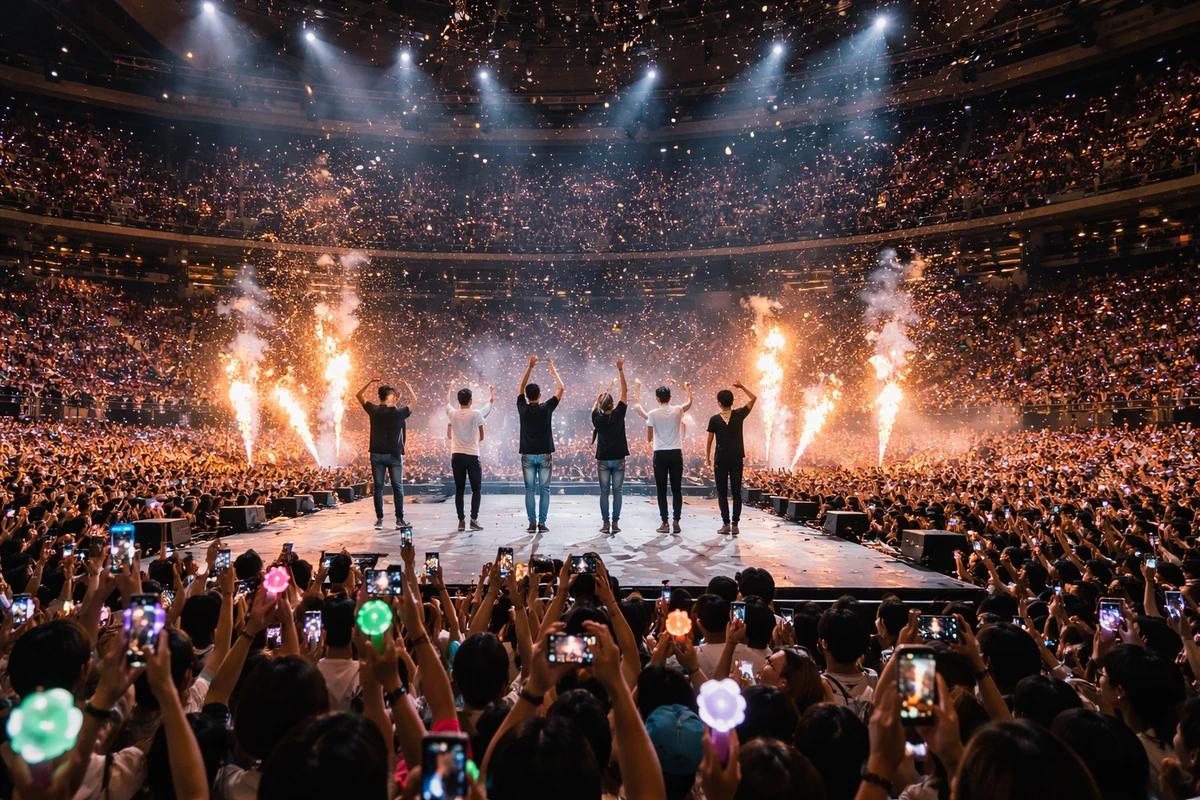
A boy band tour announcement that means more than a few extra shows
When South Korean boy band ENHYPEN unveiled a new world tour that will include its first concerts in South America, the news landed as more than a routine update for fans. In the K-pop business, where tour routing is often as revealing as album sales, the decision points to a broader shift in how Korean entertainment companies think about global demand. For years, the standard map for a major K-pop tour was relatively predictable: Seoul, several cities in Japan, a handful of stops in Southeast Asia, and if the group had reached a certain level, North America. Europe appeared selectively. South America, despite its reputation for passionate K-pop fandom, was often left in the realm of possibility rather than fully realized schedules.
That is why ENHYPEN’s move matters. The group, formed through the 2020 survival show “I-Land” and managed by Belift Lab, has built an international following quickly by the standards of even a globalized K-pop market. Its albums sell well, its online footprint is strong, and its fans — known as ENGENE — are highly active across digital platforms. Including South America on a world tour suggests that promoters and management now see the region not simply as a place where social media buzz is loud, but as a market where live shows can be organized with enough confidence in demand, logistics and long-term payoff.
To an American reader, the significance may be similar to when U.S. artists begin treating Latin America not as an occasional stop for a festival or one-off appearance, but as a core part of a major arena tour strategy. It reflects a business judgment that fandom in the region is mature enough to support the cost and complexity of a full-scale production. In K-pop, where choreography-heavy performances, elaborate visuals and tightly managed schedules are central to the product, that is no small calculation.
The timing also matters. K-pop’s global expansion first took hold through the internet: YouTube videos, social media clips, fan translations and streaming services allowed Korean artists to gain overseas followings long before touring infrastructure caught up. Live concerts have lagged behind that digital growth because they are riskier and more expensive. A sold-out online fandom does not always translate neatly into profitable arena dates thousands of miles away. ENHYPEN’s South America debut suggests the gap between online enthusiasm and on-the-ground business is narrowing.
Why South America has long been a K-pop stronghold — and a hard one to crack
For people outside the K-pop ecosystem, South America’s importance may not be obvious at first glance. The region is far from Seoul. Currency fluctuations can complicate pricing. Shipping stage equipment across continents is costly. Venue availability, local promotion, customs clearance and insurance add still more layers. Even for American acts, routing a tour across long distances can be financially tricky. For Korean companies operating from across the Pacific, the challenge is even greater.
And yet South America has been part of K-pop’s global story for years. Fans in countries such as Brazil, Chile, Mexico, Peru and Argentina have long helped drive streaming numbers, social media trends and online fan campaigns. K-pop dance covers in public plazas, fan-run cupsleeve events — a social gathering built around themed drinks and merchandise, often used to celebrate idols’ birthdays or comebacks — and organized bulk buying campaigns have all become familiar features of fandom culture in the region. In many ways, South American fans have behaved like core consumers of K-pop long before the touring business fully acknowledged them.
That disconnect has frustrated fans, but it has also reflected cold economic realities. Entertainment agencies do not build tours on excitement alone. They look for evidence that enough ticket buyers can fill the right-size venue at prices the local market can absorb. They study merchandise sales, official fan club activity, social engagement by city, brand partnerships and local media reach. The K-pop business, often portrayed as instinct-driven and trend-chasing, is in fact increasingly dependent on data. Companies now have far better tools to track where their international listeners are, how often they stream, what products they buy, and how likely they are to show up in person.
That makes South America newly visible in a different way. It is no longer merely a place where fans are enthusiastic online. It is being reassessed as a region where that enthusiasm can support a sustainable live business if the scale, ticketing strategy and local partnerships are right. ENHYPEN’s new tour suggests its management believes that threshold has been reached, at least enough to justify a first formal entry.
This is where the distinction between “interest” and “infrastructure” matters. K-pop fans in South America have not needed convincing. What the industry has needed is confidence that the market can support repeatable, professionally managed events. Once a group breaks that barrier successfully, it can reshape assumptions for the acts that follow.
ENHYPEN’s rise helps explain why this group, and why now
ENHYPEN is in some ways a fitting test case for this next stage of K-pop touring. The seven-member group debuted with a profile already amplified by reality TV, a common route in Korean pop but one that can be unfamiliar to U.S. audiences. In South Korea, survival programs often serve as both talent pipeline and marketing engine, giving fans an early emotional investment in performers before a group officially launches. Think of it as part competition show, part origin story, with viewers helping shape a future act’s fan base from the beginning.
Since debut, ENHYPEN has leaned into two strengths that travel well internationally: performance and narrative. K-pop agencies frequently develop what fans call a “worldview,” an interconnected fictional or thematic universe that ties together albums, music videos and promotional content. ENHYPEN’s image has consistently combined polished choreography with a stylized mythology-infused identity, making the group especially effective on platforms where visual storytelling matters as much as language. For global audiences, that can lower the barrier to entry. A fan may not understand every lyric in Korean, but they can grasp mood, aesthetics and performance intensity immediately.
The group has also benefited from arriving in an era when international fandom is more organized than ever. Today’s K-pop fan communities function like grassroots marketing teams, event planners and media networks rolled into one. They trend hashtags, translate interviews, coordinate birthday ads, raise money for charity in an idol’s name and create a constant stream of content that keeps a group visible between official releases. In practical business terms, that means an agency considering a new region can often measure not just passive listenership, but active community organization.
That matters for live events. A concert is not just two hours inside an arena. In K-pop, it often becomes an all-day ecosystem: fan meetups, merchandise exchanges, custom banners, synchronized fan chants and social media campaigns that extend the show’s reach far beyond those who attend. For a group like ENHYPEN, whose fan base skews young, digital-savvy and globally connected, a first concert in South America is likely to serve both as a revenue event and as a loyalty-building milestone.
There is also a branding dimension. In the entertainment industry, a “world tour” is not simply descriptive. It is a status marker. It signals who is seen as internationally viable, where management believes the fandom is deepest, and how aggressively the company is willing to invest in the act’s long-term global profile. For ENHYPEN, adding South America broadens the story the group can tell about itself: not just popular abroad, but increasingly capable of mobilizing demand across continents that were once considered difficult to monetize consistently.
What this says about the K-pop business, not just one band
The bigger story here may be less about ENHYPEN alone than about how the K-pop industry is evolving. In its earlier waves, K-pop’s global expansion was led largely by exports that were cheap to distribute and easy to scale: music videos, social media content, streaming tracks and collectible albums shipped through online retailers. Touring followed after the fact, and often cautiously. That sequence made sense. Digital attention was relatively low-risk. Touring required contracts, cargo, staffing, local compliance and the possibility of losing money if demand was overestimated.
But the economics of fandom have changed. Live events are no longer just promotional stops designed to support an album cycle. They have become one of the most important ways entertainment companies deepen fan attachment and extend the life of an artist’s brand. In K-pop especially, a concert strengthens multiple revenue streams at once. Fans who attend a show are more likely to buy albums, official light sticks, apparel, photo cards and online content subscriptions later. They are more likely to stay emotionally invested between comebacks. They are also more likely to become evangelists, bringing in new fans through clips, stories and community activity.
That dynamic helps explain why companies are willing to explore newer territories even when the immediate profit margin may be thinner than in more established markets like Japan or the United States. A South America date might not outperform a Tokyo dome show or a Los Angeles arena stop in raw revenue, but it may generate outsized value in building a regional fandom that can support future tours, merchandise launches, media partnerships and brand endorsements.
In other words, live touring is increasingly treated as infrastructure for global fandom, not merely as an endpoint. If that sounds familiar to American readers, it mirrors how the music business in the United States has come to view touring in the streaming era: not only as a direct source of ticket income, but as a way to convert casual listeners into high-value fans. For K-pop, the effect may be even stronger because fan identity is often more organized, ritualized and community-driven.
That is why industry observers are likely to watch ENHYPEN’s South America debut closely. If the shows are successful — measured not just by ticket sales but by operational smoothness, fan response and post-concert engagement — they could encourage other Korean agencies to accelerate similar plans. Once a market proves workable for one act, the learning curve becomes less steep for those that follow. Local promoters build experience. Venue operators understand the specific demands of K-pop audiences. Merchandise distribution improves. Media coverage becomes more informed. Each successful show lowers the barrier for the next one.
Why fans care so deeply when a region is finally included
For fans, the inclusion of South America carries emotional weight that goes beyond the chance to hear songs live. K-pop fandom is intensely participatory. Fans do not simply consume content; they help build the culture around it. In that context, being left off a tour map can feel like more than a scheduling oversight. It can feel like a message about whose devotion counts. For years, many South American fans have supported Korean artists online with the same intensity as fans in cities that routinely make the tour list. When a group finally announces dates in the region, the effect is partly commercial, but it is also symbolic: an acknowledgment that the audience exists as a real, visible community.
That symbolic recognition can transform local fandom. Once a concert is on the calendar, fan activity tends to intensify. Communities that were mostly digital begin organizing physical events. People prepare fan chants — the coordinated call-and-response lines that are a hallmark of K-pop concerts — make banners, arrange meetups and coordinate social media campaigns to welcome the artists. Small businesses may join in, from cafes hosting themed events to stores stocking unofficial fan-made goods. The result is a temporary but powerful local economy built around shared enthusiasm.
For American readers unfamiliar with the intensity of K-pop concert culture, imagine the communal anticipation around a Taylor Swift stadium date, blended with the choreographed audience participation of a major sports event and the collectibility of Comic-Con. The performers are the center of gravity, but the audience experience itself is also a carefully cultivated part of the product. A first concert in a new region often feels like a validation of years of unpaid fan labor.
There are concrete consequences too. Ticketing data from one successful run can help agencies return with greater confidence. Merchandise sales can justify better localized distribution. Media attention can attract regional sponsors. A market that once looked uncertain starts to look legible. That is one reason fans often campaign so hard online for their city or country to be included. They know a single show can change how seriously the industry takes their region in the future.
Still, inclusion also raises expectations. Fans no longer view an overseas appearance as sufficient on its own. They expect production values, thoughtful communication, reasonable organization and a sense that the artists are meeting them as part of the same global fandom, not as an afterthought. That means ENHYPEN’s first South America dates will be judged not only on whether they happen, but on how well they are executed.
The opportunities — and the risks — of pushing farther abroad
The business case for expansion does not erase the risks. Long-haul touring is physically taxing even for veteran acts, and K-pop groups typically perform demanding choreography that requires sustained stamina. Tight travel schedules, multiple time zones and dense promotional obligations can wear down artists quickly. In an industry already scrutinized for its pace and pressure, every added region on a tour chart raises questions about health, recovery time and whether the schedule is sustainable.
There are financial risks as well. Ticket prices have to strike a delicate balance. Set them too high, and they may alienate younger fans already dealing with economic pressures and volatile exchange rates. Set them too low, and the tour may become difficult to sustain after transport, labor, security, venue rental and taxes are accounted for. Local economic conditions matter tremendously, as do decisions about venue size. A modestly sized, sold-out show can be more strategically valuable than an overambitious booking that leaves empty seats and creates the impression of weak demand.
Then there is the issue of cultural fluency. K-pop agencies have become adept at producing globally appealing content, but touring in new regions still requires local understanding. Promotion has to reach fans in the right languages and through the right channels. On-the-ground partnerships need to be reliable. Fan expectations vary by market. Even details like merchandising lines, entry procedures and crowd management can shape whether the event feels polished or chaotic.
That is why ENHYPEN’s South America expansion is best understood not as a victory lap, but as a test of operational maturity. If management has read the market correctly — and if local partners deliver — the payoff could extend well beyond one tour cycle. If the logistics falter, the result could reinforce the caution that has kept some agencies from moving faster into the region.
None of this means the decision is reckless. On the contrary, the fact that ENHYPEN is making this move now suggests management believes the numbers, fan activity and infrastructure have aligned enough to justify the step. But the broader lesson for the industry may be that global expansion in K-pop is entering a more complex phase. It is no longer about whether demand exists somewhere on the map. It is about whether companies can turn that demand into repeatable, respectful and sustainable live experiences.
What comes next for ENHYPEN — and for K-pop’s map
If the upcoming South America dates succeed, ENHYPEN will gain more than bragging rights. The group will strengthen its claim to being one of the younger K-pop acts capable of translating digital reach into real-world turnout across multiple continents. That matters in an industry where momentum can be fleeting and where labels are constantly assessing which acts deserve the biggest long-term investment. A well-executed tour can become proof of durability.
It may also sharpen the group’s artistic identity. ENHYPEN is often praised for performance precision and concept-driven storytelling, two assets that can become even more powerful in concert. Live shows are where K-pop groups demonstrate whether their carefully managed image holds up under arena lights, in front of fans who have spent money and traveled to be there. For a group with a strong visual and narrative brand, first impressions in a new region can resonate for years.
More broadly, the announcement is another sign that the geography of K-pop is still changing. The center of gravity remains in East Asia, and the United States remains crucial for prestige and scale. But the next frontier may be less about finding entirely new audiences than about formally recognizing the ones that have been there all along. South America fits that description. So do other regions that have participated in K-pop online for years without consistently appearing in tour itineraries.
For American audiences, it is worth paying attention because this is how global pop evolves now: not in neat waves led by a single breakout hit, but through the slow construction of networks, routes and fan communities that make the next move possible. Today it is ENHYPEN adding first South America dates. Tomorrow it could be more Korean acts treating the region as a routine stop, not an exception. Once that happens, the phrase “world tour” in K-pop will mean something closer to what fans have long assumed it should mean.
In that sense, ENHYPEN’s announcement is both a milestone and a marker. It tells us where the group stands, but it also shows where the industry may be headed. The real story is not just that one band is going farther. It is that K-pop’s global business is learning to follow its audience more faithfully, even when doing so is expensive, complicated and late in coming. South American fans have heard the promise of global fandom for years. Now, at least for one of K-pop’s rising groups, the map is starting to catch up.
Comments
Post a Comment